
It seems clear that we won't get to reach Methuselah's age. In most Western countries, the average life expectancy has started decreasing from 2014 and we are, maybe, on the edge of a Seneca Cliff for longevity. It could be an effect of pollution, but not just that. Image source.
If you ever got into a discussion on the effects of pollution, you know what happens. You list the problems with heavy metals, from lead to mercury, pesticides, fine particles, plastics, everything that is -- or may be -- carcinogenic, including the deadly glyphosate, aka Roundup. Then, there comes always someone who says, "but all that cannot be so bad! After all, people keep living longer and longer!"
Alas, very, unfortunately, that doesn't seem to be the case anymore. Let me show you some data: let's start from the US (source).
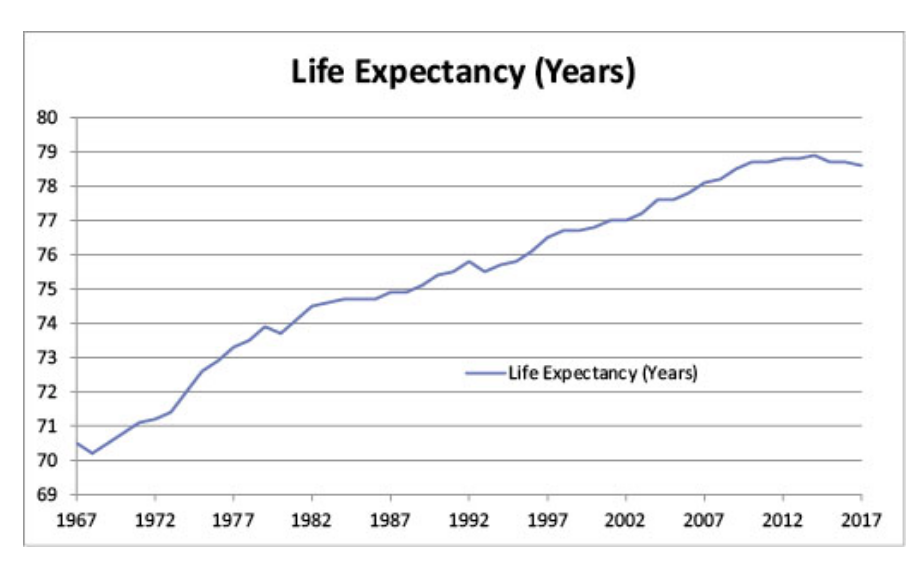

Clearly, the nearly linear trend of growth of the life expectancy at birth stopped around 2014 in most Western countries. To put things in perspective, it is not the same for other countries: both in China and in Russia, life expectancy is lower, but it keeps increasing. (again, data from the World Bank)

Before going on, a disclaimer: there is sufficient uncertainty in the data that the trend should be considered as weak. We are on a plateau that might see oscillations that could be interpreted as a return to growth.
But, clearly, something has happened in 2014 that interrupted a trend so stable that it was considered not only the way things were, but the way things had to be. What was that? Data from an article by Gilbert Berdine can tell us something about what's happening, at least in the US.

The mortality of old people keeps declining, what's causing the overall decline in life expectancy is the rising mortality of the young. Berdine comments as (highlighting mine):
The rising mortality rates for young people are attributed to suicides in general and opioid overdoses in particular. These are deaths of despair. . . . It is unclear what is causing despair in young people during a period of time when we are told that the economy is expanding.We are told that the economy is expanding, yes, but something seems to be wrong with that. In some countries, such as Italy, the economy has been contracting for at least a decade. In the US, instead, the data show that the economy is skyrocketing upward, at least if measured in terms of the GDP. America is becoming great again, actually it never stopped being that (again, in terms of the GDP). So, why is the life expectancy going down in both countries?
What's making the young killing themselves by guns and drugs? Might pollution be affecting people's mental sanity? Yes, that's exactly the case. In a recent paper, Shin and others report that not only pollution causes "subjective stress, depressive disorders, health-related quality of life (QoL) and suicide." They don't speak about life expectancy but they say, "The risk of higher stress or poor QoL in subjects < age 65 increased with air pollution more than did that in subjects ≥ age 65"
So, it is clear that pollution is taking its toll on human health, especially among the young. That may explain the "despair" that Berdine considers the cause for the increased mortality. And there may be perfectly good reasons for the young to despair, even without the help of pollution. In any case, we may have reached a Seneca Cliff of life expectancy.
Another dream of our society that turned into a nightmare. Another chunk of future that we stole from our children and grandchildren. No wonder that they are not happy with us.

