Showing posts with label earth. Show all posts

Thursday, March 5, 2020

The Earth Sign: Greeting Each Other in the Age of the Coronavirus

In these rapidly changing times, we need to change our behavior in many ways


My students doing the "Earth sign" or the "Gaia Sign" while floating in space. It is a gesture of greeting symbolizing respect for our mother Earth It might be a good idea to resurrect this kind of greeting in the times of the coronavirus. 


Humans have been greeting each other all over their long history. The standard hand-shaking is also very ancient, although it came back in fashion only in recent times. Mainly, it was only during the 19th century that hand-shaking replaced hat-tipping. The latter was seen as elitarian because hats were used to mark one's social status.

Some greeting gestures have an ominous ring, such as the "Roman Salute" that the Italian Fascists had adopted and diffused. Conversely, the traditional Buddhist greeting gesture has no such bad fame. It is called the Anjali Mudra, or Namaste in Hindi. It is done with the hands joined in front of one's chest and bowing forward a little, as you see done by Richard Gere. There are other kinds of gentle gestures. For instance, in Iran, I saw people greeting each other by putting their hand on their chest and bowing slightly forward. I think it is old-fashioned even in Iran, but it is a nice way to show one's respect to another person. 

Any of these gestures and many more could be good for a new style of greetings in the age of coronavirus, when it is not advisable for people to touch each other. The idea seems to be spreading: in Italy, some idiot even proposed to go back to the Fascist salute! Personally, I have been often using the namaste gesture. It is very nice and I see it is diffusing, although at first people are surprised if you greet them in that way. 

But I had been asking myself a question even before the outbreak of the coronavirus. Could we devise some new gesture, suitable for our times? What could be a recognizable gesture that would define the various movements we call "Extinction Rebellion," "Fridays for the Future" and the like?


A few weeks ago, I was with my coworker Ilaria Perissi and we were discussing this idea. Ilaria had a flash of thought. She joined her hands together in the shape of a sphere, and said, "this is the Earth sign." Here are Ilaria's hands, in a picture taken that very day!


I was blown away: I recognized something I already knew. Ilaria's idea is similar to an ancient Sumerian gesture, the one you see below.  These Sumerian statuettes go back to about 2700 BCE. Are these people praying? Or maybe they are singing? It might also be that this is a gesture of greeting.
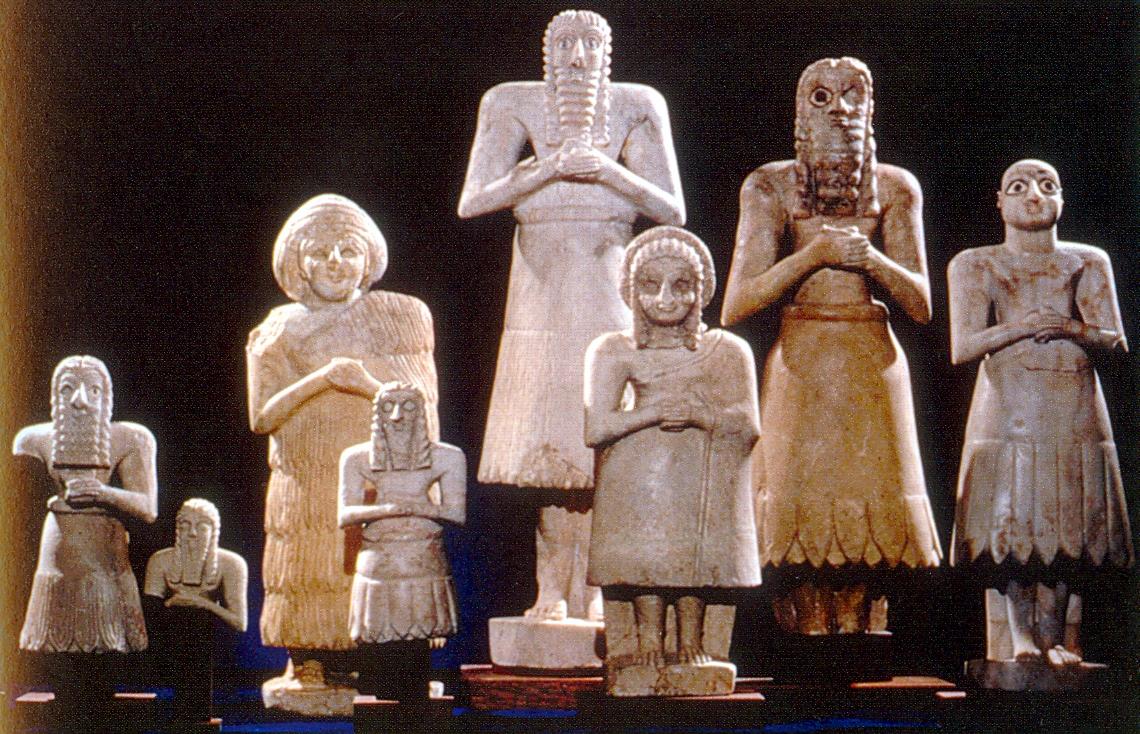

I don't think that the Sumerian knew that the Earth is spherical, so that this gesture may not be related to showing one's respect for the Earth goddess. But, on the other hand, they might have known, why not? In any case, the Sumerian gesture provides a remarkably interesting background to the idea. After all, the Sumerian were very much involved with the Goddess Inanna, an ancestor of Gaia, the Goddess of Earth.

Here is Ilaria showing the Earth sign again. The background is consistent with her expertise in marine resource depletion, the subject of our upcoming book, The Empty Sea.


We have been experimenting with this sign. It seems to work nicely, it is very much like the namaste sign when accompanied with a slight forward bowing, but with the added meaning of an expression of respect for our Mother Earth. Who knows? It is an idea that might spread!


And if we want to be good Sumerians, this is how to greet each other:


I would also like to thank Anna Lord with whom I discussed this subject some time ago, although we didn't arrive to devise a sign!

Monday, September 2, 2019

Notes on Gaian Theology: Is the Goddess a Superorganism?


One of the avatars of the Goddess. 


The beauty of the Gaian theology is that, unlike for ordinary theology, you don't have to rely only on second-hand reports about the subject of your studies. Gaia exists, and you can perceive Her all around us. Then, the question is: what or who is She? 

As you know, the modern idea of Gaia as a denizen of the Earth's ecosphere was developed in the 1970s by James Lovelock together with Lynn Margulis. Then, it evolved in various versions and it was misunderstood in various ways. For instance, Toby Tyrrell wrote a whole book trying to demonstrate that there is no such a thing as "Gaia." He succeeded only at showing that one can write an entire book on something he doesn't understand at all.

But it is true that some ways of understanding Gaia are untenable in light of what we know about biology. Sometimes we hear of Gaia described as a "superorganism" and sometimes as engaged in optimizing the ecosystem for living beings. That's no good, as explained, for instance in a 2003 text by Victor Gorshkov and Anastassia Makarieva where they correctly note that, if Gaia is supposed to be a superorganism, then She cannot exist.

But, one moment. Who said that Gaia is a superorganism? Besides, what is a superorganism? The term is sufficiently vague that it can be badly misused and misunderstood. In general, it is intended as any assemblage of biological sub-units that don't individually reproduce but rely on specialized organs for that. An eukaryotic cell is a superorganism, just as an ant colony. And if you, dear reader, are a human being, then you are a superorganism, too. But that doesn't mean Gaia is one. For instance, I have in my hands right now Lovelock's 1988 book "The Ages of Gaia" and I can't find the term "superorganism" anywhere referred to Gaia.

Instead, Lovelock had a very clear idea of what Gaia is and he described that with his "Daisyworld" model, a highly simplified ecosystem consisting of daisies that can be black or white. Note that daisies are not two species, as it is stated very clearly in the book, they are a single species with a certain polymorphism in their pigmentation. The Gaian mechanism in Daisyworld consists in the daisies slight modifying the frequency of one of their alleles -- that is the white pigment allele becomes more frequent -- to cope with a gradual increase in the solar irradiation. They do that to maintain their optimal temperature but that also affects the environment. With more white daisies, the albedo of the planet increases, more sunlight is reflected back into space, and the planet cools down. This is rare in the real ecosystem, but some algae may use this strategy. (image from gingerboot.com)


The daisyworld model is one of those genial ideas that can be completely misunderstood. And it has been misunderstood: it has been seen as a toy, or as irrelevant to the real world, or simply meaningless. But be careful: you may say it is oversimplified, rough, wrong, whatever you want, but all models are wrong and at the same time all models are useful if you understand their limits. And that's the case of Daisyworld a "level zero" model that opens up for us a completely new vision of how the Earth's ecosystem - Gaia - works. A true stroke of genius on the part of James Lovelock, one of the most brilliant minds of our times.

In any case, for what we are discussing here, the point is that the daisies of Daisyworld are NOT a superorganism. They have nothing of the complex structure of sub-units that make a superorganism. They are just a population of loosely coupled individuals. In this case, they act on the environment by slightly modifying their genome, Lovelock had in mind a time scale of millions of years, so there was plenty of time for the genome to change. But that's not a necessary condition, on a shorter time scale we don't need to touch the genome to kick-start the Gaian mechanism. Here is how Gorshkov and Makarieva describe the concept they call "biotic regulation"
Let us suppose that the living objects capable of environmental control are trees, while the regulated global environmental characteristic is atmospheric carbon dioxide concentration. Suppose further that in the course of a major atmospheric disturbance (volcanic eruption, anthropogenic activities) the global atmospheric carbon dioxide concentration becomes significantly higher than the biotic optimum. All trees on the tree-covered planet are thus faced with approximately equal unfavourable environmental conditions. Normal trees immediately begin to work on removing the excessive carbon from the atmosphere in order to restore the optimum concentration of carbon dioxide. This can be done, for example, by depositing the excessive atmospheric carbon in organic form in soil and sediments.
A different Gaian mechanism may not involve the biosphere alone but the whole metasystem formed of the linked geosphere, atmosphere, and biosphere. It is the case of the geological carbon cycle that seems to have been fundamental in keeping the Earth's temperature approximately constant over a time scale of hundreds of millions of years, as I described in a previous post.

None of these mechanisms imply centralized control, altruism, intelligence, planning, or things like that - no superorganism whatsoever. And here She is: Gaia appearing to us. It is an emergent property of the ecosystem that results from internal feedbacks that tend to keep the system in a homeostatic condition.

Back to theology, now we can answer the question posed at the beginning, who is Gaia? As a collective phenomeno of the ecosystem she looks very much like the demons that Jesus encounters in the country of the Gerasenes (Marl 5:9) when they tell him “My name is Legion; for we are many.” So, is Gaia a demoness? Maybe. In ancient times, the concept of daimon (δαίμων) didn't have the ring of evil that later Christianity attributed to it. A daimon is a force, an aggregation, an egregore of nature, generally benevolent although not all-powerful.

Names have the meaning we want to give them: We can say that Gaia is "just" an ecosystem, that she is not a Goddess at all, in the sense that she is definitely not benevolent and merciful, that she is not to be worshipped (of course not!). But there exists also the concept of "reverence" defined as "a feeling or attitude of deep respect tinged with awe." Reverence might be an appropriate attitude towards an enormously powerful creature which (who) can squash humankind into pulp in no time.

And if you don't revere -- worse, if you despise -- the Goddess, woe betide you: the ancient recognized the concept of hubris (ὕβρις) leading to Nemesis (Νέμεσις), the Goddess of vengeance, providing the appropriate retribution to those guilty of overconfidence. Maybe Nemesis is just another name for Gaia, but, eventually, we don't need an angry Goddess to destroy humankind, we seem to be perfectly able to do that ourselves. In the end, it is all in the hands of the Moirai (Μοῖραι) who spin the thread of destiny in their hands.


(h/t Anastassia Makarieva)

Friday, June 22, 2012

Earth


For three minutes of relax, watch this video showing some of the things we are trying so hard to destroy (by David Bayliss).

Who

Ugo Bardi is a member of the Club of Rome, faculty member of the University of Florence, and the author of "Extracted" (Chelsea Green 2014), "The Seneca Effect" (Springer 2017), and Before the Collapse (Springer 2019)