This is a comment by Luis De Souza on a recent paper by Ferroni and Hopkirk who reported a negative energy yield for photovoltaic plants in Switzerland (in other words, an energy return, EROEI, smaller than one). It is an anomalous result, considering that a comprehensive meta-analysis of the field reported values of 11-12 for the EROEI of the most common PV technology. So, what's wrong with the paper by Ferroni and Hopkirk? A lot of things, it seems. Here, De Souza shows that photovoltaics is a source of energy, even in a not so sunny country as Switzerland. He concludes that something went badly wrong with the review procedure with the journal that published the paper by F&H, "Energy Policy". That seems to be correct and you may be interested to know that an extensive rebuttal of that paper has been prepared and submitted to the journal by a group of researchers expert in the field of energy calculations. That rebuttal finds a lot more wrong things in F&H's paper than those identified by De Souza. In short, Energy Policy managed to publish a flawed study that should never have been published in a scientific journal. Unfortunately, it was done and now a lot of people are using it to support the war against renewable energy.

Photo-Voltaics is not an energy sink in Switzerland
by Luis De Souza
Energy Policy recently published a study conducted on the EROEI of Photo-Voltaics (PV) technologies installed in Switzerland. The end result is a remarkably low figure of 0.8:1, well below any EROEI assessments ever conducted on this energy technology.
Such a figure naturally made the delight of those campaigning against renewable energy, who take at face value any hints of negative performance. However, from this study a number immediately stands out: average lifetime energy yield of 106 kWh/m2/a. As it turns out, a closer look at this single figure is enough to disprove the hypothesis of PV being an energy sink in Switzerland.


Again, the figures vary widely, with the average under 700 Wh/Wp/a.
Comparison with PVGIS

PVGIS © European Communities, 2001-2012
Reproduction is authorised, provided the source is acknowledged
See the disclaimer here
Comparison with Swiss statistics

While this latter hypothesis is my favourite, it does not explain the employment of the strange energy per unit area figure. Also, these degradation rates would assume that in the face of a fast collapse in energy output owners would never activate panel warranty.
Final remarks

The Take Away
The EROEI figure concluded by Ferroni & Kopkirk for PV is the lowest ever and far below any previous studies.
These authors use awkward units that largely obfuscate their assumptions on yearly energy yield.
A sample of various panel models points to an energy yield under 700 Wh/Wp/a used in this study.
Official statistics point to an average yield well above 900 Wh/Wp/a for the Swiss PV park; this is in line with values from assessment tools like PVGIS.
The peer review process is not functioning properly at Energy Policy.
Such a figure naturally made the delight of those campaigning against renewable energy, who take at face value any hints of negative performance. However, from this study a number immediately stands out: average lifetime energy yield of 106 kWh/m2/a. As it turns out, a closer look at this single figure is enough to disprove the hypothesis of PV being an energy sink in Switzerland.
Basic check
The first check one can conduct on this EROEI study is to compare it with previous assessments. Pedro Prieto and Charles Hall produced what is possibly the most conservative EROEI study on PV, concluding on a figure of 2.4:1 for Spain. There is much to question in this study, in particularly the arbitrary translation of non physical requirements of a PV system into energy inputs, but for the purpose of comparison let this low figure be taken at face value.
Yearly solar radiation at the latitude of Madrid (40 ºN) is in the range of 2 000 kWh/m2. At the latitude of Bern (47 ºN) this value is down to 1 500 kWh/m2. Assuming the extraordinarily high energy inputs computed by Prieto and Hall for Spain also apply to Switzerland one can directly apply the rule of three to compute an EROEI figure of 1.8:1.
Mind here that EROEI is a logarithmic measurement. Therefore 1.8:1 is considerably closer to 2.4:1 than to 0.8:1. These simple figures start showing that something is fundamentally awkward with the results presented by Ferroni & Hopkirk.
Yearly solar radiation at the latitude of Madrid (40 ºN) is in the range of 2 000 kWh/m2. At the latitude of Bern (47 ºN) this value is down to 1 500 kWh/m2. Assuming the extraordinarily high energy inputs computed by Prieto and Hall for Spain also apply to Switzerland one can directly apply the rule of three to compute an EROEI figure of 1.8:1.
Mind here that EROEI is a logarithmic measurement. Therefore 1.8:1 is considerably closer to 2.4:1 than to 0.8:1. These simple figures start showing that something is fundamentally awkward with the results presented by Ferroni & Hopkirk.

Why energy per unit of area?
The article in itself is not very detailed and leaves much for the reader to guess. However, there is a key figure that plays into this EROEI study that immediately stands out: an average lifetime energy output of 106 kWh/m2/a for solar panels installed in Switzerland. Upfront, it appears a strangely low figure, but there is something more problematic with it. Each solar panel model is designed and built differently, with cells distributed in different ways; even among those produced by the same manufacturer the capacities per unit of area can be quite different.
The graph below shows capacities per unit of area for different models presently on sale by various manufacturers, including the world's top three.
The graph below shows capacities per unit of area for different models presently on sale by various manufacturers, including the world's top three.

While Ferroni & Hopkirk never indicate what energy output per installed capacity they use, this sample of panel capacity per unit area allows for some investigation into it. The figure below presents this calculation for these same panel models.

Again, the figures vary widely, with the average under 700 Wh/Wp/a.
Comparison with PVGIS
PVGIS is a web application developed by the Joint Research Centre (JRC) that calculates the energy output of a PV system taking into account yearly solar insulation, panel orientation and system losses to cabling, the inverter, temperature, angular reflectance and more. PVGIS has not been updated in a few years and for the most recent systems I have been involved with it underestimates first year output by 5% to 10%. But for this exercise its results are taken at face value.
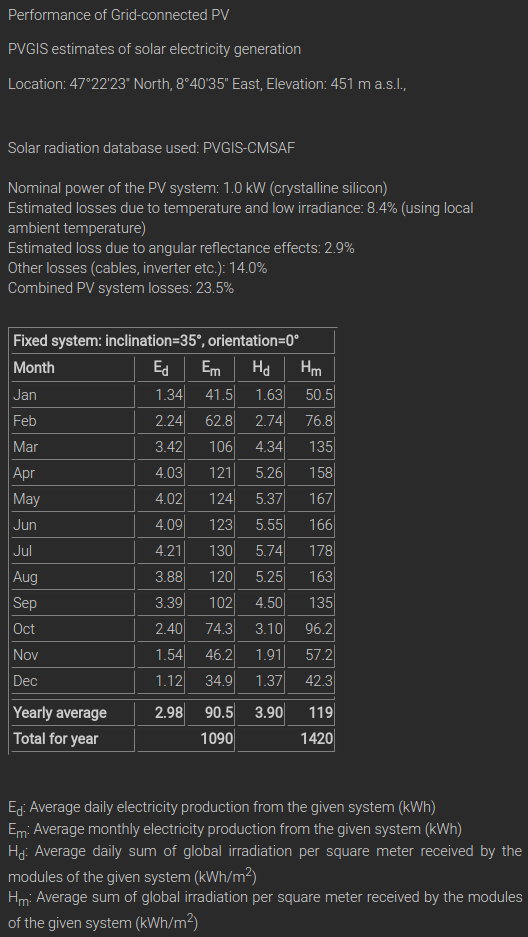
The table below is the result produced by PVGIS for an hypothetical system rated at 1 kWp, optimally oriented and installed around where I live, in the Canton of Zürich (47 ºN, in the Northwest of Switzerland). The most relevant figure in this report is the energy output estimate: 1090 Wh/Wp/a. While this is an estimate for an optimally oriented system, it provides a good measure of where the annual energy yield figure used by Ferroni & Hopkirk actually lays.
The table below is the result produced by PVGIS for an hypothetical system rated at 1 kWp, optimally oriented and installed around where I live, in the Canton of Zürich (47 ºN, in the Northwest of Switzerland). The most relevant figure in this report is the energy output estimate: 1090 Wh/Wp/a. While this is an estimate for an optimally oriented system, it provides a good measure of where the annual energy yield figure used by Ferroni & Hopkirk actually lays.
PVGIS © European Communities, 2001-2012
Reproduction is authorised, provided the source is acknowledged
See the disclaimer here
Comparison with Swiss statistics
Ferroni & Hopkirk cite the statistics compiled by Swiss Federal Office of Energy (SFOE) as the source of their 106 kWh/m2/a figure. There are a number of different documents available from theSFOE website covering all matters of energy generation and consumption.
In recent years the SFOE has produced a yearly report of renewable energy with a series of important figures. The report for 2015 is not available yet, therefore the figures used here refer only up to 2014. These are all aggregate values, but are already enough to provide another investigation path into Ferroni & Hopkirk's figure.
After going through these reports, one thing becomes evident: the SFOE does not use the energy output per unit area measure cited by Ferroni & Hopkirk. As expected, average electricity generation figures are rather provided in energy output per installed capacity (Wh/Wp/a).
Secondly it is important to note that PV is something relatively new in Switzerland, installed capacity has picked up only recently, almost tripling from 2012 to 2014. At the end of 2014 there were 1060 MWp of PV panels installed in Switzerland, a figure that grew 40% that year alone. During 2014 electricity generation from PV reached 841 GWh.
Assuming that all the new systems installed in 2014 were connected to the grid on the 1st of January a figure 794 Wh/Wp comes out for the year. This is already on the high side of the possible generation per installed capacity figures used by Ferroni & Hopkirk. However, assuming that these new systems where connected to the grid at a regular pace throughout the year, this number rises to 927 Wh/Wp. This is less than 15% off the PVGIS estimate, and possibly explainable by non optimal orientation of some systems and a small fraction of older and likely less efficient systems. Usually, systems tend to be installed towards the end of the year, to take up the most favourable legislative framework.
Possible causes
In recent years the SFOE has produced a yearly report of renewable energy with a series of important figures. The report for 2015 is not available yet, therefore the figures used here refer only up to 2014. These are all aggregate values, but are already enough to provide another investigation path into Ferroni & Hopkirk's figure.
After going through these reports, one thing becomes evident: the SFOE does not use the energy output per unit area measure cited by Ferroni & Hopkirk. As expected, average electricity generation figures are rather provided in energy output per installed capacity (Wh/Wp/a).
Secondly it is important to note that PV is something relatively new in Switzerland, installed capacity has picked up only recently, almost tripling from 2012 to 2014. At the end of 2014 there were 1060 MWp of PV panels installed in Switzerland, a figure that grew 40% that year alone. During 2014 electricity generation from PV reached 841 GWh.
Assuming that all the new systems installed in 2014 were connected to the grid on the 1st of January a figure 794 Wh/Wp comes out for the year. This is already on the high side of the possible generation per installed capacity figures used by Ferroni & Hopkirk. However, assuming that these new systems where connected to the grid at a regular pace throughout the year, this number rises to 927 Wh/Wp. This is less than 15% off the PVGIS estimate, and possibly explainable by non optimal orientation of some systems and a small fraction of older and likely less efficient systems. Usually, systems tend to be installed towards the end of the year, to take up the most favourable legislative framework.
Possible causes
The first cause that comes to mind for such low energy yield figure is an erroneous cell efficiency factor. PV cells are rated in control experiments where their energy output is assessed at a temperature of 25 ºC and a constant radiation of 1 kW/m2. This assessment is very useful to compare different cell technologies. Modern day wholesale crystalline cells reach efficiency factors between 14% and 16%, i.e. they convert that fraction of incident radiation into electrical current.
Since Ferroni & Hopkirk present average lifetime yield in energy per unit area, these authors might have converted incident radiation in Switzerland directly into an energy yield. However, instead of using the figures above, the efficiency factor they used must have been in the order of 8% to 9% to result in an energy per installed capacity value around 690 Wh/Wp/a. Such low conversion factors are more common with thin film technologies.
A second hypothesis is the employment of an unusually high cell degradation rate. PV cells loose their properties over time, both to the heat they are exposed to, as to the solar radiation itself. While tools such as PVGIS can easily model system losses, they usually leave this degradation rate out. Research centres such as the JRC have assessed PV technologies for decades, concluding on an energy yield degradation rate in the order of 0.5 %/a. Moreover, these long term studies also indicate that cells tend to degrade in a linear fashion.
The following figure presents two hypothetical degradation rates that bring down a PV panel from 1090 Wh/Wp/a to an average yield of 690 Wh/Wp/a over a 25 year lifetime: a liner degradation of 33.5 Wh/Wp/a and a logarithm decline of 4 %/a. In both cases the energy yield dives under half before the end of system life.
Since Ferroni & Hopkirk present average lifetime yield in energy per unit area, these authors might have converted incident radiation in Switzerland directly into an energy yield. However, instead of using the figures above, the efficiency factor they used must have been in the order of 8% to 9% to result in an energy per installed capacity value around 690 Wh/Wp/a. Such low conversion factors are more common with thin film technologies.
A second hypothesis is the employment of an unusually high cell degradation rate. PV cells loose their properties over time, both to the heat they are exposed to, as to the solar radiation itself. While tools such as PVGIS can easily model system losses, they usually leave this degradation rate out. Research centres such as the JRC have assessed PV technologies for decades, concluding on an energy yield degradation rate in the order of 0.5 %/a. Moreover, these long term studies also indicate that cells tend to degrade in a linear fashion.
The following figure presents two hypothetical degradation rates that bring down a PV panel from 1090 Wh/Wp/a to an average yield of 690 Wh/Wp/a over a 25 year lifetime: a liner degradation of 33.5 Wh/Wp/a and a logarithm decline of 4 %/a. In both cases the energy yield dives under half before the end of system life.

While this latter hypothesis is my favourite, it does not explain the employment of the strange energy per unit area figure. Also, these degradation rates would assume that in the face of a fast collapse in energy output owners would never activate panel warranty.
Final remarks
Replacing the inexplicably low energy yield figures used in this study by those available from the SFOE is already enough to bring the Swiss PV park into positive net energy territory. However, such result is still far from previous PV EROEI assessments, even the highly conservative estimate produced by Prieto & Hall. Just as the energy yield assumptions proved problematic in this study, I expect similar awkwardness to be found on the energy input side of the equation. However, I leave this aspect to be assessed by someone else.
The publication of such a study by a relatively renowned outlet begs for deep reflection. The last article I authored in a scientific journal was over two years in review; this is usually a slow and painstaking process. Being myself an editor and reviewer at scientific publications, I am at a loss to explain how could such a problematic figure of 106 kWh/m2/a have possibly made through the peer review process. It should have immediately raised a red flag to whoever is slightly acquainted with PV technology and economics, calling for close scrutiny by reviewers and editors alike. Something fundamental has failed in the review process at Energy Policy.
The publication of such a study by a relatively renowned outlet begs for deep reflection. The last article I authored in a scientific journal was over two years in review; this is usually a slow and painstaking process. Being myself an editor and reviewer at scientific publications, I am at a loss to explain how could such a problematic figure of 106 kWh/m2/a have possibly made through the peer review process. It should have immediately raised a red flag to whoever is slightly acquainted with PV technology and economics, calling for close scrutiny by reviewers and editors alike. Something fundamental has failed in the review process at Energy Policy.

The Take Away
The EROEI figure concluded by Ferroni & Kopkirk for PV is the lowest ever and far below any previous studies.
These authors use awkward units that largely obfuscate their assumptions on yearly energy yield.
A sample of various panel models points to an energy yield under 700 Wh/Wp/a used in this study.
Official statistics point to an average yield well above 900 Wh/Wp/a for the Swiss PV park; this is in line with values from assessment tools like PVGIS.
The peer review process is not functioning properly at Energy Policy.


