Showing posts with label plastics. Show all posts

Monday, June 24, 2019

The Stuff of Our Lives: The Seneca Collapse of Relocating


The experience of relocating is curiously similar to an archaeological excavation of the ruins of a disappeared empire. Above, you can see two jars filled with old coins recovered from the nook and crannies of my house after emptying it of everything. Mostly these are old Italian "lira" coins, others are foreign coins and, in the smaller jar, you can see an Italian "gettone" used for making calls at public phones up to a few decades ago. These old coins have no monetary value, they are just markers of time passing. 


You know that the "Seneca Effect" has to do with overshoot and collapse. From the time when the Roman philosopher Lucius Annaeus Seneca noted that "growth is slow, but ruin is rapid," I keep finding new examples of application of the idea. One that I recently experienced had to do with relocating: moving away from the home where my family had been living since 1965. From then,  the 340 square meters (ca. 3600 ft2) house had been gradually filling up with all sorts of stuff. Emptying it in a couple of months of work was quite an experience. "Sobering" is the correct word, I'd say.

I don't know if you are all good followers of Feng Shui, striving for good vibes and not too much junk in your home. I didn't consider myself as an adept of that philosophy, but I didn't see myself as a serial accumulator of junk, either. Well, I had to reconsider my position. I was a serial accumulator. Really, the amount of stuff that came out of my place was so large to be bewildering. And so much of it we had to throw away -- bewildering, too. We are still a little bewildered, but the most intense part of the saga seems to be over, so maybe I can report about my experience in this post.

First of all, we (me and my wife) tried to be good citizens and separate/recover/reuse what we could. It was one of those experiences where you note the divergence between theory and reality.

Let me start with the furniture. A lot of it was modern pieces of the kind made in laminated wood, bought in places like Ikea. We had a few of these pieces re-assembled in our new home, but the result was something that looks like it was salvaged from a shipwreck -- this furniture is not made to be reused. Indeed, the employees of the company that transported our stuff told me that most people just throw away the old furniture and buy new pieces: it is cheaper and easier. Another field of our society where the concept of "circular economy" just doesn't seem to apply.

Here is a photo of some (just some!) of our old furniture disassembled and ready to be taken away by the local waste management company. I have no idea of what they do with it, but I am sure there is no way to recycle it. It has to be landfilled or incinerated. Furniture is NOT environmentally friendly.


Then, we had plenty of things that were still perfectly usable-- even brand new -- but that we couldn't take to our new, much smaller home. Here, we tried to avoid throwing stuff away, but it was hard work, time-consuming, and not a very satisfying result in the end. Here is an image of one of the several carloads we transported to a local charity -- I counted at least six trips like this one.


At the charity, they took most of the things we brought, but a little grudgingly. They told us that they are full of clothes, books, toys, tools, tableware, appliances, trinkets, and the like. The poor can have these things aplenty, but what they need is not that: they desperately need money for food and for the rent. But that's, obviously, not what you want to dispose of when you are relocating.

Then, eventually, a lot of things had simply to be thrown away: not good enough to go to charities, too big to be stored somewhere, useless in our new home. Here, you see me throwing away my old globe of when I was a kid -- note the burned area near Australia. Maybe I was playing a nuclear war game, or maybe I was already a catastrophist at that time!


Note also that the globe is going into the "undifferentiated" bin. It is plastic, theoretically it could be recycled, but the Italian law considers only food containers to be recyclable. So, a lot of plastic objects we threw away will never be recycled and every item I dumped in the bin, shoes, tools, trinkets and more, gave me an eerie sensation of a "revenant." One day, I would find again that plastic in the air I breathe after it will be incinerated, or maybe in the form of small chunks in the sushi I eat. Not that if it were possible to recycle it, things would change so much. The thought that my old junk could be turned into a garden bench doesn't comfort me too much: also that bench would end, eventually, in my sushi.

How much stuff did we throw away? I can't say, hundreds of kilograms, at the minimum. And it is impressive to think that most homes in the Western will have the same problem, one day or another. I don't know about your experience but, after I went through all this, I cannot visit a friend at home without noting how much stuff is accumulated there. Some places are even more encumbered with all sorts of junk than our home -- getting rid of all they contain is going to be a nightmare for the owners.

Where will all this stuff end up? And how to manage it in a future in which, probably, transportation is going to cost much more than today? Maybe it will remain where it is, slowly buried by the ruins of our civilization. A treasure for the archaeologists of the future, if there will be any. But it is, after all, just entropy doing its work.



Sunday, September 16, 2018

Plastic Pollution: The Age of Unsolvable Problems


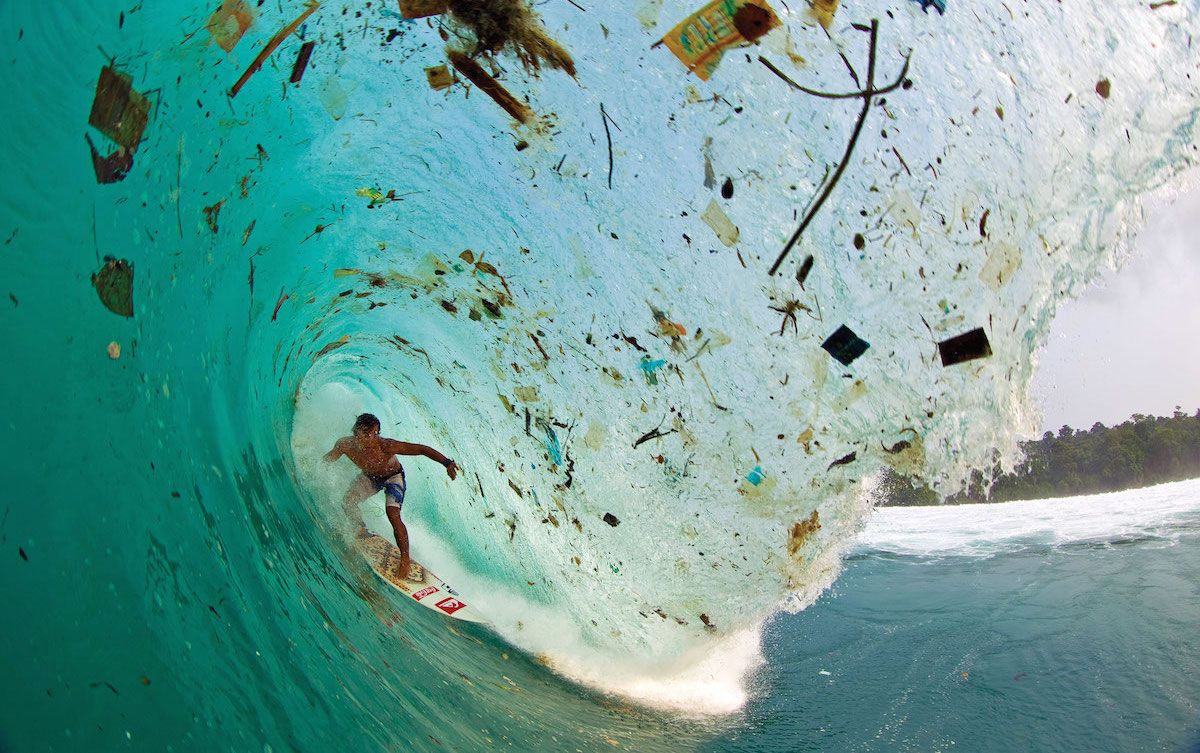
Suddenly, we discovered that plastic pollution is a problem, a big one. What to do about it? As usual, it is a question of governance: the problem in itself is not so terribly bad that it couldn't be controlled. But, over the years, we developed such effective technologies of anti-governance that we have entered now "the age of unsolvable problems". 


How bad is the situation with plastic pollution? Rather bad, by all means. Citing from a recent paper by Geyer et al., more than 8 billion tons of plastic have been produced since the 1950s. Of this mass, 9% percent was recycled, 12% was incinerated, the rest is still around. It is this mass of plastics, billions of tons, which generates the pollution we see today. It is almost one ton of plastic waste for every human being living today. Imagine if it were magically to appear in your living room: one ton for every member of your family!


Still following Geyer et al., we learn that, in 2015, the world produced 380 million tons of plastics from fossil hydrocarbons. To get some idea of how polluting this mass is, we can compare it to the total carbon emissions produced by hydrocarbon combustion, around 9 billion tons per year. As an order of magnitude comparison, we can say that about 4% of the fossil hydrocarbons we extract become plastics.  


4% doesn't seem to be a large amount, but it is not negligible, either. Apart from the horrible state of some beaches and the islands of plastics in the oceans, it is a lot of carbon pumped into the ecosystems. Its effects are unknown, especially on humans: we are all eating microplastic particles, today. What will that do to our health, nobody knows -- we are all guinea pigs in a great experiment. The long-run problem is that all this plastic is made from fossil hydrocarbons, so it is going to be gradually oxidized and turned into gaseous CO2. Then, it will contribute to global warming.

So, we have a problem and not a small one. Then, how do we deal with it? The Greens in their various shades will respond with the magic words "recycle!" or "reuse!" but there is a little problem here: you can't recycle or reuse anything for more than a limited number of times. Recycling plastics is just a way to procrastinate the unavoidable: you may know the quote (attributed to Christopher Parker), "Procrastination is like a credit card; it’s a lot of fun until you get the bill." Eventually, even recycled/reused plastics must become waste and at that point, we get the pollution bill to pay. 

A different brand of problem solvers, maybe we could call them the "anti-Greens," will come up with a completely different strategy: "let's burn it!" Yes, sure, after it is burned, we don't see it anymore -- which means it has disappeared, right? And, in the process, we magically create energy! Isn't that a good idea? Maybe it is, but if there ever was a perfect illustration of the concept of "sweeping the problem under the carpet," this would be it. When burned, the stuff plastic is made of doesn't disappear -- it is simply turned into CO2 which then goes into the atmosphere to create more global warming. And the energy we can get from incineration is just a trifle and it is obtained in a dirty and inefficient manner.


There is a third brand of people I could call the "bring me a problem and I'll show you an opportunity." They take notice that there exists something called "bioplastics" which doesn't generate extra greenhouse gases and is bio-degradable, at least in principle. So, it could solve the problem while keeping everything the way it is in the best of possible worlds. They know that, nowadays, weight for weight, bioplastics cost 2-3 times more than ordinary plastics made from fossil fuels but, hey, higher prices mean higher profits! After all, the fraction of the budget that an ordinary family can't be but small, so they can afford to pay a little more. Besides, technological progress will surely bring costs down. And when they discover that bioplastic production today is only about 4 million tons (1% of the total production of plastics), wow! Think of the possibilities of growth!!


But is bioplastic the solution to the problem? As it often happens, quantification makes short work of ideas that seemed to be good in theory. Today, bioplastics are made mainly from cereals (corn) or directly from sugar. According to the data from Statista, the world's production of sugar was about 170 million tons in 2017, less than half the amount needed to make the currently produced amounts of plastics even in the wildly optimistic assumption of a 100% efficient process. About cereals, the data tell us that in crop year 2016/2017, a total of approximately 2.62 billion metric tons of cereals were produced worldwide. Again in the wildly optimistic assumption of a 100% efficient production process, it means we should set aside about 15% of the world's cereal production - more realistically about 20%-25%. Then, of course, efficiency can be improved and we may find ways to make plastic out of plants not used as food. But, at present, it is the way things stand.


Think for a moment of what losing 25% of the food production to make bioplastics would mean for a world where billions of people live on the edge of starvation. You see that we have a little problem, here -- similar to the one that would come if we were to try to switch from fossil fuels to biofuels. And I am not saying anything about the fact that agriculture is far from being fossil-free, not at all: think of fertilizers, pesticides, transportation, refrigeration, processing, and more. Think also that, the way it is performed nowadays, agriculture is an unsustainable process that destroys the fertile soil that it needs to produce food. There is just so much that agriculture can do: it can't feed more than 7 billion people and, at the same time, provide fiber, chemicals, and fuel for everybody. 


Does that mean that the problem of plastic pollution unsolvable? No. It is, actually, a minor problem in comparison to other, much more difficult problems we face. We need to phase out fossil fuels from the world's economy but, if we were to do that very rapidly, the world's economy would cease to function. But we could phase out fossil-based plastics tomorrow. It would be uncomfortable and complicated, but nobody would die and we would rapidly adapt to new ways to do everything we do today, just using something else: metals, paper, ceramic, tissue, or whatever at hand -- even nothing in some cases. And we don't even need to phase-out plastics completely: in some areas, plastic materials are really indispensable, think of one-use medical equipment or rubber tires for road vehicles. But, in that case, we can use bioplastics: if we use it in limited amounts, it is possible. What we have to do is just to eliminate the wasteful and frankly stupid one-use plastic items: plastic bottles, spoons, forks, dishes, and the like.


It is, in the end, not a technological problem: it is a problem of governance: we, humankind, have been able to manage reasonably well the elimination of some harmful substance from industrial production. Think of lead as a component of paints or in gasoline. Think of mercury in thermometers, beryllium in some alloys, CFCs in refrigerators, DDT as an insecticide, and many more cases. International agreements were discussed, approved, and implemented. Then, these and many more substances were banned and removed from industrial use. It is possible and it has been done.


So, it would be perfectly possible to develop and implement international agreements that would curb the use of plastics made from fossil fuels and eventually ban it completely. That implies changing something in our everyday life: the "overpackaged" products that today are so common in supermarket aisles would have to disappear. Packaging is not evil: it is a way to store and ship food - we need to use it as needed, no more.


So theoretically, it should be possible -- even reasonably easy -- to eliminate plastics pollution by means of international legislative action but, in practice, it looks difficult. Over the years, efficient technologies of anti-governance (aka good old disinformation) have been developed and honed to near perfection -- we saw them applied to the issue of global warming. These technologies can be used by industrial lobbies to stop all legislative changes that would reduce their profits. That has made every problem impossible to solve.

Right now, the fossil fuel industry is desperately fighting to survive. It has been able to successfully stop many attempts to do something against climate change. It is at least unlikely that it will stay silent while it loses a market worth some 600 billion dollars per year. So, expect soon a loud campaign in favor of plastics: some hints are already starting to appear (*). And they will blame you for not sorting your waste properly!


If the campaign to keep fossil plastics will work, then the only way to get rid of the stuff will be a full-fledged Seneca Collapse.  That is, if humans can't reduce by themselves the amount of fossil plastics they use, the system will crash and force them to reduce it. This kind of crashes have happened in the past, they can surely happen again.


_____________________________

(*) The article cited on WSJ is paywalled, but the gist of it is based on an earlier article on NPR which notes how the number of plastic straws used yearly in the US is usually overestimated (500 million per day) and that the person who generated it a few years ago (Milo Cress) now admits it was just a guess. Because of this, the WSJ writer, James Freeman, concludes that the whole anti-plastics campaign is a scam designed to have you pay more money to the Green PTBs, out there. It is a standard disinformation technique based on cherry picking. They can do much better than this - you'll see that soon!


Who

Ugo Bardi is a member of the Club of Rome, faculty member of the University of Florence, and the author of "Extracted" (Chelsea Green 2014), "The Seneca Effect" (Springer 2017), and Before the Collapse (Springer 2019)