Showing posts with label transition. Show all posts

Monday, April 13, 2020

Resignation and optimism on the brink of the apocalypse


Guest post by Federico Tabellini


Despite the misleading title, I will not talk to you today about the coronavirus, but of that other, far more insidious crisis that we cannot hope to solve with a vaccine. The global ecological crisis: a crisis in which we are the virus. I would like to share with you some brief reflections on human agency, human nature and their relationship with the possibility of a sustainable society. I know, philosophical stuff – but with very practical implications. 

The idea for this article came from a series of conversations I recently had with a reader of my book ‘A Future History of the 21st Century: How We Overcame the Crisis of Civilization’. The text debates the nature of the current socio-economic system, and analyses which of its structural elements constitute obstacles to our transition to a sustainable society. It then discusses how we could potentially overcome those obstacles, focusing on specific economic, institutional and political reforms. All of this while avoiding the well-known trap into which many Degrowth theorists still fall today, which can be summarized by the dead end idea that bottom-up change is the only way out of the crisis, and that to change the world we first need to change ourselves. In short, this is a dead end idea because it cannot be translated into concrete policies. Conversely, to be carried out successfully, a bottom-up change requires a top-down change that facilitates and supports it. In other words: institutional, political and economic reforms.
After this necessary introduction, let’s get to the core topic of the article. The reader I spoke of earlier agrees with the book’s analysis of our current situation and acknowledges that the solutions proposed could produce the desired transition to a sustainable steady-state economy. However, he argues that human nature will never allow us to implement those changes. In other words, not only can human beings not change themselves – they can’t even change the very institutions they created. And this is not an unlikely change either, he claims, but an absolutely impossible one. This is the same as saying that we are trapped in a car that is heading speedily towards a ravine, with a functioning brake in easy reach of our hands, but sadly we are programmed not to pull it.
To put it another way, the problem is not to be found in a defect of the hardware (our hands) or in the resilience of the system (the car), but rather in the software code (our head). The software, he argues, is programmed for accumulation, for a growth without limits and without purpose, for constant acceleration. These things are not cultural constructs, but rather inalienable characteristics of human nature.
He then proceeds to claim, based on fringe clyodynamic theories – which he of course accepts as undisputable scientific proofs – that history demonstrates this; that civilizations have always grown until they could, and when they stopped doing so, they without exception collapsed. The only solution, he concludes, is exactly that: collapse. A non-solution. Worse still: to embrace the very idea that a solution is not possible. That we cannot pull the brake. That we cannot change direction. That we need to give up and accept that we are going to fall into the ravine, and die along with the system. Not everybody, of course. Those of us that will survive will have the chance to start again, little by little, from down there, the slow climbing of the cliff. Only this time with fewer resources. And this ad infinitum, with our heads forever preventing us from learning from the mistakes of the past: until the final suicide.
Of course – I’m sure you’ve guessed it by now – I do not agree that this is the unavoidable destiny of our species. I do acknowledge, however, that we are indeed genetically programmed for accumulation and growth, and that we are not programmed to individually impose limits to ourselves. We get immediate pleasure from accumulation, while the most we get from limits is a kind of long-term serenity. To obtain the latter we need effort and perseverance, while to accumulate more and more, we just need to follow our instincts.
In other words, starting from a clean sheet and without culture, we tend to long for growth. To have more, to produce more, to do more. What I do not agree with is that our culture has to strengthen this inclination, and cannot instead compensate for it, for everyone’s sake.
Let me be clear: contemporary global culture intensifies these human tendencies more than any other culture that preceded it. The fact that we live inside this culture makes us see it as the most natural outcome of human nature, just as the ancient romans thought of their own culture as the peak of human civilization. Neither they nor we were right, of course. In the same way as we constrained our human tendencies to indulge in gratuitous violence, and no longer slaughter slaves in an arena, so people in the future can stop growing their production and consumption beyond the carrying capacity of the ecosystems. What allows us to do this is human agency: the ability to change our culture and our institutions based on what we think is right. In this case, what is right for most people (including the author of this article) is to increase the lifespan of the human race on this planet, and make sure that life is worth living for future generations.
In this sense, we should note that our current situation involves never before seen elements that work in our favour. Here are some of the most significant:
1.      Today, for the first time in history, we know that our socio-economic model is environmentally unsustainable, and that a change is necessary (although there is currently no complete agreement on what type of change we need, or how to produce it).
  1. Today, for the first time in history, the entire world is interconnected, and can potentially discuss shared solutions (although coming to an agreement is not as easy as we hoped).
  2. Modern technologies make producing the goods and services essential to human survival more efficient. We produce and consume too much, but each unit we produce and consume has a lower impact on the environment compared to the past.
  3. It is now a consolidated fact that beyond certain levels of consumption, further consumption does not equal more well-being for human beings.[1] We already passed those limits, which means that a reduction of our per-capita consumption would not produce a reduction in aggregate well-being.
There is also historical evidence that points towards the possibility of complex social models that are not based on the relentless accumulation of material goods.
There have been entire communities in Asia and Africa that for centuries lived in societies in which the individual accumulation of material goods was socially sanctioned. These are examples of instances in which culture compensated nature, producing ecologically sustainable social models as a result.
Thus, the real fundamental question is not whether it is possible to build a sustainable society, but rather whether it is possible to do so without sacrificing the fundamental values of the West and people’s well-being. If by ‘fundamental values of the West’ we mean things such as human rights and political and civil liberties, the answer is a resounding ‘yes’ (you can find a demonstration of this in my book). If we instead mean unchecked capitalism and a lawless market, then the answer is ‘realistically, no’.
However, we do not need to ask history to know this, because history does not include the full range of possible futures. If there is a constant in human history, it is novelty. The creation of new things that constantly confute the idea that history is destined to repeat itself. History is not the full toolbox we have at our disposal to build our future. Many things that exist today did not exist before. These things are as varied as computing technologies and the internet, but also liberalism, the state of law, and human rights. We also, for the first time, live in a full world, without new frontiers to exploit. Human history has always been a history of exploitation because, among other things, there was an abundance of resources to exploit; now we are consuming (far) more than what nature produces. The situation has changed, and there is no reason to believe that we cannot change also. Before we did not need to change. Now we do. The very fact that we can see this as a problem is a relatively new thing, and a hint that we have the power to solve it.
My reader, however, appears to be blind to the very possibility of change, any change. This is because he draws his arguments not from history, but from an interpretation of history. A highly deterministic interpretation that excludes human agency. Doing so, he looks at the forest as an actor independent from the trees it is made up of. In this way, culture becomes an entity separated from people, which controls them as a puppet master. It has its own will, or moves as if it had one. There is no way we can control it. And even when it looks like we are in control, in reality we are just executing its directives. It is not the trees that make up the forest; it is the forest that makes up the trees.
Conversely, my position is one shared by most social scientists: the forest makes up the trees and at the same time, the trees make up the forest. The influence is mutual. Under certain historical conditions, it is mostly the forest that shapes the life of the trees. It decides where they lay roots, where they extend their branches, where they spread their seeds. In times of uncertainty and crisis, however, the trees can shape the life of the forest. They can shape which direction it expands. Whether it grows or retreats. If it provides sufficient nourishment for the living beings that inhabit it.
In a similar fashion, human beings are not slaves to their culture, although going against it, to change it, requires a considerable effort. An effort that the majority will not want to undertake unless they perceive it as absolutely necessary. Unless – and this is the main message I want to pass here – they believe that a change is possible.
Such a change is not likely to occur spontaneously, without direction. Most great changes in history have occurred when capable and innovative leaders (not only politicians, but also intellectuals) come together with a mass of people united by a common goal. A mass that starts small, but little by little grows until it reaches the critical threshold necessary to spark a change. This happened with women’s rights, with workers’ rights, with the liberal-democratic model, with communist revolutions, with Nazism. Change is not always positive. But it is almost always possible.
This does not mean it is probable. Often it is not. Today I think it is not probable. But it is possible. And this is really, really important. Another thing is important: change becomes more probable if we believe it possible. If the ideas of my aforementioned reader spread, change would become less probable: a self-fulfilled prophecy that could condemn our race (and others, too) to a dreadful future.
It is true: human beings are, to a certain extent, programmed by genes and culture. But they can also reprogram culture. Often they can only do this indirectly, like when the standard working day was reduced to 8 hours (an institutional reform). This produced more free time for individuals, which in turn translated into a proliferation of new activities, giving birth, among other things, to the entertainment industry and sport (previously, sport had been something that only athletes and nobles engaged in).
In conclusion, between my reader and myself there is both agreement and disagreement. We agree that the world is hurrying towards a ravine. We disagree on the possibility of pulling the brake. I firmly believe that resignation is the worst enemy of change. It paralyzes us. And I believe that optimism is needed more, not less, on the brink of an apocalypse. If we want to produce a positive change in the world, we need to look at the ravine with a smile on our lips, but also – and especially – with rolled up sleeves and our brains at work. It may be highly unlikely that we will be able to pull the brake. Nonetheless, we have the moral obligation to try. Success might not be probable, but it is surely possible. And this possibility, being rooted in the present and not in the past, is something that no deterministic interpretation of history will ever be able to disprove.

[1] See, for example, D. G. Blanchflower, A. J. Oswald, Well-being over time in Britain and the USA, in “Journal of Public Economics”, 88 (2004), pp. 1359-1386; R. Layard, S. Nickell, G. Mayraz, The marginal utility of income, in “Journal of Public Economics”, 92:8/9 (2008), pp. 1846-1857; D. Kahneman, A. Deaton, High income improves evaluation of life but not emotional well-being, in “Proceedings of the National Academy of Sciences of the United States of America”, 107:38 (2010), pp. 16489-93; E. Proto, A. Rustichini, A Reassessment of the Relationship between GDP and Life Satisfaction, in “PLoS ONE”, 8 (2013).

Monday, March 18, 2019

When the Going gets Tough, Women get Going. "MIddle Ages 2.0" and the Great Transformation Awaiting us


In Europe, Greta Thunberg has smashed all the memetic barriers succeeding in doing what nobody else had succeeded before: bringing the climate emergency within the horizon of the public and of the decision makers. In parallel, on the other side of the Atlantic, another young woman, Alexandra Ocasio Cortez has been doing something similar with her "Green New Deal."

These are remarkable changes and I think it is not casual that they are brought by women. It had already happened during the early Middle Ages, when women took a prominent role in taking the lead in reshaping a dying empire into a new, vibrant civilization, one that we sometimes call the "Dark Ages" but that was a period of intelligent adaptation to scarcity. It was also a civilization displaying a remarkable degree of gender parity in comparison to what the European society was before and what would become later on.

There is a lot that we can learn from the Middle Ages on how to manage the Great Transformation: it will be "Middle Ages 2.0".  Here, I am reposting a text I originally published on my other blog, "Chimeras" that's relevant on the subject. Expect more posts on this subject, the more I think about that, the more I tend to think that the Middle Ages could provide us with a true blueprint for the great transition.


From "Chimeras" March 1, 2016

The war of the sexes: the origins of gender inequality


 The story of Scheherazade of the 1001 Arabian Nights is the quintessence of the "war of the sexes" and of how women tend to lose it. It is said that King Shahryar would have a new lover every night and every morning he would have her killed. He stopped only when Scheherazade started telling him stories. It shows, among other things, that males behave much better when they listen to females. Picture: Scheherazade and Shahryār by Ferdinand Keller, 1880

Some time ago, I was chatting at home with a friend who is a researcher specialized in "gender inequality". I asked her what were the ultimate origins of this inequality but we couldn't arrive at a conclusion. So, I happened to have in a shelf nearby a copy of the "Malleus Maleficarum", the book that Kramer and Sprenger wrote in the 16th century on the evils of witchcraft. I took it out and I opened it to the page where the authors dedicate several paragraphs to describe how evil women are. I read a few of these paragraphs aloud and my friend was so enraged that she left the room, without saying a word. Later on, she told me that she had done that to avoid telling me what she thought I deserved to be told just for keeping that book in my shelves. Maybe she was right, but the question of the origins of gender inequality remained unanswered (BTW, later on, we became friends again). 

Why are women so commonly discriminated in almost all cultures, modern and ancient? Of course, there are plenty of studies attempting to explain the reasons. It is an interdisciplinary field that mixes history, anthropology, psychology, social studies, and even more; you can spend your whole life studying it. So, I don't even remotely pretend to be saying something definitive or even deep on this subject. It is just that, after much thinking on this matter, I thought that I could share with you some of my conclusions. So, here is a narrative of how gender inequality developed over the centuries in Europe and in the Mediterranean world. I hope you'll find it something worth pondering.

Let's go back in time, way back; when does the phenomenon that we call "gender inequality" starts? You probably know that Marija Gimbutas has been arguing for a long time that the pre-literate ages in Europe were characterized by a form of matriarchy and by the predominance of the cult of a female goddess (or goddesses). That is, of course, debatable and it is hotly debated; there is very little that we have from those ancient times that can tell us how men and women related to each other. However, when we move to the first examples of literature we have, then we see at least hints of a different world that involved some kind - perhaps - if not female dominance at least a more assertive role of women. Indeed, the first text for which we know the name of the author was written by the Sumerian priestess Enheduanna at some moment during the second half of the third millennium BCE. From these ancient times, there comes a very strong voice: the voice of a woman asserting the rule of the Goddess Inanna over the pantheon of male Gods of her times, hinting at an even larger role of female goddesses in even more ancient times.

If we follow the millennia as they move onward, it seems that the voice of women becomes fainter and fainter. In Greece, we have Sappho of Lesbos, renown for her poetry, but she comes from a very early age; the seventh century BCE. As the Greek civilization grew and was absorbed into the Roman one, woman literates seem to dwindle. Of the whole span of the Western Roman civilization, we know of a modest number of literate women and there are only two Roman female poets whose works have survived to us. Both go with the name of Sulpicia and you probably never heard of them. As poetry goes, the first Sulpicia, who lived at the times of August, may be interesting to look at. The second one, living in later times, has survived in a few lines only because they are explicitly erotic. But the point is that it is so little in comparison with so much Greek and Latin literature we still have. Women of those times may not have been really silent but, in literary terms, we just don't hear their voices.

On the other side of the sexual barrier, note how the "Malleus Maleficarum" bases its several pages of insult to women largely on classical authors, for instance, Cicero, Lactantius, Terence, and othes. It is not surprising for us to discover that from the early imperial times to the early Middle Ages, most writers were woman-haters. They thought that sex was, at best, a necessary evil that one had to stand in order to ensure the perpetuation of humankind; but no more than that. Chastity, if one could attain it, was by far the best condition for man and woman alike and, for sure, sex with a woman was only a source of perversity and of debasement. An early Christian father, Origen (3rd century CE) is reported to have taken the matter to the extreme and castrated himself, although that's not certain and surely it never became popular.

With the decline and fall of the Western Roman Empire, there appeared something that had never existed before: the monastic orders. Never before so many men and women had decided that they wanted to live in complete separation from the members of the other sex. Read a book such as the "pratum spirituale" by 6th century CE the Byzantine monk John Moschos, and you get the impression that everyone at that time, males and females, were obsessed by sex; how to avoid it, that is. Chastity had never been considered a virtue before and, yet, now it had become the paramount one. At least, however, it seems that women had gained a certain degree of independence, seeking for chastity in their own ways and with a dignity of their own. Reading documents from that age, you get the well-defined impression that men and women had somehow decided that they wanted to avoid each other for a while. It was a pause that lasted several centuries. But why did that happen?

I think there are reasons, but to understand them we must go back to Roman times and try to understand what was the relationship between men and women at that age. And we may find that it was deeply poisoned by a sickness that pervaded the society of those times: social inequality and, in particular, the institution of slavery.

The Roman Empire based its wealth on the work of slaves. Their number is variously estimated as around 10% of the population, but it was larger in the richest regions of the empire. Probably, during the 1st century CE, some 30%-40% of the population of Italy was composed of slaves (1). Slavery was an integral part of the Roman economy and one of the main aims of the Roman military conquests was capturing of large numbers of foreigners, who then were turned into slaves.

Now, most slaves were male and were used for heavy or menial work, in agriculture, for instance. But many of them were female, and, obviously, young and attractive slaves, both male and female, were used as sex objects. Slaves were not considered as having rights. They simply were property. Caroline Osiek writes that (2).

To the female slave, therefore, honor, whether of character or of behavior, cannot be ascribed. The female slave can lay no claim to chastity or shame, which have no meaning. In the official view, she cannot have sensitivity toward chastity. Her honor cannot be violated because it does not exist. .. No legal recognition is granted to the sexual privacy of a female slave.

To have a better idea of how female slaves were considered in Roman times, we may turn to a late Roman poet, Ausonius (4th century CE) who had gained a certain notoriety in his times. He was not only a poet but an accomplished politician who had a chance to accompany Emperor Gratian in a military raid in Germania. From there, he returned with a Germanic slave girl named Bissula. He wrote a poem in her honor that says, among other things,

Delicium, blanditiae, ludus, amor, voluptas, barbara, sed quae Latias vincis alumna pupas, Bissula, nomen tenerae rusticulum puellae, horridulum non solitis, sed domino venustum.

that we can translate as
Delice, blandishment, play, love, desire, barbarian, but you baby beat the Latin girls. Bissula, a tender name, a little rustic for a girl, a little rough for those not used to it, but a grace for your master

It is clear that Ausonius likes Bissula; we could even say that he is fond of her. But it is the same kind of attitude that we may have toward a domestic animal; a cat or a dog that we may like a lot, but that we don't consider our equal. Bissula was no more than a pet in terms of rights. It is true that her master was not supposed to mistreat her, and we have no evidence that he ever did. But she had strictly no choice in terms of satisfying him sexually. In this sense, she had no more rights than those pertaining to a rubber doll in our times. In modern terms, we can say that she was being legally raped. And nobody seemed to find this strange; so much that Ausonius' poem that described this legal rape was considered wholly normal and it was appreciated.

If we can still hear Ausonius' voice, we cannot hear that of Bissula. Probably, she couldn't read and write, to say nothing about doing that in proper Latin. So, what she thought of her master is anyone's guess. Was she happy that she was getting at least food and shelter from him? Or did she hate him for having been one of those who had, perhaps, exterminated her family? Did she ever dream of sticking a hairpin into Ausonius' eye? Perhaps; but we have no evidence that she ever did. If she had done something like that, by the way, she would have condemned to death all the slaves of Ausonius' household. The Roman law practiced a strict interpretation of the principle of common intention and when it happened that a slave killed his/her master, it required that all the slaves of that master were to be executed. And we know that this law was put into practice on several occasions.

So, we cannot hear Bissula's voice, just as we can't hear the voice of the millions of sex slaves that crossed the trajectory of the Roman Empire, from its foundation to its end in the 5th century CE. Exploited, without rights, probably turned to menial work whenever they got older and their masters lost interest in them, their voice is lost in the abyss of time. But, perhaps, we can get a glimpse of their feelings from their reflection on the other side; that of their masters who, in Imperial times, dedicated pages and pages of their writings at insulting women. Yes, because the silent side, that of the slaves, was not without weapons in the war that the masters were waging against them. The masters may have expected gratitude from them, perhaps even love. But they got only hatred and despise. Imagine yourself as Bissula. Do you imagine she could have loved Ausonius? And can you imagine how could she have taken some revenge on him? I am sure there were ways, even though we can't say whether Bissula ever put them into practice. No wonder that so many men in these times accused women of treachery. In the war of the sexes, the women had to use guerrilla tactics, and, apparently, they were doing that with some success.

If slavery turned woman slaves into sex objects, the resulting war of the sexes must have had a negative effect also on free women. They were not supposed to be legally raped as the slaves, but surely they could not ignore what their husbands were doing (and, by the way, free Roman women were not supposed to rape their male slaves and, if they did, they were not supposed to write poems about how cute their male sex dolls were). Very likely, this situation poisoned the male/female relations of generations of Roman citizens. Thinking of that, we cannot be surprised of the avalanche of insults that Roman male writers poured on women (want an example? Seneca in his tragedies [11 (117)]: "when a woman thinks alone, she thinks evil")

That kind of poisoned relationship continued for a long time but, at a certain moment, not much later than Ausonius' times, the Empire ceased to be able to raid slaves from anywhere, and then it disappeared. Slavery didn't disappear with the Empire: we had to wait for the 19th century to see it disappear for good. But, surely, the whole situation changed and slaves were not any more so common. The Christian church took a lot of time before arriving at a clear condemnation of slavery, but turning people into sex toys was not seen anymore as the obvious things to do. So, things changed a lot and we may understand how during Middle Ages men and women were taking that "pause." It was as if they were looking at each other, thinking "who should make the first move?" A shyness that lasted for centuries.

And then, things changed again. It was an impetuous movement, a reversal of the time of hatred between men and women: it was the time of courtly love. With the turning of the millennium, the Amour Courtois started to appear in Europe and it became all the rage. Men and women were looking again at each other and they were looking at each other in romantic terms: they loved each other. The love between man and woman became a noble thing, a way to obtain enlightenment - perhaps better than chastity. From the Northern Celtic tradition, the legend of two lovers, Tristan and Iseult, burst into the literary scene. And it was a dam that gave way. Lancelot and Guinevere, then Dante and Beatrice, Petrarca and Laura, Ibn Arabi and Nizham. West European and Mediterranean poets couldn't think of anything better to express themselves than to dedicate their poetry to noble women whom they loved and respected.

And we hear again the voice of women: and what a voice! Think of Heloise, pupil and lover of Abelard, the philosopher, in a tragic love story that took place during the early 12th century. Heloise  burst onto the scene with unforgettable words: "To her master, nay father, to her husband, nay brother; from his handmaid, nay daughter, his spouse, nay sister: to Abelard, from Heloise. And if the name of wife appears more sacred and more valid, sweeter to me is ever the word friend, or, if you be not ashamed, concubine or whore." What can you say about this? I can only say that my lower jaw falls down as I utter "Wow!!"

It was a long journey from Heloise to our times. Long and tormented, just think that not much later than Heloise, the French mystic Marguerite Porete wrote her book "The mirror of the simple souls" in a style and content that reminds the works of the Sumerian Enheduana, four thousand years before. And Marguerite Porete was burned at the stake for what she had written. And, some centuries later, the war against females continued with the various witch hunts, fueled by books such as "The Malleus Maleficarum" (1520). And think that it was only in the second half of the 20th century that women were generally considered smart enough that they were allowed to vote in general elections. But we have arrived somewhere, to an age in which "gender inequality" is considered something wholly negative, to be avoided at all costs. An age in which, at least in the West, the idea that women are equal to men is obvious, or should be. And an age in which using woman slaves as sex toys is (or should be) considered as an absolute evil.

And yet, if history moves forward, it also moves along a tortuous road and sometimes it goes in circles. The similarities of our times and Roman ones are many. Certainly, we don't have slaves anymore, not officially, at least. But that may not be so much a social and ethical triumph but a consequence of the fact that our society is much more monetarized than the Roman one. The need for money can easily make a man or a woman the monetary equivalent of a slave of Roman times. We call "sex workers" those people who engage in sex for money; they are supposed to be free men and free women, but freedom can only be theoretical when, if you really want it, you have to pay for it by starvation. And while the armies of the globalized empire do not raid any more the neighboring countries to bring back male and female slaves, it is the global financial power that forces them to come to the West. They have little choice but to leave countries ravaged by wars, droughts, and poverty. In general, the social equality that the Western World had been constantly gaining after the industrial revolution, seems to have stopped its movement. Since the 1970s, we are going in reverse, social inequalities are on the increase. Are we going to re-legalize slavery? It is not an impossible thought if you think that it was still legal in the US up to 1865.

So, maybe the rich elites of our times would again turn women into sex objects? Maybe they are doing that already. Think of Italy's leader, Silvio Berlusconi. Enough has been diffused of his private life for us to understand that he behaved not unlike Ausonius with his female toys, except that, luckily for us, he has not imposed on us some bad poetry of his.

So, is the war of the sexes going to restart? Are we going to see again the relations between men and women souring because of the deep inequality that turns women into sex toys? And maybe we are going to see the monastic orders returning and, perhaps, in a far future, a new explosion of reciprocal love? It is, of course, impossible to say. What we can say is that the world empire that we call "globalization" is all based on fossil fuels and that it is going to have a short life; very likely much shorter than that of the Roman Empire. Maybe the cycle will not be restarting, maybe it will; we cannot say. Humankind is engaged in a travel toward the future that is taking us somewhere, but we don't know where. Wherever we are going, the path is something we create with our feet as we march onward.

h/t: Elisabetta Addis


1. Harper, Slavery in the Late Roman World, AD 275-425. Cambridge University Press, 2011,

2. Carolyn Osniek, Female Slaves, Porneia and the limits to obedience, in "Early Christian Families in Context: An Interdisciplinary Dialogue" David Balch and Carolyn Osniek eds. Wm. Eedermans publishing Co. Cambridge, 2003


Expect

Monday, March 12, 2018

The View from Les Houches: Thermodynamics vs. Economics


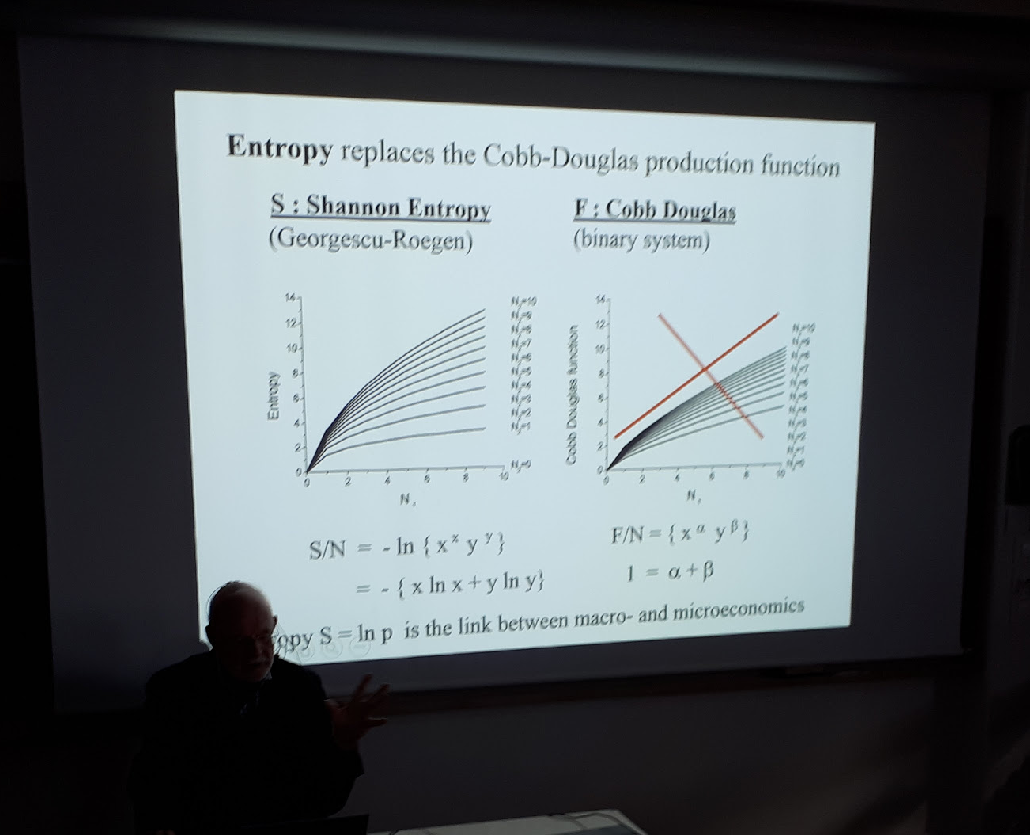
School of Physics in Les Houches, France, March 2018. Juergen Miknes shows some of the concepts that he has developed in his parallel analysis of thermodynamics and economics. It is a remarkable synthesis that you can find described in detail here. In the slide above, he suggests to replace the Cobb-Douglas function, commonly used in economics, with a function based on the concept of Shannon's entropy.

I am not sure of a number of things in Miknes' work, in particular the idea of equating (in some ways at least) the growth of entropy with the growth of production. Nevertheless, it is a fascinating work.

Something that surprised me (but probably I shouldn't have been surprised) was how strongly Miknes was challenged by an economist in the audience. Apparently, economists don't like their field invaded by those pesky physicists. So far, economists have been able to keep physics away from their secluded garden and continue keeping the field open only to people with the right credentials (according to them). For how long, it is all to be seen.


Friday, October 13, 2017

A Seneca transition for the human mind? My third presentation in Paris


One more day in Paris, one more presentation. This one was given on Oct 12th, at the "Ecole Centrale d'Electronique" (ECE) for the members of the system dynamics group of the French Association of System Science ((http://www.afscet.asso.fr/)

This one was a rather technical presentation, starting with the concept of "Mind Sized" system dynamics models to describe the "Seneca Effect", all the way to show some recent results of world modeling obtained by the MEDEAS project.

Overall, most (although not all) the people working in system dynamics are perfectly aware of the situation and of the difficulties associated with the transition. Perhaps the most interesting comment was about the Seneca effect applied to the human mind. Would it be possible, someone said, that an abrupt Seneca transition would affect human minds and somehow force them to take reality into account? It is another way to express the concept, common among the concerned, that at some moment some truly big event will force people to accept the reality of climate change (and of other related, occurring disasters).

Indeed, some people recently pushed the connection between hurricanes and climate change trying to move people into recognizing the existence of climate change. But it doesn't seem to have produced a noticeable effect on the public perception of the problem.

Maybe, someday, some really big event - a truly enormous one - will generate the needed mental transition, but it will not be easy. In my answer to the comment, I noted several cases, for instance the American whaling industry in the 19th century, where the operators went through the complete destruction of the system they were exploiting without ever realizing (or at least admitting) what they were doing. According to this example, the human civilization might be very well destroyed by climate change without realizing (or at least admitting) the existence of the problem. But so is the way humans behave.


H/t Didier Cumenal for organizing this seminar


Wednesday, October 11, 2017

My first presentation on the energy transition in Paris: is it a problem or a change?


My first presentation in Paris, yesterday, one of at least four that I am planning to give here (busy times!!). It was at the Ecole National Superieure (ENS) and it was centered on the Energy Transition, as part of a seminar involving several presentations.

Overall, I'd say that all the presentations were good with some very competent speakers. The problem that I have in these debates/seminar is always the same. People tend to think of the transition in terms of a problem. And if it is a problem, it means it has a solution (or maybe not). But if the transition is a change, then it is not a question of solutions, you cannot solve a change, you can only adapt to a change.

So, many pretended "solutions" are ways to oppose change, one that was proposed at the seminar was to exchange all tungsten filament bulbs with LED lights. Fine, it will allow us to save a lot of energy. But the change is deeper and it goes at the heart of everything we do in this society. We need to think systemic, not problem-specific. It is not just question of changing our light bulbs, it is a complete ecosystemic change.

And so we continue. Change continues to occur, too.

(h/t Daniel Moulin, image courtesy Camille Olinet)

Monday, August 7, 2017

Our Photovoltaic Future: The Metabolic Revolutions of the Earth's History.


Illustration from the recent paper by Olivia Judson on "Nature Ecology & Evolution (2017) "The Energy Expansions of Evolution". 


Olivia Judson published a very interesting paper this March on "Nature Ecology & Evolution". It is a wonderful cavalcade along 4 billion years of the history of the Earth, seeing it in terms of five "metabolic revolutions." It is an approach that goes in parallel with a paper that I wrote last year on BERQ; even though I focussed on the future rather than on the past. But my paper was very much along the same lines, noting how some of some of the major discontinuities in the Earth's geological record are caused by metabolic changes. That is, the Earth's changes as the life inhabiting it "learns" how to exploit the potential gradients offered by the environment: geochemical energy at the very beginning and, later on, solar energy.

Seen in these terms, the Earth system is a gigantic autocatalytic reaction that was ignited some four billion years ago, when the planet became cool enough to have liquid water on its surface. Since then, it has been flaring in a slow-motion explosion that has been going faster and faster for billions of years, until it is literally engulfing the whole planet, sending offshoots to other planets of the solar system and even outside it.

Judson correctly identifies the ability to control fire as the latest feature of this ongoing explosion. Fire is a characteristic ability of human beings and can be argued that it is the defining feature of the latest time subdivision of the planet's history: the Anthropocene.

Judson stops with fire, calling it "a source of energy" and proposing that "The technology of fire may also, perhaps, mark an inflection point for the Solar System and beyond. Spacecraft from Earth may, intentionally or not, take Earthly life to other celestial objects." Here, I think the paper goes somewhat astray. Calling fire a "source" of energy is not wrong, but we need to distinguish whether we intend fire as the combustion of wood, that humans have been using for more than a million years, and the combustion of fossil hydrocarbons, used only during the past few centuries. There is a big difference: wood fires could never take humans to contemplate the idea of expanding beyond their planetary boundaries. But fossil energy could fuel this expansion at most for a few centuries and this big fire is already on its way to exhaustion. If the Anthropocene is to be based on fossil fuels, it is destined to fade away rather rapidly.

Does this mean that we have reached the peak of the great metabolic cycle of planet Earth? Not necessarily so. Judson seems to miss in her paper that the next metabolic revolution has already started: it is called photovoltaic conversion and it is a way to transform solar energy into an electric potential, coupled with the capability of controlling the motion of electrons in solid state conductors. It is a big step beyond fire and thermal machinery (*). It is, by all means, a new form of metabolism (**) and it is generating a new ecology of silicon-based life-forms, as I discussed in a previous post that I titled "Five Billion Years of Photovoltaic Energy". 

So, we are living in interesting times, something that we could take as a curse. But it is not a choice that we are facing: we are entering a new era, not necessarily a good thing for humans, but most likely an unavoidable change; whether we like it or not may be of little importance. It is a new discontinuity in the billion years long history of planet Earth that will lead to an increased capability of capturing and dissipating the energy coming from the sun.

The great chemical reaction is still flaring up and its expansion is going to take us somewhere far away, even though, at present, we can't say where. 


A new lifeform, just appeared in the Earth's ecosystem:


(*) The Jews have been arguing for about a century whether electricity has to be considered a form of fire and therefore prohibited during the Sabbath. It is surely an interesting theological discussion, but for what we are considering here there is no doubt that fire (a hot plasma ignited in air) is not the same as electricity (controlled movement of electrons in solids)

(**) The supporters of nuclear energy may argue that the next metabolic revolution should be seen as the production of energy from nuclear fission or fusion. The problem is that the resources of fissionable material in the whole solar system are too small that they could hardly fuel a truly new geological epoch. As for fusion, we haven't found a technology able to control it in such a way to make it an earth-based source of energy and it may very well be that such a technology doesn't exist. But, on the sun, fusion works very well, so why bother?


Wednesday, November 16, 2016

Trump: on the way to "Scenario 3" and the end of globalization


Margarita Mediavilla and her coworkers have performed extensive simulations of the future using system dynamics models, (see here). One of their scenarios, called "Scenario 3," is based on the hypothesis of a return to national competition, protectionism, deglobalization, and the like. In comparison to other scenarios, Scenario 3 is the least expensive in terms of the energy required, but also the most environmentally damaging. And, with Trump's election, it seems that we are heading exactly in that direction. What else would you have expected? (UB)

 By Margarita Mediavilla
The victory of Donald Trump, as well as so many things that have been happening in recent years (the rise of the extreme right wing in Europe, the fall of Asian trade, the Brexit, the war in Syria and Yemen), shows that we are following the path of what we called Scenario 3. It could not be in a different way since our “scenarios” were narratives that we used to glimpse the future, and the energy told us that Scenario 3 was the most realistic one.

Scenarios are a quite common tool used by the United Nations and other international agencies to look at the future of humanity, they are used to group their reflections around coherent visions. We call Scenario 3 one of these archetypal visions that create the international agencies1 and we used in our studies that compare the available fossil fuels subject to peak oil with the expected demand of energy2.

Scenario 3 describes a future of regional competition and return to national sovereignty. It assumes that regions will focus more on their self-reliance, national sovereignty, and regional identity, leading to tensions between regions and/or cultures. Countries will be concerned with security and protection, emphasizing primarily regional markets (protectionism, deglobalization) and paying little attention to common goods, international environmental agreements, and cooperation for development. Scenario 3 describes a future of deglobalization and conflict, it and is, to a large extent, Trump's conservative discourse.

Other scenarios, such as Scenario 1, talk about economic optimism and high growth. The humanity is focused on achieving competitive markets and free trade that would, eventually, benefit everyone by correcting social inequalities and environmental problems. Scenario 1 is the scenario of globalization. There is also a Scenario 2, the one of green capitalism, a friendly version of Scenario 1, which gives priority to protecting the environment and reducing inequality, using technological advances, dematerialization, and the economy of services and information.

There is a fourth scenario at stake,Scenario 4, which consists of a friendly version of Scenario 3. In Scenario 4 there is a major change in values: society reacts against nonsense consumerism and disrespect for life. Citizens and countries decide to assume their responsibilities by being a green example for the rest. Although barriers to trade of goods are rebuilt, barriers to information tend to be eliminated. The emphasis is on finding regional solutions to social and environmental problems, usually by combining drastic changes in lifestyles with decentralized governance styles. Scenario 4 is the ecologist scenario, the one of local autonomy, cooperation and open-source, the closest to the utopias of the Degrowth movement.

The problem is that Scenarios 1 and 2 require a lot of energy, while Scenario is the one that needs less energy because it has less trade and less economic growth. Scenario 4 is also a low energy one. The bad news is that Scenario 3 is blind to environmental problems and leads to the war for resources because there is no lifestyle change towards an austere society based on renewable energy. Only Scenario 4 could be a minimally sustainable one because is the only one that invests in the energy of the future and does not grow a lot.

Trump's victory, like so many other things, shows us that the business as usual options are no longer what we used to call business as usual. We can no longer choose between neoliberal globalization or a slightly more social globalization of sustainable development. In a world where the energy is getting more and more difficult to obtain those scenarios that minimize energy consumption are the ones that have more probabilities of becoming true. Now the only possible options are Scenario 3 (neocons, right-wing) or those that could arise from Scenario 4 (anti-consumerist movements and ecosocialism).


The traditional political left parties should wake up and stop pursuing futures that resemble Scenario 2 and seek a slightly more friendly or greener globalization. Only the political options that are well aware of the planet's ecological limits can be a solid discourse against neoconservatives. In this moment we need to develop a political alternative based on anti-consumerist values, on the defense of the land and on the values of cooperation. Only this alternative can compensate self-destructive neoconservative tendencies that lead us to a dangerous competition for the resources in a planet that is going on a trend of constant ecological degradation.


Margarita Mediavilla teaches at  the School of Industrial Engineering of the University of Valladolid and belongs to the research group of Energy, Economy and System Dynamics (GEEDS) She is also engaged in the EU research project MEDEAS dedicated to modeling the energy transition in Europe.


1 Van Vuuren, D.P., Kok, M.T.J., Girod, B., Lucas, P.L., de Vries, B., 2012. Scenarios in Global Environmental Assessments: Key characteristics and lessons for future use. Global Environmental Change 22, 884–895. doi:10.1016/j.gloenvcha.2012.06.001
2 Capellán-Pérez I, Mediavilla M, de Castro C, et al (2014a) Fossil fuel depletion and socio-economic scenarios: An integrated approach. Energy 77:641–666. doi: 10.1016/j.energy.2014.09.063

Thursday, September 15, 2016

The Sower's way: the path for the future


Our paper on "The Sower's Way" has been published in the IOP Environmental Research Letters journal. It is an attempt to quantify the physical limits of the energy transition from fossils to renewables.

The title of the article takes inspiration from a strategy well known to ancient farmers, the fact that they had to save something from their current harvest for the next one; it is the origin of the common saying "don't eat your seed corn!"

Starting from this ancient wisdom, we performed a quantitative calculation of how much "seed" we need in the form of fossil fuels in order to have enough energy to build a new "harvest" of renewable energy that can replace the old one. All that without emitting so much CO2 that we would go over the 2°C limit and without anyone being left out. 

Of course, it is a calculation that depends on a lot of debatable parameters, but we did our best to remain within realistic consideration, without asking for technological miracles or drastic reductions in the human population. We just assumed current technologies and that the population curve would follow the UN projections. At the same time, we recognize that perpetual growth is a dream that only madmen or economists can think as possible. We assumed that humankind would gradually move toward a stabilization of the economy and of the population on a level of per capita energy sufficient to survive. 

It is possible, here are the main results from the paper


You can see how we assume a rapid growth of renewable energy, built up in the beginning using fossil energy but, in the later stages of the transition relying on renewable energy to continue the process, while phasing out the fossil fuels which are completely abandoned by around 2060. In this scenario, emissions do not go over the COP21 limit.

So, our calculations don't confirm the pessimistic assumptions of those who see humankind as doomed. At the same time, we don't confirm the overoptimistic assumptions of some people who see the transition as easy. It will not be. If we want it, we have to pay a high price for it and to start paying right now. We need to step up investments in a new energy infrastructure of at least an order of magnitude. Not easy, considering the state of the debate, but not impossible, either. It is a big challenge, but there is still a chance for a better future for everyone if we want to take it.

The paper is open access on IOP Environmental Research Letters. Comments on this blog are welcome. 


Saturday, January 10, 2015

The Great Transition: toward the end of growth


"The Great Transition", a recent book by Mauro Bonaiuti; an economist, presently teaching at the University of Torino, in Italy. With this book, he tackles several themes well known to those who study the interplay of resource depletion, pollution, and economic growth (and de-growth). Among these, the effects of overpopulation, decline in EROEI, environmental degradation and more. He adds, however, the economist's point of view in examining how the economy of a post-growth society could be organized. The book has been extensively reviewed by Nafeez Ahmed. Here are some excerpts from  Ahmed's article; you can read the whole text on "Motherboard"


The End of Endless Growth: Part 1


Written by Nafeez Ahmed

 
....

Some argue that even as the economy descends into madness, the seeds of hope are being planted. Even as global crises are accelerating—encompassing the risk of climate catastrophe, energy instability, and many others in addition to economic breakdown—a range of interconnected systemic revolutions are converging in a way that could facilitate a positive transformation of the global economy: from one that maximizes material accumulation for the few, to one that caters for the needs and well being of all.
That’s the conclusion of a major new book published as part of the Routledge Studies in Ecological Economics series, The Great Transition, by Mauro Bonaiuti, an economist at the University of Turin in Italy. Bonaiuti’s book applies the tools of complexity science to diagnose the real dynamic and implications of the global economic crisis that most visibly erupted in 2008.

That crisis, Bonaiuti argues, is a symptom of a longer “passage of civilization.” Advanced capitalist societies are in a “phase of declining returns” measured across the period after the Second World War, including GDP growth, energy return on investment (how much energy is put in compared to what we get out), and manufacturing productivity, among others.
Bonaiuti’s graph of GDP growth rate in Europe from 1961 to 2011, illustrating a fluctuating but consistent long decline.

....
For Bonaiuti, the declining returns are a consequence of the “the interaction between limitations of a biophysical nature (the exhaustion of resources, global warming, etc.) and the increasing complexity of social structures (bureaucratisation, the reduction in the productivity of innovation and in the educational, health and productive systems, etc.).”
....
Civilization is thus undergoing a huge, momentous phase shift as the current form of global predatory capitalism crumbles beneath the weight of its own mounting unsustainability. As this process unfolds, it simultaneously opens up a range of scenarios for new forms of society, within which there is an opportunity for “a great transition towards new institutional forms” that could include greater “democratic self-government of communities and their territories.”
Despite the very real  disru​ptions this phase shift entails, many of which have been explored in depth here at Motherboard (the unprecedented spate of global unrest being a major example), the Italian economist is cautiously optimistic about the potential long-term outcomes.

“When the framework changes, as the sciences of complexity teach us, there will be other forms of economic and social organization more suited to the new situation,” Bonaiuti wrote. “In particular, in a context of global crisis, or even stagnant growth, cooperation among decentralized, smaller scale economic organisations, will offer greater chances of success. These organizations can lead the system towards conditions of ecological sustainability, more social equity and, by involving citizens and territories, even increase the level of democracy.”

.....
If Bonauiti is right, then even as conventional economic tools turn out to be increasingly impotent, we should expect to see more and more signs of this changing framework, and with it, the emergence of potential new forms of economic and social organization that work far better than the old industrial paradigm we take for granted.

And that’s exactly what’s happening.

.....

That’s not to say any of this will happen in a simplistic, easy-peasy manner. Bonauiti identifies four potential scenarios for the future, and one of them involves “collapse”—which somewhat speaks for itself. Those who benefit from the old paradigm are likely to resist the most. Quite literally, the future of our species and the planet will be defined by the entirely unpredictable way people everywhere might respond to the reality of change, whether through resistance, disbelief, apathy, engagement, adaption, or action.

So welcome to 2015: a year when our choices could determine the future of the planet.

Who

Ugo Bardi is a member of the Club of Rome, faculty member of the University of Florence, and the author of "Extracted" (Chelsea Green 2014), "The Seneca Effect" (Springer 2017), and Before the Collapse (Springer 2019)