Monday, October 9, 2023

Cassandra is Dead. Long Live Cassandra!

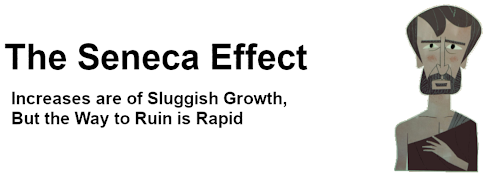
After the fall of Troy, Cassandra was taken as Agamemnon's "pallake" (concubine) and taken to Mycenae, where she was killed by Clytemnestra, Agamemnon's wife. The destiny of prophetesses is never so bright, especially when they turn out to have been right. Something similar, although fortunately much less tragic, happened to my Cassandra blog, censored on Facebook by the powers that be. So, it is time to call it quits. But Cassandra is not dead! She reincarnated in the form of the Roman philosopher Lucius Annaeus Seneca. Click on the image below to link to the new blog "The Seneca Effect" on Substack. 


On March 2, 2011, I started the blog that I titled "Cassandra's Legacy." 10 years later, the blog had accumulated 974 posts, 332 followers, and more than 5 million visualizations (5289.929). Recently, the blog had stabilized at around 2,000-3,000 views per day. It is now moving to a different site with a different title: "The Seneca Effect"

The reasons for this move are not because I wanted to. I was forced to change. Cassandra was a small blog, by all means, but I always had the sensation that it was not without an impact on the nebulous constellation of the people, high up, whom we call "the powers that be" (the PTBs).

It is a story that reminds me of the legend that George W. Bush decided to invade Iraq in 2003 after he had learned about peak oil from something written by people belonging to ASPO (the Association for the Study of Peak Oil). Apparently, he was impressed by the concept of "peak oil," so much that he decided to invade Iraq to secure the oil reserves there. 

Reasonably, it can't be but a legend, but are we sure? After all, the people who make decisions are not smarter than us, just richer. And they can misunderstand things just like we all do. Of course, their blunders make much more noise.  

And so, it may well be that many things that we see around us have a logic. Certainly, it is past the time when a certain kind of message could be eliminated simply by ignoring it. Now, it has to be actively suppressed. That is what's happening with censorship rampant on social media. Even the Cassandra blog, even though not important in itself, attracted the wrath of the powers that be. It was censored on Facebook, and it is also kept nearly invisible in search engines. As I discussed in a previous post on Cassandra, we knew it would happen, and it did. 

Of course, this blog could survive even while boycotted by Facebook, but when you discover you are in the crosshairs of someone big and powerful, it is better to duck down and take cover. It makes little sense to insist on keeping an indefensible position. It is time for Cassandra to fold. 

But this is not a defeat. It is a badge of honor that the PTBs noticed this blog and acted against it (O.K., maybe it was just a glitch of some complicated AI program, who knows?). In any case, closing the blog means recognizing that the memetic war follows the standard rules of war. It is all about movement. And that's what Cassandra is doing. It is moving. We all do. The only things that never move are the dead, and we are still alive! And "Cassandra's Legacy" will remain online, although it won't be updated anymore.

So, I moved to a blog with a different title, called, "The Seneca Effect". It was also targeted by the powers that be and it had to move away from the blogger platform. Right now, it found refuge on Substack. We'll see how it fares there!


And now, no more shall my prophecy peer forth from behind a veil

like a new-wedded bride

But it will rush upon me clear as a fresh wind 

blowing against the sun's uprising so as to dash against its rays, 

like a wave, a woe far mightier than mine. 

No more by riddles will I instruct you. 

And bear me witness, as, running close behind, 

I scent the track of crimes done long ago. 

For from this roof never departs a choir chanting in unison, 

but singing no harmonious tune; 

for it tells of no good.

Aeschilus, Agamemnon


Friday, August 11, 2023

Margherita Sarfatti: the Woman Who Destroyed Mussolini

A ghostly image of Margherita Sarfatti (1880-1961), a remarkably interesting Italian intellectual, known mostly because she was the lover of the Duce, Benito Mussolini, at the beginning of his career. She might have been much more than just a lover, and she may have played an important part both in Mussolini's successes and in his eventual downfall. Margherita Sarfatti makes a cameo appearance in my novel "The Etruscan Quest" and, here, I expand my interpretation of her role in history by proposing that she may have been one of the causes, perhaps the main one, of the doom of her former lover. Of course, I cannot prove this interpretation, but I can at least say that it cannot be disproven, either. As for many things in history, truth is now with the ghosts who lived the events that we read about. So, why not try to ask them?

Italian Version


Ah.... sorry, Ugo, I didn't want to scare you.

No... no, I am not scared. Just a little surprised. Who are you? 

Don't you recognize me? I know that I am all white and a little transparent, but maybe you can.

Hmmm.... not sure. Did we ever meet before?

In a way, yes. I am a character in your novel, "The Etruscan Quest" Actually, not just a character. But I do appear in your story.

Now that I look at you, well, maybe yes.  You look like... a lot like.... a portrait I saw. Are you Margherita Sarfatti?

Yes! That was very good, Ugo!  

Well, as I said, I am surprised, but I do recognize you. It is a pleasure to meet you, Donna Margherita. 

You don't have to call me 'Donna Margherita.' Just Margherita is fine. Where I am now, certain things are not important.

I imagine not. But I hope you were not displeased by what I wrote about you in my book.

Not displeased, Ugo. I liked what you wrote. So, I thought I could pay you a visit.

Ah... thanks, Margherita. It was a pleasure to write about you. Although, of course, it was just a cameo role in my novel. 

I know. Yes, but it was nice of you. You wrote good things about me. Though, I think you were missing something. 

Mmm.... maybe I understand. But I didn't know if I had the right answer to the questions I had. 

Well, now you can ask me. Wouldn't you?

Yes, it is a remarkable chance. Even though I guess you are just a mental projection of mine. 

Maybe. Or maybe I am a real ghost; how can you tell?

Whatever you are, Margherita, there is this nagging question that I have had in mind for a long time. And I think I can ask you about it. What happened to Mussolini that made him change so much in the 1930s? I mean, from a shrewd leader to a stumbling boor? How did he get involved in this mad idea of rebuilding the Roman Empire? 

And, Ugo, if you are asking me, I think you believe I have the answer, right?

Well, yes. After all, you were placed in a position where you could know things nobody else knew. The lover of the Duce; you had access to the highest ranks of the government. And you were even received by President Roosevelt in 1934..... 

But if I am just a projection of your mind.....

You are teasing me, Margherita. 

Ah, sorry, Ugo. Well, after all, it doesn't matter if I am a ghost or just part of your mind. You never know what the boundaries of one's mind are. And in Hades, we may know things that living people can't know. So, let me see if I can answer your question. For that, I have to start from the beginning. And, please understand that this story is still painful for me. So far, I never told it completely to anyone. 

It is an honor, Margherita. I appreciate it. 

Thanks, Ugo. I know that you do. So, you know that I was Mussolini’s mistress for more than 20 years; from when he was an unknown journalist up to when he became the "Duce degli Italiani". He changed so much in those 20 years. And then he dumped me for a younger woman. I think it was in 1932 that he met her, Claretta Petacci was her name. See? Even as a ghost, you can be upset. That is why ghosts are said to howl in desolate places, clank chains, and things like that. I am not doing anything like that, but if I remember this story.... well. Think about how many things I did for Benito. I found money for him, invented slogans for him, taught him how to deal with powerful people, even table manners. And do you know who invented the term "Duce"?

But wasn't it invented by Gabriele D'Annunzio? 

Yes, D'Annunzio used it. But the idea that Benito should use it as a title was mine. And it was so successful! Incredibly so. By the 1930s, everyone was using it in Italy. And that was bad for several reasons. Anyhow, let me go back to your question. Yes, Mussolini was a shrew leader when he became Prime Minister in 1922. Everything he touched seemed to be a success. And then, everything changed. But to explain how it happened, I must tell you a few things about earlier times. First of all, do you know that Mussolini was a shill for the British Secret Service?

It is known. Historians agree that he was paid by the British as a propagandist to push Italy into the war against the Central Empires.

Yes, he did. And have you ever wondered why the British came to choose him?

Good point, Margherita. I hadn't thought about this. 

Well, you should have. The story is that in 1912 I met Benito for the first time when he was the director of the "Popolo d'Italia." He was a fascinating man; he had an inner force; unusual. I have to tell you that I fell in love with him. Desperately in love, it happens. But I also thought that all that force could be directed to something useful. So, in 1914, when the Services contacted me....

The British Secret Service? But why you, Margherita?

Shouldn't it be obvious? Don't you know that I can speak five languages?

Yes, I knew that, but....

My family. They were international bankers, industrialists, traders... We had connections everywhere. And you also know that we were a Jewish family. 

I knew that, too. 

Well, so, no surprise that I had many connections. In business, and also in politics. So, you could say that I was a shill for the British, too. But don't misunderstand me. I am Italian; I did what I did because I thought that it could help Italy -- but also Britain. Britain and Italy were sister countries at that time. I saw nothing wrong with helping the British get a little help from Italy in their fight against Germany. And so I told them of this young journalist, a smart man, a person who could help them.

I see.... this is not written in the history books. 

Of course not. But if you ask yourself the right questions, you can find good answers. Benito spoke no English; he wasn't known at all outside Italy. He was, by all means, a small player in the great game. There had to be a good reason why the Services looked for him. 

And that was you, Margherita. I am amazed, but it sounds true. 

Indeed, Ugo, indeed. Benito accepted to work for the British. He did that for the money, but it was also a shrewd decision for him. He knew that he could use the support of the Services to make a political career in Italy. Shrewd and lucky at the same time. You know that he was drafted into the army in 1915, right?

I know, yes. He wrote a diary of his experience in the war. 

The army treated him as a useful asset -- they didn't want him to die. So, they sent him to a quiet area of the front. But it was still dangerous, and he was lucky enough that he was wounded by an Italian gun that exploded near him. It gave him the fame of a war hero. Shrewd and lucky, as I said. 

Yes. Lucky, but only up to a certain point. 

Ah, in life, it is not such a good thing to be lucky. If you are, you arrive to think that you deserve to be lucky.... and that's what happened to Benito. But let me go in order. You know what happened after the war was over, right?

Of course I know. The years of civil strife, then the March on Rome. Mussolini taking power....

Yes. And the Services played a role in that, too. Obviously, they didn't want Italy to fall into the hands of the Bolsheviks, and they didn't want it to collapse again into statelets. We arrived close to that. So, they helped Benito to take over. It was part of my task, too. You know, my family was rich, but still I needed money. And the Services were not stingy. They understood that Benito badly needed me to set up his plan.

You won't find that written in the history books. 

No, of course not. But there are many things not written in history books that are true, nevertheless. But let me continue. The March on Rome was a success; the King of Italy made Benito Prime Minister, then he gradually gained more and more power. Things were going well. Italy was recovering from the disaster of the Great War, the economy was expanding, the civil strife had disappeared, and many good things were done by the Fascist government. Yes, they had not been light-handed when they took power, but it could have been much worse. I had no official position in the government, but as the Duce's lover, I had a lot of influence in many things. And I could indulge in my passion: art. I was collecting artwork, setting up a coterie of top-level artists; I could say that life for me was fine in the best of words, or almost so. And I was still in love with Benito. Yet, I could see that something was not so well. Dark clouds at the horizon, if I am to use the imagery I read in your novel. 

Oh... sure, in my novel, there is a discussion on the haruspices being able to interpret the signs in the sky. 

Yes. I could say that I was seeing ominous signs in the sky. At some point, I started thinking that there was something wrong with the whole story. Simply said, Benito was gathering too much power. There was this idea that "Mussolini is Always Right" -- it started as a joke, but then people started believing in it for real. And then there were the elections of 1929, where there was only one party you could vote for, and there was a "yes" already printed on the ballot. No wonder the Fascists won with more than 99% of the votes. But that wasn't the way to go. It was a dangerous road, too much power in the hands of a single person. I tried to tell Benito, but he won't listen to me. By this time, he was already changing. He had always been.... how to say, "strong-willed," maybe. By then, he was simply stubborn and believing only in himself. 

The way he is often described....

He had not always been like that, Ugo. But yes, things were going down a slippery road. In parallel, there was that odious man, Adolf Hitler, who was taking power in Germany. And the British were starting to understand that, with Mussolini, they had created a golem that they couldn't control anymore. Do you know the story of the Golem, right?

Of course. The monster created by the Rabbi of Prague. 

So it is. When people have power, they tend to create monsters that they can't control. Maybe I had that power when I created the Duce...

Margherita, I do think you did that with good intentions....

.... and the road to hell is paved with good intentions. Anyway, let me continue with the story. In 1932, I turned 50, and I discovered that I had become too old for Benito. He was three years younger than me. He met that woman, Clara Petacci, and he wasn't interested in me any longer. But that wasn't the worst thing. I was losing him -- sometimes he was still listening to me, but mostly he would just do what he wanted. Any idiocy that came to his mind was immediately hailed by his coterie as a great strategic insight. And he was fascinated by that other golem in Germany, Hitler. At that time, I met my contacts in the Services, and they told me about their plan. Just like the Rabbi of Prague destroyed his golem, the British had concocted a plan to destroy the golem called Benito Mussolini. 

Ah... Margherita, that sounds fascinating. And what was the plan?

It was simple, but well thought out. These people, you could say that they were evil, but you can't say they are not smart. So, they started with the fact that Italy had a small colony in the Horn of Africa, Somalia; they had conquered it in the 19th century. But the region also had a British colony and a French one. And the only African land that was not in European hands, Ethiopia, was right there, at the border with Somalia. It was still ruled by the king of kings, the Negus Neghesti. Italy had tried, once, to expand in Ethiopia, but they had been defeated at the battle of Adua, back in 1886.

I know this story. I guess the Italians wanted revenge for that defeat, right?

Yes, there was this idea of getting revenge, but it wasn't considered an important thing. Ethiopia had never been part of the propaganda baggage of the Fascist party. Benito barely knew it existed, and he had never mentioned the story of Adua in his writings. It was something dormant. I would call it a dormant evil. But the British had focused on that. I think they specialize in evil. See, the idea was to convince Benito to seek revenge for the defeat of Adua. 

And how would that be useful to them?

Simple, as I said. The idea was to push the Duce to attack Ethiopia. And for that, he would have had to assemble a large force: men, equipment, and resources committed to a remote land. Then, of course, the Ethiopians would resist, and Italy would be forced to commit even more resources to the task. And, while the fight was going on, the British would intervene with a naval blockade. They could do that easily; the British rule the waves, don't they? No way for the Italian navy to contest that. And, without the possibility of resupplying the army in Ethiopia, the Italians would have had to surrender. Maybe the British would have graciously intervened to save the poor Italians from being exterminated by the angry Ethiopians. And that was the basic idea: the Duce would lose face; then, he would have had to resign. Job done.

The Perfidious Albion; as they say about Britain. 

Indeed, perfidious. But that's the way they operate. There is a reason why Britain has been ruling the waves for so long. There are things I know that you can know only from this side.... But I think it is better if I don't tell you. Anyway, let me continue with this story. I thought the plan was elegant. It implied some bloodshed, of course, but it might have prevented a much worse disaster later on. So, I enthusiastically accepted to cooperate. And you may ask now who had this idea of the new Roman Empire that would be created by the conquest of Ethiopia. 

I can guess that, Margherita.....

Yes. I concocted this absurd idea that Italy could rebuild the Roman Empire by conquering a country that had never been part of the Roman Empire. I thought of it mostly as a joke, but people believed it! It was all over the place.  Everyone was saying that, and everyone was convinced of that. You have that thing you call "Ngrams," don't you? 

We have that. I am surprised that you know about that, Margherita.

Why surprised? We ghost know a lot of things. But never mind that. You can use Ngrams to see how certain ideas penetrate the public consciousness. And if you look up the word "Ethiopia," you'll see how it picked up interest all of a sudden around 1932. At my time, I didn't need Ngrams. I was one of the sources of this propaganda operation and I could see how things were moving. I had the Italian secret service passing to me their reports. They were going to the Duce, too, but he wouldn't read them, and if he did, he didn't care so much. But I did. The idea of attacking Ethiopia truly exploded with the public. You have a term for this kind of thing, right?

Yes, we call them "psyops." 

That is a nice term. We didn't have it, but we knew how to set certain things in motion. I was not the only one working at that, of course. The British government did a good job by signing a memorandum of understanding with the Italians, where they said that if Italy attacked Ethiopia, Britain wouldn't move a finger to help the Ethiopians. The Perfidious Albion, indeed. Anyway, I do think I played a role in convincing Benito that conquering Ethiopia was a good idea. I even hinted that he could become the new Roman Emperor. 'Benito Caesar,' or something like that. And I think he believed me! How silly men can be! I wrote a lot of propaganda to favor the intervention; you can still find what I wrote. You have this thing you call "The Web."

Yes, Margherita. I read something you wrote about Ethiopia. I commented by saying that it was the best piece of propaganda ever written. 

That was kind of you. 

No.... you were really great. Although I would say....

.... a little evil, maybe?

I wouldn't say exactly that, but....

Ah... Ugo, I am ashamed of some of the things I wrote. But I did believe that I was acting for a good purpose. Anyway, I was heavily engaged in this propaganda operation. In a sense, it was fun: these things get you engrossed. I even went to meet President Roosevelt in 1934. You may have wondered how it was that he received me as if I were a head of state, even though I had no official role in the Italian Government. It was because of the plan. In 1934, it was in full swing, and Roosevelt wanted to know about it from me. Not that I was the only source of information for him. But he asked me a lot of things, and I understood that there were things that I had not been told about the plan. Much darker things than what I knew. But Roosevelt didn't tell me much. I was dismissed, and I went back to Italy. I went to see Benito, and he was suspicious about me, about the British, about the Americans, about everyone. It was a critical moment... 

Maybe you could have told him about the plan?

Sure: the perfect way to have me shot by a firing squad as a traitoress. But I could have done that if I thought he would have believed me. But, no. He has already arrived at the stage where he would believe only the things he wanted to believe. I found that my propaganda operation had gone so well that it had affected him, too. He was convinced that Italy could become an Empire again by conquering Ethiopia. Fully convinced. He had swallowed that, as they say in Britain, "lock, stock, and barrel." In a sense, it was a success for me. But it was one of those successes that count as defeats. That day, I saw myself as a relic. Whatever I had done was done; from then on, there was nothing anymore I could do. I remember I left Benito's Palace, "Palazzo Venezia," thinking I would never set foot there again. And I didn't. I came to know that he had instructed the guards at the entrance to deny me entrance if I were to appear. 

Again, Margherita, a fascinating story. But the plan didn't work as it was supposed to work, right?

No, it worked exactly the way it was supposed to work. Just not the way I was told it would. In 1935, Italy attacked Ethiopia, and the war started. I was expecting -- hoping -- that the British navy would start the blockade, but I knew that the plan was more devilish than that. The British did nothing to help the Ethiopians, but they enacted economic sanctions against Italy. It had no effect on the war, but it was as if they wanted Italians to get mad at them. And they succeeded at that: The Italians were raving mad at the British. You should have been there to understand. 

I read something about that, yes. 

Then, Ethiopia surrendered in 1936, and the king of Italy became "Emperor of Ethiopia," and no one found that silly. It was an incredible success for Benito. He was loved, adored, nearly worshipped. People really believed that Italy had become an Empire again. And that Italians were going to trash those decadent plutocracies of Northern Europe, including their Jewish masters. 

It was hard on you, right?

Yes, even though I had converted to Christianity, I was still considered a Jew. Even by Benito himself. You know what he wrote about me? That I was smelling bad because I was a Jewess.... that kind of man, he was. 

I am sorry about that, Margherita. 

You don't have to be sorry, Ugo. It is the way things went. Anyway, the naval blockade of Ethiopia was still part of the plan; it was just postponed. It was enacted in 1941, after  Italy declared war on France and Britain. And things went as planned. Italy had 250,000 troops in Ethiopia, they couldn't be resupplied from the mainland. They soon surrendered; what else could they have done? An easy victory for the British, and a terrible loss for Italy. Those troops could have changed how the war went if they had been available in Europe. 

So, it was a plan.... I hadn't thought about that, but it makes a lot of sense. It was a truly devilish plan by the Perfidious Albion.

Yes, you see, they didn't just want to get rid of Mussolini. They wanted to destroy him and make sure that Italy was thoroughly destroyed, too. No more a threat to the British Empire. It worked incredibly well. Of course, it was possible only because Benito was so dumb. But it was not just him. You see, propaganda is a beast that's nearly impossible to control. You sell dreams to people, and people become enamored with their dreams. And every attempt to wake them up fails or, worse, makes them angry at you. 

I know. You risked your life in 1938.

Yes, it was very hard for me. With the racial laws, I was targeted directly as a Jew. Fortunately, I could run away from Italy fast enough. And you may wonder how I could do that.

Your friends in the British Secret Service, right?

Yes. They helped me run away to France and from there to Argentina. They gave me a pension, and the agreement was that I shouldn't tell anything to anyone about the plan. The Italians agreed that that was the best way to get rid of me. Better than a bullet into my head -- it could have raised suspicions. And it was fine for me, too. Even if I had told the story of the plan, who would have believed me? I can do that only now, when I am a ghost. I was lucky, most of the Italian Jews were not so lucky. My sister Nella was deported to Auschwitz in Germany, and she was killed there. 

I am sorry about that. But can I ask you a question, Margherita?

Of course, you can.

Did you really believe in what you were doing, Margherita? I mean, propaganda? Or was it because you were....

.... paid?

Yes, I mean, I don't want to offend you, but....

Let me answer you with another question, Ugo. I know that your career was as a scientist, right?

Right. 

And you were paid to be a scientist, right? 

Of course, yes. 

But you believed in science, right?

I still do, Margherita..... Even though....

I understand. I know something about what's happening in your world. Yes, and I am sorry for the people like you who believed in science and were so badly betrayed by it. It was the same for me with Benito and the Fascist party. But, in the beginning, I believed in him. I deeply believed that Italy needed a man like him. How things change! He changed so much. It was as if a cancer devoured him from the inside. Yet, something of the old Benito remained. And, in a way, I can understand how that woman, Petacci, loved him to the point of following him to the end. A sad story; she didn't have to. I am sorry for her. But so things are. Sooner or later, everyone ends up where I am, in Hades. 

Yes, you know, Margherita. I was wondering. It is not often that I see ghosts... are you some kind of....

You make me laugh, Ugo. No, I am not a psychopomp. I am not announcing your death!

Ah... that's nice to know! 

I am happy to see that you are relieved! Anyway, it was a pleasure to speak with you. I understand that you are writing another novel, right?

Yes, it is about Mata Hari. 

Oh, such a nice woman. I met her a few times here in Hades. 

The way you say it, it seems that Hades is a nice place. 

Not really, You'll find it boring, I think. 

Well, so things are, I guess. 

So things are. And have nice writing, Ugo. Maybe Mata Hari will come to visit you as a ghost, too. Let me disappear the way ghosts know how to do.......

______________________________________________________________________


Ugo Bardi's novel, "The Etruscan Quest," was published in 2023 by "Lu::Ce Edizioni". The story told in the novel takes place during the time of Fascism in Italy, and it touches many of the elements of madness that overcame the country at that time. Margherita Sarfatti, a real historical figure, makes a cameo appearance in the novel. 


Here is Sarfatti's text that I described as "The Best Piece of Propaganda Ever Written"

More details about the Italian adventure in Ethiopia can be found in this post and this one

This post was in part inspired by a conversation with Anastassia Makarieva


Wednesday, June 28, 2023

Are Mercenary Armies Evil? From Malatesta Baglioni to Evgeny Prighozyn:


During the siege of Florence in 1530, Michelangelo Buonarroti was actively fighting with the Florentine army. When the city fell, someone hid him in a secret room under the Santo Spirito Church. It is not open to the public, but I had a chance to visit it a few years ago. It is impressive to see the trapdoor built nearly 500 years ago still perfectly functioning. And when you walk into the secret room, you can see Michelangelo's drawings on the walls; the sensation is that he had left just a few days before. If these drawings still exist, and also other masterpieces by Michelangelo, is a merit of the "Condottiere" Malatesta Baglioni, who avoided a bloodshed by forcing Florence to surrender.


During the War of the League of Cognac (1526-1530), the condottiere Malatesta Baglioni was hired by the Florentine Republic to defend the city against the Imperial Army. In 1530, he switched sides. He ordered to turn the cannons of his army against his employers and to open the doors of the city to the besiegers. It was a quick fall for the Florentine Republic that, from that moment, ceased to exist. 

It was a typical behavior of mercenary armies, one of the reasons why they have bad fame from the time of Machiavelli's "The Prince." (1517). Machiavelli didn't see the siege of Florence in 1530 (he died in 1527), but what he wrote was prophetic. 
"Mercenaries and auxiliaries are useless and dangerous, and any ruler who relies on them to defend his state will be insecure and in peril ... Why? Because they have no affection for you, and no reason to go to battle except the small wages you pay them, and those aren’t enough to make them willing to die for you! 
Correct, but wait one moment. Does that mean that mercenary armies are an evil to be stamped out from the surface of the Earth? If we look at the details, Malatesta Baglioni switching sides in 1530 was not so much a betrayal as a masterpiece of diplomacy. It came one week after the main army of the Florentine Republic was decisively defeated by the Imperials. At that point, the war was over, Florence had lost. And Baglioni acted in consequence. He avoided further bloodshed and, among other things, if you can still see the city of Florence in its full Renaissance glory, it is because the agreements that led to the surrender in 1530 were honored by all the parties involved. The city was not sacked, and the citizens' lives were spared. 

Not that mercenaries won't occasionally engage in sacking cities and massacring civilians (there are a few examples in history) but if you can pay them to fight, you can also pay them to stop fighting. That's unlike the behavior of soldiers of national armies, often motivated by propaganda to hate their enemies. They will often fight to the end, which is bad for them and for everyone. 

So, let's try to compare the actions of Malatesta Baglioni with those of a much more recent mercenary condottiere, Yevgeny Prighozyn, and his "Wagner" troops in Russia. There is a clear similarity between Baglioni turning his cannons against Florence and Prighozyn directing his tanks against Moscow. In both cases, we have a mercenary captain betraying his employers. 

Baglioni acted on the perception that the Florentine Republic was already defeated, and he was correct. The Florentines didn't attempt to resist, choosing instead the path of least damage. Prighozyn may have acted on the basis of a similar perception, but he was completely wrong. We may speculate that he was banking on promises that he would be helped by forces inside or outside Russia. Maybe he expected a major Ukraine offensive, or an uprising in Moscow, or he simply was handsomely paid to do what he did. We'll never know for sure who pushed Prighozyn to rebel but, whoever they were, they betrayed him and left him and his soldiers alone against a much more powerful enemy: the whole Russian army. 

The interesting part of this story is how the attempted uprising was relatively bloodless. Prighozyn's men found themselves facing annihilation a few hundred miles from Moscow. Even if their boss hadn't told them to turn tail, they would have surrendered. That must have been clear to the Moscow authorities, too, and they didn't try to annihilate the mercenary column. They have better uses for a few thousand trained soldiers than exterminating them. The whole story ended, if not satisfactorily, at least without bloodshed. 

This is the good thing about mercenary armies. They are, in a sense, a step in the direction of purely robotic armies which will be the only ones fighting in the future. Robots don't fight for glory or for "the country;" they fight because they are programmed to fight. And their programmers probably think and behave like the "condottieri" of mercenary armies: they care mostly for money. War is never a good thing, but if it can be a little less bloody, it is at least an improvement. 


Friday, June 23, 2023

The Lucky Demons that Rule us. Why Pay to Risk Your Life?


The acrylic plexiglass dome of a modern submersible is a technological marvel, but it is also extremely dangerous. A small crack, and it is gone. 

 
In his "The World Until Yesterday" (2012), Jared Diamond tells how he seriously risked his life having boarded a boat that sunk, managed by an incompetent crew. It is a story that resonates with the recent case of the wreck of the Titan submersible and its passengers. How could it be that they had accepted to embark on such a risky enterprise? And paying a lot of money for it, too. It can only be explained by considerations about how the mind of rich and powerful people works.

In Diamond's book, you can find a fascinating discussion of how traditional societies deal with risk. Diamond makes a convincing argument that our ancestors, just like people living in modern traditional societies, were much more careful, even paranoid, in comparison with most of us. He tells us how his Papua friends spent an inordinate amount of time discussing whether a broken twig was the result of someone having been there before or just an effect of the wind. It is paranoia, yes, but if they reasoned in that way, it had to be because that attitude helped their ancestors to survive. 

Now, think of our society. It is true that we encourage risk-taking and that it has a certain logic. Risks are risks, but the rewards you can reap in our world are enormously larger than anything a person living in a tribal society could hope to obtain. By acting crazy, you may become the local big man, maybe, but the rewards are not so large: there is no money to accumulate in a small village 

But, in our world, rewards can be enormous if you are enormously lucky. Think of Benito Mussolini: an elementary school teacher with political ambitions. When he was wounded by the explosion of an artillery piece in his own trench, it was a double stroke of luck for him. Not only he survived, but he also avoided being caught in the rout of the Italian army after the defeat of Kobarid. Actually, it was a triple stroke of luck because he gained the fame of a war hero due to his light wounds. After the war, he set up a political party, and he launched his followers marching on Rome. They could have been crushed by the Italian army, and Mussolini himself was ready to escape to Switzerland. But the King of Italy refused to give the order, and then Mussolini became the absolute ruler of Italy for more than 20 years. He was also lucky enough that some of his initial military adventures were successful. It is true that eventually, his luck ran out, but from a genetic viewpoint, Mussolini was hugely successful. Some sources say he had at least 11 illegitimate children plus five legitimate ones.

It is not just a question of having been lucky once. Mussolini came to think that his luck was not just a random event but a feature of his life. You can read about this attitude in the diary that Mussolini's son-in-law kept. He really thought he was infallible and even immortal. Late in his career, Mussolini thought he could get away with murder -- actually with genocide. He did, until he didn't anymore. 

There are other cases of rulers who interpreted their luck as a manifestation of supernatural benevolence toward them by the almighty powers. Hitler was one. He barely survived the trenches of WWI, and it is said that he thought he was immortal. Until he discovered he wasn't. Probably, Saddam Hussein reasoned in the same way when he launched the ill-fated attack on Kuwait in 1991.

The case of the four rich passengers who boarded the Titan submarine in 2023 is probably similar. They may have been thinking they were immortal, enough to make them engage in this reckless idea. Apart from the human tragedy of their death, the point this story raises is that they may well be representative of the elites ruling us today. They are reckless and convinced to be always right and even immortal. It is a deadly combination for people who control enormously powerful weapons: from nuclear warheads to propaganda. Deadly for them, but not just for them. 


Cassandra: singing no harmonious tune; for it tells of no good


And now, no more shall my prophecy peer forth from behind a veil
like a new-wedded bride
But it will rush upon me clear as a fresh wind 
blowing against the sun's uprising so as to dash against its rays, 
like a wave, a woe far mightier than mine. 
No more by riddles will I instruct you. 
And bear me witness, as, running close behind, 
I scent the track of crimes done long ago. 
For from this roof never departs a choir chanting in unison, 
but singing no harmonious tune; 
for it tells of no good.

Aeschilus, Agamemnon

Monday, March 22, 2021

Ugo Bardi's Latest Post on "The Seneca Effect". The Hydrogen Myth


Ugo Bardi's latest post on "The Seneca Effect"

The Hydrogen Myth: Technology and Religion in the Decline of Civilizations


I just started a new blog titled "The Hydrogen Skeptics." It is about the hydrogen economy and hydrogen as a fuel and it is a little technical as a subject. So I thought it was not appropriate to discuss it in a somewhat philosophical blog like "The Seneca Effect." Yet, there are points in common, as I am arguing in this post. Above: the nuclear-powered car "Ford Nucleon", unfortunate technological prodigy of the 1950s, that never was turned into anything practical.


Friday, February 12, 2021

Cassandra has Moved


Professor Sabine Hossenfelder engages in a performance about Cassandra. Nice song, well sung, and it catches something of Cassandra's story and character. Although I am reasonably sure that Cassandra would not wear that kind of clothes. 


Cassandra's blog is closed. It will remain on line, but it will not be updated anymore. Ugo Bardi has moved to a new site called "The Seneca Effect."  It may be a bit more philosophical than the old Cassandra blog, but it will not be very different. 

You may also follow Ugo Bardi at "The Proud Holobionts" blog, a more optimistic blog dedicated to -- you guess to what! -- holobionts! A new concept that favors collaboration over competition in the evolution of the biosphere. 

And don't forget Ugo Bardis' musings about history and myths at the Chimera blog, with some fictional interpretations of Cassandra's story: An Interview with Cassandra  and "The True Story of the Fall of Troy"

Finally, if you like to hear Ugo Bardi rather than reading what he writes, you can find his youtube channel. It is still al little experimental, but it may grow to something interesting in the future. 

Thank you to all those who followed this blog for nearly ten years. It was a pleasure, but things keep moving and we have to move, too!

UB


Monday, February 1, 2021

Censorship: How the West is becoming more and more like the old Soviet Union


A message I received from Facebook on Jan 29, 2021. Five of my posts were deemed "spam" and erased. Some were somewhat "political" although non-partisan, but two were purely technical. That these posts were erased is an indication that censorship is by now applied to all forms of dissent, not just political ones. It was not unexpected, but it was still somewhat shocking after decades of propaganda that had convinced most of us that the Western world was a place where you could enjoy "freedom of expression." But we are quickly moving toward a Soviet-style management of public information, as Dmitry Orlov noted already in 2013. It had to happen and it did.


Last year, a Spanish climatologist, a friend of mine, had his Facebook page erased. Apparently, it was because it was deemed as too "catastrophistic" (or for whatever reason had caused the opaque fact-checkers of Facebook to take it as a target). He protested and he also tried to convince other climatologists to start a boycott of Facebook. 

The answer was a little disappointing, to say the least. It may be best described as a resounding worldwide "meh." Those climatologists who bothered to reply to him expressed the concept that, yes, censorship is bad, but, you know, you can't allow deniers to diffuse their fake science around. 

It was on that occasion that I discovered that most people like censorship. It is just that it should be applied to those they disagree with. In that case, they actually love it and protest because Facebook doesn't censor enough (you can read that, for instance, here).

The problem with censorship is that it is a little like playing the apprentice sorcerer: once you start the mechanism, you don't know how to stop it. What's happening now is that censorship is becoming widespread, wide-ranging, and pervasive. Everyone can be affected and it takes unexpected forms. I was surprised when Facebook decided to erase two rather technical posts of mine, apparently because they were critical of the concept of a hydrogen-based economy. Apparently, censoring doesn't just apply to political dissent. Any dissent is now considered bad

Of course, Facebook is not the government, but it would be silly to dismiss the whole story by saying "it is a private company." Facebook has now almost 3 billion users, close to half of the world's population. No other entity in the world -- governments included --has such a reach over so many people. Do governments have any power on Facebook? Or does Facebook own the governments?

It was expected, we knew that it was coming. Already in 2009, Dmitry Orlov had noted in his book "Reinventing Collapse" how the Soviet and the American Empires had been moving along parallel tracks, with the American Empire poised for collapse just a few decades after the Soviet one. In a later book, "The Five Stages of Collapse" (2013), Orlov described the mechanisms of censorship in the Soviet Union and discussed many remarkably prescient concepts on how electronic surveillance in the West would dwarf anything that the old and clumsy Soviet system could do to spy their citizens. 

And so, there we are. Covering the whole story of the Soviet censorship would be very interesting exercise that not even Orlov attempted in his books. I can't claim to be an expert in these matters (*), but let me just note that censorship in Russia was a nuanced story, not just a clumsy dictatorship dictating to people what they had to believe. In part, yes, censorship was imposed by the government but, in part, it was also enforced "from below." Russian newspapers often carried comments by the "korrespondents" (Корреспондент), people who were not professional journalists. They seem to have had a certain leeway in criticizing the government, of course only as long as they didn't express doubts about the founding myths that kept the state together. They were similar to our commenters on newspapers and social media who have a list of no-no's that's probably as long as they had. The Soviet Union had an efficient trolling system that could demolish a dissenter, just like our trolls can. (the story of how Boris Pasternak was demonized for his "Doctor Zhivago" novel is a good example of the mechanism)

Overall, it is clear that censorship is developed by societies under stress to try to keep the social fabric together as much as possible. If you think that Russia had been invaded 4 times by powerful Western armies over less than two centuries, you can also understand that the fear of the West was not paranoia, but a reasonable attitude for Russians. And many of them preferred to support a bad government rather than risking that the US would bring democracy to them by the usual methods.

About the West, nowadays, I don't think we need to note how stressed we are. And, as a result, we are clearly heading in the direction of a Soviet-style management of public information. Is it unavoidable? Most likely yes. It is a desperate, last-ditch effort to keep together a political system that's rapidly crumbling away, but which is doomed in the long run (perhaps even in the short run). But it is probably unavoidable: we'll have to live with censorship because it is the simplest way to try to stop the forces that lead to the disintegration of society.

So, what should we expect for the future? The analogy with the Soviet Union holds only up to a certain point. In Soviet times there was no Internet, or it was in its infancy. The new communication technologies are disrupting everything, as we saw in the recent "Gamestop" story (see this interesting discussion by Chuck Pezeshky) and we may well be moving toward some completely different information exchange system that, for the time being, remains difficult for us to understand. Maybe it would be something like the glasnost (transparency), that Mikhail Gorbachev introduced in the Soviet Union in 1986. But glasnost didn't prevent (and perhaps eased) the collapse of the Union. Eventually, if collapse has to come, it comes.


Additional note: A commenter defined this post as a simplistic way to cry, "but free speech!" I understand his point, but that was not what I wanted to say. By comparing the US with the old Soviet Union in terms of censorship, I noted that the experience of the Soviet Union can tell us a lot on what is in store for us in the future. They did suppress dissent rather efficiently. But the result was a rigid society that eventually crashed very quickly. It is always the same story: The Seneca Effect. The more you try to stave off collapse, the faster it is when it arrives. 


(*) Russians and people from other areas formerly being part of the Soviet Union are welcome to correct my interpretation of censorship on the other side of what once was called the "Iron Curtain." I did my best to inform myself, but I never lived there.


Friday, January 29, 2021

The Sacrifice of the Sacred King


"In antiquity this sylvan landscape was the scene of a strange and recurring tragedy. On the northern shore of the lake, right under the precipitous cliffs on which the modern village of Nemi is perched, stood the sacred grove and sanctuary of Diana Nemorensis, or Diana of the Wood. ..  In this sacred grove there grew a certain tree round which at any time of the day, and probably far into the night, a grim figure might be seen to prowl. In his hand he carried a drawn sword, and he kept peering warily about him as if at every instant he expected to be set upon by an enemy. He was a priest and a murderer; and the man for whom he looked was sooner or later to murder him and hold the priesthood in his stead. Such was the rule of the sanctuary. A candidate for the priesthood could only succeed to office by slaying the priest, and having slain him, he retained office till he was himself slain by a stronger or a craftier."

From "The Golden Bough" - by James G. Frazer


Post by "Mon Seul Desir"

Hello Ugo 

You once asked, what was the meaning of Trump, it crossed my mind that without anybody’s planning or intentions, Trump became an immense collective scapegoating ritual where all the sins and impurities of the tribe are placed upon the king, who is then ceremonially driven out to purify the tribe. Since the 1960s this seems to have increasingly become the function of the American Presidency superseding its previous role which it has held since the days of George Washington, that of a near omnipotent God-Emperor who incarnates American collective power. It’s certainly corresponds to the sacred geometry of Washington DC, enclosed by its pomerium, the sacred regalias on display, the Temples to the Divine Emperors, the Axis Mundi rising through the centre of the Capitol’s rotunda. I personally visited the place a decade ago and was absolutely struck by the mystical religious layout of the place. It was effectively the centre of a secular City of God, destined to extend to, and redeem the entire world. I would say that Americanism is in fact the world’s dominant religious system, erecting its theocracy over the ruins of the British World Empire just as the theocracy of Diocletian Jovius was erected over the ruins of the Roman-Hellenistic Mediterranean Empire. 

Now I must point to the Ancients warnings against hubris and the prophecies of Christian mystics that the reign of God can only come with the return of Christ. When one pushes too hard against the Cosmos, it pushes back. Alexander declared himself greater than Hercules, he was assassinated, his family exterminated and Ptolemy Soter was one of the few of his Companions who lived to found a dynasty and die in his bed. 

 I think that when the history of the USA over the past century is written several generations from now, it will describe not the March of Progress towards the future, the description will be of an ever increasing surrender to hubris culminating in overreach and collapse. 

This is the consequence of giving the powers of an advanced culture to an archaic one, they see what they can do with the new powers, not what they shouldn’t do. The social structure is overwhelmed by the new powers, the effect is that of Dr Erskine’s Supersoldier Serum, what is good becomes better, what is bad, worse. 

Homeric society started out as heroic warrior communities ruled by chiefs and freemen’s councils, their cosmology was of Primordial Chaos forged into Order by the Will of the Gods, the earthly rulers were shades of the Gods, ordering the human community as the Gods ordered the Cosmos. As their knowledge advanced, they studied the Order imposed by the Gods, the regularities they shaped, the ordered structures, from this they developed basic mechanics, observations of nature and the skills to create ordered organizations of their own, the concepts of objective law and disciplined organizations led to basic state bureaucracy and when merged with the fury of the Iron Age warrior led to the Greek Phalanx and the Roman Legion. The Homeric kings who in the past had commanded a few thousands warriors who were the freemen of his kingdom became massively powerful monarchs who had armies of tens to hundreds of thousands supported by workshops and officials who could undertake campaigns for years and where bound to absolute obedience. They became the Incredible Hulk’s of the Ancient World capable of smashing through everything in their paths, the humanistic ethic of the original Homeric world was overwhelmed by a power system stronger than it, the exercise of power became increasingly arbitrary, society turned into a regime of slavery and terror, the lacks of ancient culture became evident, the lack of a deep sense of ethics, no real work ethic, the absence of culturally integrated large scale structures, even the rulers enjoyed no security, any courtier could be a possible assassin, simply eating lunch was a terrifying adventure, their own relatives couldn’t be trusted, the guards who protected them one day could butcher them the next... 

One sees this in Seneca who discussed the ethics of committing suicide under a despotism, of Boudicca who revolted and was massacred after she and her daughters were tortured by petty officials who had the power of life and death over even provincial aristocrats, the Gospels can be read as the testimony of common people living under the arbitrary will of the powerful. Boudicca could torture and kill any commoner under her power, imperial officials could do the same to her, the officials could be ordered by the Emperor to kill themselves on a whim and the Emperor themselves had to watch everyone... The Homeric values of personal freedom and dignity had lost any meaning and increasingly it became impossible to do science under the constraints of Hesiod’s metaphysics, the whole concept of a civilization ordered under its own collective will was dying. 

Ultimately this became unsustainable, the reaction came, the Christians stated power comes only from God, the Cosmos is not ordered by the Emperor or any God he represents, it was created by God as an intrinsically ordered structure, there no law of Man, only the law of God which Man can only discover and interpret, all this apparatus of temporal power is just the product of ambition and greed, there is no divine purpose here, a counterfeit of the true City of God. The theology of the Glory of Rome died, abandoned by a people that could not bear its weight anymore and just wanted to breathe freely. Deprived of the faith that sustained it, Rome collapsed under its weight its ruins to become spolia to its heirs who had turned to the City of God. 

Now Medieval Man stepped into the world with the certainty that it was God’s and that he had to live by His rules. Everything moved by His eternal laws, that could be understood and applied to both the human and natural realms. Rulers were as completely under God’s law as the beggar, a new institution was born, Medieval Kingship and Feudalism organized with the support of God’s Church, a massive body of law and customs was created to modulate, contain and control power, lord and vassal relationships, knighthood, the Estates, the Guilds, the Communes, ultimately reaching its fullest development in the great Medieval Courts like Versailles, war was codified into the sport of Kings instead of the genocidal total wars of the late Classical world. The much ridiculed Versailles functioned as a containment structure for power, the King could reign without ruling, he didn’t need to constantly torture and kill people to show he was in charge, he simply distributed perks and honours, he had great fringe benefits compared to a Classical ruler, greater personal comforts, minimal risks of assassination, eating his meals in peace, no worries about his guards, outside the palace a massive array of autonomous institutions ran the whole society without royal intervention, the king’s subjects lived in security and prosperity, the much maligned costs of Versailles were insignificant compared to the costs of despotism. The so-called Enlightenment pseudo philosophers could never have survived in Ancient Rome, they would have been lion food, in a 20th century tyranny it would have been concentration camps and bullets in the back of the head, they were in fact free because the containment structures of the Versailles system protected them, they thought France could be made into a better country if it was ruled by a Caesar, they got Napoleon who used up the wealth and manpower of France the way Alexander used up Macedon, people don’t realize what they have until they lose it... 

Now armed with the concept of God’s law, the development of philosophy took new directions first under the scholastics and then under the natural philosophers taking the development of science well beyond that of ancient world, a new Christian work ethic fostered the Guilds of free craftsman who took technology beyond that the classical era with the clock, navigation skills, new architecture and art and eventually an Italian named Volta but together the first electric battery, opening a new unsuspected realm to science, knowledge that would overturn the Medieval metaphysics and lead to the Quantum Realm and the world of Relativity. 

 By the 19th century the world saw the emergence of a new form of organization, Technocracy, to manage the new railways and telegraph system, the first components that would grow into the Technosphere and a schizophrenic type of Man, Medieval Man in family and public life and Technospheric Man at the railway station, telegraph office and engineering and science lab. 

The concept of regularity and intrinsic order in Homeric society lead to technologies and forms of organization that overwhelmed its ethics and social structure, the Roman Empire was a supersized Homeric chiefdom with the bureaucracy and military of King Philippe the Second but without the customs and institutions that restrained and stabilized his regime, before the power system Homeric society was completely helpless, only the replacement of its values by Medieval ones, accompanied by the collapse of the Roman system allowed the people to become free. 

Today Technospheric Man has carried out a similar revolution, Technocracy, Quantum Mechanics, Relativity, it’s technology, it’s conception of Man as taught by Freud and Jung, its achievements that have obliterated the old sense of limits, the Atomic bombs that can level mountains in minutes, the contraceptives that have removed immemorial fundamentals of the relations between the sexes, the medical advances, the communication systems and so much more. Today’s Western system is simply a collection of decayed Medieval courts surrounded by the modern equivalent of the Fuggers and Medecis in the corporate lobbyists attempting to use structures taken from Black Panther’s Wakanda and Doom’s Latveria to create some sort of City of God on Earth, they’re as completely overwhelmed as the Classical rulers were, they wanted absolute power, they have it and everything that goes with it, they’re afraid of each other and of the people they rule, they’re quickly finding that absolute power burns the hands that attempt to wield it. But do they even truly understand what they’re attempting to wield? Does their Medieval mentalities even contains the concepts and cognitive patterns that would allow them to understand? 

That the problems the world is facing are problems in managing the Technosphere, they’re not political and the accepted techniques of financial and legal manipulation don’t work, traditional assumptions are obsolete, essentially what is required is Apollo Mission Control style technocratic management. Do these skills even exist in the current elites? Or they will simply persist in enforcing superstitious rituals of purity and redemption? 

Today I point out the Internet, consider what the printing press did to the power of the Medieval Church, the first printed books came in 1455, 62 years later in 1517 Martin Luther posted his 95 theses and the rest is history. The Internet is the printing press on gamma rays, it’s Big, Mean and Green, consider that the properties of any substance is dependent on the nature of its bonding patterns whether its chemical or social bonds, the current system is dependent on vertical bonds converging on small groups of people, the Internet allows the creation of very large numbers of horizontal bonds across this structure, eventually sufficient to overwhelm the vertical structure and cause it to collapse. I don’t think their pathetic attempts at censorship will work anymore than burning printed tracts and heretics worked for the Church. Can the current governments even survive into the age of the Internet? 

Now this was a long one Ugo, when I start writing I’m never sure how it’s going to come out!

Monday, January 25, 2021

The Ghost Shirt Rituals: Preparing for the End of the World


Ishi, (c. 1861 –  1916), the last member of the Native American Yahi people, photographed as he was in 1911 when he came out of the woods in California. How did the Yahi react when they saw that the Whites were going to exterminate them? Perhaps not differently from the way we are reacting to the prospect of the collapse of our civilization: going crazy. The overreaction to the current Covid pandemic is just the first stage of the wave of madness that's engulfing humankind.


Imagine you are a Native American living before the arrival of the Whites. Maybe you are a Lakota, hunter of the central plains. Or maybe a Yahi, living in the thick forests of California. Or a member of any of the many Native American nations that existed back then. 

As a Native American, you have your family, your friends, your day-to-day routine of things and tasks. And you are busy with that, except for one thing: you know that there is a big problem. A VERY big problem. There is an entire nation, out there, bent on exterminating you and your people: the Whites. 

At first, you try to ignore the problem: those Whites are far away. Or maybe you'll deny that they are coming, or that they are so many as they are said to be. But, at some moment, the truth cannot be anymore ignored or denied. The Whites are there. They are coming for you, for your family, your children, your friends, your people. And you know that there is really no way to stop them. So, what do you do? 

You go crazy. And so does everyone. Suddenly, you are catapulted into a "new normal," a world where the routines of everyday life have disappeared. You are now into a sort of "heroic space" where you are supposed to go through mystic rituals that involve dancing yourself to a trance, wearing "ghost shirts" that are supposed to protect you from the Whites' bullets. Even more extreme dances, called "sun dances," involve hanging oneself to a pole with a rope with hooks at the end that pierce one's breast. That is supposed to make warriors braver in the coming fight

A contemporary representation of the "sun dance" involving people hanging themselves to poles with metal hooks stuck inside their breasts and other forms of self-inflicted tortures. This image was probably made to emphasize the "barbaric" aspect of these rituals, but it is true that the Native American society, under heavy stress, had developed these bloody self-punishing dances.

We don't know how exactly the Native Americans of those times saw these bloody rituals. Did they really believe that ghost shirts made them invulnerable? Did they really think that their problem was that their warriors were not brave enough and that to become braver they needed to hang themselves to poles by the breasts? We can't know, and we can't know if someone understood that it was way too late, that the Native American peoples should have acted much earlier to face the Whites as a united nation, instead of scattered tribes. But so moves the great wheel of history, mercilessly crushing everything and everyone when their time has come. After the massacre of Wounded Knee (1890), nobody could anymore think that ghost shirts were a solution.   

The Native Americans were not the only culture that went crazy when facing their own demise: Mon Seul Desir (see the text below) calls this phenomenon the "Indian Reservation Syndrome" and he lists other cases of societies gone into a frenzy of mysticism and rituals when they faced problems that they could not solve. One was the Nongqawuse cattle-killing cult in South Africa, another was the Boxer Rebellion in China (the latter also believed that their spiritual powers made them invulnerable to bullets). 

And then, of course, there is our civilization. We are facing a disaster even worse than anything the Native Americans ever faced: the collapse of the whole planetary ecosystem. And, like them, we are going crazy. 

You can see the ongoing craziness everywhere in its many forms, but the overreaction to the Covid-19 pandemic is perhaps the most pervasive, the most destructive, and the most misunderstood form of craziness that has hit us. The parallels with the rituals of the Native Americans are evident, with the role of the ghost shirts taken by the face masks as a visible garment signaling the beliefs of the wearer, and by vaccines as magic tools making people invulnerable to the enemy. 

The most evident parallel is how the current rituals include various forms of penance. Westerners are not hanging themselves by the breasts, but they undergo segregation, limitations to movement, loss of personal freedom, economic ruin, and more. The idea is to turn the whole story into an obsessive-compulsive ritual carried out with the same stoicism and indifference that Native Americans showed in their bloody rituals. 

It is part of the way the human mind works: when things go bad, the first reaction is to look for someone to blame. But, sometimes, when things go not just bad but truly rotten, then the culprit may turn out to be yourself. So, with the Covid pandemic, that's the reason for the general acceptance of rules and laws that, in other times, would have been unthinkable. It explains the demonization and the mistreatment of those who are the victims and not the perpetrators of what's happening: single human beings, treated as the one cause of the pandemic.

It was probably unavoidable. The Covid is not the real problem, we all know that. The problem is another: it lurks in the background, but it is there. No ghost shirt (and no vaccine) will send away the ecosystem collapse that we are facing


Note: What I wrote is not meant to disparage the Native Americans, nor their beliefs. The Sun Dance was a deeply felt ritual developed by people who were trying to cope with an impossible challenge and I am sure that they genuinely believed in what they were doing. I personally met some Lakota men who were still doing the dance and, years ago, even an Italian man who had converted to the rituals and was doing the dance, including the metal hooks stuck in his breast. These people deserve our respect for their courage and their dedication. About the current Covid rituals, I am sure that many people in the West genuinely believe that they are doing something good and useful by punishing themselves with masks, distancing, home segregation, and all the rest. But there are differences. One is that the Sun Dance was meant to unite the people, whereas the Covid rituals are explicitly meant to separate them. Also, the Sun Dance rituals originated from the people, while the Covid rituals, no matter how sincere are the believers, have been inflicted on the people, not developed by the people. 

_________________________________________________________________


The message from "Mon Seul Desir" that inspired this post

Hello Ugo,  

Thanks for the data, it confirms what I’ve was perceiving through feel and anecdotes, you’ve put hard numbers on it. It’s something I’ve been observing building up for a number of years, increasing drug use, alcoholism, and mental illness, I call it the Indian Reservation Syndrome, it’s the product of cultural collapse. I think you have heard of how primitive people can leave themselves to die when they lose their traditional way of life, it was hubris to say that this is confined to allegedly primitive tribes. Any culture can collapse when it comes into contact with a more advanced one. 

A couple of years ago I started having the feeling that collapse would start with massive mass psychoses, like the Nongqawuse cattle-killing cult, the Ghost dance, the Boxers, and the Cargo cults, I’ve been amazed by the Covid cult, it has turned into a collective obsessive-compulsive disorder, disconnected from any reality and resembling witchcraft and demonic possession hysteria, it has the common factor of having been embraced by the elites and much of the educated, with Mr. Fauci and Ferguson in the role of Herr Kramer and Sprenger. And it’s not isolated but part of a massive collective frenzy extending into every aspect of society. The processes that led to this, I’ll take up in a later message... 

Now for the Galla Placidia text, I see you as pointing to a non-linear transition, a complete change of state of the system, where the Homeric world gave way to the Medieval World, the City of God replacing the Glory of Rome. For this to occur implies that Medieval potentialities already existed in Late Rome, the collapse of the Empire allowed actualization of them. We are all chimeras, modernity is a chimera with a younger culture as a ghost in the shell of an older one. The Late Bronze Age had the Homeric world growing within itself, the Roman Empire had the Medieval world within and the modern West which is simply Medievalism in its late form has the Technospheric world growing within itself. 

How do you recognize the new culture? When its mythology emerges in a recognizable form, in pagan Rome the Gospels were regarded as crude tales for the credulous and uneducated, in the Bronze Age, Homer was probably seen as folklore for simple soldiers and sailors. I needed to find something similar, in December 2017 Me and my wife purchased movie tickets and sat down to watch Thor Ragnarok and I found it, Technospheric Mythology right in front of my eyes, it’s regarded as just entertainment for children, I thought about the utterly alien feel compared to movies from the 1950s like the 1959 Ben Hur movie. That earlier movie represents the Medieval Myth, you could show it to an audience from centuries ago and it would be fully comprehensible, but show Thor to even a 1959 audience and it would be surreal and insane, the motivations and morality of the characters would be mostly incomprehensible. 

I’ve seen the way many people react to it, it’s just special effects, it’s action, they can’t see why these movies are so popular. The Christian Myths are the Neoplatonic- Aristotlean weltanschauung turned into a narrative, the Marvel, DC, Inception and so on are the Relativistic-Quantum-Jungian weltanschauung similarity turned into narrative.

_____________________________________________________________

This is a moving and beautiful song by the Italian singer Fabrizio de Andre (1940, 1999) inspired by the massacre of Sand Creek of 1864 where some 700 Cheyenne and Arapaho people were killed, most of them women and children.


They took our hearts under a dark blanket
Si son presi il nostro cuore sotto una coperta scura

Under a small dead moon we slept without fear
Sotto una luna morta piccola dormivamo senza paura

He was a twenty year old general
Fu un generale di vent'anni

Blue eyes and the same jacket
Occhi turchini e giacca uguale

He was a twenty year old general
Fu un generale di vent'anni

Son of a storm
Figlio d'un temporale
 
There is a silver dollar at the bottom of Sand Creek.
C'è un dollaro d'argento sul fondo del Sand Creek.

Our warriors too far on the bison trail
I nostri guerrieri troppo lontani sulla pista del bisonte

And that distant music got louder and louder
E quella musica distante diventò sempre più forte

I closed my eyes three times
Chiusi gli occhi per tre volte

I found myself still there
Mi ritrovai ancora lì

I asked my grandfather. is it just a dream?
Chiesi a mio nonno è solo un sogno?

My grandfather said yes
Mio nonno disse sì
 
Sometimes the fish sing at the bottom of Sand Creek
A volte i pesci cantano sul fondo del Sand Creek

I dreamed so hard that my nose bleed
Sognai talmente forte che mi uscì il sangue dal naso

Lightning in one ear in the other heaven
Il lampo in un orecchio nell'altro il paradiso

The smallest tears
Le lacrime più piccole

The biggest tears
Le lacrime più grosse

When the snow tree
Quando l'albero della neve

Bloomed with red stars
Fiorì di stelle rosse
 
Now the children sleep in the Sand Creek bed
Ora i bambini dormono nel letto del Sand Creek

When the sun raised its head between the shoulders of the night
Quando il sole alzò la testa tra le spalle della notte

It was just dogs and smoke and upturned tents
C'erano solo cani e fumo e tende capovolte

I shot an arrow in the sky
Tirai una freccia in cielo

To make it breathe
Per farlo respirare

I shot an arrow in the wind
Tirai una freccia al vento

To make it bleed
Per farlo sanguinare
 
Look for the third arrow at the bottom of Sand Creek
La terza freccia cercala sul fondo del Sand Creek

They took our hearts under a dark blanket
Si son presi il nostro cuore sotto una coperta scura
.......

Who

Ugo Bardi is a member of the Club of Rome, faculty member of the University of Florence, and the author of "Extracted" (Chelsea Green 2014), "The Seneca Effect" (Springer 2017), and Before the Collapse (Springer 2019)