Showing posts with label russia. Show all posts

Wednesday, June 28, 2023

Are Mercenary Armies Evil? From Malatesta Baglioni to Evgeny Prighozyn:


During the siege of Florence in 1530, Michelangelo Buonarroti was actively fighting with the Florentine army. When the city fell, someone hid him in a secret room under the Santo Spirito Church. It is not open to the public, but I had a chance to visit it a few years ago. It is impressive to see the trapdoor built nearly 500 years ago still perfectly functioning. And when you walk into the secret room, you can see Michelangelo's drawings on the walls; the sensation is that he had left just a few days before. If these drawings still exist, and also other masterpieces by Michelangelo, is a merit of the "Condottiere" Malatesta Baglioni, who avoided a bloodshed by forcing Florence to surrender.


During the War of the League of Cognac (1526-1530), the condottiere Malatesta Baglioni was hired by the Florentine Republic to defend the city against the Imperial Army. In 1530, he switched sides. He ordered to turn the cannons of his army against his employers and to open the doors of the city to the besiegers. It was a quick fall for the Florentine Republic that, from that moment, ceased to exist. 

It was a typical behavior of mercenary armies, one of the reasons why they have bad fame from the time of Machiavelli's "The Prince." (1517). Machiavelli didn't see the siege of Florence in 1530 (he died in 1527), but what he wrote was prophetic. 
"Mercenaries and auxiliaries are useless and dangerous, and any ruler who relies on them to defend his state will be insecure and in peril ... Why? Because they have no affection for you, and no reason to go to battle except the small wages you pay them, and those aren’t enough to make them willing to die for you! 
Correct, but wait one moment. Does that mean that mercenary armies are an evil to be stamped out from the surface of the Earth? If we look at the details, Malatesta Baglioni switching sides in 1530 was not so much a betrayal as a masterpiece of diplomacy. It came one week after the main army of the Florentine Republic was decisively defeated by the Imperials. At that point, the war was over, Florence had lost. And Baglioni acted in consequence. He avoided further bloodshed and, among other things, if you can still see the city of Florence in its full Renaissance glory, it is because the agreements that led to the surrender in 1530 were honored by all the parties involved. The city was not sacked, and the citizens' lives were spared. 

Not that mercenaries won't occasionally engage in sacking cities and massacring civilians (there are a few examples in history) but if you can pay them to fight, you can also pay them to stop fighting. That's unlike the behavior of soldiers of national armies, often motivated by propaganda to hate their enemies. They will often fight to the end, which is bad for them and for everyone. 

So, let's try to compare the actions of Malatesta Baglioni with those of a much more recent mercenary condottiere, Yevgeny Prighozyn, and his "Wagner" troops in Russia. There is a clear similarity between Baglioni turning his cannons against Florence and Prighozyn directing his tanks against Moscow. In both cases, we have a mercenary captain betraying his employers. 

Baglioni acted on the perception that the Florentine Republic was already defeated, and he was correct. The Florentines didn't attempt to resist, choosing instead the path of least damage. Prighozyn may have acted on the basis of a similar perception, but he was completely wrong. We may speculate that he was banking on promises that he would be helped by forces inside or outside Russia. Maybe he expected a major Ukraine offensive, or an uprising in Moscow, or he simply was handsomely paid to do what he did. We'll never know for sure who pushed Prighozyn to rebel but, whoever they were, they betrayed him and left him and his soldiers alone against a much more powerful enemy: the whole Russian army. 

The interesting part of this story is how the attempted uprising was relatively bloodless. Prighozyn's men found themselves facing annihilation a few hundred miles from Moscow. Even if their boss hadn't told them to turn tail, they would have surrendered. That must have been clear to the Moscow authorities, too, and they didn't try to annihilate the mercenary column. They have better uses for a few thousand trained soldiers than exterminating them. The whole story ended, if not satisfactorily, at least without bloodshed. 

This is the good thing about mercenary armies. They are, in a sense, a step in the direction of purely robotic armies which will be the only ones fighting in the future. Robots don't fight for glory or for "the country;" they fight because they are programmed to fight. And their programmers probably think and behave like the "condottieri" of mercenary armies: they care mostly for money. War is never a good thing, but if it can be a little less bloody, it is at least an improvement. 


Sunday, September 13, 2020

Famines as Military Weapons: Is Europe in Danger?


 A Dutch girl photographed at the time of the "hongerwinter", the famine that hit The Netherlands in 1945, during WW2. 

In the West, we tend to think of famines as events of the remote past that will never return, a view typified by Steven Pinker in his 2011 book "The Better Angels of our Nature." This attitude is often accompanied by sneers at Paul Ehrlich who, in 1968, predicted extensive worldwide famines that were soon to occur. Even when famines are discussed as a real possibility, they are seen as affecting only those remote countries where hordes of dark-skinned or slant-eyed people already live in near-starvation conditions. 

We forgot how close in time was an age in which hunger was a fact of life and famines a common occurrence. The last important famine in Europe was in the Netherlands in 1946 -- that was less than a hundred years ago, not in the Middle Ages. Our lack of historical memory is the reason why we are not surprised to see books such as "One Billion Americans" by Matthew Yglesias, where the author happily neglects the problems involved with supplying food and energy to a U.S. population three times larger than it is nowadays. 

The real problem with assessing the possibility of future famines is that they are often man-made, that is actively created by human actions. Starving an enemy is a time-honored strategy that works beautifully. We have a detailed report of how it was put into practice by the Romans at the time of the Siege of Jerusalem of 70 AD, but it is surely much older than that. In recent times, the US secretary of state, Mike Pompeo, threatened Iran in 2018 by saying that they must listen to the U.S. 'If They Want Their People to Eat.'  Clearly, the temptation to starve another country into submission never completely disappeared and it may returning.

So, by looking at a not so remote past, we can dimly understand what is in store for us. Famines were a major weapon during world war 2, although historians have often preferred to concentrate their attention on conventional military events. Let's review that not so old story.

 
The Starving of Europe -- Famines as a Weapon during World War 2

There are still people alive in Europe who experienced the food shortages of WWII. Not everywhere there were people dying of starvation, but the food supply was an acute problem all over the European land. And, in some areas, people died in large numbers. Here are some data

The total toll listed in this table is about 15 million casualties. These famines were not just the result of overpopulation and the scarcity of supply. People starved because they were the targets of extermination programs carried out by governments.

The main area of Europe where famines struck is the Eastern one. It was also the theater of the largest confrontation of WW2: the German attack on the Soviet Union. Most historians agree that it was one of the greatest strategic mistakes in history and, surely, the Germans understood that they were taking a huge risk. Why did they decide to embark on this idea? One typical answer is that since Adolf Hitler was mad, stupid, and evil, everything he did was mad, stupid, and evil, too. But there may be much more than the madness of the person at the top that generated the disaster. The attack on the Soviet Union may not have been just a military miscalculation, but a desperate attempt to reverse a hopeless situation. Simply put, despite all their flamboyant military victories, the Germans were losing the war because they had no control on their food supply. 

It is a complex subject that had its origins in World War 1. Very early, during the war, the Allies had imposed a naval blockade on the Central Empires with the specific scope of starving the Germans and their allies. The effect was not immediate: at that time, Germany produced about 80% of the food it consumed, and the Germans thought they could survive by increasing the domestic production and relying on imports from Scandinavian countries and from Romania. In practice, the situation worsened gradually with German agriculture being badly affected by the lack of manpower and of fertilizers. 

One symptom of how bad things were was the situation in Belgium, where the lack of food soon became dramatic, Being occupied by the Germans, Belgium was subjected to the British naval blockade and could not import food. That led the US to step in, supplying food that was supposed to be only for the Belgians. But it is hard to think that the occupying forces wouldn't partake at least some of it. In the book Prolonging the Agony (2018), the authors, Docherty and Macgregor, maintain that the Americans knew very well that the food they were supplying to Belgium was feeding German soldiers, but the US industry was making such good profits from the war that they didn't want it to end too soon. This is mainly speculation, of course, but may have some elements of truth and it is surely an indication of how dramatic things were in Europe at the time. 

As WW1 went on, the blockade became more effective in starving the Germans and the Austrians. The number of casualties caused by the famine in these countries is variously estimated, but the numbers range from more than 700.000 to 400,000 persons dying of starvation in Germany alone. Probably, the Central Empires would have lost the war anyway, but it is also true that starved soldiers don't fight very well. Incidentally, the physical debilitation of Europeans during the last phases of the war was probably one of the reasons for the spreading of the "Spanish flu" that killed over 2 million people more in Europe. 

A result of the terrible experience of WW1 was that the Germans were acutely aware of their vulnerability to food shortages. On the eve of WW2, the situation was about the same as it had been during WW1, with the German agriculture able to provide no more than about 80% of the supply. There followed that an attack on Britain would lead to the same result as it did in 1914, a naval blockade and the consequent starvation of the Germans. That was one of the main reasons for the Molotov-Ribbentrop agreement, signed in 1939. The agreement is best known for the partitioning of Poland, but it also involved the supply of food and petroleum from Russia to Germany. Details on this part of the deal are reported by Edward Ericson in his "Feeding the German Eagle" (1999). Only by means of this food the Germans could think of engaging in an attack on France. As we know, it was successful and the next step for Germany was subduing Britain. 

As it happens with the best plans of mice and men, things went agley for Germany with their defeat in the Battle of Britain. In 1940, with the British navy still dominating the sea lanes and blocking the shipment of food to continental Europe, the Germans saw in front of them the specter of a new famine. It could be kept at bay only as long as the Soviets were willing to supply Germany with food. But it didn't take an especially trained strategic mind to understand that it was a risky position. What if the Soviets were to decide to ally with the British? 

Once the Germans started seeing themselves stuck in a hopeless situation, it made sense for them to try anything, no matter how desperate it was. That was the origin of der Hungerplan, one of the most evil ideas ever conceived by human minds. The plan was to occupy the grain-producing areas of Western Europe, mainly Ukraine, and divert all the production to Germany. The proposer of the plan knew very well that this would have led to the death by starvation of millions of people. The developer of the plan, Herbert Backe, noted a "surplus population" in Russia of about 20 to 30 million. Evil as evil can be but, about evil plans, something similar to the Backe plan had already been devised by the Italians in 1935, when they had planned to take over Ethiopia to gain "a place in the sun" (the equivalent of the German concept of lebensraum) for their population. Fortunately for the Ethiopians, Ethiopia was too far from Italy to be realistically seen as a source of food for Italians.

In the figure, you see the very face of evil: Herbert Backe (image from Wikipedia). It is remarkable how he looks like a harmless bureaucrat, maybe the way he saw himself. In any case, Backe injected some method in the folly that had overtaken the minds of the people in power in Germany. We tend to focus all our attention on Adolf Hitler, but he was not alone. Evil had been percolating down from the high levels of the German government, touching just about everyone. The "Unternehmen Barbarossa," (Operation Barbarossa) was a logical consequence of a certain way of seeing the strategic situation of Germany in 1941. If the Germans had succeeded in defeating the Soviet Union, then "Festung Europe" (Fortress Europe) was secure with the supply of food they would obtain from Eastern Europe.

In part, the Hungerplan succeeded: the Germans did take control of Ukraine and its grain-producing fields. Starvation did kill a large number of people living in Slavic countries. But the Soviet Union didn't surrender and the amount of food that could be shipped to Germany from Eastern Europe was limited. The result was an even more evil plan (evil does multiply!) involving the extermination of the "useless" people, those who couldn't be put to work at something useful for the war effort. That was the origin of the Jewish holocaust, but the Germans also exterminated large numbers of prisoners of war, of people judged racially inferior, and of their own citizens. The Dutch famine ("hongerwinter") of the latest phases of the war was also a consequence of the Germans concentrating all the food resources inside their own territory.

There was some method in this folly and, indeed, the Germans were successful in avoiding famines in their country. There are reports of food shortages in Germany during WWII, but not of victims of starvation. But that, of course, didn't save Germany from defeat and, afterward, the Germans experienced some of the treatment they had inflicted on their neighbors. Tens of thousands of German prisoners of war died of starvation or of diseases associated with malnutrition in Allied prisoner camps. Then, the "Morgenthau Plan," that the Allies had initially embraced, involved nothing less than the complete destruction of the German industry. As a consequence, Germany wouldn't have been able to import food from abroad and that would have resulted in the death of tens of millions of Germans. Fortunately for the Germans, the plan was soon abandoned and the Germans allowed to rebuild their country. But they had seriously risked being exterminated, just like they had planned to do with their neighbors. 

All that didn't happen during barbarian ages or in remote regions of the world: it happened in civilized Europe less than one century ago. Not so far away in time and space that you could feel safe that it won't happen again.


Europe nowadays: a risk of famines?

If you look at the data for the food import and export nowadays, you would be tempted to say that Europe is self-sufficient, it even has a certain surplus production. But that would be a dangerous delusion: it is just the result of the transformation of agriculture from a rural activity to an industrial one. In the process, the agricultural productivity was greatly increased in terms of production per unit area, but at the cost of making agriculture dependent on fossil fuels, just as many other industrial activities. And if Europe is not self-sufficient in terms of fossil fuels, it cannot be self-sufficient in terms of food supply.

Industrial agriculture can produce at the high yields of our times by means of the widespread availability of fertilizers, pesticides, and mechanization, all depending on the availability of fossil fuels. In addition, as I wrote in a previous post, the problem is not so much food production, but food supply. The latter requires processing, refrigeration, packaging, and more -- again, dependent on fossil fuels. All these are elements of a complex system that brings food from the fields to the plates of European citizens. Remove one of them, and the plates go empty. That says nothing about the problems that climate change and soil overexploitation are creating, but let's skip that. The situation is worrisome enough already.

Now you see what the problem is: all the elements of the food supply chain in Europe depend on the availability of energy, mostly in the form of liquid fuels. Remove the fuels and the system collapses, people starve and die. Now, think that Europe is highly dependent on imports for its energy: more than 50% on the average. Note also that the energy that Europe produces internally is mostly coal and nuclear, plus some solar and wind. It is mainly electrical energy, but agriculture, as it is nowadays, is based on fossil fuels. It would be possible to transform the agricultural processes in ways that would power it using electricity, but that would take time and money -- and nobody seems to be willing to invest in such an effort. Finally, consider that an important fraction, more than 30%, of the imported fossil fuels in Europe comes from Russia. Now you see that in many respects history repeats itself: the Molotov-Ribbentrop pact comes to mind.

Fortunately, Europe is not at war (so far), but its strategic position in terms of food supply is just as fragile as it was 80 years ago. The coronavirus crisis of 2020 gave us some idea of what can happen. For some days, the disruption caused by the virus caused people to storm supermarkets, often finding just empty shelves there. Fortunately, the food crisis seems to have been short-lived, but it was there and it is still having consequences. If Europe were to face a serious international crisis and its capabilities to import food and fuel were reduced, we would go back to 1945, with food having to be rationed, people going hungry, and probably dying.

From here on, it is not difficult to imagine apocalyptic scenarios. You know that Western European governments seem to feel an irresistible attraction toward attacking Russia (preferably in winter), to the point that they did that several times during the past few centuries. So, it is not inconceivable that they could decide to try again. Apart from the military results of such attacks, by now proverbial, the cost and the resulting economic disruption would probably guarantee a Dutch hongerwinter for all Europe.

An exercise in applied catastrophism can lead us to imagine various scenarios in which hundreds of millions of Europeans starve and die, but these are scarcely useful as planning instruments. We might instead wonder how famines could be avoided. Here, an interesting exercise is to compare the events that started in 1939 with those that took place some 70-80 years before, when Prussia embarked in a series of wars of conquest that culminated with defeating France at the battle of Sedan, in 1870. At that point, the European situation was not unlike that of 1939, with France defeated by Germany. But, after Sedan, the French and the Prussian governments agreed on a peace treaty. The prisoners of war were not exterminated, the leaders of the losing side were not hanged, there was no talk of exterminating or enslaving the untenmeschen -- the inferior races. Nothing like that.

What made 1870 a much smaller disaster than WW2? Probably not a single factor, but there was one fundamental difference: In 1870, the European population was less than half of what it is today and Europe was self-sufficient in terms of food production. The mother of all mistakes for Europeans came later: it was to raise the European population to levels that relied on imports for the food supply. One of the results was an ideological vision that saw the European nations engaged in a cutthroat competition for the lebensraum, the "vital space."  Once they got into this frame of mind, the logical conclusion for every state was to expand their population at the fastest possible speed, exterminating or enslaving everyone who didn't belong to the herrenvolk "master race."  

Today, with the European natality plummeting and the native European population imploding, the idea of conquering a lebensraum for Europeans seems to be a little outdated, to say the least. Nevertheless, the European population is still large and the problem of food supply remains. Maybe it will be possible to keep things under control and steer Europe toward a lower population and a self-sufficient energy supply based on renewables. But the future is coming fast, as it usually does, faster than you would like to see it arriving. And, as usual, the future is full of surprises.


A comment by Ugo Bardi's personal troll, Mr. Kunning-Druger

I see, professor, that the subject of extermination fascinates you. It must be because you belong to that group of fanatical anti-human ideologues who fashioned for themselves the name of "Club of Rome" and who had the extermination of mankind as one of their first stated purposes -- part of their ideological manifesto titled "The Limits to Growth". So, every post you publish, is a nail in the coffin of these obscure forces who work against us. We know who you are, and you'll be treated as you deserve. Did you mention "extermination?" Oh, yeah.....


Friday, May 8, 2020

No parade in Moscow this year, but the "ring of fire" around Russia remains


This year, we won't see the traditional victory parade in Moscow (Парад Победы в Москва) that normally takes place on May 9 (above, an extract of last year's parade). It is another effect of the COVID epidemics, but the parade will be probably held in September. It has too much political significance for Russia to be skipped: it is a reaction against the perception of being surrounded by hostile powers. And that may not be just a sensation but it may derive some substance by noting the "ring of fire" of NATO bases in Western Europe along the borders with Russia. Of course, on this side of the world, we can't imagine that these bases are there for purposes different than the defense of our freedom. But you, you may perhaps understand that, on the other side, there may be a certain feeling that it could be otherwise.  

So, the yearly parade in Moscow is a political and military message directed to the West. And for a better understanding of how things are perceived in Russia, I think I could propose to you a recent talk by the Russian filmmaker Karen Shakhnazarov on the meaning of the WWII memory in Russia.


Shakhnazarov makes several interesting points, often forgotten in the West. Comparing the forces involved, he notes how at the start of WWII the Soviet Union was outnumbered in terms of population and weaker in terms of industrial production. And not just that: the Soviet Union was surrounded in 1940 by a "ring of fire" of hostile powers. It was not only Germany, on the Western front. There was a "second front" in East Asia, where Japan was a hostile power, and the Soviet Union also needed to keep troops ready against a possible attack from Turkey, and even from Iran. So, he concludes that the decision of the German government to attack the Soviet Union in 1941 was not so reckless as it is often described. It was a risky gamble but, given the forces available, it could have paid. For a while, the destiny of the world was uncertain but, eventually, the balance swung decisively against Germany -- it was a close call, though.

The second world war just followed an established pattern. It was not the first time that practically the whole Western World had ganged up against Russia: it had already happened in 1812 (Napoleon's invasion), in 1853 (the "Crimean War"), and also at the end of WWI, when there was a moment in which Russia was invaded by Western armies, even by an American one, although this story is mostly forgotten in the West (but not in Russia). And, of course, the idea of surrounding Russia with a "ring of fire" is still alive and well today, as we all know. But why?

In the 1950s in Italy, we had a typical propaganda story that said that we should have feared that the Russian Cossacks would have brought their horses to drink at the holy fountains of St. Peter's cathedral, in Rome. That, of course, never happened, but the fear of Russian armies sweeping through Western Europe remains embedded in the way of thinking of Western European leaders and military planners. Just like the fear of Western Armies marching on Moscow remains embedded in the way of thinking of Russian leaders and military planners. There is nothing rational in this idea, but it is grounded in the way things are after centuries of struggles.

So, are we - Western and Eastern Europeans - destined to remain in fear of each other forever? Possibly not. History never repeats itself, although it often rhymes. Empires come and go, but there are things that last longer than empires. One is the backbone of Eurasia: the road that connects the Eastern and the Western part of the continent. It was once called the "silk road" and now it goes under the name of the "Belt and Road Initiative." It is a connection that has been existing for more than two millennia and that survived the vagaries of states, empires, and battles. It will survive more states, empires, and battles. One day, it will make the wars in Western Europe look like what they are: petty squabbles among statelets. It will take time, but history is never in a hurry.


Monday, July 29, 2019

The Brief Spring of Global Science: How Climate Science is Affected by Nationalism and Propaganda


The start screen of the "Climadrom" site, kept by Aleksander Zhabskiy. The site is strongly oriented toward rejecting the current scientific interpretation of climate change, labeled as "climate alarmism," "hysteria," and the like. This view seems to be fashionable in Russia in all sectors of society and, nowadays, Russian science seems to have rejected the current understanding of climate change as seen in the West. Yet, we must keep trying to bridge the gap: if people don't speak to each other, the only way they have to communicate is to fight. In this sense, the site by Mr. Zhabskiy has some merit in seeking for a discussion at the international level. I did present my views that he correctly published.


There was a time, during the 19th century, when Darwin's ideas on natural selection were rejected by the whole French science. One reason was the influence of Baron George Cuvier who had interpreted the geological record in terms of mass extinctions periodically caused by planetary catastrophes (see this link to know more about this fascinating story). French scientists saw Cuvier's role in nationalistic terms and thought that it was outrageous that their great master was contradicted by those silly Britons.

The concept of "National Science" was rather common throughout the 19th century and the first half of the 20th. Earlier on, scientists were still communicating with each other in Latin, but that was abandoned with the 19th century and that led to science being more and more constrained by national borders and national cultures. There are many examples of how this evolution affected the scientific debate: one is how the work by Alfred Wegener on continental drift was widely rejected in the 1950s in part because of anti-German sentiments in the West (a link). I could cite examples of how the Fascist government in Italy tried to purify Italian Science from foreign influences in the 1930s. Then, of course, there was "Soviet Science," supposedly different from the decadent capitalist science practiced in the plutocracies collectively known as "The West." An example is how the Ukrainian biologist Trofim Denisovich Lysenko fought Western Genetics.

But all that seemed to be past and gone with the internationalization of science after that the American legions had imposed English on the rest of the world, just as the Roman legions had imposed Latin long before. As a young researcher, in the 1980s, I perfectly understood that science was international: everyone, anywhere in the world, could be a scientist by accepting two fundamental tenets: publish in English and speak in English. International science was egalitarian, global, and suspicious of national borders. The researchers of my age even tended to mock the older generation of scientists because of their limited command of English. The fall of the Soviet Union, in 1991, seemed to give the final push to the full internationalization of science: there would be no more "Soviet Science." Just as the world's economy was being globalized, the same was taking place for science.

That was just a brief spring: today, nationalism is returning everywhere with a vengeance and science is not immune to the trend. I can tell you how the capability of my younger colleagues to speak English seems to be going down every year a little more and one of the shocks of my life was when, a few years ago, one of the students engaged in a laboratory exercise complained to me that the instruction manual of the instrument he was using was in English.

The downfall of English is just a personal impression but it seems clear to me. Some people in Italy seem to find it totally incomprehensible that I keep a blog in English. Actually, I don't know another example of an Italian scientist who keeps a blog in English, except for my coworker Ilaria Perissi. (If you know of other examples, please let me know!)

How about Climate Science? As it is normal, it is an international field that encompasses contributions from all countries with a significant budget in scientific research. But it seems to me that in Italy climate science is especially neglected. Don't get me wrong: there are several excellent climate scientists in Italy, but the average effort in the field is not impressive. Some evidence of the problem is a recent petition denying the anthropogenic origin of global warming, said to have been signed by 90 leading Italian scientists. Actually, the  "leading scientists" are a ragtag band of elderly scientists, scientists with no competence on climate, and people who are not even scientists -- some of them belonging to all three categories at the same time. Nevertheless, that such petition exists is a symptom of deep problems. Much worse was when, in 2015, the president of the Italian Society of Physics (!!) refused to sign a statement on climate science in support of the ongoing Paris negotiations.

So, what's the problem in Italy? Perhaps the same the French had with their Baron Cuvier. In Italy, we have Antonino Zichichi, an elderly particle physicist who has left a strong imprint in Italian physics and who, today well in his 90s, is still active in criticizing climate science in ways that we can define at least questionable. But it is also a question of science being intertwined with politics: the Italian movement called "sovranism" is clearly suspicious of climate science as a foreign scam.

And let's go to Russia. Judging from what can be read in the scientific literature in English, Russia may be in the same conditions as Italy in terms of neglect of climate science, perhaps even worse. With the best of good will, I couldn't locate much in terms of major contributions to climate science by Russian scientists working in Russia, with the work by Gorshkov and Makarieva being the main exception with their concept of the "biotic pump". I asked my colleagues if they could name a serious Russian climate scientist working in Russia and they couldn't. Maybe they are publishing in Russian?

I may be wrong if I say that Russia is neglecting climate science, but there is clearly a problem, there: a much larger one which has to do with politics. I must admit that, If I were a Russian citizen, I would find it hard to dismiss the idea that the whole story of anthropogenic global warming is just one more psyop coming from the West. The Western media are producing so much propaganda and so many lies that the temptation is to disbelieve anything that comes from a Western source. It is the destiny that befell the Moon landings, now widely disbelieved in the very country that was so proud of having sent men to the Moon not long ago. The same destiny may be affecting climate science: despite decades of efforts of thousands of excellent scientists, it tends to fall into the same category of government-sponsored propaganda. All this goes together with the locking up of science and scientists within national boundaries, something that may turn foreign scientists from colleagues into enemy agents and foreign science into political propaganda.

And now? Could we ever recover a unity in science allowing us to act together against climate change? Could we do that before it will be too late? For sure, at present, we are moving in the opposite direction. As usual, when people refuse to talk to each other, the only possible way to communicate is to fight. And, unfortunately, it may be where we are heading to.

I am grateful to Mr. Aleksander Zhabskiy for the useful conversations we had on the matters covered in this post.

Sunday, September 2, 2018

How Can They Lie to us so Blatantly? The Strange Case of Wealth Inequality in Russia


The figure is taken from the "Independent" dated 23 November 2016. It is an example of propaganda techniques based on spin and omission. We live today in a true Empire of Lies

(note: this article was modified after having received a comment from "Alien Observer")


By mere chance, I happened to stumble into the graph you see above. It bothered me: can it really be that Russia is, by far, is the most unequal country in the world? It just didn't fit with what I know of Russia. Yet, the power of well-presented graphic information is such that for a while I tried to rationalize these data in my mind. Maybe the fall of Communism really caused some kind of terrible unbalancing of the Russian society. Scratching my head, I thought that I had to check the data.

Perusing the Internet on this matter, I found several other 2016 reports in the mainstream media about the alleged high inequality of the Russian society. In a 2016 article on CNN, you can read that "Russia is the most unequal major economy in the world," while on "Radio Free Europe" they say that "wealth disparity in Russia is unparalleled."

But there is something wrong with these reports. I checked with the World Bank, I checked with the "World Inequality Database," I checked with the Statista site. I even checked the  CIA Factbook, not exactly people known for their sympathies for those evil Russians. The result was always the same: Russia is NOT the most unequal country in the world. "Inequality" is a wide-ranging concept that can be measured in various ways but, in general, Russia is ranked at about the same level as the United States and at much lower levels of inequality than countries like India or Brazil.

So, what are these reports based on? CNN doesn't provide links to their sources, but they refer to a company called "New World Wealth." Radio Free Europe cites one Mr. Tony Shorroks of a company called "Global Economic Perspectives." Neither source seems to be very reliable. A company called "New World Wealth" has a Web Site but, frankly, it looks like a fake company: their "reports" are simply links to the site of a bank in Mauritius and, in any case, none of them says anything about social inequality in Russia. As for Mr. Shorroks' company, it seems to exist in London, but it doesn't even have a Web address - it is hard to think that it can perform an independent economic analysis of the Russian Federation.

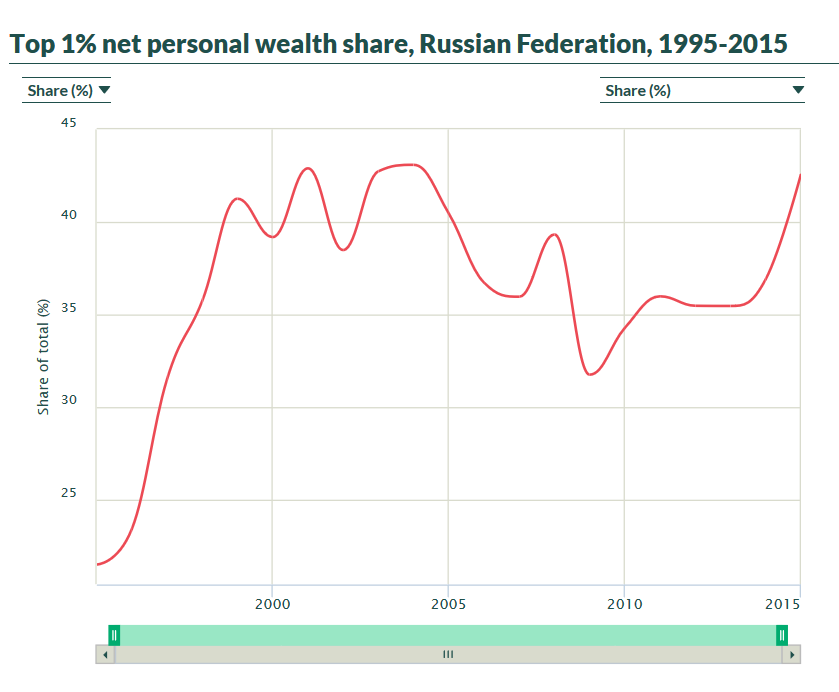
How about the data on the Independent? The number provided for Russia just doesn't seem to be right. According to the World Inequality Database, the share of wealth of the top 1% of the Russian population is around 42%, not 74.5%. Again, they don't provide a link but, after some work, the 74.5% value can be found buried in a table at page 145 of a report published by Credit Suisse (h/t Alien Observer). How is it that this number is so different than others is probably because of the data the Credit Suisse use are incomplete, as they themselves say. In any case, the wealth of the top 1% is a very partial tool to measure how unequal a society is. It only tells you something about the existence of an upper crust of super-rich people, whose wealth is very difficult to estimate anyway. It tells you nothing on how wealth is distributed among the rest of society, the poor and the middle class.

So, among the data available in several reports, the Independent chose the only number they could find that gave them the possibility of denigrating Russia -- conveniently forgetting to cite all the others. But that's the way propaganda works. Good propaganda - better defined as "perception management" - is not about telling lies, it is about distorting the truth, typically, by means of the three basic propaganda techniques: omission, spin, and saturation. Here, we have a classic case: the data which agree with a certain interpretation are cited (spin), the others are ignored (omission).

The interesting point, here, is that I could find nothing on the Web that challenged these stories about inequality in Russia. It seems that most people are too busy and distracted to have the time and the inclination to check the data they read in the media. So, the concept of "high inequality in Russia" just flashes up in people's perception and then it becomes part of a diffuse worldview.

So, here we are: the whole issue is not so much about Russia, it is about how blatantly they can lie to us and get away with that. How about much darker things for which we have no reliable sources? How can we believe in anything we read in the media? And note that this is not the kind of fake news diffused by amateurs on the social media. These are news appearing on major media outlets which, by the way, often claim to be fighting fake news.

Maybe lies are not a bug but a feature of our society. It seems to be true that we can "create our own reality," as an aide to Donald Rumsfeld is reported to have said at the time of the invasion of Iraq. So we are creating a true "Empire of Lies" and that's not a good thing.


___________________________

Some more info on inequality in Russia. Here is a graph from the "World Inequality Database"


As you can see, inequality in Russia increased after the fall of the Soviet Union but, later on, it started to go down with the economic recovery. Recently, however, it went up again, most likely because of the strain on the economy imposed by the international sanctions. Still, the current value of about 42% for the 1% share doesn't compare with the 74.5% value given by the Independent. 

Here are, instead, the data for the US.
The graph is a little outdated. Today, the 1% share in the US is higher than it was in 2014 and about the same as it is in Russia. Note also that these data are only about personal wealth but say nothing about other factors, such having a health insurance, which is provided for free by the state to Russian citizens, but not to American ones. About the growing inequality trend, maybe it is correlated to the oil production peak in the US - in any case, today the level of inequality in the US is close to that of England in the 18th century.


Sunday, June 10, 2018

Is the Empire on the Edge of the Seneca Cliff? Italian Prime Minister Conte Opens to Russia at the G7


It is rare that a province of the Empire tries to pursue an independent foreign policy but, at the last G7 meeting, the new Italian Prime Minister, Giuseppe Conte, did something like that. He stated that Russia should return to the G8 (now G7) and called for the lifting the economic sanctions against Russia.

In the past, such deeds on the part of provincial politicians didn't go unpunished by the Imperial Powers, but this time the Empire seems to be in disarray - with Emperor Trump himself seeming to pursue a policy of disengagement. Might Conte's statement be part of the start of a radical change in the Empire's structure, with the provinces becoming more independent from Washington? For sure, the Empire is not yet sliding down the unavoidable Seneca Cliff which will lead to its disgregation. But it seems that we are moving in that direction.

As a comment to Mr. Conte's declarations about Russia, I thought I could reproduce here a piece that I was planning to post on another blog of mine ("Chimeras") but which suddenly became appropriate for Cassandra's Legacy. It is the translation of a text written by Giuseppe Iannello in occasion of the centennial of the Earthquake of Messina - an Italian city on the North-Eastern tip of Sicily. The 1908 earthquake was a major disaster and the role of the Russian sailors helping the victims is still remembered nowadays in Italy.

Here, Iannello states, correctly in my opinion, "The people of other nations, offering their help, proved to be friends to the Italians, but the Russians turned out to be brothers."


 The Russian Sailors in Messina: Beyond the Myth

 by Giuseppe Iannello - 25 Dicembre 2008


A Russian sailor from the ship "Slava" standing in front of the rubble of the Messina Earthquake of Dec 28th, 1908.


by Giuseppe Iannello - 25 Dicembre 2008


Those were days of true glory in Messina. But organization and discipline are not enough to explain the undisputed fame of saviors and heroes of the Russian sailors. 

Six days of glory. Real glory, glory able to challenge time and the judgments of the scholars in retrospect. A glory told to us by the press, but above all told by the people, by the people who saw with their eyes and heard with their ears. The Russian sailors entered the collective memory as heroes, as saviors, obscuring all the other rescuers. Why? A useless question if we ignore the narration of those six days and embark on historical and psychological analysis. Because the answer lies, in fact, in the deeds of those thousands of sailors who arrived on six ships of the Russian military fleet. 

There are many myths to dispel and "adjustments" to be made to avoid that the heroism of a people is identified with that of individual figures who, in reality, were only catalysts of needs that were born from a collective soul. We refer, for example, to generals and admirals. The command of the expedition of the Baltic Sea Fleet in the Mediterranean had been entrusted to Admiral Litvinov and he was sent to him while in the port of Augusta on request from the local authorities to provide assistance to the people of Messina. But it was not he who "decided" to move, he needed approval from his superiors, he needed an order; which would mean the loss of many hours waiting for that order. It was because his subordinates, officers, ensign, simple sailors, understood the situation and pressed to leave for the Strait of Messina. And so they did. In his memories ("The Imperial fleet of the Baltic between two wars, 1906-1914") Garald Graf, then ensign in the Admiral Makarov, the first of the Russian ships to leave, tells us, "Litvinov was not a man who knew how to make up his mind," but in the end he was persuaded. 

From the beginning, obedience and discipline do not explain the efficiency and the success of the Russian relief work. In "La terra trema" (the ground shakes) by Giorgio Boatti it is even possible to talk about an "almost inhumane discipline". It is true, during the hours of navigation from Augusta the Russians had had time to organize themselves in teams, to prepare everything that could have been necessary for them. But the same could have been done by others. The merit of the Russians is not there. And it is not in the discipline nor in the organization, it is not in the method of their remarkable action. Michail Osorgin, a compatriot of those sailors, debunks the myth of the "method". And he does so immediately, just a month after the catastrophe, in a long correspondence from Rome for his newspaper, the "Vestnik Evropy". The reputation of the Russian navy had been nearly destroyed by the defeat that it had suffered in the Japanese-Russian War. The only method that led the sailors was for Osorgin to save as many "souls" as possible, the difference with everyone else was this tremendous need to wrest as many people as possible from death. 

The organization was dictated by this need: the schedules, the shifts, everything was functional for this purpose, the sailors placed no value in themselves; people's lives came before the orders and the simple sailors were the ones convincing their superiors to reshape orders. On the other hand, it must have sounded really strange in the ears of a Russian to be praised because of the organization of their army: what to say then - says the Russian journalist - about the organization and discipline of the Germans, who were also present at the place of the disaster? 

The Russian sailors became the catalyst of all the positive energies against the resignation, the discomfort, which often turned into apathy, in a sort of indifference that was often transmitted to rescuers. On the contrary, the action of the Russians was contagious and the cadets of the Sutley, the first British military ship to arrive, perhaps a few tens of minutes before the Makarov, felt it and understood how to distinguish themselves.

No stain therefore on the work of the Russians? That of the immediate shooting of the looters, thieves caught in the act: it is interesting to note how this particular is expressed only in journalistic reports and has been judged irrelevant by the collective memory, the oral and written memory handed down by the survivors from father to son, from generation to generation. The Russians did not actually deal directly with the hunting of the looters, but they used their weapons to defend themselves and defend a population totally exposed to the evil of the profiteers or to despair. The Russians (and the English) did not take care of the defense of property - as they did not bother to bury the dead - they took care of the people whom they heard whining under the rubble and to cure the wounds of the survivors.


We discuss this story with Tatiana Ostakhova, a researcher at the University of Messina, who lets us read something from her work in progress: the letters of Russian sailors published in Russian newspapers and other articles published in the weeks immediately following the earthquake. The letters are in part those already published by the Province of Messina in 2006, which however were based on an original edition in French. They are letters all characterized by common feelings: the inability to describe the indescribable, the horror of the scenario in which they operate, the madness of the survivors and the absurdity of which every hour are witnesses. The sailors are not exalted, they do not glorify, they only narrate and at times with amazement, they also take note of the immobility of the Italian forces. The comparisons will be made by the others, the correspondents, the other rescuers and above all the people who will not forget the good received. And the news of those good deeds will run like the wind: in Naples, the first landing of the wounded by Makarov turns into a sort of apotheosis for the Russian sailors, who are acclaimed. Wherever they were recognized in the city, the Russian sailors could not escape the warm manifestations of gratitude. 

Michail Pervuchin in his article "The Russians and the Italians", translated by Ostakhova, sums up the difference between the Russians and everyone else. The people of other nations, offering their help, proved to be friends to the Italians, but the Russians turned out to be brothers. The correspondent affirms it on the basis of the testimonies gathered and of what was read in the Neapolitan newspapers: "the others certainly helped; but the Russians have not only helped, they gave everything they had to the refugees, including their spare shirts". "In Palermo and Naples - continues Pervuchin - women and children, refugees from the destroyed cities, still show off their jackets and their sailor's jackets, the officers' jackets. There are no German or English clothes on refugees. Russian clothes, yes ". Then another testimony: "all have given, but while others gave the superfluous, the surplus, the Russians, and we saw it, they gave us what was necessary to themselves, even the last thing they had. Yes, to the last thing they had. This is what struck us ".

However, good does not always beget more good. In January, the Russian sailors were told, "thank you but your help is no longer necessary". A Russian correspondent speaks of envy in this regard, Colonel C. Delmè-Radclif, military attaché of the British Embassy in Rome, in a confidential report speaks of jealousy of the Italian authorities. The fact remains that only the Italian soldiers and a few other volunteers remained in the rubble: the gates were blocked for everyone else, including Italian civilians. The same refrain was repeated to all: there is no need for more help because the army has taken control of the whole city. The fate of many people, still alive under the rubble, was sealed.


Giuseppe Iannello

Friday, August 21, 2015

My career as a Putinologist nipped in the bud


What kind of alien creatures are infesting my blog?


How many Russians read this blog? From the data I have from Google Analytics, I thought they were many; by far the largest fraction of readers from non-English speaking countries. So many that I published the data and asked for comments from my Russian readers.

The comments I received from Russia were very few. I reasoned that maybe most Russians following the blog could read English, but had trouble in expressing themselves in English; and that sounded plausible. Then, I noticed something strange: my blog in Italian (Effetto Risorse) also had a large readership from Russia; again, according to Google Analytics. Now, I know that many Russians speak good English, but Italian? Something just didn't click together the way it should have.

I was scratching my head while thinking about this story when I got a message from Allan Stromfeld Christensen (of "From Filmers to Farmers") who asked me, "are you sure that all those visits are from real people?" And he went on to tell me that he had noticed a lot of visits from China to his blog, but that these visits had turned out to be just web bots.

So, I went to check my site with a different analytical tool, "Statcounter" that I had installed but wasn't using so much. Statcounter claims to detect "actual human activity" and, indeed, the data it reports put the number of visits from Russia way down in the list; no more than about 1% or less of the total. My site is infested with Russian bots, and that's it. (or, at least, it looks like the most reasonable interpretation of the data)

You can imagine that it was a very disappointing discovery for a Russophile, as I am. But so is life, and you live to learn. After all, 1% of visits from Russia is still better than 0% visits from Russia. But my career as a Putinologist is ruined!

But the whole story is worrisome. Russian bots, all right, but what else? What are all those bots infesting the Internet? Where do they come from? Even more worrisome, who are you, out there? Are you all bots? Or droids? Or holograms? Or bug eyed monsters? Or little green men? Or what? Is there anyone human reading my blog? Who knows? Mysteries of the Internet.......


Thursday, July 30, 2015

Western style Catastrophism: a few questions for my Russian readers


Weekly page views of "Resource Crisis" on July 30, 2015. Note how Russia is the largest non-English speaking country in the list. These data are not the result of  any special post about Russia, they are a normal feature of the blog.  


I don't need to say that I am very pleased for the success that this blog is having in Russia. Russia is a country that I know reasonably well, I know the people, the places, nature, a little of the language and, well, about countries you can use the verb "like" regarding your attitudes toward it; but you can also use the verb "love." Personally, I would feel more inclined to use the latter term in regard to my personal feelings regarding Russia.

This said, however, I am curious about why exactly "Resource Crisis" is having so much success in Russia. It is true that I have posted a few times about matters regarding Russia, but this is not, by any means, a Russia-oriented blog. And, for what I know about Russia, the general attitude, there, is not at all "catastrophistic" as this blog is.

So, I thought I could dedicate a post to this subject and ask my Russian readers (and also non Russian ones) if they can spare a little of their time to comment on some questions that I am asking to myself and to them.


1. Would you agree with my impression that in Russia there doesn't exist a "catastrophistic" line of thought regarding "the end of the world as we know it"? In the West, we have a number of thinkers, for instance James Howard Kunstler, John Michael Greer,  Guy McPherson, Dmitry Orlov and many others (perhaps also yours truly!) whose work is dedicated to the exploration of the concept of social and economic collapse, and even to the extinction of humankind. Their relevance in the overall cultural and political discourse in the West is minor, but, I venture to say, not irrelevant. But, I can't find any equivalent Russian thinkers - which may very well due to my very limited command of Russian. Or is it just that catastrophism doesn't "stick" to the Russian mind?

2. Did anyone in Russia predict in advance the collapse of the Soviet Union? This question is related to the first one. The West seems to be going towards its collapse not without considerable warning, although consistently choosing to ignore it. Did anyone warn the Soviet government of their impending collapse? (not that, most likely, the Soviet Government would have done better than the Western ones, but, out of curiosity......)

3. Did you have the impression, as I do, that most people in Russia tend to see both peak oil and climate change mainly as Western propaganda? My contacts with the Russian oil industry and universities tend to think that Russia is immune to peak oil because of its large reserves and also that it will be scarcely affected by climate change, because it is located in the North. Some people seem to think that Russia could actually gain something because of global warming. Both these impressions - in my opinion - are utterly wrong and could seriously damage Russia in the long run.

4. Do you think that the current Russian leaders have some kind of long term plan on how to manage the Russian mineral resources? Russia controls a considerable fraction of the remaining world mineral resources. Even though large, these resources are not infinite. So, should Russia help Westerners to waste fuel produced from Russian oil for their SUVs, or, rather, keep the oil for the future prosperity of Russia? Does anyone in Moscow think about these matters?

5. What should be Russia's future source of energy? Here, it seems that most Russians think of a comfortable, nuclear powered future. That may be a possibility, but the Russian uranium resources are not infinite and surely are not among the most abundant in the world. Theoretically, fast neutron reactors overcome the problem of uranium depletion and Russia is probably the most advanced country in the world in this area. But fast neutron reactors are a very difficult technology, frayed with risks and uncertainties, also strategically vulnerable. Shouldn't Russia consider alternatives?  Despite being a Northern country, Russia has plenty of high insolation regions and plenty of available space. Why neglect solar energy so much as it has been done up to now?

So, if you are Russian (or even if you are not) and you feel that you can say something about these questions, or on other points related to Russia, your comments are most welcome!


Some recent posts of mine related to Russia (I would also thank Prof. Tatiana Yugay for her posts on my blogs, both in English and in Italian)

Putin Eats Babies: lies, damned lies and psyops . (May 12 2015)

The Mind of Empires (May 3, 2015)

The Great Oil Game (May 2, 2015)

How Do Empires hunt bears?  (March 9 2015)

Unleashing the Oil Weapon against Russia (Oct 6, 2014)


Who

Ugo Bardi is a member of the Club of Rome, faculty member of the University of Florence, and the author of "Extracted" (Chelsea Green 2014), "The Seneca Effect" (Springer 2017), and Before the Collapse (Springer 2019)