Showing posts with label Les houches. Show all posts

Monday, March 19, 2018

The View from Les Houches: The Seneca Collapse


I gave a presentation focused on the Seneca Effect at the School of Physics in Les Houches this March. Here I show various concepts associated with overshoot and collapse with the help of "Amelie the Amoeba" (This picture was not taken in Les Houches, but in an earlier presentation in Florence).

Here are some commented slides from my presentation. First of all, the title:


And here is an image I often use in order to illustrate the plight of humankind, apparently engaged in the task of covering the whole planet Earth with a uniform layer of cement, transforming it into Trantor, the capital of the Galactic Empire of Asimov's series "Foundation"


I moved on to illustrate the "new paradigm" of resource exploitation: the idea that mineral resources never "run out", but simply become more and more expensive, until they become too expensive.


It is not a new idea, it goes back to Stanley Jevons in mid 19th century, but for some reason it is incredibly difficult to make it understandable to decision makers:


Then, I spoke about the Seneca effect, there is a lot to say about that, but let me just show to you one of the slides I showed during the talk: the Seneca Cliff does exist!


Fisheries are an especially good example of overexploitation (or perhaps a bad example, there is nothing good about destroying all the fish in the sea. And this leads to a rather sad observation:


I also showed how the Seneca Effect can be used for good purposes, that is to get rid of things we need to get rid of. This is an image from a paper that we (Sgouris Sgouridis, Denes Csala, and myself) published in 2016.


You see the Seneca cliff for the fossils, the violet part of the curve. It is what we want to happen and it would be possible to make it happen if we were willing to invest more, much more, in renewable energy. But, apparently, there is no such idea on the table, so the future doesn't look so good.

But never mind. We keep going and, eventually, we'll arrive somewhere. In the meantime:


Thursday, March 15, 2018

The View from Les Houches: Of Rare Metals and Cute Kittens


Les Houches, March 2018. José Halloy of the Université Paris Diderot discusses mineral depletion in his presentation. Note how he utilizes Hubbert curves to estimate the trajectory of mineral extraction. He predicted that the dearth of very rare elements will negatively affect the electronics industry, perhaps killing it completely.


José Halloy's presentation at the Les Houches school of physics was focused on the availability of rare minerals for electronics. This is a problem that's rarely discussed outside the specialized world of the "catastrophists", that is of those who think that mineral supply may be strongly restricted by depletion in a non-remote future. In this field, Halloy seemed to side with the "hard" catastrophists, that is expressing the option that depletion will make certain things, perhaps even the whole electronics industry, impossible.

The problem, indeed, is there: modern electronics is based on the unrestricted use of very rare minerals - the term "very rare" indicates those elements which are present only in traces in the earth's crust and which, normally, do not form exploitable deposits of their own. If you pick up your smartphone, you probably know that it contains several of these very rare elements gallium (for the transistors), indium (for the screen), tantalum (for the condensers), gold (for the electric contacts) and more.

Most of these elements are "hitch-hikers" in the sense that they are produced as impurities extracted from the production of other elements: for instance, gallium is a byproduct of aluminum production. Whether we can continue to supply these elements to the electronic industry in the future depends on a host of factors, including whether we can continue to extract aluminum from its ores. In this sense, recycling is not a good thing since recycled aluminum, of course, does not contain gallium, because it has already been extracted during the refining phase. Note also that recycling tiny amount of very rare elements from electronic devices is extremely difficult and very costly. So, in the future, the supply of these elements is going to become problematic, to say the least.

Does it mean the end of electronics? José Halloy seemed to be very pessimistic in this sense, but I think the question was not posed in the correct way. If you ask whether current electronic devices can survive the future dearth or rare mineral, the answer is obvious: they can't. But the correct question is a different one: what kind of electronic devices can we build without these elements?

Here, I think we face a scarcely explored area. So far, the industry has been produced all kind of devices focusing solely on performance on the basis of the assumption that there aren't - and there won't ever be - mineral supply problems. Can we make a smartphone without gallium, indium and all the rest? That is, limiting the elements used to the basic ones, silicon, aluminum, and other common materials? It is a difficult question to answer because, really, it has never been addressed, so far.

Yet, I think there are excellent possibilities to develop a new generation of electronic devices which are both using very little (and perhaps zero) rare elements and which are designed for complete (or nearly complete) recycling. The basic element of all electronic circuits, transistors, can be made using silicon and, in general, there are alternatives to rare metals for most devices, even though in most cases not with the same performance. For instance, light emitting diodes (LEDs) are currently based on gallium nitride (GaN) and there seem to be no comparable substitutes. Without LED, we would have to go back to the old cathode ray tubes (CRTs) which we consider primitive today. But, after all,  CRTs performed well enough for us up to not many years ago. So, it would be an inconvenience, but not the end of the world.

So, it is clear that we'll have to settle on reduced performance if we want an electronics without rare elements, perhaps on a strongly reduced performance. But maybe we don't need the kind of performance we have been used to in order to keep going. Think about your smartphone: it is an incredibly complex and powerful device used mostly for trivial tasks such as looking at clips of cute kittens and sending likes and thumbs-up to other machines. Does "civilization" really need these devices? It is all to be seen.

For a fascinating discussion of an industrialized world running without rare metals, see the excellent book by Pierre Bihouix "L'age Des Low Tech" (in French - alas!)

Wednesday, March 14, 2018

The View From Les Houches: What Are Models For?


Sandra Bouneau, researcher and lecturer at the university of Paris-Sud, shows her model at the School of Physics in Les Houches, France, in March 2018. As you can see from the image, her model is complex and detailed. It is one of the several models presented at the school which attempt to describe the trajectory of the transition.

Overall, all the models based on physics (including Bouneau's one, as far as I understood it) arrived to similar conclusions, confirming the calculations that myself, Denes Csala, and Sgouris Sgouridis published in 2016. In practice, the transition is possible, but it won't happen all by itself. The economic system needs to be pushed in the right direction, in such a way that it will be able to provide the necessary investments.

The problem is that the system is not being pushed hard enough. Some parts of it, including the US governments, are pushing in the wrong direction, dreaming of an impossible "energy dominance" (and even if it were possible, what good would it be for America?).

At the bottom of the whole problem, it is the fact that policy-makers don't believe in models, although they may declare the opposite. There have been many models developed during the past century or so which would have created a different world if the powers that be had acted on the advice provided - first and foremost "The Limits to Growth" of 1972. But that model was not only disbelieved but positively demonized.

In the end, All models are made to search for trajectories which avoid collapse, so ignoring models ensures collapse. And that's what we are doing!


Monday, March 12, 2018

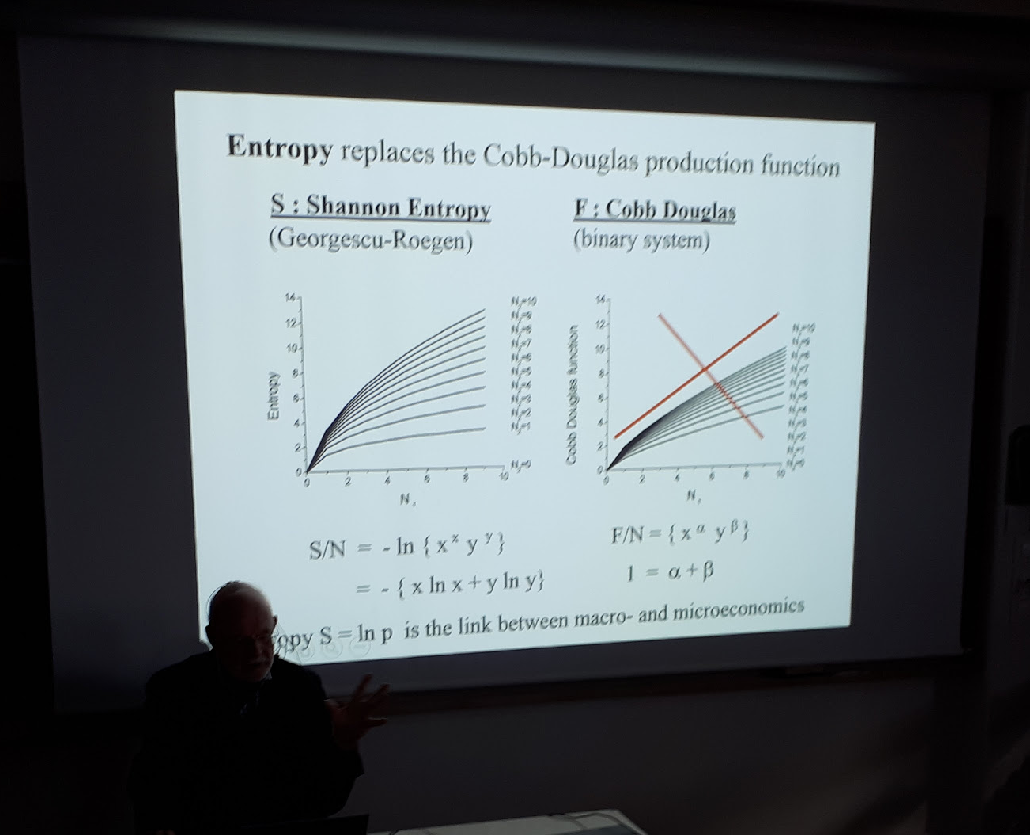
The View from Les Houches: Thermodynamics vs. Economics


School of Physics in Les Houches, France, March 2018. Juergen Miknes shows some of the concepts that he has developed in his parallel analysis of thermodynamics and economics. It is a remarkable synthesis that you can find described in detail here. In the slide above, he suggests to replace the Cobb-Douglas function, commonly used in economics, with a function based on the concept of Shannon's entropy.

I am not sure of a number of things in Miknes' work, in particular the idea of equating (in some ways at least) the growth of entropy with the growth of production. Nevertheless, it is a fascinating work.

Something that surprised me (but probably I shouldn't have been surprised) was how strongly Miknes was challenged by an economist in the audience. Apparently, economists don't like their field invaded by those pesky physicists. So far, economists have been able to keep physics away from their secluded garden and continue keeping the field open only to people with the right credentials (according to them). For how long, it is all to be seen.


Sunday, March 11, 2018

The View from Les Houches: the Revenge of Lotka and Volterra


Les Houches, March 2018. Fatma Rostom of the University of Paris, shows the basis of her model of the energy transition. It is the good, old Lotka-Volterra model, also known as the "Predator-Prey" or the "Rabbits and Wolves" model. (the LV model, among friends)

Perhaps surprising, this model, presented first in the 1920s, is enjoying a new life today and it was mentioned in several talks. Long considered a toy for freshmen in biology, it turns out to be extremely rich in its capability of describing the stepped dissipation of thermodynamic potentials in a nonequilibrium system.

Dr. Rostom modified the model in order to take into account economic and monetary factors, but even the "raw" LV model can describe real-world phenomena. It was found to be at the basis of the Hubbert Curve (Bardi and Lavacchi, 2009) and it was recently shown to be able to describe the cycle of exploitation of fisheries (Perissi et al. 2017). And, of course, the model is at the basis of the dynamical interpretation of the "Seneca Effect"

The talk by Dr. Rostom was very good for several reasons, one for her emphasis on "mind-sized" models, a concept that I had introduced some years ago under the influence of Seymour Papert. In the current situation of confusion and even of despair, we badly need models that policymakers can understand if they have to act in a meaningful way

But, in the end, what results did Dr. Rostom reported. Well, not very optimistic ones, as you can see in this paper of hers and others

Saturday, March 10, 2018

The View From Les Houches: Can We Move to Renewables Fast Enough?


Les Houches, March 2018. At the School of Physics on the Energy Transition, Gregor Semieniuk of the University of London shows the updated trends in investments in renewable energy. 


Just a few years ago, there was ground to be optimistic about the energy transition. Renewable energy production showed a robust growth and the same happened for investments. If the trend could have continued, renewables would have swamped away fossil fuels easily and seamlessly.

Instead, something went wrong in 2012. The growth of investments stalled, it went up and down for a few years and, by now, it is clear that it has plateaued. Investments in renewable energy are not growing and we don't know if they will ever restart growing.

While it is true that the prices of renewable energy are going down, at these investment rates it is clear that we can't go through the transition fast enough to comply with the Paris targets. Possibly, we won't even be able to replace fossil fuels before they become too costly to produce. This is the result that myself and my coworkers Csala and Sgouridis obtained two years ago. According to our calculations, humankind would need to invest at least ten times as much, likely much more, in terms of energy to go through the transition fast enough.

In his talk, Gregor Semeniuk showed other estimates confirming that the investment rates in renewables are not sufficient for what we need to do. The gist of his presentation was that if governments don't intervene, the transition will not happen fast enough. He showed several examples of past transitions which took place mainly because they were driven by the resources provided by the state.You can find the hugely interesting paper on these matters by Mazzucato and Semieniuk on "Technological Forecasting and Social Change" and also more material at this link.

There remains the fundamental problem: how do we increase investments in renewable energy? Our faith in the free market is not helping us in this issue.


Thursday, March 8, 2018

The View From Les Houches: Saving the World Using Physics


 Above, Carey King from the University of Austin, Texas, shows his Trump socks during his talk at the meeting of the School of Physics in Les Houches, France. I strongly suggest to read King's hugely interesting paper titled Information Theory to Assess Relations Between Energy and Structure of the U.S. Economy Over Time. You may find in it aswers to questions you have been asking yourself for a long time.


The School of Physics in Les Houches, France held a session on Energy Transitions during the week from March 4th to March 9, 2018. About 70 scientists, mostly physicists, gathered in a remote village in the French Alps to discuss the energy transition, the supply of mineral resources, and climate change.

It was one more attempt by scientists to save the world. Having been there, I can say that the task is difficult but this group managed to come up with several good ideas, some of which might even work.


In future posts, I'll try to summarize some of the talks at the school. For the time being, let me just thank the organizers for the good experience:


Hervé Bercegol
Marie Degremont
Zeynep Kahraman
Jacques Treiner


Who

Ugo Bardi is a member of the Club of Rome, faculty member of the University of Florence, and the author of "Extracted" (Chelsea Green 2014), "The Seneca Effect" (Springer 2017), and Before the Collapse (Springer 2019)