Showing posts with label energy. Show all posts

Sunday, December 1, 2019

What's wrong with the oil industry? Too many claims of abundance start sounding suspicious


Above: the Financial Times of Nov 29th, 2019. Has the US really become energy independent?


Peak oil theorists have always been the favorite punching ball of mainstream oil pundits but, recently, the attacks against the peak oil idea have started becoming so loud and widespread that I am starting to think that there has to be something wrong with the oil world nowadays. As an especially bad example, I may cite a recent article on Forbes by Michael Lynch. I understand that some people have a bone to pick and they want to pick it clean, but this is a little too much -- there are limits to how nasty one can be, even in a heated discussion. 

Yet, some claims of great oil abundance seem to be based not just on the pleasure of denigrating peak oil theorists but on data said to be real. Just as an example, see a recent article on the Financial Times where we can read that,
The US has cemented its status as a net exporter in world oil markets, a sharp reversal from past years that could affect its ties to foreign allies. 
You may wonder the logic of using the term "cemented," that carries the meaning of consolidating something already existing. Indeed, claims of the US having reached "energy independence" in terms of crude oil had become common after that the US production had exceeded imports -- that meant nothing, of course, it was pure dry-holing. At that time, the US had, and still has, a deficit of nearly 3 million barrels of oil in terms of import/export balance, as you can see in the figure below. (image from SeekingAlpha)

The EIA data for crude oil confirm that in November of this year the US had a DEFICIT of 2.7 million barrels per day in the import/export balance. So, how can the FT claim that the US is a net exporter, then? Simple: under the category of "oil" they sum crude oil and oil products. The latter include refinery products such as kerosene, diesel fuel, lubricants, etc. And, indeed, recently the sum of the exports of these two categories has touched and slightly exceeded the curve of the crude oil imports. 

Does that mean that the US is now "energy independent" in the sense that it exports more oil than it imports? Not at all. That would be true ONLY if the exported products were wholly made with US oil -- which obviously cannot be the case. The US production, nowadays, comes in large part from shale oil, which is light oil. But refineries prefer to use heavy oil, which is imported from Canada and other regions outside the US. The refined products made from this oil can be counted as "oil exports" but it is not oil that was produced in the US. If what counts is the US energy independence, then it is obvious that it is just a trick to make the US look like it is producing more than it does. 

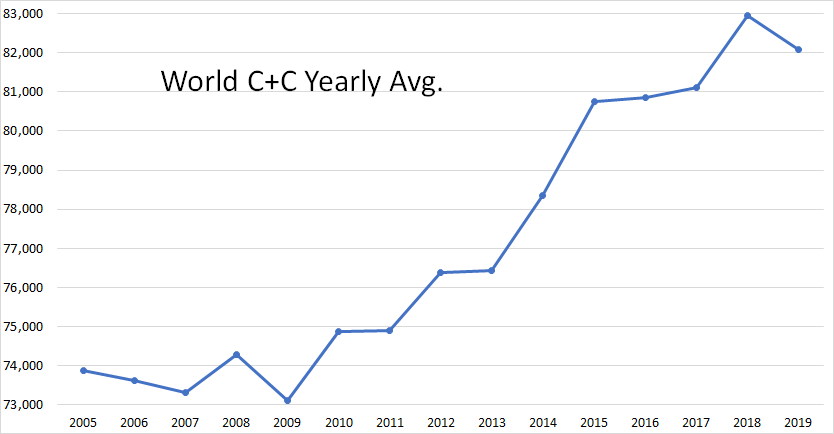
It is true that the US oil production keeps increasing, so far, but for how long can it continue growing? Indeed, there seems to be a suspicious excess of glee in these claims of oil abundance. Could it be an attempt to cover some big problems? Hard to say, but one thing is impressive: 2019 should the first year in a decade -- since the great recession of 2009 -- when the world oil production declined (data by Ron Patterson).


The story of peak oil has been a war of opinions and we know that wars are won by those who win the last battle. Mr. Lynch is surely convinced that his opinions on peak oil have been vindicated, but it may be too early for him to take a victory lap. 

Are we looking at the other side of the growth curve


Monday, October 21, 2019

The West Fades. The Center Quietly Returns: The New Silk Road


An image from the workshop on desalination and mineral extraction from seawater organized by Sharif University in Teheran this week. In the photo, you can see people from Oman (3), Iran (3), South Africa (1), India (1), and Bangladesh (1). It was not only a multi-ethnical group but also a Eurasia-centered one. It gave me some impression of the shifting balance of power in the world, from the West to the Center, and inspired this post. 


If you think about that, it is funny that we tend to define ourselves as "Westerners." Most civilizations and cultures in history have tended to see themselves as the center of the world, just think of China: it is supposed to be "the Middle Kingdom". This idea that we are on an edge is something that we've probably inherited from the ancient Greeks, when everything west of them was seen as a land of mystery, peopled with savages, monsters, and Gods. 

But the fact that we call ourselves Westerners doesn't mean we think we are a periphery of the world, not at all. Most Westerners seem to cherish the idea that we are the real center, the most advanced, enlightened, and powerful area of the world. The rest of is, well, it is mostly inhabited by turban-wearing barbarians, savage tribes, or, at best, ancient and decadent empires on their way to dissolution. These Non-Westerners need our guidance if they have to attain the nirvana as defined here: democracy and economic liberism.

But the world is vast and things change. Empires are born, reach their pinnacle of greatness and then collapse while still claiming that they will last forever. That may be the destiny of that great world empire, the "Western Empire," that started with the British and continues with the Americans. The center of the world may well be returning to what it used to be up to a few centuries ago, gravitating around that "geographical center" sometimes said to be in Egypt, sometimes in Turkey, sometimes in Syria. It doesn't matter where it is exactly: it is at the heart of the gigantic landmass of Eurasia, somewhere in the region we call the "Middle East."

Chess players know how important it is to dominate the center if they want to dominate the game. Not for nothing, indeed, the game of Chess was developed not far from the center of the world: somewhere in Persia. But to dominate the center, you need to be able to move in and out of it and in the real world that takes roads. In ancient times, the center of Eurasia was crossed by the Silk Road: a long and winding road that went through mountains and deserts, including also coastal sea lanes. It was the realm of commercial caravans with their camels slowly marching from one edge to the other of a Eurasian supercontinent and to Africa as well, carrying gold, silver, ivory, spices, silk, and much more.

The Silk Road lost importance and then disappeared with the arrival of the Westerners who monopolized commerce with their ships and power with their armies. The concept of national borders had never existed before but it was the death toll for the old caravans, now confined within states. Commerce was taken over by Westerners with their container ships, crossing the oceans in a gigantic network that created the empire we call sometimes "Globalization." Not just a commercial empire but a military one as well, dominated by the mighty armies of the West.

Empires are run by a combination of commerce and military power and it is the balance of costs and profits that keeps them together. The old Silk Road never turned into a continental empire because it was just too expensive to move armies along it on long distances. But the agile camel caravans provided the link that was needed for the road to remain open: a low-cost system that didn't need a military governance system and couldn't afford it anyway, Instead, the modern sea lanes of the current World Empire are kept together and controlled by the mighty carrier strike groups of the American Navy: nothing and nobody would even dream of challenging their power, so far. But the carrier group is a behemot that needs to be fed, and for how long will that be possible?

Things keep changing, as they have always been doing. The old Silk Road is being revamped with the name of the "Belt and Road" initiative. It is the revenge of the land over the sea: the lanes of the new silk road are nearly invulnerable to the naval power of the Westerners if nothing else just for the sheer vastity of the territory it connects. Think about that: the population of Eurasia and Africa, together, make almost 6 billion people. The rest of the world is a periphery. 

So, the Western domination may be fading and much of what we are reading in the news nowadays is a reflection of this decline. With the depletion of the resources that created the Western Empire, first coal, then oil, the center is returning where it used to be and the great road that links Eastern and Western Eurasia is going to be again the pulsating artery of the world. Maybe Eurasia will be crisscrossed by fast trains powered by solar energy, or maybe the old camels will return: solid, resilient, unstoppable.

And the Westerners? They will return to their ancient role of seafaring pirates: coming and going like storms, leaving little trace. Curiously, though, they'll be leaving a reverberation of their presence with the English language, initially carried into Eurasia by the American Legions, now the tool of choice by Eurasians to understand each other.

Perhaps English is the true reason for the use of the term "The West" since it did originate on the extreme Western edge of Eurasia. But that's just a quirk of history: once, at least four languages were spoken along the old silk road: Mongolian, Persian, Arabic, and Turkish, while Chinese and Greek were spoken at the two ends. English as the dominant language may make things simpler and continue being used during the 21st century, and even farther in the future. Or we may switch to some other language: perhaps "googlish" or some other pidgin language. Who knows? As always, life is a journey, not a destination.


Monday, February 4, 2019

The Biodiesel Disaster: Why bad Ideas are Always so Successful?

This is a modified version of an article that was published on "Il Fatto Quotidiano" in Italian on Jan 31, 2019


Behind the simian mask, there is yours truly, Ugo Bardi, sitting at his desk.  The sign is in Italian, but you can understand that it is against biodiesel and in favor of Orangutans. 

Sometimes it happens that you are asked a question that forces you to reflect. So, a few days ago, I was at a public meeting on energy and climate and I was telling about the work we do at the university and with the Club of Rome. In the debate, someone asked me: "But, professor, from all these models of the world you make, after all, what did you learne?".

Some questions are not easy when the topic is complex and you have to summarize the answer in a few sentences. And you have to come up with something right away! But I think I could put together a good answer when I said, "The main thing we've learned is that the models work well. Even the famous model of 'The Limits to Growth' that the Club of Rome had proposed in 1972 still describes reasonably correctly the state of the world today. But this has a consequence: the system is predictable because it tends to move in a certain direction. And this means that changing things is very difficult ".

The problem of the difficulty of changing things, even when it would be necessary, came back to me by later on, when reading a recent report on biodiesel. This stuff is really terrible: it causes deforestation and destruction of the fertile soil. In terms of greenhouse gas emissions, it is much worse than traditional diesel fuel.

But, you could say, at least biodiesel replaces a non-renewable fuel obtained from oil. In practice, the problem is that we are not getting very far with the replacement. Making the appropriate calculations, we find that, today the production of biodiesel is about 2.7% by volume of the total production of diesel (the details of the calculation are at the end of this post). Considering that biodiesel contains less energy than diesel fuel, it is just over 2% of the total. And for this miserable 2% we destroyed forests all over the world and massacred untold numbers of orangutans?

Maybe you do not care about orangutans or ancient forests, you just want fuel for your diesel SUV. And you could tell me, couldn't biodiesel production be increased? The problem is that there are not many forests left to be razed in the world. To produce more biodiesel we should start using land that is currently used for food production. This means starving people to feed the cars: and we risk to get to that for real if we continue with current trends.

But how is it that we put ourselves in this absurd situation? The beauty is that the idea was to make an "ecological" fuel. Ecological my xxxx! But it is what I was saying before. The system (and the system is us) tends to maintain its trajectory. When we realize that there is a problem, in this case, the lack of diesel fuel (peak diesel), as well as global warming, we launch ourselves towards the solution that seems to keep things as they are. By replacing diesel oil with biodiesel, it seemed to be possible to fix everything with no change or with just minimal change. We use a renewable fuel and we keep our stoves on wheels running. But it doesn't work like that. We only created a lot of damage without getting anything useful.

What we should have done, and we are still in time to do, is to move from the noisy and inefficient internal combustion engines to vehicles that use electric motors powered by renewable energy, much more efficient and non-polluting for real. Of course, this requires making investments, changing habits. Thus, the knee-jerk reaction of so many people when the idea is proposed is "I do not want to change anything, give me biodiesel so that I keep my diesel car". It is understandable, but we are in an emergency situation both for the climate and for the availability of fuels. And change we must.


h/t Virna Quintini  and Veronica Aneris

Calculation

It is curious that nobody on the Web seems to have bothered to do the calculation of how much biodiesel is actually produced in comparison with fossil diesel. I tried to find the data and the result is a bewildering mess of different units, claims, and counterclaims. Of course, if you are a good conspiracy theorist, you would suspect that the people producing biodiesel don't want to make it easy for us to understand how minuscule is their contribution to the world's fuel production. But, eventually, I could put together a calculation that seems to be correct and that Antonio Turiel kindly checked and validate. And, yes, the contribution of biodiesel to the world's diesel consumption is minuscule. So, let's go with the numbers.
BP.com gives 1577 Kboe of biofuels (the people who use these weird units should be killed by a lightning strike coming from God herself). I think it means one million and a half barrel of oil equivalent per day. And then, it is reasonable to say that biodiesel could be a fraction of that, as you say, ca 0.65 million barrels per day. That makes 237 million barrels per year. One barrel is 42 gallons, indeed we have some 10 billion gallons per year, a datum which corresponds to one provided by the biodiesel journal. Again, these people he should be struck by lightning for using these units. So far, so good.

Then, back to IEA, they say that the world diesel production was 1234442 thousand tonnes in 2016, or 1234 million tons, or 1.2 billion tons. One toneq corresponds to 6.88 -- 7.33 barrels (depending on the assumptions), let's say it is 7 barrels/ton. The result is that the world diesel production is some 8.5 billion barrels/year, which is a reasonable number considering that the total oil production is some 90 million barrels/day, or 32 billion barrels/year. Converting this to gallons, we need to multiply by 42, and we get 350 billion gallons/year

To recap, the good results are

DIESEL production is 9 Billion Barrels/year OR 350 billion gallons/year

BIODIESEL production is 0.237 Billion Barrels/year OR 10 billion gallons/year

Which means that the total production of biodiesel is 10/360= about 2.8% in volume. A little more than 2% considering the lower heat content in biodiesel.

The poor people who had devised the SI system must be twitching in their tombs when they think at the mess that is the story of the zillion units used in this field.


Friday, June 8, 2018

Exponential Growth Towards a Sustainable Future: the Limits of Solar Panel and Wind Turbine Production

Solarplant near Rüdersdorf, Germany 2014, © Molgreen, CC BY-SA 4.0
Solar plant near Rüdersdorf, Germany 2014, © Molgreen, CC BY-SA 4.0

(Reblogged from blog.wozukunft.de)

Guest post by Gregor Hagedorn

Many people, including myself, fear that the great acceleration (1, 2) of our consumption and destruction of resources such as land, biodiversity, soil, minerals, and fossil energy sources, could lead us into a catastrophe. Other people point out the positive side of near-exponential growth in various fields: renewable energy production, "biotechnology and bioinformatics; computational systems; networks and sensors; artificial intelligence; robotics; digital manufacturing; medicine; and nanomaterials and nanotechnology" (Peter H. Diamandis & Steven Kotler 2012. Abundance: The Future Is Better Than You Think). Others propose that the roadmap to prevent the climate catastrophe should follow an exponential "carbon law", modeled on Moore's law for the semiconductor industry (Rockström et al 2017).

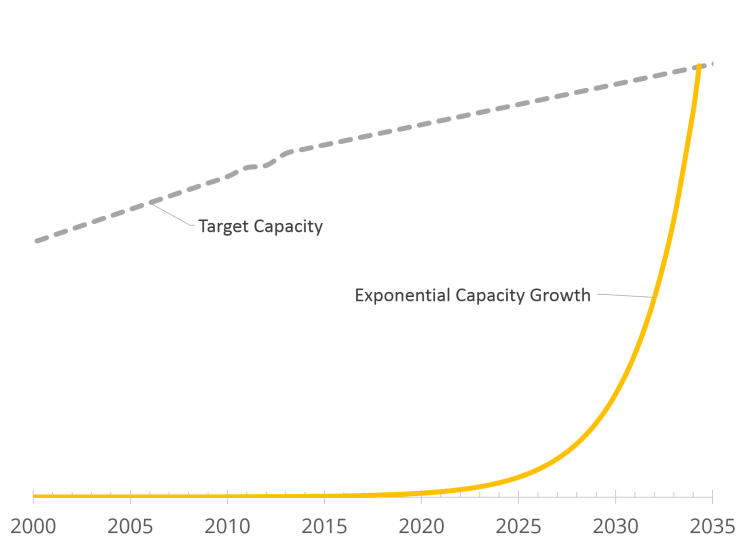
Exponential growth models leading towards sustainability certainly offer hope. An example might be the renewable energy transition: the growth of cumulative solar energy capacity is indeed almost exponential.

Exponential Growth in Renewable Energy Production (© Gregor Hagedorn, CC BY-SA 4.0)
Exponential Growth in Renewable Energy Production Capacity. The gray target final energy capacity is assumed to be slowly increasing as a result of a combination of energy savings in rich countries and equitable growth in poor countries. (© Gregor Hagedorn, CC BY-SA 4.0)

However, looking at the graph, it is clear that the assumption of unchecked exponential growth makes no sense. An extrapolation of the historical annual growth rate (39.14%) means that the final doubling of capacity occurs in the last 25.2 months. Huge productions facilities would have to be built for the necessary solar panel and wind turbines – to be used only for a very short time.

Most scientist and economists are aware of this, but I have experienced many lay people and politicians taking “exponential problem solving” at face value – which may be a problem.

Renewable energy capacity growth as an example

What would a more realistic model be? As a biologist, I am acquainted with logistic growth models limited by a capacity factor such as the available food or land. But organisms will reproduce until the capacity is exhausted, often going into overshoot followed by a period of population collapse (die-off). Humans have foresight (at least sometimes). And investors usually calculate the profitability of investments.

Bardi & Sgouridis 2017 evaluate the effect of time of return on energy investment of renewable energy production installations (e.g. photovoltaic installations, wind parks). In my understanding, this is relevant but different from the effect of the economic return on investment on the factories producing the solar panels, wind turbines, etc. What effect does a minimum life-span of these factories have on the energy transition? As I could not find a publication (please comment, if you know one!), I decided to investigate this.

As I could not find a publication (please comment, if you know one!), I decided to investigate it myself. I will focus on a single of these transformation dynamics, the economics of investing. This is not meant to be a comprehensive model, encompassing the complexities of the real world and aimed at making actual predictions. I think of it more as a thought experiment to estimate the difference between exponential growth and a reasonable return-on-investment on production facilities under otherwise ideal growth conditions. Basically, I assume that any new factory should be running, with reinvestments and upgrades, for 30 years. The following indented text documents the assumptions behind the model (skip ahead, if you like).

1. To simplify, I use the capacity growth value for solar photovoltaic panels (0.105 GW 1992 to 405 GW projection 2017, = 39.14% annual or 2.78% monthly growth) as representative for the entire renewable energy mix needed in the future (the combined growth rate of wind turbines, concentrated solar, geothermal, etc. would lead to a more complex and more realistic picture).
2. Global Final energy consumption values are from Wikipedia (partly interpolated and partly estimated from primary energy supply).

3. After 2014, consumption is extrapolated using assumptions about energy savings and equitable growth needed for poorer countries. I assume that the combination of energy savings and additional energy needed for equitable growth for a good life on 9-12 billion humans will be doubling global final energy consumption between 2014 and 2100 to about 220 PWh/year. The slope of this increase is significantly smaller than the past increase, but the sudden transition into linear growth is a strong simplification. The end result roughly matches the common assumption of a demand of 2kW average equivalent power/person in 2100 (see., e.g., Bardi & Sgouridis 2017); 12 billion people * 2 kW = 24 TW average = ca. 210 PWh/year.

4. Global final renewable energy capacity is calculated by assuming we need 8 × average output as peak output; compensating for within-day volatility, seasonal volatility requiring long-term storage, average capacity factor (cloudy/non-windy days), regional volatility (if Portugal and Germany are to supply each other to reduce volatility, they both need large excess capacity). This is a wild guess. The capacity factor for solar in Germany is around 10%, wind between 20 and 50%, but we talk global here and I have not good data for a global average. Please help if you can provide better global, cross-technology estimates for the relation between peak capacity and annual final renewable energy consumption!

5. The model assumes that factories producing solar panels, concentrated solar plants, wind turbines, etc., require a production time of 30 years for an economic return on investment.

6. During this time, re-investments occur making production cheaper or increasing the production capacity (higher wind turbine/solar panel output, or more efficient technologies, generating more power per item). Since both solar panels and wind turbines are relatively mature technologies, I assume an increase in capacity for a given factory of 30% over the 30-year lifetime (modeled as 1.32% per year in the first 20 years, with no further investments and gains in the final years). Again, this is a wild guess; better estimates are most welcome. (Different assumption for improvement rates change the outcome only marginally since it is mostly equivalent to the addition of small factories with a shorter lifespan, decreasing the average lifespan of a factory per production capacity.)

7. The model includes a replacement rate for older renewable energy installations. The aging-related yearly capacity loss of various renewable energy solutions (e.g. 0.5-1% in solar panels) is ignored here, considering the assumptions for overcapacity above. For solar the panel warranty is usually 20-25 years, but usability may be much longer. I assume 20% replacement for yearly cohorts after each of 20, 25, 30, 40, and 50 years (i.e. max lifespan 50 years). The 20-year category includes replacements for storm damages, etc.

8. After 2051, the production time of some factories is extended for a number of years, to reduce the ensuing production fluctuations. Again: The real world is much more complex. Investment into production plants depends on many economic factors: workers, capital, interest rates, location and regional planning, regulatory conditions, supply chains for raw material and preprocessed parts, etc. And, again, this is no prediction model, but a mind-sized analysis of one factor!

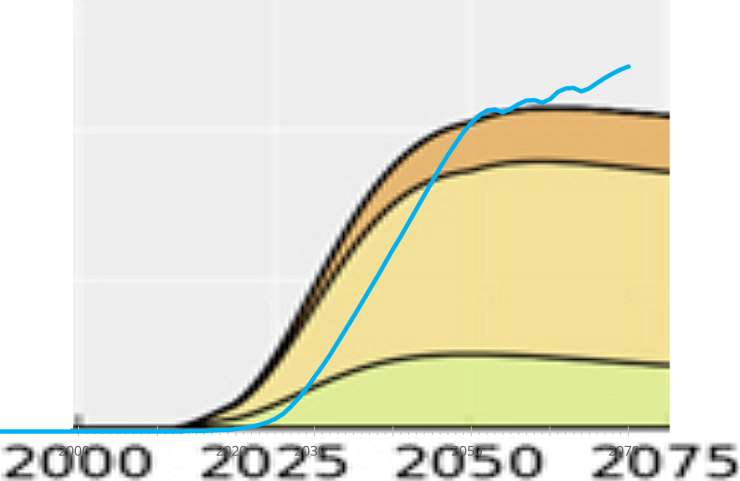
The resulting graph looks like:

Factory Depreciation limited versus Exponential Growth in Renewable Energy Production (© Gregor Hagedorn, CC BY-SA 4.0)
Factory-depreciation-limited (blue) versus exponential growth (yellow) in renewable energy production (© Gregor Hagedorn, CC BY-SA 4.0)


What did I learn?

"Exponential growth" only matters in the beginning. The vast majority of capacity increase happens between 2027 and 2051 in a near-linear fashion. Under the parameters chosen, only 7.8% of the capacity is produced under the exponential growth model. Clearly, this result depends on the growth rate and the expected lifespan of production facilities for solar panels, concentrated solar power, wind turbines, etc. The result will be similar whenever the factory lifespan is similar to the time it takes to reach the capacity growth target.

Some additional, minor observations (skip ahead, if you like):

1. Whereas under a fully exponential calculation the energy production capacity for 100% Renewable Energy is reached 2034, it takes until 2051 in the present calculation. (Note that this may still allow reaching the Paris climate goals; but also note that the calculation does not deal with issues like volatility, storage, transport, stranded assets, etc.).

2. With regard to new production capacity (factories) in the present calculation: 2027 is "peak acceleration", followed by five years in which production capacity continues to increase, but with less new capacity each year. And that is it. Under the (arbitrary!) assumption that you need at least 30 years return on investment into a new plant, it would be uneconomical to build additional production facilities between 2033 and 2051. From 20151 on, replacement of older factories and increasing demand for solar panel and wind turbine replacement creates a new market for the establishment of new production facilities.

3. Between 2051 and 2100, a period of alternating over- and underproduction occurs in the present calculation, which uses global yearly factory cohorts and an inflexible re-investment / capacity upgrade scheme. In reality, many individual factories would have different lifetimes, be upgraded at different times, and some factories might make losses and be closed prematurely. All of this would enable the markets to track demand more flexible. Still, being able to track a market which transitions from a strong growth market to a weak growth market which then transitions into an increasingly strong replacement market will be a challenge. Some Lotka–Volterra-like oscillations are in fact not uncommon in markets, see, e.g., the DRAM production in the semiconductor industry.

4. The production capacity for solar panels, wind turbines, etc. in 2017 is about 114 GWpeak/year (please comment if you think this number is incorrect!). Under my assumptions (and in order to achieve the target capacity by 2051), production capacity must very quickly rise to about 5700 GWpeak/year in 2032. It then grows slowly, through productivity increases in existing factories to a peak of 6643 GWpeak/year in 2047. The exact values and years depend on many assumptions in this calculation and are likely to be only very rough estimates. However, the estimates show that building sufficient production capacity for the energy transition is a huge challenge – and a huge market opportunity.

5. Comparing the results with the return-on-energy models from Sgouridis et al. 2016 (see the crude graph below): a) total peak capacity in 2075 is about 100 TWpeak, less than then 165 TWpeak in our calculation; b) total capacity is falling after 2050 in Sgouridis et al. 2016; c) the main growth occurs about 8 years earlier; d) the transition towards capacity is smoother, i.e. in the last 8 years capacity is added slower than in my (purely factory-output-optimized) model.
Comparison of model with result of Sgouridis et al. 2016 (© Gregor Hagedorn, CC BY-SA 4.0)


General Conclusions

The idea that a future acceleration of technological progress at an exponential rate will solve many problems has several proponents, the best known of which are perhaps Diamandis & Kotler. Their 2012 book has been widely reviewed and criticized. Patrick Tucker (2012, An Awesome Adventure to the Future) applauds them for encouraging the view that problems can be solved. But as Dale Carrico (2012, Schlock and Awesome; Or, The Futurists Are Worse Than You Think) points out, uncritical wishful thinking without regard to problems and limitations is "escapism from the real present, what it offers as solutions are nothing but distractions from problems". Gregor Macdonald (2012. 'Cornucopians in Space' Deliver a Dangerously Misguided Message – Optimism has its dangers) notes that Diamandis "is an adherent to the notion that exponential growth in technology will eventually reach a crescendo, thus offering humankind super-solutions at a kind of hyperspeed rate of change." But while technological progress is helpful and welcome, "the magnitude of the world’s present challenges cannot wait for the array of potential solutions that may start to work". He warns that "celebrating the success of solutions before they have actually arrived – indeed, well before they have arrived, is no solution at all". Michael Marien (2012, globalforesightsbooks Book of the Month) observes that the "techno-ecstatic focus of Singularity … serves to obscure the need for “soft” social technology that is of equal if not greater importance" and "questions are ignored about how the new abundance will be distributed in a world of massive and increasing inequality, where many governments are running huge deficits and hamstrung by ideological gridlock and obsolete ideas", conceding that "As inspirational futurism suggesting possibilities of a better world for all, there are certainly many good budding ideas here that may bloom."

Some of the general problems of belief in unchecked growth are very nicely exposed by Tom Murphy (2012, Exponential Economist Meets Finite Physicist) - highly recommended!

One of my own conclusions is, that exponential decay, such as the aforementioned "carbon law", makes more sense than the growth case. Overall, however, the assumption that initial large reductions can be achieved with relatively low investment, followed by decreasing reductions at increasing cost is more plausible than the case of exponential growth. Again, this cannot be repeated forever, as cost becomes prohibitive, but this is not really necessary to achieve the goals intended by the "carbon law" proposal.

My own view is that it is good to point out signs of hope and progress (some of my favorites are, e.g., Hans, Ola & Anna Rosling - do read the new book 'Factfulness', Max Roser and his co-workers, or Dina D. Pomeranz). And we all hope that innovation can solve at least some of our problems.

However, most people already expect miracles from technology. While innovation may follow exponential growth for some time, this will in all likelihood always change to a different growth model over time1. The calculations above are only an example.

Scientific limits of the earth system, economic limits (as in the example above), sociological and psychological limits of humans and their societies, as well as the potential for exponential technological growth, need to be viewed together. Ignoring parts of the system will not lead to a solution.

But worse: I see the perceived need for and the creed in endless future technological innovation as a distraction. As misleading. as prolonging our current phase of procrastination and not solving the many problems we can already solve right now.

It is not true that we are currently desperately trying to survive and have no other option than to send our own children into a slavery of food, energy and resource scarcity. It is not true that our only chance is to hope for yet non-existent technologies.

The truth is: We have the technologies, we can solve the energy (see, e.g., Bardi & Sgouridis 2017), food, biodiversity, transportation, equity, etc. problems.

But we are not using the solutions at the necessary scale. We are procrastinating and seeking excuses: whether it is that the problem cannot be solved or that they will solve themselves thanks to a sudden explosion of exponentially growing innovation. We are celebrating ourselves in the media for deploying positive solutions at small scales. At the same time, we are directing the general economy through taxes, tariffs, and subsidies at many orders of magnitude into the opposite, destructive direction.

We are not building a house for our children, we are burning it down. Our greed for money, for personal power and sex, for eating meat and other luxury foods, for playing with ivory tower problems has us care more about ourselves than about the future of our children.


Notes
1 I believe this even applies to the tech development under the scenario of technological singularity, wiping out humanity – but this is a different discussion...


References

Ugo Bardi & Sgouris Sgouridis 2017. In Support of a Physics-Based Energy Transition Planning: Sowing Our Future Energy Needs. BioPhysical Economics and Resource Quality, December 2017, 2:14, doi:10.1007/s41247-017-0031-2

Rockström, Gaffney, Rogelj, Meinshausen, Nakicenovic, Schellnhuber 2017. A roadmap for rapid decarbonization. Science 355: 1269-1271. doi:10.1126/science.aah3443

Sgouris Sgouridis, Denes Csala & Ugo Bardi 2016.The sower's way: quantifying the narrowing net-energy pathways to a global energy transition. Environmental Research Letters, Volume 11, Number 9. http://iopscience.iop.org/article/10.1088/1748-9326/11/9/094009/meta


(© Gregor Hagedorn 2018, CC BY-SA 4.0, first publ. 2018-05-15, last updated 2018-06-11. Image: a cropped version of Photovoltaic installation near Rüdersdorf, Germany, © Molgreen, CC BY-SA 4.0)

Sunday, April 29, 2018

Nuclear Fusion: is it still worth investing on it in an age of cheap renewable energy?

A review by Giuseppe Cima of the situation with nuclear fusion. The matter is complex, but Cima identifies the crucial point: even assuming that nuclear fusion were to work as expected, it would be more expensive than the presently available renewable technologies. Consider also that it will take decades before we can have fusion reactors able to produce commercially available energy (if ever). How much better and cheaper will renewables be by that time? Considering that fusion is not a "clean" technology, as sometimes claimed, it doesn't seem to have any realistic chance to be useful for something, now or in the future. So, why are we still spending money and resources on this technology? One more example of the human blind faith in technology and its miracles (U.B.)


ITER TOKAMAK, looking carefully, at the bottom right circled in red, a human in a yellow jacket. The probable size of a magnetic confinement fusion reactor is huge and it's at the core of most of its problems.

My view on nuclear fusion, in a nutshell

 by Giuseppe Cima


Nowadays few businesses would invest in conventional nuclear power stations. In the US, subsidies of 100% or more fail to attract private investments for a nuclear fission power station, the classic form of nuclear energy. So, the perspectives for a revival of nuclear are not rosy.

But there exists another form of nuclear energy, thermonuclear fusion, the one that powers the stars. Fusion, the sticking together of light nuclei such as hydrogen, is a nuclear reaction distinct from fission, where heavy atoms, such as uranium, break apart. Fusion energy research has been pursued since the WWII years in national labs and universities all over the world. Despite all efforts, though, so far it has not provided a clear indication of being feasible. What are the current perspectives of this form of energy?


Fusion technologies

There are two ways to burn hot nuclear fusion fuel: make it react very quickly before the burning gas flies away, the way an H bomb works, or use a magnetic field to insulate the plasma from the reactor walls. The bomb method can be replicated in a series of micro-explosions in the lab, but the rate has to be high enough to produce relevant electric power and this poses huge unsolved problems. A giant laser fusion experiment in the US, the National Ignition Facility, has demonstrated how difficult and expensive is to produce a micro-explosion once a day. Imagine doing that hundreds of times per second for years. Even with a budget provided by the military for weapon development, laser fusion is far away from pointing to a credible commercial reactor.

Therefore, from the inception of fusion energy research, most efforts have been devoted to magnetic confinement of steady state hot plasmas. After 70 years of trying, almost everybody in the field has concentrated on one favorite scheme which goes under the name of TOKAMAK, a Russian invention. The tests performed so far indicate that the minimum size of a potential reactor core will be large, the size of a large building. ITER, a TOKAMAK presently under construction in France to demonstrate the feasibility of fusion, is of this size but, apart from the size, it is so expensive that its construction is requiring the financial contribution of all developed nations on earth.

The doughnut-shaped ITER reactor core is 30 meter in diameter, 20 m high. It is an extremely complex device, much more sophisticated than an equivalently powerful nuclear fission reactor and roughly 10 times the volume. Its core weights more than 30 thousand ton, just the floor of ITER uses 200 thousand cubic meters of concrete.

Size is the most obvious drawback of nuclear fusion: the large size makes it impossible to mass produce these reactors. This factor gives a considerable advantage to the competition, made of comparatively small generators: gas turbines of 50-100 MW, efficient windmills of a few MW, photovoltaic solar panels of less than 1 kW. These generators can be transported by truck and the speed of their industrial development has been inversely proportional to the power of an individual module. The cost of electricity for photovoltaics and wind originates mainly from the cost of capital invested in the generator and its ancillary equipment, just as it's the case for Deuterium-Deuterium fusion where the fuel is nearly free. Natural gas power stations burn inexpensive fuel and have the lowest generator capital cost of all, but are CO2 polluters, nowadays a serious drawback.

We must specify that the fuel for fusion reactors is nearly free only in the case of the Deuterium-Deuterium fusion. The current idea, instead, is to use the easier reaction of Deuterium with Tritium, the latter being another radioactive isotope of Hydrogen. It is a very rare isotope that can be bred in the same TOKAMAK which is burning it, but not in sufficient quantity to keep these reactions going. This is another issue of ITER-like reactors, for the time being swept under the rug.

Because of its large size and complexity, it's very hard to imagine that a TOKAMAK fusion reactor could be less expensive than a conventional fission reactor and detailed present-day estimates put the cost of the kWh to more than 12 ¢, just for the capital cost, and before knowing all the details of a working reactor.

Instead, electricity commercialized from unsubsidized photovoltaic and wind generators is presently sold at prices between 2 and 7 ¢/kWh, depending on location, and there is room for more savings. These sources are intermittent, fusion is not, but for a renewable-dominated electrical production, the additional cost of energy storage would entail a fraction of the cost of energy production. This is a purely economic consideration: renewables are already less expensive than fusion energy.

There is a second very relevant drawback linked to the large size of the fusion reactor: its development time. ITER will experiment with real fusion fuel not earlier than 2035 and will realistically carry on the experiments in the following 10 years. It implies that this experimental phase, not a prototype reactor since ITER will be incapable of producing energy, will have taken roughly 50 years.

To make a dent in the world electricity production one should implement thousands of 1 GW size reactors. How long of an experimentation phase should one consider to reach this goal from when ITER will have answered the initial round of questions? Maybe 100 years, i.e. a couple of experimental phases.

To summarize, on top of a plethora of unresolved, even unknown, design issues of technical nature, magnetic fusion poses problems linked to the huge size of the TOKAMAK reactor core: a large kWh cost and a very long development time. For the ones sensitive to the "cleanliness" of fusion I also have to mention that ITER at the end of its life will present a bill of around 30,000 tons of heavily radioactive waste without having produced a single kWh. Magnetic fusion is not clean: its fuel and the products of the reactions may be modestly radioactive, but the machinery itself is not.


Why the reactor has to be large

Why a magnetic fusion reactor has to be big, physically very large? Thermonuclear fuel has been proven to burn in the H bomb, but it can burn also non-explosively, think of the sun. For any fuel to burn in steady state, the energy released in the volume of the burning matter equals the energy escaping from it, heat produced equals heat lost, the energy balance equation. The rate at which energy is produced grows in proportion to the density of the fuel, the number of atomic nuclei per unit volume. The reactor power density increases with the density of the reacting particles.

The plasma in a reactor is a gas of atomic constituents roughly in thermal equilibrium, its kinetic energy content is characterized by a pressure. If the TOKAMAK plasma has to be contained by a magnetic field, the field pressure has to be substantially higher than the plasma pressure. The magnetic pressure produced by the external superconducting magnets at the plasma location is limited at present to less than 200 atmospheres by the mechanical strength of the magnets. Improvements are foreseeable on the magnets front and they would be helpful, but the magnet materials are themselves subject to the laws of nature of solids: these improvements will be marginal.

Like in an ordinary gas, the plasma pressure is proportional to particle temperature and density. The fusion temperature has to be in the region of hundreds of millions of deg C hence, because of the magnetic pressure limit, the particle density turns out to be pretty low, a million times less than the molecular density of the air we breathe. The result is a low power density.

On the other side of the reactor power balance equation, the energy lost by the plasma is dictated by plasma turbulent motions and the size of the device. Turbulence has been experimentally demonstrated to be present at a significant level in all magnetically confined plasmas of thermonuclear interest, just like with water in a canal.

The analogy is close, for a given incline the water flow in a canal is constrained by an irreducible turbulent drag, with negligible dependence on the canal construction details. This is the case also for energy confinement in a thermonuclear plasma, it's dominated by unavoidable turbulent fluid motions. But a reacting core large enough to reach power breakeven always exists because its volume (energy production) to surface (losses) increases with its size, a purely geometric consideration. The sun, even without a magnetic field, is certainly large enough for breakeven.

These are the reasons why the tokamak reactor has to be very large. The size required to maintain the large core temperature needed for the plasma to fuse. This is the main factor making nuclear fusion expensive and very hard.


Bottom line


As things stand, present-day renewable technologies are considerably less expensive than a potential nuclear fusion reactor - even assuming it would work as expected. My work in fusion coincided with the Reagan electric sector deregulation when something similar happened between natural gas and coal-fired power stations. The development of large aviation jet engines made possible efficient, inexpensive, factory produced, electricity generators which proved to be impossible to beat and coal power plant investors went bankrupt to allow for the American industry to take advantage of the newer, less expensive, technology. It was then too early for the wind and photovoltaic revolution but now they are here to make nuclear fusion obsolete before it has been proven to work.


The author

Giuseppe Cima has been employed in various capacities by fusion research labs and Universities in Europe and the US for most of his professional career: Euratom Culham UK, ENEA Frascati and CNR Milan, the Fusion Research Center at UT Austin. He published more than 70 peer-reviewed papers in this field, mostly about EM waves for plasma diagnostic and heating, magnetic configurations, turbulence measurements. After losing faith in a deconstructionist approach to fusion, he started an industrial automation company in Texas. He is at present retired in Venice, Italy, where he struggles to protect the environment, conserve energy and teach technology and science.


Wednesday, March 14, 2018

The View From Les Houches: What Are Models For?


Sandra Bouneau, researcher and lecturer at the university of Paris-Sud, shows her model at the School of Physics in Les Houches, France, in March 2018. As you can see from the image, her model is complex and detailed. It is one of the several models presented at the school which attempt to describe the trajectory of the transition.

Overall, all the models based on physics (including Bouneau's one, as far as I understood it) arrived to similar conclusions, confirming the calculations that myself, Denes Csala, and Sgouris Sgouridis published in 2016. In practice, the transition is possible, but it won't happen all by itself. The economic system needs to be pushed in the right direction, in such a way that it will be able to provide the necessary investments.

The problem is that the system is not being pushed hard enough. Some parts of it, including the US governments, are pushing in the wrong direction, dreaming of an impossible "energy dominance" (and even if it were possible, what good would it be for America?).

At the bottom of the whole problem, it is the fact that policy-makers don't believe in models, although they may declare the opposite. There have been many models developed during the past century or so which would have created a different world if the powers that be had acted on the advice provided - first and foremost "The Limits to Growth" of 1972. But that model was not only disbelieved but positively demonized.

In the end, All models are made to search for trajectories which avoid collapse, so ignoring models ensures collapse. And that's what we are doing!


Monday, March 12, 2018

The View from Les Houches: Thermodynamics vs. Economics


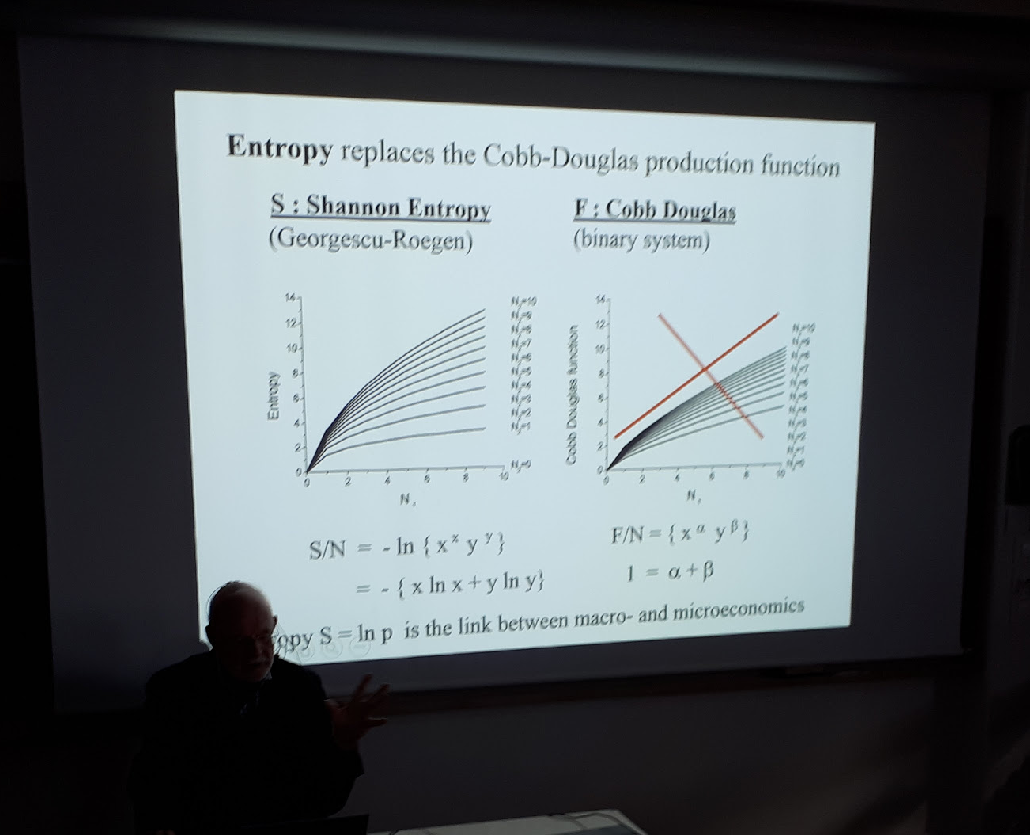
School of Physics in Les Houches, France, March 2018. Juergen Miknes shows some of the concepts that he has developed in his parallel analysis of thermodynamics and economics. It is a remarkable synthesis that you can find described in detail here. In the slide above, he suggests to replace the Cobb-Douglas function, commonly used in economics, with a function based on the concept of Shannon's entropy.

I am not sure of a number of things in Miknes' work, in particular the idea of equating (in some ways at least) the growth of entropy with the growth of production. Nevertheless, it is a fascinating work.

Something that surprised me (but probably I shouldn't have been surprised) was how strongly Miknes was challenged by an economist in the audience. Apparently, economists don't like their field invaded by those pesky physicists. So far, economists have been able to keep physics away from their secluded garden and continue keeping the field open only to people with the right credentials (according to them). For how long, it is all to be seen.


Thursday, March 8, 2018

The View From Les Houches: Saving the World Using Physics


 Above, Carey King from the University of Austin, Texas, shows his Trump socks during his talk at the meeting of the School of Physics in Les Houches, France. I strongly suggest to read King's hugely interesting paper titled Information Theory to Assess Relations Between Energy and Structure of the U.S. Economy Over Time. You may find in it aswers to questions you have been asking yourself for a long time.


The School of Physics in Les Houches, France held a session on Energy Transitions during the week from March 4th to March 9, 2018. About 70 scientists, mostly physicists, gathered in a remote village in the French Alps to discuss the energy transition, the supply of mineral resources, and climate change.

It was one more attempt by scientists to save the world. Having been there, I can say that the task is difficult but this group managed to come up with several good ideas, some of which might even work.


In future posts, I'll try to summarize some of the talks at the school. For the time being, let me just thank the organizers for the good experience:


Hervé Bercegol
Marie Degremont
Zeynep Kahraman
Jacques Treiner


Sunday, February 11, 2018

Keep on trucking? No, Keep on Platooning!


The concept of "platooning" involves electronically connected trucks running close to each other. It is a much more innovative idea than that of self-driven private cars and it has the potential of revolutionizing road transport by drastically reducing costs. (image from scania.com).


Self-driving cars (or "automated vehicles," AVs) are all the rage in the debate. In most cases, we have a lot of hype and little evidence but it is also true that such cars are not impossible. So, what can we say about this idea?

I often say that technological progress is subjected to the golden rule that it generates more problems than it solves. So, not surprisingly, the way AVs are normally proposed today they would solve no important existing problem but would bring new ones. In most cases, you are told that you'll still own a car, use it for commuting, take your family to a vacation - the only difference with AVs is that you are relieved of the drudgery of having to keep your hands on the wheel and your eyes on the road. But a recent study reports that, under equivalent conditions of owning a driverless car, people tend to log in more miles and keep their cars circling around rather than bothering about finding a parking space. Not exactly the way to reduce traffic congestion and pollution.


But there is a different application of AVs which may qualify as a true technological breakthrough. It is "platooning." (Image from The Business Times). At first sight, it doesn't look like a big innovation. Trucks running close to each other? Didn't that already exist under the name of "trailers"?

There is a breakthrough here, and it is a big one. First of all, platooning doesn't need the massive complication of a completely self-driving car. A platoon of trucks is still supposed to be controlled by humans - what is needed for platooning are sensors and actuators coupled with some computing control. Then, of course, you need safety tricks to ensure that a "de-platooned" truck doesn't run awry, but that should not be a problem. Platooning is one of those "sweet" technologies that need only existing subsystems to function.

Then, the advantages. A minor one is that a platooned truck has a lower aerodynamic resistance. But this is peanuts in comparison to the real advantage of the scheme: saving on the cost of personnel. The platooned trucks simply do what the first truck does, there is no need for every truck to have a driver. So, connect two trucks together and you halve the number of drivers needed. Connect three or more, and you proportionally reduce the cost of the human drivers.

Now, according to a recent study of the American Transportation Research Institute (ATRI), the cost of drivers represents 40% of the total transportation cost per mile (p. 24 of the report). You see how big the change could be just in terms of reducing the number of drivers.

But there is more. Right now, there is no interest in slowing down trucks in order to save fuel because the cost of drivers rises proportionally to the number of hours traveled. But for platooning it makes sense to slow down the whole train and reduce fuel costs. Slower trucks also bring fewer accidents and consequently lower insurance costs. Slower speeds also allow using smaller engines and simpler technologies. And that would also reduce the need for maintenance of roads and bridges. All these effects come together in bringing costs down.

So, platooning is a big innovation. But it must be seen in light of the evolution of the whole society. Alice Friedemann has argued in her book "When Trucks Stop Running" that trucks are a critical element of the way modern society function. Will we have sufficient resources to keep trucks running in the future, platooning or not?

Surely, a complete societal collapse generated by resource depletion or runaway climate change would necessarily ensure that the transportation system would collapse, too. But platooning could make trucking much more resilient. If trucking were to use less energy, trucks could be made to run on electric power provided by batteries or by overhead wires. Current rubber tires are made from petroleum but if the trucks slow down we won't need so much rubber as we do today and rubber synthesized from biological sources could do the job. The same is true for the asphalt of roads: slower trucks would place a lower strain on road surfaces and we might go back to "Macadamized" roads.

So, platooning is an innovation that we shouldn't ignore. And, as usual, it will have important impacts - not necessarily good. Substantially lowering the cost of road transport will make it more competitive in comparison to rail. This could further marginalize the already marginal role of railroads in freight transportation. Then, nothing prevents from platooning also buses or other kinds of vehicles, also reducing transportation costs. That might mean the end of railroads, except for high-speed trains where road vehicles can't compete.

But the truly major effect of platooning is on employment. In the US alone, there are more than 3.5 million truck drivers. Trucking is the most popular medium-skill jobs still available in most of the industrialized world. Platooning may create millions of unemployed drivers. How society will react to that is hard to say, but the shock is likely to be felt.

As usual, we move into the future driven by enthusiasm and by the idea that better technologies automatically mean better life. Platooning is just one of the new technologies which may lead us to some direction that we might not have wanted to take. But we will.


(h/t Arthur Keller)

Sunday, December 31, 2017

Are We Decoupling? (Not really, but happy 2018 anyway!)


"Decoupling": are we really so smart that we can do more with less? Apparently not: we can paint things in green, but it is not the same thing. But so is life and happy 2018 to everybody! 


Decoupling looks like an obvious idea, isn't it? After all, isn't that true that we are becoming more efficient? Think of a modern LED light compared with an old lamp powered by a whale oil. We are now hundreds of times more efficient than we were and we also saved the whales (but, wait, did we.....?). So, if we can do the same things with much less energy, then we could grow the economy without using more energy, solving the climate problem and also the depletion problem. It is part of the concept of "dematerialization" of the economy. Then we paint everything in green and all will be well in the best of worlds.

But there has to be something wrong with this idea, because it is just not happening, at least at the global scale. Just take a look at this image:

Note how closely related the GDP an the world's energy consumption are. It is impressive because the GDP is measured in terms of money flows. So it seems that money, although not a measure of power in itself, is a proxy for power. The idea that "money is power" doesn't seem to be just a metaphor.

Now, by carefully looking at the curve, we could say that we have been doing a little better in recent years. That is, we seem to have been able to produce a little more GDP for the same amount of energy. But there are two problems: the first that the divergence we see today is not larger than anything we have seen during the past 50 years. The second that this is NOT decoupling as it is normally defined, that is, the ability to grow the economy (the GDP) while at the same time consuming less energy.

Of course, we may argue about the definition of decoupling, but nothing short of a complete inversion of the current trend would allow us to keep growing while, at the same time, avoiding the double challenge of climate change and of mineral depletion. But if that were happening, you would see the little circles in the graph completely change the slope of the curve, forming a kind of "hockey stick" shaped curve. That's not the case, obviously.

Actually, if you really eyeball the curve, you can see a small hockey stick that occurs at points 14-16. These points correspond to 1979-1981, a historical phase of reduced energy production during the most difficult moment of the great "oil crisis." For about three years, at that time, we had true decoupling, but it was hardly something pleasant or that we would want to repeat today in the same terms.

In the end, society needs energy to function and the idea that we can do more with less with the help of better technologies seems to be just an illusion. If we reduce energy consumption, we'll most likely enter a phase of economic decline. Which might not be a bad thing if we were able to manage it well. Maybe. Calling this "a challenge" seems to be a true euphemism, if ever there was one. But, who knows? Happy 2018, everybody!


__________________________________________________________
__________________________________________________________

Further notes: all the above is at the global level for the total (primary) energy production. It doesn't mean that some kind of decoupling can't be obtained at the regional level or for some specific kinds of sources. So, let's take a look first at the regional level:


I haven't been able to find the origin of this graph, but it seems to be legitimate (note how the axes are exchanged with respect to the one I showed before). The curves for single states are noisier than those for the global economy, which may indicate that states move high energy intensive activities from one to another. But, overall, the linear relation between GDP and energy consumption remains the same. We see "hockey sticks" (for Russia, for instance) they correspond to major economic crises, again not something that we would like to have.

Now, let's see some data for specific energy sources. The case of crude oil is especially interesting. Here, I am reporting some data from a paper by Michel Lepetit, of "The Shift Project" (h/t Thierry Caminel)


We clearly see here the hockey stick of the energy crisis o 1973-1982; it is much more evident for crude oil than it is for the aggregated world energy production. Note also how the slope of the curve of GDP vs. Production changed after the oil crisis. Evidently, the world's economy emerged from the crisis less reliant on crude oil: a certain degree of decoupling had occurred. 

But note also that the slope of the curve from 1982 onward still shows a positive dependence of oil production vs. the economy. A true "decoupling" would mean inverting the trend, as shown below (again from Le Petit's paper), where we see what we expect from the IEA scenarios


As you see, true decoupling is quite a challenge. We saw that kind of slope change only for the great oil crisis of the late 1970s. Maybe we could see it again, today, only for another comparable crisis. 

Nevertheless, I don't think it is impossible to decouple from crude oil. As I argued in a previous post, the oil industry may be facing a "Seneca Cliff" as the result of the contemporary challenges of depletion and of technological change in transportation. But that would mean little to save humankind from a climate catastrophe if it is compensated by an increase in the production of energy from other dirty sources, say, coal.  And so, we keep going and the future is waiting for us. 


Sunday, November 26, 2017

Why do we need jobs if we can have slaves working for us?


We normally assume that anything that creates jobs is a good thing, but is it, really? Is our current prosperity related to having "jobs"? Isn't it, rather, the result of the large number of "energy slaves" working for us in the form of fossil fuels? Today, everyone of us has probably more slaves in terms of available energy output than even the richest in the ancient world could have. But, in the ancient world, the rich Roman patricians knew the source of their wealth and practiced "otium" (a term untranslatable in English) intended as the search of pleasure and knowledge free from the needs of everyday survival - with their human slaves taking care of that. In our times, instead, we tend to neglect, or even actively deny, the role of our fossil slaves. We state, and maybe even believe, that our antics ("jobs") are what makes us live and we engage with gusto in the equivalent of digging holes in the ground and filling them up again: it seems to us a good way to please the deity we call "dʒiːdiːˈpiː" (or "GDP"). And we think that if the GDP God doesn't seem to favor us so much anymore, it is because we didn't dig enough holes, or not deep enough, and so we engage in a frenzy of more hole digging and hole filling which we call "job creation". But, deep down, we know that, sooner or later, our fossil slaves are going to evaporate into thin air and leave us to do the work ourselves. (U.B.)

This is a post by Nate Hagens and DJ White. Rich in ideas and concepts, it is longer than the average post on Cassandra's Legacy but well worth the effort of reading, savoring each sentence in it.  


Working drafts copyright ©2010-2017 - Not to be reproduced in any form without the explicit permission of the authors


by NJ Hagens & DJ White, EarthTrust


First, some review of relevant points:

BASIC

1. Fossil carbon compounds are incredibly energy dense, as their formation and processing was done by geologic forces over deep time. One barrel of oil contains about 1700 kWh of work potential.Compared to an average human work day where 0.6kWh is generated, one barrel of oil, currently costing under than $50 to global citizens, contains about 10.5 years of human labor equivalence (4.5 years after conversion losses).

2. As such, these ‘fossil slaves’ are thousands of times cheaper than human labor. Applying large amounts of these ‘workers’ to tasks humans used to do manually or with animals has generated a gargantuan invisible labor force subsidizing humanity – building the scale and complexity of our industry, complexity, population, wages, profits, etc.

3. GDP - what nations aspire to - is a measure of finished goods and services generated in an economy. It is strongly correlated with energy use, and given that almost 90% of our primary energy use is fossil fuels, with their combustion. 'Burning stuff' (measuring how much primary energy is consumed) is a reasonable first approximation for GDP globally.

4. Regionally and nationally this relationship can decouple if the ‘heavy lifting’ of industrialization is done elsewhere, and the goods (and embodied energy) imported. (e.g. China). The relationship between global energy use (which is ~87% fossil fuel based) and GDP remains tightly linked.

ADVANCED

5. The common political mantra that higher GDP creates social benefits by lifting all boats has become suspect since the 2008 recession and ‘recovery.’ For the first time in the history of the USA, we now have more bartenders and waitresses than manufacturing jobs. In order to
maximize dollar profits, it often makes more sense for corporations to mechanize and hire ‘fossil slaves’ than to hire ‘real workers.’ Real income peaked in the USA around 1970 for the bottom 50% of wage earners.

6. GDP only measures the 'goods' and doesn’t measure the 'bads' (externalities, social malaise, extinctions, pollution). Actually, natural disasters like oil spills and hurricanes are ostensibly great for GDP** because we have to build and burn more stuff to replace the damaged areas. (**Note, only to a point – once a country – e.g. Haiti or the Philippines - cannot afford to replace what was lost, then natural disasters become a sharp negative to GDP as infrastructure underpinning future GDP is lost and can’t be rebuilt)

7. On an ‘empty planet,’ pursuing GDP in order to gainfully employ people (and distribute money so they could buy needs and wants) seemed to make sense. However, on an ecologically full planet pursuing GDP with no other long-term plan is using up precious natural capital stocks just to maintain momentum and provide people brain-pleasing neurotransmitters.

8. There are numerous alternative measures to GDP that incorporate well-being and happiness and subtract environmental ills. But it won’t be easy to switch objectives from GDP to e.g. G.P.I. (Genuine Progress or Happiness) because the present creditors will expect to be paid back in real GDP ($) rather than happiness certificates. Still, over time, strict metrics of success based on consumption alone are likely to change.

9. There will likely be a growing disparity between ‘jobs’ (occupations that provide income and contribute to the global human heat engine) and ‘work’ (those tasks that need to be accomplished by individuals and society to procure and maintain basic needs). However, at 2015 USA wage rates, moving from $20 per barrel (the long-run average cost for oil), to $150 per barrel, the army of energy slaves declines from 22,000 per barrel to under 3,000 – meaning the economy shrinks and therefore much more work needs to be accomplished via efficiency improvements, real humans, or making do with less.

10. Our institutions and financial systems are based on expectations of continued GDP growth perpetually into the future. No serious government or institution entity forecasts the end of growth this century (at least not publicly).

_______________________________________________________________


Okay. Let’s unpack all of this a bit.

Often in the news today, you'll hear people talking about job growth and job creation like it's a good thing. Everybody wants a good job, right? The more jobs we have to do, the better off we are!

Yet if you kick open an anthill or a beehive, the insects will not be grateful for the sudden boost in job creation, and they will effectively utilize the cross-species language of biting and stinging to inform you of this opinion. From this we may infer that insects don't understand economics.

Alternately, it could it be that ants - having honed their behaviors for 130 million years and having attained a total biomass we have only recently (and temporarily) matched - might be in tune with some deep realities about jobs, energy, and the embodied cost of building complexity.

Since this is Reality 101, let’s ask some basic questions. What ARE jobs, really? How do they relate to energy and wealth? How do we keep track of whether we’re richer or poorer? We all kinda feel like we know. And (as a general rule) whenever “we kinda feel that we know” is the case, we should probably take a closer look.

To do so, we’ll first need to add a few things to our story about ants. We need to revisit our invisible energy slaves, discover what “freaks out” capuchin monkeys, and think about what wealth actually is.

Energy Slaves again

As you recall - and as we’ll discuss in greater detail as the course goes on - every American has over 500 invisible energy slaves working 24/7 for them. That is, the labor equivalent of 500 human workers, 24/7, every day of the year, mostly derived from burning fossil carbon and hydrocarbons.

Every American thus has a veritable army of invisible servants, which is why even those below the official poverty line live, for the most part, lives far more comfortable and lavish with respect to energy and stuff than kings and queens of old (but obviously not as high in social status). Being long dead and pulled from the ground - and thus a bit zombie-esque - these energy slaves don’t complain, don’t sleep, and don’t need to be fed. However, as we are increasingly learning, they do inhale, exhale, and leave behind waste. Since they’re invisible, we don’t think about these fossil helpers any more than we think about nitrogen (which happens to be 78% of what we breathe in, but hey, it’s just “there”, so why think about it?) Same with our 500 energy helpers. The extent we think about them is when we fill up at the pump or pay our electric bill – and then only as an outlay of our limited dollars.

We use the “slave” metaphor because it’s really a very good one, despite its pejorative label. Energy slaves do exactly the sort of things that human slaves and domestic animals previously did: things that fulfilled their masters’ needs and whims. And they do them faster. And cheaper. Indeed, it probably wasn’t a big coincidence that the world (and the USA) got around to freeing most of its human slaves only once industrialization started offering cheaper fossil-slave replacements.

The things we value are created with a combination of human and energy-slave work combined with natural capital (minerals and ores, soils and forests, etc.). There are huge amounts of embedded energy in the creation and operation of something like an iPad and the infrastructure which makes it work. When we tap our screen to view a kittycat picture, the image is pulled from a furiously spinning hard drive which may be halfway around the planet, propelled by some fossil slaves, and routed through data centers which are likewise fueled. The internet uses over a tenth of the world’s electricity - that’s a lot of energy slaves. The infrastructure itself has taken decades to build, and requires constantly increasing energy to maintain. But we don’t think much about that either.
So the internet is infrastructure we have invested energy in, just like a built anthill has been invested in with ant labor. If the internet (or an anthill) was destroyed and needed to be rebuilt, that situation would certainly create jobs. But it would also require a lot of energy, raw materials and work. Ants don’t have energy slaves, so they don’t want more work to do. They are dealing with finite energy inputs in their ecosystem. If more energy (ant-labor) is devoted to rebuilding the anthill, less energy is then left to care for the larvae, forage for food, and defend the hive.

Energy slaves don’t care either way about job creation. (Being zombies and all). But why do we?

Everybody wants a good job.

Remember this, because it’ll come up again and again in Reality101: evolution works with what it’s got. It’s a stepwise process, and each step is based on what was available in the step before. This is true both for biological and social evolution. That’s why there are no animals on the Serengeti with wheels: there’s no viable path to evolve wheels from feet, because even if there was a way of designing animals that had wheels, there are no viable intermediate stages. Hold that thought…

Now in times past, a human’s career, their societal function, was largely about their own individual labor and skills. A blacksmith worked with metal. A cooper made barrels. A shoemaker made shoes.

Others made furniture, cloth, or other valuable commodities. Farmers created food. Preachers preached. Others did simpler labor like digging ditches or cutting down trees. The relative value of their labor was roughly set by how much other humans valued the end product of such labor, so a skilled blacksmith might be able to trade his services for more status and better accommodations than a ditch digger. Thus, it became an integral part of human culture that the products of some work were considered more valuable than others. It became a mark of social status and pride to have such a career. Hold that thought too, we’ll be coming right back to it.

Cue the Screaming Monkeys.

“Equal Pay for Equal Work” is currently the slogan for those opposed to sexual discrimination, which is usually characterized by women getting paid less than men. And it’s a sentiment which has deep roots in the ape and even simian mind.

If you give capuchin monkeys the “job” of doing a nonsense task in exchange for a reward, they will happily do it all day long as long as they keep getting a reward - cucumber slices. But if a capuchin sees the monkey in the next cage get a (better tasting so higher value) grape while it still gets a cucumber slice, it’ll go ape, throwing the cucumber slice in the face of the experimenter in a rage. It gets the same cucumber slice it has been happy to work for before, but it no longer wants it, because it no longer feels fair in comparison to its cage mate’s effort and reward. Instead, it wants the experimenter and the other monkey to be punished for this inequity (we watched this video of Frans de Waals experiment in class).

Think for a moment how central this monkey reaction is to the human world around you. We’ll come back to it later in the course, and will refer to the term “capuchin fairness” because a similar mechanism turns out to be behind a great deal of human behavior. We’re outraged at the notion of somebody getting more reward than we do for doing the same thing. Indeed, many large-scale human institutions now stress perceived fairness of process over quality of end results. (A prominent example might be the US Congress). Moreover, this monkey-business also reiterates the concept of relative wealth being more important to a monkey mind (and a human mind, it turns out) than absolute wealth, which is kind of nuts, but that’s monkeys for you.

It turns out that our brains are simultaneously trying to optimize two different, and somewhat incompatible pursuits, both of which have deep evolutionary roots in our social species. One is energy gathering and wealth creation: obtaining food, procuring clothing and shelter – basically optimal foraging theory applied to the human biological organism. The other is equitable social distribution and transparency of process. A tribe of hunter-gatherers needed to cooperate as a mini super-organism to get food and defend territory and stand together against competitors. But within the tribe, an individual’s success depended on it getting a reasonable share of what the tribe had. We’re descended from tribe-members who insisted on at least their fair share, as is every living capuchin, so it’s not surprising it’s such a strong feeling. But when both of these instincts are operating simultaneously, in an era where our species happened upon a buried treasure of fossil pixie dust, some interesting practices emerged…

Ok. Ants. Monkeys. Energy Slaves. So where did “jobs” come from?

A funny thing happened on the way to the Anthropocene. To an ever-increasing degree over the last two centuries, wealth has been created more by fossil slaves than by human labor, significantly more - and it’s at its all-time peak about now. (you’ll have the information to derive this yourself by the end of this course).

If you don’t believe that, try hiring a bunch of people to push you and your SUV around hundreds of miles per week with their own muscles and see what it costs you, and then see how little it costs you to buy the same work in a tank of gasoline. In fact, the vast majority of the tasks and stuff that used to be done by human labor is now done by fossil slaves and the infrastructure they have enabled. The slaves have also made shipping nearly free, so any actual human labor we need can also be hired in the cheapest places on earth (under essentially slave labor conditions), and shipped to us by planes, trains, ships and trucks for next to nothing. So rather than buying furniture from local artisans, we make local firms compete with furniture made halfway across the world which is cheaply shipped to a local store. To a good first approximation, the USA doesn’t make anything anymore (well, movies…).

We have amassed a huge amount of wealth, even if much of it is dumb stuff like plastic toys and salad shooters and things that quickly break. There are so many things we think we want, so we get them. We eat salads with fresh veggies which may be grown 5000 miles away and air-flown to our stores by energy slaves running the planes, refrigerators, trucks, and stores. The average dinner travels over 1400 miles to get to your plate in USA.

We increasingly buy disposable everything - used once and tossed away. Most everything is short-life these days; when your authors were young if you bought a fan, you expected it to last 20+ years. Now if it lasts 2-3 before you toss it, that’s about par for the course. Planned obsolescence exists because it’s “good for GDP.” A new dishwasher now lasts 6-8 years when it used to last 12-16, because they now have integrated cheaper electronics that fail. Our GDP has become tethered to rapid product-replacement cycles keyed to our short attention spans and our enjoyment at buying new things. This creates “jobs” for car salesmen, advertising executives, etc., but has tilted the scales in favor of “useless GDP” rather than real societal utility. We know how to make things with high quality that last, but due to time bias and the financialization of the human experience, such an objective is relatively unimportant in our current culture. Many people get a new phone every 18 months with their cell plan, and perfectly functional ones wind up in the landfills.

But how should we distribute the largesse of the energy slaves? Does everyone get equal shares? Do we take the total number of dollars (which is the way we count such things) created by energy-slave work and divide them equally among the population?

Heavens no. We haven’t even acknowledged that the energy slaves are responsible. Rather, with a bit of help from opportunism, social evolution co-opted the pre-existing “work for pay” concept into an uneven distribution system that “felt” fair.

These days there are a lot of jobs in the USA, which keep us very busy not making much of anything of long term value. We do advertising, hairstyling, consulting, writing, and a lot of supervising of the things our fossil slaves do. We don’t care all that much what we’re doing as long as we feel we’re getting paid at least as well for the same task as the other capuchins – er... people - around us, and that with our compensation we can buy things that give us pleasing brain-reward experiences. These days in this culture, a “good job” is defined by how much it pays, not by what it accomplishes. Many people would consider it an optimum situation, a great job, to sit in a room for 40 hours per week and make $100,000 per year, just pulling a lever the way a capuchin does for a cucumber slice. You know they would (would you? Think about it. Now think about how that compares to the career you’re currently planning).

And that’s where the perceived equality is: the equality of inconvenience. The 40-hour work week is a social threshold of inconvenience endured, which is now what we keep primary social track of rather than the productive output of a person’s activity. In 1930 John Maynard Keynes predicted that wealth would increase 600% in the next century (which is only 15 years away) and because of this wealth, people would only need to work 15 hours per week. He was right about our wealth increase, but paradoxically, we are working longer hours than ever! Because socially, everyone who isn’t a criminal is supposed to have a job and endure roughly equivalent inconvenience. Any segment of society which went to a 15-hour work week would be treated as mooching freeloaders, and be pelted by cucumber slices and worse.

In a society in which we’re all basically idle royalty being catered to by fossil slaves, why do we place such a value on “jobs”? Well, partly because it’s how the allocation mechanism evolved, but there also exists considerable resentment against those who don’t work. Think of the vitriol with which people talk about “freeloaders” on society who don’t work a 40-hour week and who take food stamps. The fact is, that most of us are freeloaders when it comes down to it, but if we endure 40 hours of inconvenience per week, we meet the social criteria of having earned our banana pellets even if what we’re doing is stupid and useless, and realized to be stupid and useless. Indeed, a job that’s stupid and useless but pays a lot is highly prized.

So “jobs” per se aren’t intrinsically useful at all, which is why ants don’t want more of them. They’re mostly a co-opted, socially-evolved mechanism for wealth distribution and are very little about societal wealth creation. And they function to keep us busy and distract us from huge wealth disparity. We’re too busy making sure our co-workers don’t get grapes to do something as radical as call out and lynch the bankers. Keeping a population distracted may well be necessary to hold a modern nation together.

And since most of our wealth comes from invisible, mute slaves we don’t even think about, it isn’t clear to us that what we’re actually doing in current economies is distributing the wealth they create.

That means we can now have wild disparities in pay, as long as it “feels like” others are doing something qualitatively different. The amount paid to a wall street vice president is hugely greater than that paid to a college professor, which in turn is greater than that paid to an environmental campaigner. This has pretty much nothing to do with the relative worth of each function to society, and everything to do with how well-connected such jobs are to the flow of energy-slave-created wealth. Yet if higher pay is received by someone in another “tribe” who we don’t directly interact with, we don’t feel the urge to scream and throw our paycheck. We just wish we had a “better” job.

If we reflect on the possibility that we have en-masse simply accepted the premise that the job is somehow paid what it’s worth, we arrive at some disturbing conclusions. Is a teacher, farmer, or fireman really of less value to society than a real-estate flipper? The amounts paid for jobs have been allowed to float freely, detached from actual societal value as the degree of political connectedness of those with such jobs varies. The vast majority of our wealth comes from primary natural capital in tandem with fossil slaves and from the fruit of empire; jobs are mostly an ad-hoc mechanism for distributing this wealth unequally in a way which effectively conveys the illusion of egalitarian process.

For now, are most of us just idle princes and princesses in a fossil-slave kingdom, none of us really at huge risk, and mostly doing things which have little net value? And what happens when our fossil slaves grow wings and fly away into the atmosphere? What will the princes and princesses do then?

That’s just Gross.

This leads us to the story of how we keep track of our wealth and productivity and success. How DO we keep track of that collective wealth anyways?

Well for real wealth, mostly we don’t. The value of a healthy ecosystem, clean air, seas full of fish, fresh drinkable water… love, joy, happiness and fulfillment… all these things our market system considers to be of essentially zero value. Armadillos, dolphins, hummingbirds, rainforests… you get the idea.

But our economists have a metric called “gross domestic product” GDP which is what our society uses to roughly keep track of our ‘success’. It represents the dollar value of all finished goods and services produced in a time period (typically, a year) within a nation’s borders. Since that other stuff- you know, the natural world- doesn’t consist of finished goods and services, it isn’t counted (now if you kill the hummingbirds and make them into ornaments for hats, or turn armadillos into ashtrays, they then can be added to GDP because they’re now products which are “finished”!).

The fact that parts of the environment which have been “finished” are considered more valuable than parts which are “unfinished” is one way in which GDP sets a fairly screwy default value in our current world. It’s a tacit societal value system: anything without a transacted money value isn’t part of GDP. So a nation which chops down all its trees to sell to another country for firewood has a better GDP than one which leaves its trees standing. It’s a funny way to figure wealth, but it’s what we’ve got. And oh, by the way, we’re betting everything on it.

GDP is based on money transaction (money is, roughly speaking, a claim on future energy), and since most current wealth is created by our fossil energy slaves, GDP is directly tied to the energy burned by society. Indeed, it has recently been shown that GDP is tied to fossil fuel energy, and thus CO2, in a way which may be described very simply by treating human society as essentially a giant heat engine. In other words, a very simple model which treats human civilization as an essentially mindless consumptive system - a thermodynamic amoeba in search of energy - suffices to match the GDP with the quantity of energy burned.

And over the last 100 years, our burning of energy, and thus our world GDP, has gone through the roof. The number of dollars representing the wealth created from the burning has also increased, and exponentially so in the last 50 years, and since the 2008 crisis, even faster.

It may be reasonable to reflect that during this same period, sometimes called The Great Acceleration, the planet has been largely laid to waste, a mass extinction has accelerated, the seas have been depopulated of most fish, and the systems which sustain large complex life on earth have been progressively compromised. Yet we continue to grow the scale of the heat engine to accomplish the primary objective of the modern human economy: to maximize dollars and jobs.

Bear in mind that what we’re doing - if we get right down to it - is converting trillions of watts of fossil-slave energy into a few watts of pleasing stimulation inside our brains. (alternately: tiny amounts of brain-reward chemicals) And the side-effect of this process is all around us. Mountains of waste, acidified oceans, altered climates, pollution, mass extinctions, and mischief. Here we use “mischief” as the general term for things humans do en-route to pleasing themselves, which may include building racetracks, using disposable diapers, making wastebaskets out of elephant feet, overbuilding fishing fleets, throwing out our electronics every two years to replace them with new ones, etc. It doesn’t “feel like” waste at the time. But if you ask someone in 200 years what percent of fossil magic was wasted, they will likely say “all of it,” because not much useful fossil fuel (or anything previously built with it) will likely remain.

The ubiquity of fossil slavery during our lifetimes has caused us to conflate wants and needs. Most of what we “feel like” we need these days is nothing we evolved to need. Consumerism is driven largely by social competitiveness. Most capuchins – er…, people - find it more important to have a bigger house than their neighbors, than to have an even bigger house in a neighborhood where it’s the smallest one. Relative wealth - it’s not just for monkeys (we and the monkeys like fairness, but it feels more fair if we’ve got stuff at least as good as the people we interact with).

And this signaling of status is important socially and sexually. A lot of the things we feel we need are just for show.

And do you remember the “hedonic ratchet” effect from earlier discussions on bias, heuristics, fallacies and delusion? To get the same mental stimulation we got yesterday, we require the expectations of ever-increasing reward. That means more money and more energy slaves. Or at least the expectation of same.

Happiness is not correlated with wealth beyond having the basics of life covered. Most of the things which actually make us happy, joyful, and fulfilled are in our virtual mental worlds, and not in the physical world at all. A Filipino may have only a small percent of the number of energy slaves as an American, but be every bit as happy, and surveys have shown that to be true.57 It’s quite possible to be “poor” and happy. Equally, it’s quite possible to be rich and miserable. Our brains are even primed for it, seemingly.

So where does this leave us?

Well, you already know that our amoeba-like heat-engine of an economy is wrecking the earth, acidifying the seas, melting the polar caps, causing what could become the greatest mass extinction in 65 million years, and throwing our future into doubt.

But at least we have our good ol’ energy slaves to continue creating GDP. Right?

Well…

Thing is, the energy slaves will soon be going away forever. In the last 30 years we’ve burned a third of all fossil energy that has been used since it was discovered thousands of years ago. Since your authors have been alive, humans have used more energy than in the entire 200,000 year history of homo sapiens.

We are just now passing through the all-time peak of liquid hydrocarbon availability, which is the chief driver of our economies due to its special attributes.

Each year, basically from now on, most of us will have fewer fossil energy slaves marching behind us. You’d think this wouldn’t make much difference, right? Since they’re invisible anyhow? But in fact it’ll make a great deal of difference, because we’re heading back into times – either gradually or suddenly, but inexorably - in which human labor makes up an increasing percentage of the total energy we have available. One day human (and perhaps animal) labor will again be the majority of the work done in human societies – just like it is in an anthill.

And this will happen in the context of a more used-up natural world. Rather than being able to catch dinner by throwing a hook in the nearby ocean, the nearest healthy schools of fish may be ten thousand miles away in Antarctica, and hard to get to without dirt-cheap energy slaves to make giant refrigerated ships to pursue and move them around for us. The copper mines will be mostly used up. The inorganic phosphate deposits we used to make fertilizer, mostly gone. And so on.

Or rather than “gone,” let’s use the more accurate term energetically remote. That is, there will still be loads of “stuff” underground, but it won’t be the very pure ores of yesteryear. It’ll be stuff that requires digging up a huge amount of rock for a tiny amount of whatever we’re after. Because (remember the Easter candy story) we always use the best stuff first. Yet we’ll be going after worse and worse ore with fewer and fewer slaves. And the heavy breathing of the fossil slaves will have pulled our seas and climate back towards conditions in which they were born - a hellish primordial world of toxicity.

This all raises the question - or at least should - of whether it might not be a good idea to set the fossil slaves free and let them rest, since they’re going away soon anyhow and when they do we will really need a livable planet. They don’t need jobs, and we don’t need dollars for happiness. Yet this flies in the face of capuchin entitlement and evolved mechanisms for brain reward, which – in effect - take our current societal arrangements for granted. As our fossil slaves eventually retire – childless –we might have to rediscover the difference between jobs and work, just like the ants.

On GDP, Stone Heads and Babies


“Can you think of any problem in any area of human endeavor on any scale, from microscopic to global, whose long-term solution is in any demonstrable way aided, assisted, or advanced by further increases in population, locally, nationally, or globally?” Al Bartlett

So other than using up non-renewable resources and degrading the natural world, what other consequences can there be when maximizing GDP is our plan for the future?

Well, for one thing, it can lead us to really screwy societal choices.

For instance in the infamous Easter island culture, there was an organizing belief in belief that all food, resources, and other good things came from their dead ancestors, and that the way to make your dead ancestors happy was to build giant statues for them. This was actually not that different an organizing concept from GDP, in that both exhibit a near-hallucinatory level of disconnect from physical reality and ecology.

As ecological changes on Easter island worsened due to rats cutting into food supplies, it “made sense” to vastly ramp up the production of giant stone statues, making them ever-bigger (and hence presumably more pleasing to the dead ancestors... “too big to fail”, perhaps...). This was a colossal undertaking for a stone-age people using human muscle power, and required a lot of wood for rollers and leverage. So they cut the trees down, which caused erosion to begin washing away their productive farmland.

The worse things got, the harder they worked making stone giants. The final generation of stone giants never left the quarries - they were too big to move. As a part of this process, eventually the last large tree was cut down, which made sense based on their organizing beliefs, but was in retrospect not a good plan. It not only meant their fertile soil washed away, but meant they could no longer make boats to go fishing. So they starved, fought, and suffered a lot as their populations crashed.

For the Easter Islanders, erecting these stone monuments was an example of “jobs” masquerading as “work” - basically tasks done for social-obligation reasons that did not provide actual biological or group-fitness benefits. (do you think there may be modern-day equivalents?)
Today it’s easy to joke about these islanders and their “giant stone heads” as a high point in the history of human doofus-ness. Yet our adherence to GDP is a similarly skewed metric, equally detached from the realities of ecology, from human happiness, and from the potential for future generations with decent life quality. On a much larger scale, we too are eroding farm land (which these days is largely a dead medium used to hold the seeds in place and receive industrially-produced fertilizer and pesticides), destroying the ability to get fish (by wiping out fisheries), and, because of our numbers, mucking things up to a degree the Easter Islanders never reached.

We’ve already mentioned that - due to being blind to the energy slaves who do nearly everything for us - we now tend to conflate “jobs” with “work”, where “jobs” are just a social distribution mechanism for energy-slave largesse - an entitlement entwined with social status - and “work” is what is necessary to temporarily improves an individual, tribe, nation, or species’ circumstances.

We’ve also noted that we have folded “planned obsolescence” into most built consumer devices, so they break more quickly and require replacement, tuning their life-cycle to human whims and brain rewards rather than to real utility. Mostly we don’t really even want or expect gadgets to last as long as they used to; as long as we can afford it, we want the newer, cooler, stuff. And advertising helps keep our culture primed for it.

The fact is, we have designed a social system that requires growth. Money –really a claim on future energy and resources – comes into existence irrespective of whether such future energy and resources will be available. Each year we need growth in a household/city/state/nation/world to service and pay off monetary loans that were created previously. No serious government or institutional body has plans for anything other than continued growth into the future. Growth requires resource access and affordability but starts first with population.

So, right as our energy slaves are about to start going away forever, leaving 7-10 billion humans without the things they have come to take for granted, our nations have decided the answer is to make more babies! Yep, to raise GDP you need more demand for toys, diapers, teachers, etc… more jobs, because more jobs means more transactions which means more GDP! More GDP means “growth” so growth is good! China has just reversed its 1-child policy, which prevented massive starvations and slowed the horrendous assault on China’s environment. Many other nations, such as Japan, Germany, and Sweden, are now offering bonuses for getting pregnant. In Denmark advertising firms are encouraging couples to have more babies for the good of the economy via sexy commercials.61

Paradoxically, as traditional drivers of GDP growth – development of virgin land, credit expansion, low cost fossil fuels, and groundbreaking innovation- wane in their impact, there may be renewed incentives proposed not to shrink our population as ecology would advise, but instead to grow it! Currently we are having (as a species) over 120 million babies per year. This works out to over 335,000 human babies born every day – compared to a total extant population of all the other Great Apes (bonobos, chimpanzees and gorillas) of about ~200,000! Since ‘demand” is considered a quasi-magical force in current economic theory, babies are considered to be good for business (yet children brought into the world now for GDP reasons will face some real challenges in their lives. Nate and DJ decided not to do that for a host of reasons).


China is building massive empty cities now. No kidding. Cities with nobody in them, ready to be moved into by the bonus babies to grow GDP. That’s edging perilously close to building giant stone heads.

When you get right down to Reality101 and the intermediate human future, this is actually worse than building giant stone heads, because stone heads don’t suffer, reproduce, or require further degradation of the ecology to provide for. In many real ways, the world and human species would be far better off if we immediately moved from GDP to “giant stone heads” as a metric for success (and say, doesn’t that imply to you that we might even do better than giant stone heads, if we put our minds to it?).
GDP sets a money value on everything in the natural world and in human experience, and the most important things are currently valued at or near “zero.” Yet as we’ve seen, GDP is currently tied to the work of fossil slaves, who will be gradually flying away. There’s no way, even in principle, for “growth” such as we’ve recently seen to continue indefinitely, and considerable data points to it ending quite soon. GDP will begin a long decline because it’s tied to finite realities in the physical world.

The good news, of course, is that GDP is an insane metric for success, just as “giant stone heads” was (though to give the Easter islanders their just due, at the time they had no evidence their belief was nuts, while in 2016 we have demonstrable proof that the conclusions of neoclassical economics are refuted by basic science). If we decide that we value happiness, quality of life, and a healthy planet with uncounted thousands of human generations left, we could in principle jettison GDP and do things differently.

It won’t be easy, only necessary. It’ll be easier to fail than succeed, for the societal inertia of a raging amoeba hungry for growth is a hard thing to change. Nothing much depends upon it other than the human destiny and the fate of complex life on the planet.

Learn to see the giant stone heads around you, and think about them.


Who

Ugo Bardi is a member of the Club of Rome, faculty member of the University of Florence, and the author of "Extracted" (Chelsea Green 2014), "The Seneca Effect" (Springer 2017), and Before the Collapse (Springer 2019)