Showing posts with label disinformation. Show all posts

Thursday, June 11, 2020

You are What you Read: How to Manage your Personal Echo Chamber


Mr. Trump has often being accused of "lying" in his many speeches and tweets. For sure, much of what he says can be said to be "contrary to fact." But is the president really lying or is he simply stating what he thinks truth is? One man's lies are another man's truth. And the problem is that people tend to see the world according to the different echo chamber in which they live. Everyone seeks for facts that support their opinions. We badly need to take control of the information flow that we receive and I think we can do that. Let me show you how I try to do it by disclosing my personal information bubble.


Not long ago, I stumbled in a comment on "Quora" for the question, "Why do some people deny climate change? Here is a shortened version:

CO2 levels of 400 ppm being dangerously high are not accepted by scientists I find credible. There is no significant sea rise. The temperature has not changed by even 1 degree C. over the past century. Climate Change has not increased hurricanes or their intensity. I may rethink this if there is an undoubtedly measurable change in the level of the seas, or a decade long temperature rise.
Now, if you are an average reader of "Cassandra's Legacy" you'll agree with me every statement in this paragraph is wrong in the sense of being "contrary to fact." But I am sure that the writer of this paragraph is a good person. He signed with his full name and I could see his profile. I think that if he were a neighbor of mine we could be good friends (as long as we would avoid discussing climate science!). He truly believes in what he says and he thinks his vision of the world is the right one.

What's wrong here? How can it be that "truth" is so different depending on the viewpoint? The problem is that we all live in an "information bubbles" or "echo chambers" where views are shared with other members of the same bubble/chamber. And if everyone thinks that something is true, then it is very difficult for a single person to deny that something -- even to imagine that it could be completely false.

So, we badly need to take control of the information we receive. We need to select trusted sources and balance the voices we hear in such a way to see things from different viewpoints. Otherwise, we are easy prey for the simplest propaganda tricks, continuously used against us. Silly tricks, but they work. And they work very well. Can we avoid this trap? I think so, but it takes some work.


First of all, I believe that blogs are by far the best source of information we have. Of course, you know that blogs are somewhat out of fashion in a word where your attention span can't hardly digest more than one or two paragraphs. Blogs are supposed to be passé, and their long texts are static and don't fit in the narrow screens of cell phones. Nobody has time for blogs anymore.

It is a mishmash of some 66 blogs, not far from the "Dumbar Number," the number of people with whom one can maintain stable social relationships. It is a list that, most likely, won't make any sense to you, but it does to me. It changes all the time, but it maintains a "core" of blogs that I have been following for several years. "The Old Reader" doesn't allow alphabetic ordering the links, so the list starts with the blogs I have been following for a long time, those at the bottom are new entries (or re-entering the list after a hiatus).

So, what am I reading? You may notice that I am following some of the most subversive blogs of the Web: the pro-Russian Saker, the neo-Eurasianist site of Alexander Dugin, the ultra-communist site of Caitlin Johnstone, and the very subversive "Moon of Alabama." But take into account that I can't avoid being exposed, at least a little, to the standard mass media. So, I am not unaware of what's being said in the mainstream debate. But I can tell you that every time I open the site of a major newspaper, or of CNN, or of RT, I am surprised by the shallowness and the poverty of the information they provide (and not just that, you know better than me that they lie most of the time). And it helps little to try to balance what you read on CNN and RT: averaging two lies doesn't generate a truth.

Then, there are several scientific blogs I follow. Some are rather catastrophistic, such as the ones by Jem Bendell, by Gail Tverberg, or by Antonio Turiel (The Oil Crash). But I also tend to follow a good number of "climate denialist" sites, such as the arch-evil site of Alan Watts (Watts Up With That). Indeed, they are evil, but in a certain way funny. And I learn a lot from their posts. I also follow Roy Spencer, though I disagree with him, he is still a valid scientist. The site kept by Judith Curry is normally boring, but it often provides interesting links. I also follow the Italian "New Ice Age," they are totally cocoa bananas and, fortunately, they don't seem to be so active anymore. But they made death threats against me in the past, so I'd better keep track of what they are up to.

Then, there is a group of blogs that I consider as true gems, but not easily classifiable in political or scientific terms, such as the Kelebekler blog (in Italian), the Empathy site by Chuck Pezhensky, the Gaianism site by Eric Assadurian, the Blogmire by Rob Slane. And many other blogs in different languages, it is truly a zoo. Over the years, I found that I often tend to follow blogs I disagree with. The only kind I can't possibly stomach are those promoting racism, violence, suprematism, oppression, intimidation, and the like -- sorry, those won't make it to my list.

So, what do you think? Are these blogs harming my mental sanity? Maybe. For sure, many people tend to think that I am "strange," especially those who watch TV every day and, if you read the Cassandra blog, you probably understand why. I am hard to classify as being "left" or "right." I don't even fall into the category of the "catastrophists" because I believe that collapse can be reversed. That seems to anger some people who are convinced that it is a good thing that we are all going to die very soon. But, frankly, I am not in a hurry.

There is more, but I don't think you are especially interested in my personal blog preferences. I just wanted to point out to you what I believe is a better way to manage your information bubble. You may give it a try! And if you have stories, comments, or suggestions on information bubbles, we can discuss the subject in the comments.


    Saturday, August 23, 2014

    "Peak UFO": the decline of a cultural cycle


    Peak UFO: Results of a query for "unidentified flying objects" in the JSTOR database, a collection of scientific journals. The number of articles mentioning the "UFO" concept is an indication of the scientific interest in the field. It peaked in the late 1960s and declined afterward.


    When I came to age, in the early 1970s, the concept of UFO, unidentified flying object, was well entrenched in the worldview of the time. A worldview that included science fiction, space exploration, and UFOs together; a triad of different facets of the same idea: that space was the "new frontier" as President Kennedy said in 1960s, or the "final frontier" as it was repeated at the start of every episode of the first series of "Star Trek".

    Time has passed, and the frontier has turned out to be too difficult to reach. After the moment of enthusiasm of the post-war years, space exploration turned out to be too expensive for a society which started to be burdened by the growing costs of mineral depletion and of pollution. With the final frontier becoming more and more remote, science fiction abandoned the genre of space conquest, moving toward epic fantasy and pseudo-medieval settings. And UFOs seemed to recede below the threshold of consciousness of the media.

    But did UFOs really disappear? This summer, following a suggestion by "Corvide", I went back to this arm of the space triad of the 1960 and I read 

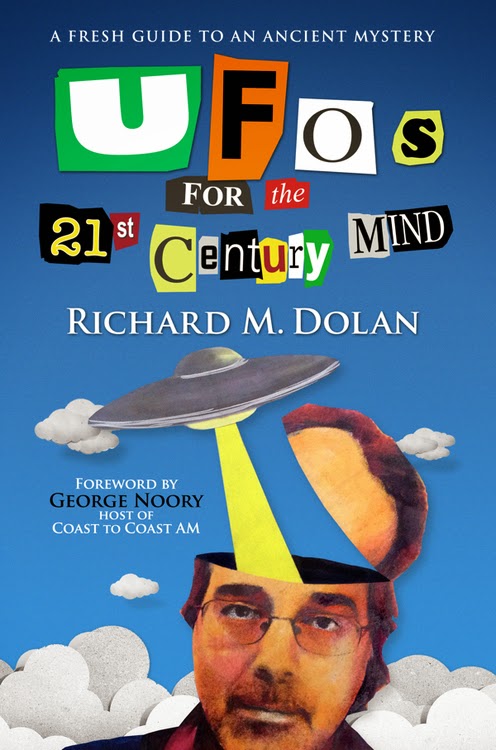
    two books. One is "The UFO Phenomenon: Fact, Fantasy and Disinformation" by John Michael Greer (AKA, the Archdruid), the other "UFOs for the 21st century mind", by Richard M. Dolan.

    Both are recent books which attempt to evaluate the whole UFO cycle from its beginnings, that we may take as the late 1940s (even though the phenomenon is much older). Of the two, Greer's book is by far the better. Greer is skeptical about UFOs intended as manifestations of extraterrestrial entities, but the most fascinating part of his study is not so much about that. It is the part dedicated to how the UFO story was the origin and the test bed of the disinformation techniques which were then extensively used over and over, in particular by the US intelligence. Greer's book deserves a complete discussion which I'll try to tackle in a future post. Here, instead, I'll give space to Dolan's book which is also fascinating, but for completely different reasons.

    About "UFOs for the 21st century mind" let me say that if there ever was an example of the concept of "beating around the bush" this is it. The book goes on for almost 500 pages (472 to be exact) of case after case of people claiming the strangest things seen in the sky or on the ground, but never the author feels the need to define what we are talking about. What does Mr. Dolan think UFOs are? To find some kind of an answer, we must go to chapter 10, where we find, buried in the mass of the book, a mere 29 pages of discussion on this fundamental question. And a very unsatisfactory discussion it is: we are told of the Hollywood-style features of the "Grays" and of weird speculations such as the fact that these creatures might be working on a long term breeding program for the creation of human-alien hybrids (p. 379).

    The fascination with Dolan's book lies all there: in this startling contrast between a large number of claims that there is "something" up there and the extreme poverty of the interpretations of what this "something" could be. It doesn't help that Mr. Dolan thinks that we are victims of a conspiracy which has the government hiding the truth from us; the book has a distinct feeling of being badly outdated. Reading it feels like reading a science fiction story of the 1950s, with its space heroes yielding blaster guns against the alien invaders. Is it possible that in more than half century of discussing UFOs we haven't progressed even just a bit, with the "Grays" of today replacing the "little green men" of the 1950s? But that seems to be where we stand.

    Not that it is a fault of Dolan, nor of other UFO researchers. The problem may simply be impossible to deal with, even worse than that of the P vs. NP in mathematics. Let me explain: it is perfectly possible that there exist other civilizations, somewhere, and that these civilizations could be technologically much more advanced than ours. I also have no objections to the concept that these civilizations could be neighboring us in ways that we cannot understand at present and being in contact with us occasionally, or even frequently.

    Once this is stated, however, how do we proceed? So far, the most complex thing we know is the human brain and human brains have at least a fighting chance to study other, similar, brains. But what about something more complex (and perhaps much more complex)? We have at least one example of a high-tech civilization coming in contact with a low tech one. It was in the years during and after World War II, when the Melanesian islanders observed the arrival of the US army (and earlier on, of the Japanese army). The islanders were not stupid, but they totally misunderstood the meaning of what they were seeing. The result was the phenomenon that we know today as "Cargo Cult".

    Then, consider what could happen if the difference in complexity and technological level were much higher. Imagine yourself as a honeybee: would you be able to understand that your hive was built by human beings for their purposes? Would you be able to even perceive the existence of human beings? You see what the problem is. So far, the study of entities more intelligent and more powerful than us has been reserved to the field we call "theology" which starts from assumption not exactly compatible with the scientific method as we know it nowadays.

    This is the big problem with UFOs, probably an unsolvable one. Listing thousands (or even tens of thousands) of cases of "mysterious things flying above" (or landing from said above) is not useful. We are just accumulating a sort of "bestiary" of aliens, a compendium of the kind popular during the Middle Ages. But we are not progressing in the biology or the ecology of aliens. We don't even know if what we are seeing is real, although deformed by our limited capabilities of perception and understanding, or is an illusion, vanitas vanitatum, like the dragons and the sea serpents of medieval bestiaries.

    In the end, it seems that the UFO phenomenon was the result of the culture of the times when it was born. A result of the optimism of the post-war years and of the diffusion of the concept of space as the new (or final) frontier. Once that concept started to vanish from our cultural horizon, the same destiny befell on the UFO phenomenon.  

    Is it over, then? Are we really alone and we have just been dreaming of more powerful entities visiting us (and, perhaps, benevolent and merciful entities?). The absence of evidence is no evidence of absence, especially if we don't know what exactly should the "evidence" be. So, there may well be, out there, higher patterns that we can't understand but that we may dimly perceive. It has been said that now we see darkly, as in a mirror, but then we will see face to face. And, who knows? The only unsurprising thing about the future is that it is always full of surprises.


    Who

    Ugo Bardi is a member of the Club of Rome, faculty member of the University of Florence, and the author of "Extracted" (Chelsea Green 2014), "The Seneca Effect" (Springer 2017), and Before the Collapse (Springer 2019)