Showing posts with label peak oil. Show all posts

Thursday, July 16, 2020

The End of an Age: The Great Failure of Catastrophism


Colin Campbell, the founder of the association for the study of peak oil and gas (ASPO). 


The considerations I develop below originate from a post by Michael Krieger where he describes how he is so dismayed by the reaction of the public to the current epidemic that he is closing his blog to rethink the whole matter over. You can read similar feelings in a post by Rob Slane of the "Blogmire" and of Chris Smaje on "Resilience." Many others are dismayed at how badly the COVID-19 crisis was managed: a threat that was real but, by all measures, not so terrible as it was described. Nevertheless, it generated an overreaction, more division than unity, political sectarianism, and counterproductive behaviors, and it ultimately led people to accept being bullied and mistreated by their governments and even to be happy about that.


by Ugo Bardi


The "peak oil movement" was started by a group of retired geologists around the end of the 1990s. It grew to include many kinds of scientists, including physicists, chemists, biologists, and others. You could call us "catastrophists," but catastrophe was not our goal. We were not revolutionaries; we never thought of storming the Bastille, giving power to the people, or creating a proletarian paradise. We were scientists; we just wanted society to get rid of fossil fuels as soon as possible, although we thought that the final result would be a more just and peaceful society. 

But how to reach this goal? Of course, we understood that humankind is a vague term and that people tend to seek for their personal well-being, rather than that of their fellow human beings. But we saw no reason why the people in power shouldn't have listened to our message. After all, it was in their best interest to keep the economy alive. So, the plan was to diffuse the message of resource depletion as a scientific message, not a political one. We did our best to produce models, to make studies, to convene meetings, to publish scientific papers. The very fact that our main talking point was a bell-shaped graph meant that we were speaking to the tip of the social pyramid. We knew (or at least we should have known) that most people cannot understand a Cartesian graph. There is a reason, after all, why in Excel the default graphical representation of data is a bar chart.

It was an utter failure. We might have expected it, but we were much better as scientists than as politicians. We thought we could speak to "the ear of the prince" as Niccolò Machiavelli had tried to do, centuries ago. He discovered, as we did, that the prince doesn't want counsel, he only wants obedience. The prince operates according to a time-tested strategy that goes as "scare them, then force them to obey." The commoners operate on an equally time-tested strategy that goes as "be scared and obey," or, at least, "pretend to be scared and pretend to obey."

So, what happened is that some threats were just ignored: peak oil, resource depletion, and now climate change. Instead, other threats were amplified beyond recognition and some elites used them as a chance to reinforce their power on other elites or on the commoners. That was the case of the recent coronavirus epidemic.

As a combination of overreaction and non-reaction, we are now facing the downward slope that I had termed the "Seneca Cliff," the start of a probably irreversible descent, at least for several decades. No wonder that many of us are dismayed. But how is it that the human society either overreacts or doesn't react to external perturbations? Compare with the behavior of a system such as a forest. It is a system in many ways as complex as the human economy (quite possibly, more complex) but it tends to reach and maintain a certain level of stability. Forests manage and conserve their resources, maintaining an incredibly complex diversity. And when a fire starts, the forest waits for it to burn out, and then it patiently re-colonizes the burned area. It is the way natural systems work -- today we tend to define with the term of holobionts. 

Why can't human systems behave in that way? Clearly, we have a lot to learn, especially on how natural holobionts evolved and attained their stability. Perhaps we are moving in that direction in any case. It is a question of natural selection, those entities which are unstable tend to disappear in favor of the more stable ones. Maybe human society naturally evolves in this direction, even though it will involve a lot of suffering and it will take a lot of time before we arrive there. Perhaps, we could think of some kind of "directed evolution," with the human intelligence used to turn society into a societal holobiont. But that's exactly what the catastrophists, peakers and the others, failed to attain -- evidently it is not easy. Whatever we do, in any case, we keep marching toward the future. And so, onward, fellow holobionts!


Friday, July 10, 2020

On the Edge of the Cliff: We need a new way of seeing the world


A new blog by Ugo Bardi, "The Proud Holobionts"

Long-term predictive models don't have a very good record, but some turned out to be prophetic. One case is that of Hubbert's 1956 prediction of a peak in the production of fossil energy shortly after the start of the 21st century. He was optimistic about the possibility of replacing fossil fuels with nuclear energy, but, apart from that, he was right on target. Now we are on the edge of the cliff and we have to take a different attitude toward the ecosystem that supports our existence. The concept of "Holobiont" may help us a lot in this task. We are holobionts, the ecosystem is a larger holobiont, we must find a way to live together. 


The American geologist Marion King Hubbert deserves the credit of having been the first to see the main trends of the 21st century, nearly 50 years before it were to start. In his 1956 paper, Nuclear Energy and the Fossil Fuels, he presented the figure above: a bold attempt to place the human experience with energy on a 10,000 years scale.

Of course, Hubbert was overly optimistic about nuclear energy which, in reality, started declining decades before fossil fuels did. But, with this graphic, Hubbert had laid down the human predicament several years in advance with respect to more famous studies such as "The Limits to Growth" (1972). Catton's "overshoot" (1980), and many others. Without a miracle that could replace fossils well before they would start declining, the human world as it was in the 20th center was doomed. Nuclear energy was not, and could not have been, that miracle.

Hubbert's may not have been always cited, but the debate on the decline of the natural resources raged for decades -- with most of the debate being based on various interpretations of the concept of technological progress. In the most optimistic views, depletion was not considered a pressing problem and, in any case, it was believed that technology would chase the problem away, automatically and without pain for anyone, purely on the basis of market forces. In this view, it made no sense to slow down economic growth in order to save resources: on the contrary, accelerating the exploitation would lead to more growth and to the consequent availability of more and more advanced technologies. The opposite attitude was that the problem was important and imminent, but that predictive models could lead to planning efforts based on slowing down the exploitation of the remaining resources, giving sufficient time for a technological switch toward higher efficiency/new sources. Over time, the debate veered more and more toward the concept that climate change was a much more important problem than resource depletion. But the contrasting attitudes didn't change.

All the debate led to nothing. Nothing was decided, nothing was done. Society turned out to be impervious to early alerts and technology unable to be the miracle that was touted to be. In 2020, we have arrived at a critical point: the start of the irreversible decline of the technological society that had been developed over about two centuries of use of fossil fuels as an energy source. We are seeing the "Seneca Cliff," the unavoidable destiny of a system that has expanded beyond its limits, that has gone in heavy "overshoot" to use Catton's definition?

And now? Clearly, it is too late to deploy miracle technologies: we are starting to go down and the question is how to face the decline: can we still avoid to turn it into a crash? The data show that it would still be possible to soften the decline and to go down on a relatively smooth slope. But the resistance to the unavoidable is actually worsening the situation. Politicians and most of the public are still convinced that the way to go is to "growth" without realizing that they are hastening collapse and making it faster and harsher.

How did we arrive here? It was not a failure of science and technology. It was a cultural failure. We tried to manage the future without the right tools. In retrospect, it was obvious that tools developed in an age of abundance wouldn't be useful, actually counterproductive, in an age of scarcity. Imagine a banker stranded on a remote island trying to get food by building a automated cash teller. You get the point.

At this point, we could say that we need a new vision of the ecosystem. That's correct, although reductive. It is not a question of what we "need." It is a question of an unavoidable cultural transformation that's going to come, whether we like it or not. We have to come to terms with the ecosystem. In different terms, we could say that the ecosystem is going to decide what it is going to do with us -- not consciously (probably) but just practically. Either it is going to get rid of an obnoxious species -- the humans  -- that has done only damage to everything, or that species is going to take a different attitude that will make it less obnoxious.

That's the challenge we face, not an easy one, but not impossible either. The cultural tools we need have been partly developed and are being developed. A basic one is the concept of "Holobiont" the idea that the fundamental components of the ecosystem are not organisms, but holobionts intended as colonies of creatures that hang together for mutual benefit. Human beings are holobionts, trees, forests, steppes, and tundras are holobionts. The whole ecosystem is a holobionts. And we can be proud of being good holobionts and learn to live together with the larger holobiont we call "Gaia" . Will we be able to do that?

We can discuss these matters on the new blog "The Proud Holobionts" and in the Facebook group with the same name. Onward, fellow holobionts!


Friday, July 3, 2020

The ten worst predictions in history: learning from past mistakes


  Ugo Bardi experiments with new predictive methods.


This post was inspired mainly by the shock I had with the various failed attempts to predict the outcome of the Covid-19 epidemic. It was truly a sobering experience: bad predictions, clueless politicians, arrogant scientists, idiotic journalists, and more. It made me doubt of the usefulness of models in general. I think we are doing several (too many) things wrong with the way we use models and (sometimes) we trust them. I'll be discussing more on this subject in future posts, for the time being, here is a list of failed predictions that I think can teach us something.


1. Coronavirus Deaths. In 2020, the model developed in large part by Neil Ferguson at the Imperial College in London was the main element that led the British government to engage in a strict "lockdown" policy to avoid the hundreds of thousands (perhaps millions) of deaths that the model predicted as a result of the COVID-19 disease. Most European States followed suit. It is still early to evaluate how the real world followed the model but, if we look at the result proposed in the "Report n. 9", we see that the model was clearly overly pessimistic. The authors of the model defended their work saying that their prediction of doom was just one of several scenarios, which is correct, but weak as a defense. In the future, we'll be able to say if Europeans truly wrecked their economies for nothing but, for the time being, the coronavirus experience can be seen as a sobering experience on the limits of the models as predictive tools.

2. The Population Bomb. In 1968, Paul Erlich and his wife Anne wrote a book titled "The Population Bomb." To say that it was catastrophistic is a little of an understatement. It is known to have contained the sentence  In the 1970s hundreds of millions of people will starve to death in spite of any crash programs embarked upon now. As we all know, that didn't happen. Instead, the 1970s ushered an era of apparent abundance in the food supply that led to a rapid increase in the human population. Yet, The Erlichs' prediction may not have been so bad, at least in qualitative terms. In reality, the current population is so large that if a new famine comes, it will cause the death of not just "hundreds of millions of people" but, likely, billions of them. You might argue that the present situation is much more dangerous in terms of risks of famines than it was half a century ago, when the world's food supply was not so critically linked to the supply of fossil fuels as it is today. This story illustrates once again how difficult it is to use models for quantitative predictions, even though they may be qualitatively good. 

3. Julian Simon's 7 billion years of prosperity. In 1994, Julian Simon wrote, "We now have in our hands in our libraries, really the technology to feed, clothe, and supply energy to an ever-growing population for the next 7 billion years... " (Myers, N., and Julian Simon. (1994): Scarcity or Abundance, New York: Norton.). In reality, we are reaching the limits of our capabilities of doing that just now. We may conclude that Simon was off of some 7 billion years. It was a ridiculous idea from the beginning but, at least, it shows to us that there is no limit to how wrong you can be with your predictions!

4. Too much oil. In 1999, the respectable (so to say) "Economist" magazine published a leader titled "Drowning in Oil" where it was argued that the prices of oil were going to become so low that they would damage the economy, literally "drowning it in oil." The authors went on proposing that the oil price could soon go down to 10 dollars per barrel and perhaps even to 5 dollars per barrel. Needless to say, the trend was exactly the opposite, with oil prices starting a sustained rally that took them all the way up to some 150 dollars per barrel in 2008. Curiously, oil prices did plunge, briefly, to "negative" values in 2020, but if this is what the Economist authors were thinking, they were 20 years off with their prediction! This story is just one of the many disasters that ensued when someone tried to predict the vagaries of prices, even in a not so remote future. Prices are so strictly linked to human whim and perception that it seems to be simply impossible to predict them.

5. The Great Horse Manure Crisis. It is said that, in 1894, The Times newspaper predicted… “In 50 years, every street in London will be buried under nine feet of horse manure.” This prediction was obviously wrong, as reported and it is often used to poke fun at those silly catastrophists. But, in reality, there is no trace in the archives of "The Times" that it was ever uttered, it is a piece of fake news.  This story illustrates that you can be wrong even with a non-existing prediction!

6. The Wargame that lost the war for Japan.  It is known that, before the start of WW2, the Japanese admiralty engaged in a series of simulation games destined to determine the possible outcome of a war against the United States. It is reported that when one of these simulations was leading to a crushing defeat for the Japanese forces, the umpires (or perhaps Admiral Yamamoto himself) ordered two Japanese carriers "refloated," so that the game ended with a Japanese victory. The story of the refloated carriers is probably a legend, at least in part, but it is true that the Japanese wouldn't have engaged in the war against the US hadn't they had some kind of evidence that they could have won. It shows how dangerous it is to trust models for systems that have a binary outcome.

7. The Peace Dividend. In the 1990s, with the Soviet Union defeated and gone, some people thought that there was no more justification for the gigantic and cumbersome military apparatus that the Western Empire (officially) maintained as a defense against Communism. So, they thought it could be dismantled and the money saved distributed to the people. That was called the "peace dividend." Alas, that idea now looks as remote as the fall of the Roman Empire. Soon, there came the 9/11 attacks and the military apparatus was beefed up even more. Those who had proposed the idea of a peace dividend never realized that nobody ever made money on peace. And, as you see, it is rarely a good idea to think that people will behave in ways that make them lose money.

8. Nibiru. The story of the planet Niburu that should impact on Earth appeared for the first time in 1995, diffused by Nancy Lieder. The first predictions said the cataclysm should have been in 2003, but the best-known prediction indicated 2012 as the fatal year, something that gained a certain notoriety and a number of followers. Of course, nothing happened in 2012, so the date of the impact has been progressively moved onward, but the whole story seems to have lost interest -- as it should have. At least, this story tells us that wrong predictions may be a lot of fun and cause little damage. 

9. The Solow-Swan model. In the 1950s, Robert Solow proposed a model for the US economy based on a simple formula that generated exponential growth. The model came to be known as the "Solow-Swan" model.  There was no term in the model that accounted for the possibility of a decline or a collapse so that it was generally interpreted by economists as implying that there were no limits to growth and that the economy could be growing forever. Today, most of the choices made by politicians and decision-makers all over the world seem to be based on this model, trying, for instance, to "restart the economy" after the SARS-Cov2 epidemic by means of stimulating more consumption. That, of course, is going to make things worse if the crisis is caused by a dearth of natural resources, as it is the case. This model shows us how you can do tremendous damage to humankind even by means of just a one-line equation.

10. The second coming (or the parusia). If you read the texts written by the early Christians, Paulus, and others, it is rather clear that they were expecting the "second coming" of Jesus Christ during their lives. That, of course, didn't happen and Christians have been waiting for this dramatic event for a long time, and they are still waiting for it, sometimes under different names such as the "rapture." We cannot exclude that one of these days we'll hear a booming voice coming from the sky telling us that "The Day of Judgement has come" -- but so far that didn't happen. So, this prediction turns out to have been wrong of at least 2000 years (so far). But Christians are still waiting for the second coming and so we can conclude that predictions with no well-defined time frame can never be disproved!


Wednesday, June 3, 2020

Epidemiological Models: A Simple Explanation of How they Work


There is a certain logic in the way the universe works and so it is not surprising that the same models can describe phenomena that seem to be completely different. Here, I'll show you how the same equations describe chain reactions that govern such different phenomena as the spread of an epidemic, the cycle of extraction of crude oil, and even the nuclear reaction that creates atomic explosions. All these phenomena depend on the efficiency of energy transfer, the parameter that's known in energy studies as EROI (energy return on energy invested), related to the "transmission factor" (R) of epidemiological models. Above, a classic clip from Walt Disney's 1957 movie, "Our friend, the atom." 


You may be surprised to discover that epidemiological models share the same basic core of peak oil models. And it is not just about peak oil, the same models are used to describe chemical reactions, resource depletion, the fishing industry, the diffusion of memes on the Web, and even the nuclear chain reaction that leads to nuclear explosions. It is always the same idea: reinforcing feedbacks lead the system to grow in a frenzy of exploitation of an available resource: oil, fish, atomic nuclei, or people to be infected. In the end, it is perhaps the most typical way the universe uses dissipate potentials. As always, entropy rules everything!

Modeling these phenomena has a story that starts with the model developed in the 1920s by Vito Volterra and Alfred Lotka. They go under the name of "Lotka-Volterra" models or, sometimes, "Prey-Predator" models. This heritage is not normally recognized by people in the field of epidemiology, but the model is the same: the virus is a predator and we are the prey. The only difference is that an epidemic cycle is so short, typically a few months, that the prey, people, don't reproduce during the cycle. Then, if you think that oil companies are predators and oil fields are the prey, then we have again the same model. Finally, you can see the atomic chain reaction that takes place during fission as generated by neutrons acting as predators and atomic nuclei acting as prey. In the Walt Disney interpretation, shown in the clip above, ping-pong balls are the predator and mousetraps are the prey.
 
To describe the model, let's focus on epidemiology. These models are called "SIR," with the acronym standing for "Susceptible, Infected, Recovered." The idea is that the Infected stock grows proportionally to both the Susceptible and the Infected stocks -- it is a feedback loop. No feedback, no growth, this is how these models work. Then, of course, the virus will gradually run out of susceptible people, growth will slow down and, eventually, the infected stock will start declining. Then, the epidemic will be over.

So, let's see what the model produces in its simplest version. I made it using the Vensim (TM) system dynamics package (see at the end of the post for the details *)


Note how the number of susceptible people (blue curve) gradually declines. Instead, the number of cases per unit time (green curve) and the total infected people (red curve) show a cycle of growth and decline. Finally, the recovered people (gray curve) grow and then stabilize. (they might also die, the equations won't change.)

Let's compare with peak oil models: the names of the variables change, but the model is the same

Susceptible  --> Oil Resources
Infection rate --> oil production
Infected --> Extracted Oil
Recovered --> Pollution

Note the green curve in the figure. It is symmetric and bell-shaped: it is the typical "Peak Oil" curve. In the case of oil, the curve describes the production in barrels per day. In the case of an epidemic, it describes the number of new cases of infections per day. The curve for the victims should be the same, but (hopefully) smaller and shifted forward in time to take into account that you die after having contracted the virus. The red curve in the figure is proportional to the amount of oil extracted and not yet burned. It is the "capital" of the oil industry. As oil is burned, it becomes pollution and disappears from the model 

You can play the same game with other phenomena. For instance, in the case of the "mousetrap model" developed by Disney studios, the one shown in the clip at the beginning of this post, you have that

Susceptible --> trapped balls
Infection rate --> number of traps springing per unit time.
Infected --> number of flying balls
Recovered --> balls on the ground


In general, epidemiological models are normally much more complicated than the basic SIR model that I showed above. That is, in my opinion, a weakness of these models. Attempting to evaluate such parameters as how many people will contact each other per day, and from that estimating the infection rate is nearly hopeless and, indeed, these models have a poor record in terms of quantitative forecasting. Even peak oil models, although not so bad, turned out to be unsuccessful in estimating the data of the peak, at least in terms of volumes of liquids produced.

But this is a long story and I won't get into it, here. Let me just say that, in general, models may be useful even (and perhaps especially) when you don't ask them to make exact predictions. Often, a correct warning may be much more useful than an incorrect prediction. That's true when the models are well-grounded in physics and can tell you what will happen, even though not necessarily when.

Something that you can learn from these models is how the behavior of the system is determined by an efficiency parameter called R in epidemiology and EROI (energy return on energy invested) in peak oil studies. Yes, these two parameters are the same -- apart from some details. They share the property that they need to have a minimum value in order for the chain reaction (the epidemics or a cycle of extraction) to start. In epidemiology, you can show that R must be >1 for the infection to grow. As the epidemic proceeds, R becomes smaller. When R=1, you have the "peak virus" and the number of infected people starts declining. That's called "herd immunity."

Things are not so simple for the peak oil curves, but the story is the same. You can show that an energy-producing resource cannot be produced with a positive energy yield unless you have EROI=1/η at the beginning of the extraction cycle, with η the efficiency of the transformation of the energy of the extracted resource into useful energy (exergy). For crude oil, we may probably take η as equal to 0.1-0.2. The implication is that oil extraction is not viable for EROI<5-10, which is consistent with the current situation. We are close to EROI values that correspond to an unavoidable decline of the industry. (Note that this condition is for "peak capital" -- "peak oil" comes for even larger values of the EROI)

Ah... by the way, these limits of the EROI values are valid only for exhaustible resources such as crude oil. They do not hold for renewable energy sources such as solar energy -- of course, you can't run out of sunlight!
_________________________________________________________________________

The R and the EROI parameters of chain reaction models -- a quick explanation


Ro is defined as the expected number of cases generated by one case in a population where all individuals are susceptible to infection, that is, at the initial stages of the epidemic. As the epidemic proceeds, varying proportions of the population become immune. To account for this, the "effective reproduction number" is used, written as Rt or simply R. It is the average number of new infections caused by a single infected individual at time t. When the fraction of the population that is immune increases so much that R drops below 1, it is said that "herd immunity" has been achieved. It means that the number of infected people does not grow any longer and gradually decreases toward zero.

The EROI (or EROEI) (energy return of energy investment) factor in oil extraction is defined as the number of barrels of oil produced using the energy obtained from one barrel. It is more general than that, but let's remain with crude oil. Obviously, when the EROEI goes below one, the whole enterprise of oil extraction becomes useless in terms of producing useful energy. But "peaking" of oil production starts well before the EROI goes below one, as we'll see in the following.

R and EROI look similar and, indeed, they are the same thing. To say something more about this matter, we need to write down the equations of the model. Here they are for the SIR system, with S=susceptible, I=infected, and R= recovered


dS/dt = - k1SI

dI/dt = k1SI  - k2I

Note that the coefficient k1 is the same in both equations because the number of people who become infected is equal to the number of those who cease being susceptible -- these two coefficients won't be the same in the equivalent equations for oil extraction. The other coefficient, k2, is the frequency of recovery of the infected people. There is a third equation describing the growth of the "recovered" stock, but it is simply equal to k2I and we can neglect it here. 

Now, from the equations above, we can say that the R factor is equal to the number of new infections divided by the number of infected people. We need to take also into account the recovery frequency: the gradual disappearance of people from the "infected" stock. So that the result is:

R Sk1/k2

Note that the variables in this model are usually expressed in terms of fractions. So, the number of susceptible people at the very start of the epidemic is supposed to be 100% of the population, that is, unity. There follows that

Ro= k1/k2

Now we can determine the value of R needed for attaining "herd immunity." the value needed for stopping the growth of the infection. For this, we take the second equation of the two of the model. We want to know when the number of infected people, I, starts to decline. That means to find when dI/dt <0. That is:


k2R-k2 <0

Or, R<1.  

This is the condition for herd immunity. It explains the attention dedicated to this number for the current coronavirus epidemic. 

Measuring R may be a good idea but, in reality, it is not a very useful way to forecast the trajectory of an epidemic. To measure R you need to know S, but normally you don't know who is susceptible and who is not unless you try to infect them. So, saying that "R has become smaller than one" is the same thing as saying that "the number of infected people in the population has started declining." And the latter term is what you can actually measure or, at least, estimate. As someone said, "Models are accurate only when they become irrelevant."

How about the EROI? The equations are the same, but with a small difference. Whereas people move quantitatively from the "Susceptible" to the "Immune" stock, transforming a unit of energy embedded in underground oil into a unit of usable energy cannot be 100% efficient. So, you need another coefficient in the equations, a "transformation efficiency", η as a coefficient of k1 in the second equation. Obviously, it must be that η<1 because of the 2nd law of thermodynamics.

We go through the same mathematical tricks and we find the condition for the amount of stored energy (the "capital" of the industry) starts declining. It has to be:

EROI < 1/η

For the transformation of crude oil into useful energy into a thermal engine, we can roughly estimate a life cycle efficiency of the order of 10%-20%. There follow that oil extraction is not thermodynamically viable for an EROI < 5-10, which agrees with independent estimates of EROI for crude oil. It was probably around 30 during the early stages of exploitation and therefore allowed the industry to grow. Currently, the average EROI for oil extraction is probably around 10-15, so that we are close to the start of the irreversible decline of the industrial system that exploits it. Or, it may have already started. 

Note that the condition EROI < 1/η does NOT correspond to "peak oil" as it is normally defined. It is, rather, "peak capital". Peak oil refers to oil production, which is not the same thing. But it is not possible to find an equivalent simple expression that correlates the EROI of the system with the occurrence of the peak. We can only say that it occurs earlier and, therefore, for larger values of the EROI.


___________________________________________________________________

(*) Here is the Vensim model I used for the graph shown in this post. If you want the code, just write to me. 


Thursday, April 30, 2020

The most accurate model-based prediction of all times

The "base case" scenario from the 1972 edition of "The Limits to Growth." This scenario described the trajectory of the world's economy on the basis of the data and assumptions that were judged to be the most reliable ones. This run might turn out to have been amazingly accurate some fifty years after it was proposed.


One of the most remarkable features of the story of the "Limits to Growth" study of 1972 is how effectively it was possible to convince almost everyone that it was completely wrong. Amazingly, though, the most vituperated model-based prediction in history may turn out to have been perhaps the most accurate one.

Note how the scenario above, the "base case" scenario, saw the start of the decline around 2010 and the start of the collapse maybe a decade afterward, that is now. If the oil collapse generated by the coronavirus takes the whole economy with it, as it may well happen, then this scenario turns out to have been unbelievably accurate. And that for a prediction made 50 years ago. Truly amazing!

Now, of course, this story has to be taken with some caution, predictions can be right even by mere chance. But, in this case, there is a certain logic in this result: the base case scenario had been already noted by Graham Turner to have been following the real-world data. But that was true for the growth side of the diagram: even standard economic models had been predicting economic growth. The crucial test for the model was to be the sharp change in slope expected to take place around 2010-2020.

Of course, no model could have predicted that the turning point would have been triggered by a word pandemic -- as it happened. But "something" had to give and the virus is not a cause of anything, it is just the straw that breaks the camel's back. The little push that sent the system in a direction where it had to go.

So, it IS possible to use models to predict the future. Another example of a good prediction is the famous one by Marion King Hubbert of the peak of oil production in the US. In 1956, he had proposed 1970 as the likely date and he had been right. On the other hand, predictions are not always so good. In 1970, Hubbert himself had predicted the global "peak oil" for the year 2000. Later on, ASPO (association for the study of peak oil) had estimated the peak for 2010. Both predictions were not so bad, but a little pessimistic if the peak arrived in 2020.

Perhaps the most surprising discovery, here, is how the most vituperated predictions turned out to be the most accurate. Conversely, many economic models that predicted infinite growth were much praised, but they seem to have badly missed the ongoing collapse. Maybe vituperation is a good yardstick to judge whether a prediction is good or bad. In any case, always remember that the future always takes you by surprise. You can't really predict it, but you may always be prepared for it.


Monday, January 20, 2020

How to Predict the Future: Confessions of a Modern Cassandra


Telling the truth has always been dangerous and the original Cassandra, the Trojan prophetess, had to suffer the consequences for what she said. But there is a more interesting question: how did she manage to be right while everyone else got it wrong? Here I tell you of my experience as a modest 21st century Cassandra, with my blog. (if you like to hear the story told by the prophetess herself, you can read it here and here.)


It is traditional at the start of a new year to make predictions, but this time I would rather go back to what I have been doing for the past more than 15 years of blogging and social media activity. I have been dealing with several different subjects and, in some cases, I made predictions or I offered my assessments. How right (or wrong) was I?

I think my record was not so bad as a Cassandra. And from this record, I think there are three rules for good (let's say decent) predictions:

1. Always trust thermodynamics
2. Always mistrust claims of marvelous new technologies
3. Always remember that the system has unpredictable tipping points

So, below you'll find a list of what I think were my main successes and failures.
___________________________________________________________________


So, let's start with where I was right.  


2002 - The Hydrogen Economy is a Hoax. 2002 is the year when Rifkin published his book titled "The Hydrogen Economy." I had been working on hydrogen and fuel cells for some time while at the Lawrence Berkeley Laboratory, in Berkeley, and I knew very well that things were not so easy as Rifkin painted them in his book. But, in the beginning, I have to confess that I tried to follow the crowd in search of research grants. Then, I thought it over and I decided that I had to say what I thought: this idea won't work. And I was right: 20 years later, no trace of the hydrogen economy, no hydrogen vehicles on the road, no production of hydrogen from renewable energy. Here is a 2007 post of mine on this subject

2003. No Nuclear Weapons in Iraq.  I don't think I had a blog at that time, but I did write an assessment of mine in Italian on whether it was likely that Iraq could have had WMDs in the form of nuclear weapons. My conclusion was that it was not possible: Iraq lacked the conditions and the infrastructures needed. As a result, I was vilified and insulted in various ways and told that if I loved Saddam so much, why didn't I go live in Iraq? But you know how it ended. I haven't been able to find that article of mine, but it is mentioned in this post.

2005. The compressed air car (Eolo) is a scam.  The car running on compressed air is an idea that remained alive in Europe for some 10 years, starting in 2005. A French inventor, Guy Negré, claimed that he could mass-produce a vehicle that he called the "Eolo" that could compete with other technologies in terms of price and performance. I was skeptical from the very beginning on the basis of some simple calculations. And I was right. No matter how I was insulted by some diehard followers of the Eolo, more than 10 years later, Mr. Negré is no more with us, but his Eolo car never appeared on roads.

2005. Electric Cars are the future. Already in 2005, I bought myself an electric scooter and I started writing articles where I promoted electric vehicles as a good technology that could alleviate several problems we have: traffic, pollution, climate change, etc. I was right in thinking that EVs would become fashionable, even though it took some time for decision-makers to understand the point. Even today, EVs face strong resistance from an unholy alliance of oil companies, carmakers, and environmentalists. But they are going to replace traditional vehicles in the coming years.

2008. Oil prices will go down. You remember how, in 2008, oil prices had started a rally leading the barrel to be priced at $150. There was a moment of panic in which everyone was expecting prices to keep climbing even higher. They forgot that prices are the result of a compromise between offer and demand and that, since demand cannot be infinite, prices can't, either. So, in 2008 I published a post on "The Oil Drum" where I argued in this sense and I proposed that prices would go down. It was what happened.

2011. Andrea Ross's e-cat is a scam. In 1989, I had witnessed the first claims of "cold fusion." The story swept through the scientific world like a tsunami, but it turned out to have been a mistake. It also triggered infinite attempts of imitation, some of which were outright scams. One was the story of the "E-Cat" invented by Andrea Rossi in Italy. After some initial attempts of assessment, it was clear to me that it was a total hoax, and I said that more than once. Actually, it should have been clear to everybody, but Rossi generated a group of faithful followers who engaged, among other things, in insulting and vilifying the unbelievers  - I never received so many insults in my life as I did from this bunch of madmen. Now, almost 10 years after the first claim by Rossi that he would soon start mass-producing his machine, I think it can be said that it was a hoax. Find the story here.

2011. The Limits to Growth was Right! In 2011, I published my first assessments of the story of "The Limits to Growth," study and later on, a book titled "The Limits to Growth Revisited," my first book in English. I re-examined the whole story how of the study was rejected and demonized, widely described as containing "wrong predictions". I concluded that there was nothing wrong in the book and that its rejection was one of the first examples of a negative PR campaign designed to discredit scientific results that were considered harmful to some political or industrial lobby. My assessment was among the first studies that led to a re-evaluation of the study that's still ongoing. It is still early to say if one or another of the 12 scenarios published in the 1972 book was "right" but there is no doubt that the study is now considered a milestone in the understanding of complex systems, as it deserves to be. In this sense, I had made a correct prediction.

2016. The "Sower's Way:" Photovoltaic Energy is the future. Here, I have been always a sustainer of PV energy, since 2005, when I placed PV panels on the roof of my house. I think I was right too, especially when PV reached "grid parity" with other technologies producing electric power. But it is moving onward. I marked the "2016" date because it is when I published a paper dealing with the concept of the "Sower's Way," that is, that we need to invest fossil energy to build up the new renewable energy infrastructure. We are moving in that direction, although facing a dogged resistance by groups of greenies who have decided that we all have to die in the darkness.


Now some cases in which I turned out to be wrong.

 
2003 -- Peak oil in 2010. Here, I don't think I ever made a peak date prediction myself, but I have been a "peak oiler," among other things the president of the Italian section of ASPO, the association for the study of peak oil. So, I share the blame for the two mistakes that peakers made. The first was to focus on the "peak" as if it was an equivalent of the apocalypse and spending inordinate amounts of time to try to predict the exact date when it would arrive. The second was to underestimate the importance that "non-conventional" oil could have had. We didn't realize that shale oil is not so much an economic resource as it is a strategic dominance weapon. There have been several predictions (including mine) that the shale "bubble" was going to burst, but so far it has not.

2005 -- EROI is a metric that can help us choose the best alternatives for the future.  When I discovered the concept of EROI (energy returned on energy investment) or EROEI (energy return on energy invested), developed by Odum and Hall, it was a small epiphany for me: here was an objective, scientific, rational way to evaluate the best technologies for the future. I wrote my first paper on the subject in 2005. That text became rather popular in Italy. But I didn't imagine what the reptilian part of human brains could do when it understood what EROI was and what could it be used for. The concept was stretched, massacred, mongrelized, cut to pieces and made into a stew, and more. Whoever had an interest in making a certain technology look good could find ways to juggle the numbers and assign to it a high EROI. The reverse was also possible if one wanted to demonize a certain technology. So, you can find studies that assign an EROI <1 to photovoltaics and > 100 to nuclear energy, and also the reverse. At this point, EROI has become a useless metric, destroyed by too much politics applied to it.

2009 -- High Altitude Wind Energy. In 2009, I published on the Oil Drum a positive assessment of high altitude wind energy, in particular of the prototype being developed in Italy, the Kitegen. I was way too optimistic. High altitude wind power turned out to be much more difficult to develop than it had seemed to be at the beginning. There is nothing in the idea that goes against the laws of physics but, evidently, there are big problems, probably related to the control of the kites. Today, 10 years later, high altitude wind energy remains an unfulfilled promise, even though there still exist companies engaged in the field. I continue to think that this technology can play a role in the future, but it won't be the game-changer it seemed to be 10 years ago.

2019 - Greta Thunberg: the unexpected storm.  In 2018 I published a post in which I examined the trends of the "climate change" meme, concluding that the public interest for it was declining and that soon nobody would have been interested in it anymore. I was wrong: in 2019 Greta Thunberg appeared, changing everything. As I wrote in a later post, I made the classic mistake that all forecasters make: thinking that past trends will also be future trends. Sometimes it is true, at times it is deadly wrong, as in this case. It is curious to note how the young Swedish lady has been playing in the real world the role that Asimov's character, "The Mule" played in the "Foundation" series: something outside statistics and unpredictable by models.

____________________________________________________

There may be more things wrong and right that I said, after all, I calculated that I infested the Web with something like 3 million words, up to now! So, if you remember something I wrote that was egregiously wrong or right, tell me in the comments, I'll see to add it as a note to this post.

Overall, maybe I could have done better, but I think that if Lady Cassandra is seeing me from wherever she is now, in Hades, she may be nodding in approval!


Sunday, December 1, 2019

What's wrong with the oil industry? Too many claims of abundance start sounding suspicious


Above: the Financial Times of Nov 29th, 2019. Has the US really become energy independent?


Peak oil theorists have always been the favorite punching ball of mainstream oil pundits but, recently, the attacks against the peak oil idea have started becoming so loud and widespread that I am starting to think that there has to be something wrong with the oil world nowadays. As an especially bad example, I may cite a recent article on Forbes by Michael Lynch. I understand that some people have a bone to pick and they want to pick it clean, but this is a little too much -- there are limits to how nasty one can be, even in a heated discussion. 

Yet, some claims of great oil abundance seem to be based not just on the pleasure of denigrating peak oil theorists but on data said to be real. Just as an example, see a recent article on the Financial Times where we can read that,
The US has cemented its status as a net exporter in world oil markets, a sharp reversal from past years that could affect its ties to foreign allies. 
You may wonder the logic of using the term "cemented," that carries the meaning of consolidating something already existing. Indeed, claims of the US having reached "energy independence" in terms of crude oil had become common after that the US production had exceeded imports -- that meant nothing, of course, it was pure dry-holing. At that time, the US had, and still has, a deficit of nearly 3 million barrels of oil in terms of import/export balance, as you can see in the figure below. (image from SeekingAlpha)

The EIA data for crude oil confirm that in November of this year the US had a DEFICIT of 2.7 million barrels per day in the import/export balance. So, how can the FT claim that the US is a net exporter, then? Simple: under the category of "oil" they sum crude oil and oil products. The latter include refinery products such as kerosene, diesel fuel, lubricants, etc. And, indeed, recently the sum of the exports of these two categories has touched and slightly exceeded the curve of the crude oil imports. 

Does that mean that the US is now "energy independent" in the sense that it exports more oil than it imports? Not at all. That would be true ONLY if the exported products were wholly made with US oil -- which obviously cannot be the case. The US production, nowadays, comes in large part from shale oil, which is light oil. But refineries prefer to use heavy oil, which is imported from Canada and other regions outside the US. The refined products made from this oil can be counted as "oil exports" but it is not oil that was produced in the US. If what counts is the US energy independence, then it is obvious that it is just a trick to make the US look like it is producing more than it does. 

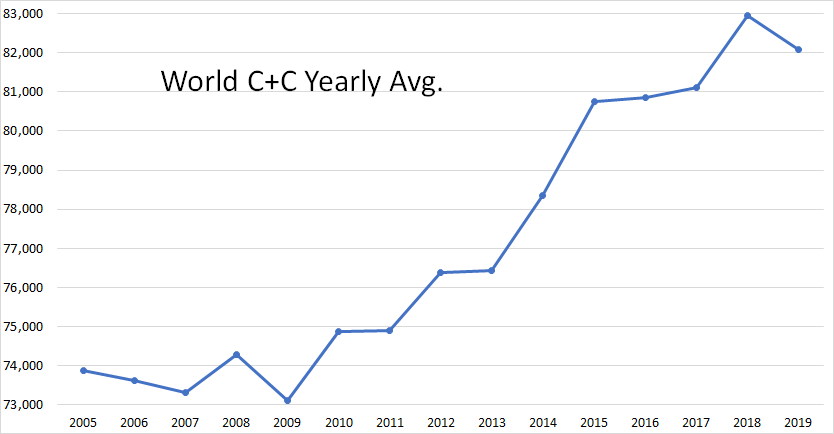
It is true that the US oil production keeps increasing, so far, but for how long can it continue growing? Indeed, there seems to be a suspicious excess of glee in these claims of oil abundance. Could it be an attempt to cover some big problems? Hard to say, but one thing is impressive: 2019 should the first year in a decade -- since the great recession of 2009 -- when the world oil production declined (data by Ron Patterson).


The story of peak oil has been a war of opinions and we know that wars are won by those who win the last battle. Mr. Lynch is surely convinced that his opinions on peak oil have been vindicated, but it may be too early for him to take a victory lap. 

Are we looking at the other side of the growth curve


Sunday, October 27, 2019

Report From Iran: A Country we can't Ignore


Above, Ugo Bardi giving a talk at the University of Tehran, October 2019


Iran is a country that maintains something of the fascination it had in ancient times when it was both fabulous and remote. In our times, it remained somewhat remote but also a country that couldn't be ignored as it went through a series of dramatic events, from the revolution of 1979, the hostage crisis, the Iraq-Iran war from 1980 to 1988, and much more. The latest political convulsion was the "Green Revolution" in 2009 that quickly abated, but the country clearly keeps evolving, especially in its relations with the West. It is impossible for anyone, including perhaps the Iranian themselves, to evaluate everything that's going on in their country. For sure, Iran is complex, changing, varied, and fascinating, perhaps as much as it was at the time of Marco Polo when it was the hub of the merchant caravans carrying silk and spice from China. These are some notes from a trip to Tehran where I stayed for a week in October 2019.


The first impression you have when you arrive in Tehran is of chaos: heavy traffic, throngs of people, movement and noise everywhere. But it takes little time to understand that this is friendly chaos. Especially if you happen to be Italian, you find yourself rapidly at ease in the confusion. Tehran is appropriately exotic in the bazaars, but also quiet in the suburbs, and very modern in places such as the shopping center near the Azadi lake, where you could think you are in Paris.

One thing about Iran is that it is a remarkably friendly place. That's not unexpected: Most people everywhere in the world are naturally friendly if they don't feel threatened, or feel that they are being swindled or chided. They are also normally able to separate real foreign visitors from the image their TV presents to them. If, as a visitor, you approach the local people in a friendly manner, they will almost always reciprocate in the same way. In Iran, Western governments are often perceived (for good reasons) as evil entities, but that doesn't apply to individual foreign visitors.

Just to give you some idea of the Iranian attitude, let me tell you of when I was sitting with my wife at a local restaurant (by the way, if you happen to be in Tehran, try the Reza Loghme on the Mirza Kurchak Khan street: Iranian fast food, absolutely great!). There, we entered in a conversation with another customer who turned out to be a civil engineer. When he learned that we were heading to see the Abgineh (glassware) Museum of Tehran (again, a highly recommended place to visit), he accompanied us there and then he insisted to pay our tickets in order, he said, "to show us the traditional Iranian hospitality." That surely takes Iran several notches upward in the classification of friendly countries, but it was not the only example in our experience in Tehran. That friendliness may also extend to American visitors, the Iranians were friendly with them even at the time when the US was referred to as the "Great Satan," as Terence Ward reports in his book "Searching for Hussein" (2003).

This said, Iran doesn't seem to be just friendly to foreigners, it seems to be friendly also to Iranians -- at least these days. Of course, for a foreigner it may be difficult to detect social tensions brewing below the surface but what I can tell you is that in Tehran there is no heavy security apparatus detectable, unlike what you can see in many Western cities. We were taken to see from outside the residence of president Hassan Rouhani in a building in the Northern Area of Tehran: the security of the President seemed to require only a few policemen standing around the building. Of course, there may have been other, invisible, security measures. But it is impressive how they don't seem to expect serious troubles.

In terms of social tensions, the obvious thing that comes to the mind of a Westerner about Iran, just as for all Islamic countries, is the status of women. Iran and Saudi Arabia are probably the only states in the world enforcing by law the Islamic tradition for women to cover their heads. Yet, the time when women were harassed by the police if they didn't cover their heads well enough seems to be a thing of the past. In Iran, if a woman likes to wear a black chador that makes her look like a European nun, she is free to do so and many do. But most Iranian women, at least in Tehran, tend to interpret the rules creatively. The headscarf, the hijab, is worn halfway over the head and it is often light and brightly colored. The dress is also colored and decorated, women also wear jewelry and makeup. The result is often very elegant and lively. My wife reports that after a few days in Tehran she felt completely at ease wearing the hijab and that she even felt a little strange when she had to abandon it, coming back to Europe.

Of course, the impressions of a week may be misleading, but what I noted in terms of the social structure of the country seems to be consistent with the data. In Iran, women are still a minority in terms of being part of the workforce, but their role is important and larger than in other Middle-Eastern countries. Also, the gap seems to be rapidly closing. Iran also remains a relatively poor country: in terms of GDP per person (PPP), it ranks at about half that of Italy and one third the value of the US. Nevertheless, in terms of social equality, as measured by the Gini coefficient, Iran does better than the United States, although not as well as Italy. Iranians also have a good public health service

A country's educational system is a good indicator of social cohesion: dictatorial governments have no interest in an educated citizenship -- they rather tend to exterminate their citizens or use them as cannon fodder. Iran, instead, shines in this area with the state providing free of charge education for all citizens with impressive results. Some 4.5 million students enrolled in university courses, which is only slightly less than in the US in relative terms and much larger than in Italy. Iran has one of the largest ratios of students to the workforce anywhere in the world.

Of course, an evaluation of the Iranian education system would have to consider the scientific level of the universities and it is true that, right now, they don't score as high as Western ones. But the universities I visited seemed to be staffed by competent people and the research level was good. Here, one has to take into account the language barrier that often puts non-native English speakers at a disadvantage in the competition for space in the best scientific journals. I noted also that the research institutes I visited were massively staffed with women although, as it happens in Europe, the top-level positions are still mostly in the hands of men. That may rapidly change, though.

Islam is also part of the national Iranian culture: visiting Iran at the time of the Arba'een celebration gives you some idea of the importance of some religious traditions: you need not be a Shi'a Muslim to understand how deep the feelings for these traditions run and how fascinating they can be. Nevertheless, I would say that the current Iranian society is remarkably secularized. I can't quantify that, just take it as a personal impression.

And now something about the perspectives. The first question is population: It reached 80 millions and it continues to grow, although at a progressively slower pace. Iran is moving toward its demographic transition, but it is not there, yet. That may be a serious problem in the future: Iran is a large country but mostly dry and only a fraction of its land is arable. The result is that food must be imported from abroad. So far, this has not been a problem: globalization has made it possible to buy food anywhere and the result has been the near disappearing of hunger and famines worldwide. But things keep changing: globalization is on its way out and we may see a return of the old maxim that says "thou shalt starve thy neighbor into submission."

Recently, The US secretary of state, Mike Pompeo, seemed to suggest that starving Iranians was the objective of the US sanctions, although he later denied that. In any case, the food supply problem is recognized by the Iranian government, hence the emphasis on research on desalination and water management (incidentally, the reason why I was in Tehran). Desalinated water, so far, has been way too expensive to be used in agriculture, but that may change in the future and, in any case, water management is a vital element in the future of Iran.

Then, there is the question of oil production. Here are the latest available data for Iran. (From "peakoilbarrel.com" -- the Y scale is in thousands of barrels per day)


At its peak, around 1978, the Iranian oil production had reached about 6 million barrels per day making Iran one of the main oil producers in the world. After the revolution and the war, it reached a certain stability at near 4 Mb/day. But you see the effect of the economic sanctions: Iran's production was nearly halved and exports nearly zeroed. At the current prices of oil, it is a loss of revenue of tens of billions of dollars, not at all negligible for a GDP around 500 billion dollars.

The Iranian economy can survive the loss of revenues from oil: it is surviving it right now, although with difficulties. But, in a certain sense, the sanctions are not completely bad: they can be seen as a stimulus to move in a direction in which Iran has to move anyway. The national oil resources are not infinite and the gradual loss of demand worldwide is going to bring Iran to a point where it will have to cease to be an oil-based economy. These are the same challenges faced by all countries in the world: abandon oil and move to an economy based on renewable energy. It is a difficult challenge that won't probably be met without trauma and suffering, but it is not a choice. Willing or not, we all have to go in that direction.

One problem, here, is the evident lack of what we call "environmental awareness." Of course, university researchers and teachers in Iran are aware of climate change, but most people seem to think that it is just one more Western hoax concocted to force them into submission. Seeing the world from the Iranian side, I can't fault them for being oversuspicious. In recent times, Western governments have been doing their best to lose even the last shreds of credibility they had managed to maintain. And the results are easily detectable: I asked a group of about 30 students of the faculty of engineering of Tehran University what they thought of Greta Thunberg. It turned out that none of them had any idea of who she was.

Overall, though, I am not pessimistic about the future of Iran. Facing a difficult challenge, Iran has some advantages. One is that of being at the hub of the nascent Eurasian exchange zone. Another is to be a well-insolated country that makes it especially suitable for solar energy. In the end, I would agree with the idea proposed by Hamid Dabashi in "Iran, the Birth of a Nation" (2016) where he notes that Iran was a nation before it was a state. The Iranian nation is kept together by strong cultural traditions and linguistic ties. It has survived tremendous challenges in the recent past, it has a chance to survive the new ones that will come.


Acknowledgments: Ali Asghar Alamolhoda, Ati and Soroor Coliaei, Grazia Maccarone, Fereshteh Moradi, Mohammad Mohammadi Hejr,  Hossein and Samaneh Mousazadeh, Bijan Rahimi, and several others.


Who

Ugo Bardi is a member of the Club of Rome, faculty member of the University of Florence, and the author of "Extracted" (Chelsea Green 2014), "The Seneca Effect" (Springer 2017), and Before the Collapse (Springer 2019)