Showing posts with label gold. Show all posts

Sunday, December 9, 2018

Why do Dragons Love Gold so Much?


We, humans, love gold so much that we have even imagined that giant, flying reptiles would share our love for the yellow metal. This curious vision of dragon's motives has a certain logic, although it takes some work to understand it. But it is sure that gold has been important in human history from the time, at least five thousand years ago, when our Sumerian ancestors started to collect gold and use it to prop the power and the prestige of their big men, the Lugals. 

Cassandra's Legacy has published several posts dedicated to gold. Below, a reflection by Pepi Cima, here some links to older posts. 


What has Gold Ever Done for us?

by Pepi Cima


Could it be that gold mining is in modern times completely useless, very costly and terribly detrimental to the environment and nobody has seriously thought about it? Could gold acquire a status not too dissimilar to that of the rhinoceros horn?


Warren Buffet, the most revered investor of all times, says: “Gold gets dug out of the ground in Africa, or someplace. Then we melt it down, dig another hole, bury it again and pay people to stand around guarding it. It has no utility. Anyone watching from Mars would be scratching their head.”

Present day Gold economy is very costly for the environment and for our fossil fuel reserves. Gold bank reserves, equivalent to tens of years of civilian use of the metal, could be sold on the open market to reduce gold mining together with all its environmental and social negatives without affecting any of its industrial uses.

GOLD MINING FACTS

Global gold production totaled roughly 3300 tonnes in 2017. 10 listed gold mines are responsible for nearly 30% of global output, the remaining mines are private unlisted mines and very many Artisanal and Small Mines, ASM. ASMs, triggered by booming gold prices, have become a lucrative source of income in countries such as Thailand, Peru, and Senegal over recent years.


They involve a lot of people, one widely used estimate is that more than 100 million people globally depend either directly or indirectly on ASM for their livelihood. In Africa alone, more than 6 million people are directly employed in ASM.
Gold mining is a very big industry in absolute terms: in 2017 the market capitalization of the first 20 public gold mining companies was reported at 140 B US$, for comparison oil companies in 2018 totaled 1250 B US$.

China, the largest gold producer in the world, in 2016 accounted for around 14% of total annual production but no one region dominates. Asia as a whole produces 23% of all newly-mined gold. Central and South America produce around 17% of the total. Around 19% of production comes from Africa and 14% from the former USSR.

Increased gold prices, together with low energy costs, are encouraging the exploitation of lower and lower grade mineral in bigger and bigger mines.


GOLD AND THE ENVIRONMENT

The consequences of all this mining are land damage produced by deforestation and environmental destruction at the mine and its surroundings. Its impact is particularly damaging because it mostly occurs in pristine environments, see for example the huge mines of Las Claritas in the Caribe Indian region of Venezuela and El Sauzal in the astoundingly beautiful Tarahumara region of the state of Chihuahua in northern Mexico.

A quick look at the aerial pictures of Google Earth, ( 6°11'35.00"N, 61°26'9.60"W and 26°59'52.73"N, 107°54'3.51"W are the relative geographical coordinates) would suffice to get an idea of the physical devastation. Artisanal and small-scale mines are responsible for similar, smaller scale, havoc but in larger numbers.


Gold mining is particularly destructive also from the pollution point of view: mercury and cyanide are the two main chemicals employed in gold extraction.

For every gram of gold produced using the amalgamation process between one and two grams of mercury are released in metallic form or as vapor. UNIDO (UN Industrial Development Organization) estimates that small-scale gold mining is responsible for about a third of world mercury emissions.

Every year, 2,000 tonnes of mercury arising from human activities such as coal-fired power plants and gold mining are emitted into the atmosphere, according to FOEN, the Swiss environment office. The heavy metal is found at the site of contamination but because of its extreme volatility also at locations far from where was originally released.

Cyanide, mainly used in large industrial mines, is highly toxic. Low-grade ores are stacked into heaps and sprayed with a cyanide solution at a concentration of about one kilogram NaCN per ton of ore, a few grams of gold. The precious metal is complexed by the cyanide to form soluble derivatives, e.g. Au(CN)2. The "pregnant liquor" is separated from the solids which are then discarded to a tailing pond or spent heap, the recoverable gold having been removed. The metal is recovered from the "pregnant solution" by reduction with zinc dust or by adsorption onto activated carbon. This process can result in environmental and health problems. A number of environmental disasters have followed the overflow of tailing ponds at gold mines. Cyanide contamination of waterways resulted in numerous cases of human and aquatic species mortality.

Switzerland hosts the environmental policy center of competence for chemical products and toxic waste in Geneva, Global Environment Facility (GEF), a 183 member countries environmental cooperation voluntary organization. Coincidentally most of the gold produced in the world physically transits Swiss refineries. In 2017 2,404 metric tons of raw gold were imported into the country, worth 70 BSF, and 67 BSF were exported. Only the chemical/pharmaceutical sector is more important with 98 BSF.

GOLD MINING AND THE SOCIAL ENVIRONMENT

Degradation of the social environment is an associated issue too. Although the vast majority of artisanal scale mines are undertaking a vital livelihood activity, there is strong evidence that elements of organized crime are involved. A host of players have vested interests in maintaining the status quo of informality and illegality for example because of money laundering or smuggling schemes or of support to civil war. Incidents occur related to unsanitary work environment, child labor, human rights abuses. Some have little to do with the mining company but take place on or in the direct vicinity of the mining concessions.

Furthermore large industrial mines don't necessarily provide jobs for local unskilled populations, as is the case for the mines in the Tarahumara territories of northern Mexico where literally none of the locals are employed and all the mine workers are flown in and out from neighboring regions to an otherwise isolated mine.

GOLD MINING AND ENERGY

Gold mining is a very energy-intensive industry. In 2013 the EIA reported that the top 5 Gold mining companies were using 104 liters of diesel fuel per gold ounce extracted, at more than 10% of the extraction cost at diesel price untaxed rates. At European street pump rates, it would have accounted for nearly half of production costs.

Incidentally, Bitcoin perpetuates the energy wastefulness of gold, another money-form which has materialized as an environmental nightmare.

There is an ample literature on gold recycling and gold is often cited as an example of virtuosity of circular economy. Unfortunately an example of something of which we already have too much. A broader view of how the "system" works is badly needed.

GOLD ECONOMY

Most of the gold ever dug out of the earth in the whole history of humanity is still stored somewhere since it is precious and doesn't corrupt. In a chemical sense.

The best estimates currently available suggest that around 190,000 tonnes of gold have been mined throughout history, of which around two-thirds have been mined since 1950. Because of its indestructibility, almost all of it is still around in one form or another. On earth, we store a supply of gold large enough to keep us going for more than 100 years. But going where? Roughly 20% of production is used in electrical contacts and jewelry but most of it as a reserve of value of one kind or another.

Many think of gold as something without which financial markets would not work.

On the other side liquidity problems with a gold-based monetary system caused the Nixon administration to abandon the gold standard and from that point forward no currency has a natural resource tethered to it. All money is now created from thin air, 95% or so via commercial bank loans. 

If there is something all economists seem to agree on is that the gold standard is a bad idea for a modern economy.

Most people don't have a clear opinion about the opportunity of saving gold as a reserve of value but many stash gold in deposit boxes anyway. Freud interpreted this behavior in his usual way.

Distinguished economists seem to have a clearer idea about the subject for example, in this excerpt from General Theory of Employment, Interest, and Money, par. VI, Keynes says with a sense of humor worthy a Monty Python sketch:

Just as wars have been the only form of large-scale loan expenditure which statesmen have thought justifiable, so gold-mining is the only pretext for digging holes in the ground which has recommended itself to bankers as sound finance; and each of these activities has played its part in progress….

GOLD AND BANKING

Governments seem to know everything there is to know, in their vaults, they accumulate gold in gigantic amounts and at tremendous cost.

Central bank reserves consist of foreign currencies and precious metals, mostly gold. From the following table, one can see central bank gold distribution among countries, as a percentage of their reserves and in grams per citizen. Interestingly the two largest economies, the US and China are at the opposite sides of the spectrum. The large US reserves percentage, 75%, has to do with the belief that the US dollar doesn't need much in terms of foreign currencies reserves, its weight in the world markets makes it believable by itself. China's small percentage reflects the young age of that country as a world financial/industrial power. Modern money theory doesn't support the use of physical gold as currency reserve.


Collectively, at the end of 2015, central banks held around 31,400 tonnes of gold, approximately one-fifth of all the gold ever mined. Moreover, these holdings are highly concentrated in the advanced economies of Western Europe and North America, a legacy of the days of the gold standard. This means that central banks have immense pricing power in the gold market, crucial to the fate of gold mines all over the world. In recognition of this, major European central banks signed the Central Bank Gold Agreement (CBGA) in 1999, limiting the amount of gold that signatories can collectively sell in any one year. There have since been three further 5 years agreements, in 2004, 2009 and 2014 and the signatories have stated that they currently do not have any plans to sell significant amounts of gold. Central banks have committed to being stewards of stable markets and that they will not engage in uncoordinated large-scale gold sales. Are they aware of their environmental responsibilities too?

WHAT TO DO WITH GOLD

Can we do something useful with this giant reserves of gold? Yes, we can, we can exploit the huge labor investment done by humanity since ancient history to the advantage of the physical and social environment we live now in, without affecting the present uses of the metal.

Recognizing the little utility in hoarding present-day gold reserves most governments could agree to destine their gold to civilian use in competition with gold mining. They could do so for tens of years in a row with no practical repercussions. A side benefit would also be the one of reducing the appeal of gold for illegal money recycling and tax evasion. Our fossil fuel reserves would benefit too.

CONCLUSIONS

The commercial sale of gold reserves would represent a great victory of the environmental cause over superstition and fear of the wrong enemy, a good starting point to reexamine priorities in our economy and its relationship with a degrading environment.

The gold industry is one egregious example of how badly the demand/offer feedback loops of our exchanges work. Our right hand doesn't know what the left hand does.

The supply side of energy and labor is much more heavily scrutinized that the demand one. We investigate and invest in new energy sources far more than thinking of what to do with the energy they produce.

Do we know if we are developing so much activity and destruction for a good reason? Is this subject discussed? Are legislators taking proactive initiatives, like they do about vehicles gas milage? With cars, we move around for work and pleasure, and we should question this too, but what are we achieving with gold?

Could it be that gold mining is in modern times completely useless, very costly and terribly detrimental to the environment and nobody has seriously thought about it? Could gold acquire a status not too dissimilar to the one of the rhinoceros horn?

The gold tragedy keeps reminding me of Atahualpa's execution at the hands of the conquistadores after requiring a ransom in gold. Different actors but the end of that sad story is still not in sight.


Inca jewel, very original and beautiful art was melted to pay for Atahualpa's ransom

Saturday, October 28, 2017

The Seneca Cliff of the Gold Industry.


This article is reposted from Steve St. Angelo's website with the kind permission of the author. It illustrates a typical theme of the "Cassandra's Legacy" blog, the fact that all human enterprises are dynamic; they evolve, change, and adapt to the challenges generated by the environment. 

In particular, the mining industry follows a typical dynamic cycle of exploitation generated by the gradually declining profits that come from mining less and less concentrated ores. It is true for crude oil and it is true for gold as well. The latter is perhaps the mineral mined today at the lowest possible concentrations. For gold, concentration (or ore grade, if you prefer) is the crucial parameter that determines the cost of production. As a consequence, the gold mining industry is especially fragile and vulnerable to depletion coupled to market oscillation. The current situation is explained by Steve Rocco in detail in this fascinating and informative post. 


THE FRAGILE GOLD INDUSTRY: Gigantic Equipment, Massive Capital Expenditures & Rising Costs


The gold industry has been built on the leveraging of debt and energy.  The days of using human and animal labor to produce the precious yellow metal are long gone.  While some gold is still mined the old fashion way, the overwhelming majority is produced by using colossal-sized mining equipment, massive amounts of capital, energy, and materials.  Thus, the global gold supply comes via a very complex industry with a lot of moving parts.  When one of these critical parts are in short supply or removed, then the entire gold supply system disintegrates.
An example of one of the newest complex gold mines in the world is the Pueblo Viejo Mine in the Dominican Republic, owned by Barrick (60%) and Goldcorp (40%), which cost a staggering $3.7 billion to build.  The Pueblo Viejo Mine started production in 2013 and is now running a full capacity.  Gold production at the Pueblo Viejo Mine is over one million ounces per year.  According to Barrick, it’s cost of sales at Pueblo Viejo was $564 an ounce in 2016.  However, cost of sales does not include “all costs.”  We must also factor General and Administrative, Exploration-Evaluation, Mine Closure and Income Tax expenses.
However, these additional expenses do not include the initial $3.7 billion cost to build the mine.  According to data, the Pueblo Viejo Mine has approximately 15.5 million oz (Moz) of proven and probable gold reserves.  Even though additional gold discoveries at the mine will be added in the future, if we assume a 15-year initial payback period, the annualized capital cost would be an extra $250 per oz of gold produced.
Thus, the $564 cost of sales plus $250 capital cost now equals $814 an ounce.  But, this does not include the additional expenses which would push the actual total cost from the Pueblo Viejo Mine over $900 an ounce.  This is just my simple calculation which shouldn’t be compared to the industry’s more complex accounting of Net Present Value.  Even though the Pueblo Viejo Mine is Barrick’s lowest cost gold mine in the company, Barrick’s total cost to produce gold last year was $1,125, based on the $1,251 spot price.  Again, that is my simple “Net Income Break-Even Analysis.”
Regardless, the Pueblo Viejo Mine is a very advanced complex mine that processed 7.5 million tons of ore to produce the 1.1 Moz of gold last year.  According to Barrick’s 2016 Sustainability Report, the Pueblo Viejo Mine consumed the following in 2016:
Pueblo Viejo Mine Materials & Energy Consumed:
  1. 4.9 billion gallons of water
  2. 3,100 metric tons cyanide
  3. 338,000 metric tons lime
  4. 18.7 million GigaJoules of Energy (3.1 million barrels of oil equivalent)
There are many other materials not included in that list above, but the ability to produce gold at the Pueblo Viejo Mine is only possible from a very complex supply chain.  The majority of materials and energy consumed by the Pueblo Viejo Mine has to be transported to the Dominican Republic Island in the Carribean.
For example, Barrick’s mining equipment fleet at the Pueblo Viejo Mine includes following (info from OSIsoft Report):
  1. (34) CAT 789 Haul Trucks
  2. (2) Hitachi 3600 Shovels
  3. (3) CAT 994F Front Loaders
  4. (30) Support equipment
The estimated maintenance budget for just the haul truck fleet is $18 million.  And when one of the 34 trucks goes out of service, it cost one hell of a lot of money.  The truck downtime cost is $700 per hour.  The six tires the CAT 789 Haul truck uses cost approximately $30-40,000 a piece and last a little more than a year.  The CAT 789 Haul truck gets about 0.3 miles per gallon.
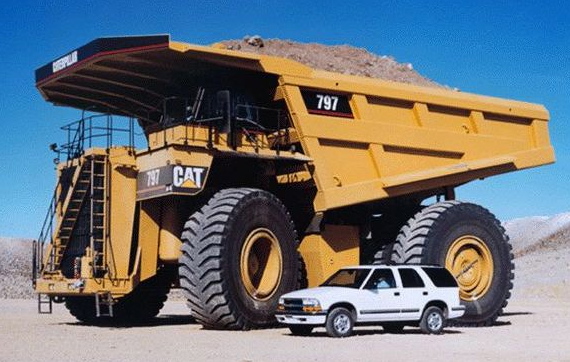
(CAT 797F transported by Mercedes Semi-tractor)
Now, the featured picture (above) that I used for this article is not the CAT 789; it is the CAT 797.  The CAT 797 weighs twice as much as the CAT 789, used at the Pueblo Viejo Mine.  However, I just wanted to give an idea of just how big these haul trucks can get.
Furthermore, the mining, excavating and hauling of ore out of the Pueblo Viejo Mine is controlled by high-tech computerized systems.  The hauling of the ore by the large truck fleet is monitored by state of the art technology that designs the most efficient method to remove the ore out of the mine, so very little time is wasted.  Again, time is money.
We must remember, the more technology that is used in a system, the more complex and fragile it becomes.  Of course, technology is great at making large operations run more efficiently and faster, but the downside is that if one or more critical parts are removed, the complex mining system breaks down.  What would happen to gold production at the Pueblo Viejo Mine if cyanide becomes in short supply?  Without cyanide, the processing of gold ore grinds to a halt.
While I have provided one example of the enormous cost and massive amounts of capital needed to produce gold and one mine, let’s take a look at what is going on at the top 8 gold mining companies in the world.

Top 8 Gold Mining Companies Costs & CAPEX Spending Surge

It is quite amazing how much more it costs to produce an ounce of gold today than it did at the beginning of the century.  The huge rise in the total cost to produce gold is why the price is nearly five times higher.  Unfortunately, many precious metals analysts suggest that the increase in the gold price is due to either market sentiment or increased demand.  I have stated in several articles that the tremendous increase in the gold price was due to the rise in the price of oil:
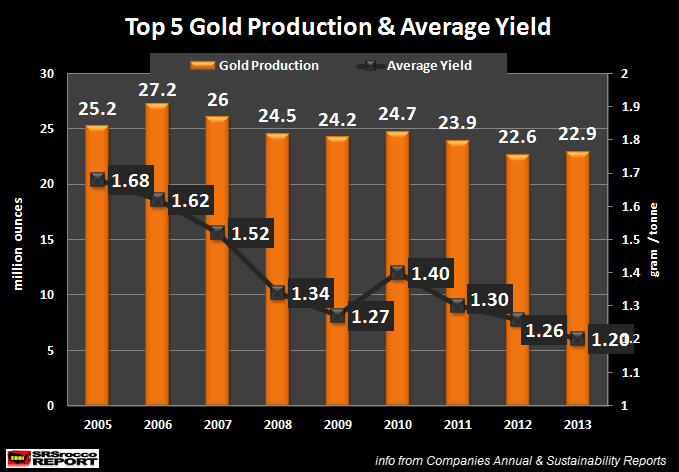
However, there are additional factors that also impact the cost to produce gold.  For example, the gold mining industry now has to move a great deal more ore to produce the same amount of gold it did in 2000.  The next chart shows the falling yield in the top gold mining industry from 2005 to 2013:
In just eight years, the top five gold miners experienced a near 30% decline in average gold yield from 1.68 g/t (grams per ton) to 1.2 g/t.  If we went back five more years to 2000, I would imagine it would be closer to a 40% decline in average yield.  Thus, it now takes the processing of 40% more ore to produce the same amount of gold today.  Which means, it now takes a hell of a lot more energy and materials to produce gold today than it did 16 years ago.
This next chart puts into perspective the increased cost to produce gold today versus in 2000:
This graph shows the increase “Cost of Goods Sold” for producing gold at the top 8 gold mining companies in the world.  Even though many of the companies have seen a decline in the Cost of Goods Sold since the peak in 2013, the overall figure is still much higher than it was in 2000.  Some of the companies included in the chart above have seen their Cost of Goods Sold increase significantly because they increased their gold production substantially.  However, Barrick did not have that excuse.
Barrick produced 5.9 Moz of gold with a $553 million cost compared to $5.4 billion in 2016 on 5.5 Moz of gold production.  Here we can see that Barrick’s Cost of Goods Sold increased ten times while production is about the same.
According to the data at YCharts.com and these companies’ annual reports, the total Cost of Gold Sold in 2000, was $4.9 billion ($4,953 million) versus $23.6 billion ($23,588 million) in 2016:
Now, what is amazing about the figures in the chart above is that the Cost of Goods Sold figure has more than quadrupled while total gold production in the group only increased by 2 Moz.  The top 8 gold miners Cost Of Goods Sold increased from $206 per oz in 2000 to $907 last year.   The huge increase in cost to produce gold is the very reason the price surged from $279 in 2000 to $1251 in 2016.  Let’s look at the comparison:
Cost of Goods Sold vs. Gold Price:
2000 vs. 2016 Cost of Goods Sold = 4.4 times increase
2000 vs. 2016 Gold Price = 4.5 times increase
So, if we removed all SUPPLY & DEMAND forces from the equation, it is quite surprising that the gold price is up by the same amount as the cost to produce gold.  However, we need to also look at the rise in capital expenditures.  During the same period, the top 8 gold miners total capital expenditures increased from $1.7 billion ($1,723 million) in 2000 to $6.1 billion ($6,088 million) in 2016:
Again, we can see that total capital expenditure (CAPEX) increased from $72 per ounce in 2000 to $234 an ounce in 2016, while overall production only increased by 2 Moz.  The group’s CAPEX spending only increased 3.2 times versus the 4.4 times in the Cost of Goods Sold, but it shows that it cost a heck of a lot more money to sustain or replace production.
If we understand that the present value of gold is tied to its cost of production, then we would realize it has a PRICE FLOOR.  Sure, the gold price could spike lower, but its average annual price has remained close to (or above) its cost of production for quite some time:
This chart represents my “Net Income Breakeven Analysis” for Barrick and Newmont, the two top largest gold companies in the world.  As I also mentioned above, Barrick’s cost to produce gold in 2016 was $1,125 when the spot price was $1,251.  Thus, the market has priced gold above its cost of production (in these two companies) since at least 2000.
Lastly, the gold mining industry needs a vast amount of materials, parts, energy as well as a very complex supply chain system to produce the precious yellow metal.  If one part of the supply chain breaks down, then it becomes extremely difficult or impossible to produce gold.  While there are many fragile aspects of the modern high-tech gold industry, I believe ENERGY is the most crucial.
Once the world starts to experience a decline in global oil production, the vast supply chain system will begin to break down.  This will impact the largest mines the most.  I will be writing more about this subject matter and also why a declining global oil supply will push the price of gold up much higher.
HOW TO SUPPORT THE SRSROCCO REPORT SITE:
My goal is to reach 500 PATRON SUPPORTERS.  Currently, the SRSrocco Report has 141 Patrons now!   Thank you very much for those who became new members and new Patrons of the SRSrocco Report site.
So please consider supporting my work on Patron by clicking the image below:


Friday, September 5, 2014

Depletion: the problem with gold


Depletion is the true elephant in the living room of our age: it is a gigantic problem but it is rarely - if ever - recognized. Few people understand that depletion does NOT mean that we run out of anything. It means that producing a mineral commodity becomes so expensive that fewer and fewer people can afford it. It is happening with all mineral resources and, in this post, Steven Rocco reports about the situation in the gold mining industry. Clearly, we are not running out of gold, but with the cost of fuel increasing by a factor of five in ten years, you can't but wonder how the gold industry will be able to maintain the present production rates. (UB)


From the blog "SRSrocco Report", reproduced by permission of the author

GOLD MINING INDUSTRY: Fuel Costs Explode Over The Past Decade

 By on August 4, 2014 
 
The gold mining industry literally devours energy to produce an ounce of gold.  In the past decade, fuel consumption at the top gold miners more than doubled, but the actual energy cost grew at a much higher rate.

The huge increase of diesel consumption at the top 5 gold miners is due to several factors.  As ore grades continue to decline, the gold mining companies need to extract more ore to produce the same amount of gold.  Thus, the massive haul trucks that transport this ore burn more diesel in the process.
Furthermore, as open-pit mines age, they deepen which forces the haul trucks to travel longer distances at a higher grade.  One of the largest haul trucks in the world is the Caterpiller 797F.  These haul trucks are massive and can transport 400 metric tons of ore in a single trip.

CAT 797 pic

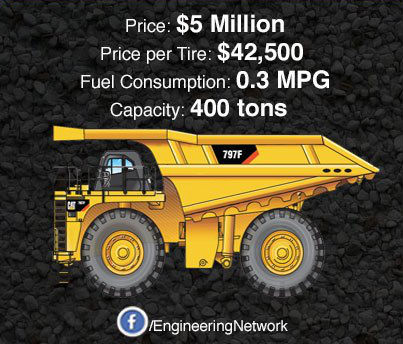
The CAT 797F has a standard 1,000 gallon tank and has options for a 1,500 and 2,000 gallon tank.  The graphic below (from the Engineering Network) provides some of the costs and statistics of the CAT 797:


CAT 797F

The CAT 797F costs $5 million a pop and uses six tires that cost $42,500 a piece.  Here is a fascinating cost factor that I found quite surprising.  According to an article in the Engineering and Mining Journal:

studies show tire costs can exceed 25% of total haul-truck operating costs per ton; and total tire service and replacement costs over the useful service life of a haul truck can exceed the original purchase price of the truck.
Basically, tires cost just as much or more than the haul truck itself.  That is an amazing statistic that just goes to show how expensive it is to mine gold.
In addition, you will notice the CAT 797F has an excellent fuel consumption rating of 0.3 miles per gallon…. which is a little more than 3 gallons per mile.  To get an idea of how much more diesel the gold mining industry consumes today, let’s look at the following chart.


Diesel consumption per ounce of gold produced more than doubled from 12.7 gallons per ounce in 2005 to 25.8 gallons per ounce in 2013.  You will notice that the diesel figures for 2012 and 2013 are the same.  At first I thought we would see an increase in 2013, but as companies started cutting back on construction of new mines as well as high-grading (extracting higher grade ore), consumption remained flat.

We must remember, these gold mining companies consume diesel in the transportation of their waste rock and ore, mine construction and to a lessor extent… electric generation when connecting to the grid is not possible or economical.

Diesel consumption per ounce of gold produced increased in 2013 at Barrick and Newmont, but fell at AngloGold, Goldfields and GoldCorp.  However, total diesel consumption in the group increased from 583 million gallons in 2012 to 591 million gallons in 2013.  The reason the gallons per ounce figure remained the same in 2013 as it was in 2012 was due to an additional production of 300,000 oz of gold.

While the top 5 gold miners doubled their diesel consumption per ounce of gold produced since 2005, their actual energy cost increased a great deal more.  The next chart reveals just how much these costs increased.


In 2005, these gold miners spent an estimated $30.48 of diesel per ounce of gold produced.  This figure doubled by 2008 to $69.92 when the price of a barrel of oil skyrocketed to $145.  When the recession hit in 2009, causing the price of oil to plummet, diesel costs for the gold miners declined as well.
Then over the next three years, diesel costs per ounce increased significantly from an estimated $55.91 in 2010 to $102.43 in 2012.  Even though the figure in 2013 is slightly lower than 2012, costs have more than tripled since 2005.

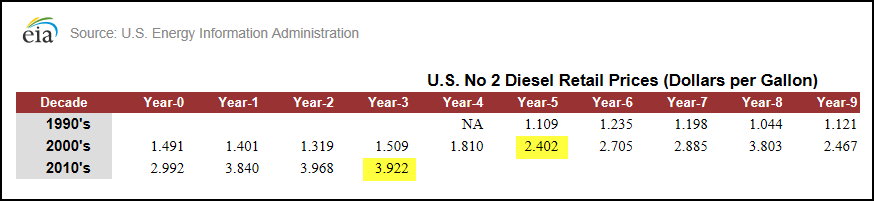
I estimated these figures by using the average annual price of diesel stated by the EIA – The U.S. Energy Information Agency.  Here is their data table:
U.S. Diesel Prices

The price of gallon of diesel was $2.40 in 2005, hit a peak of $3.97  in 2012 and averaged $3.92 in 2013.  So, not only have the gold miners doubled their diesel consumption for each ounce of gold produced (2005-2013), the price of diesel increased 63% during the same time period.

Now, if we go back just a few more years and look at the rate of change since 2003… its staggering.  I don’t have the actual diesel consumption figures for the top 5 gold miners for 2003, so here I provided some estimates below:

2003-2013 Estimated Change In Diesel Consumption & Cost

2003 = 12 gallons per ounce (conservative estimate)
2003 = $1.51 price of gallon of diesel
2003 = $18.12 diesel cost per ounce
2013 = 25.8 gallons per ounce
2013 = $3.92 price of gallon of diesel
2013 = $101.14 diesel cost per ounce

What a difference a few years makeaye?  Here we can see that the price of diesel in 2003 ($1.51) was almost a Dollar less than it was in 2005 ($2.40).  I was conservative and estimated that diesel consumption declined to only 12 gallons per ounce in 2003 compared t0 12.8 gal/oz in 2005.

Thus, the actual estimated diesel costs per ounce increased more than five times since 2003… actually 5.6 times.  Which means, the top 5 gold miners spent on average, $101 on diesel for every ounce they produced in 2013 compared to $18 in 2003.

Even though this diesel cost figure only represents a small part of the overall costs to mine gold, energy still represents the largest factor in determining the value of gold.  When I say that, it goes above and beyond the additional sources of energy such as electricity a gold mining company purchases when they process and refine gold.

It’s important to realize that all the mining equipment and materials used in the gold industry are not produced out of THIN AIR in the same way the Fed creates money.  All the metals and products that go into manufacturing mining equipment are only made possible by the huge amounts of energy consumed in the process.

This is also true for the materials consumed at the mine.  For example, Barrick purchased 292,000 metric tons of lime in 2012 at its mines.  Lime is listed as a material cost on its balance sheet, but the overwhelming factor to produce lime is calculated by the energy consumed in all forms and all stages.

We must remember, lime is extracted by huge excavators and moved by huge trucks which is then transported from the quarry to the mine by more trucks.  This all consumes a great deal of energy.  Again, the value of the lime used in the gold mining industry comes from the amount of energy consumed in all forms and stages.

Lastly, we also need to consider all the human labor in all stages.  Lime isn’t extracted or transported by robots (not yetLOL), but by humans.  Human labor is a form of energy.  So, when a reader sends me an email saying that labor is a higher cost than energy on a typical gold company’s balance sheet, I politely respond by saying… HUMAN LABOR IS ALSO A FORM OF ENERGY.
In conclusion, the gold mining industry consumes a lot of diesel to produce an ounce of gold.  As we can see, total diesel costs are rising even faster.  I am not concerned about the impact of increased diesel costs on the gold mining industry in the following years.  However,  the real threat to the industry will be a lack of available fuel supplies in the future… not the energy cost.

I will discuss this in more detail in future articles and reports.

Thursday, July 24, 2014

Mineral depletion: the trouble with gold


The main point that I am making with my latest book, "Extracted" is that mineral depletion is one of the major sources of our present economic and environmental troubles. Explaining this point is not easy: most people still seem to believe that depletion means "running out" of something. But that's not the case. Depletion is a gradual phenomenon that goes on all along the cycle of extraction of all mineral resources. Extraction starts with the "easy", high concentration resources, but gradually must move to more expensive, low concentration ones. As a result, the returns on extraction diminish with time (and extraction also causes more damage to the ecosystem). One of the consequences is the high prices we are seeing nowadays for all mineral commodities. It is not that we are running out of anything, but ore grades are falling everywhere, extraction is becoming more and more expensive, and that must have an effect on the market prices. The gradual disappearance of low cost/high grade ores can be seen with practically all mineral commodities, but it is especially evident with some of them. The article below is reproduced from Steven S. Rocco's blog and it describes the present situation with gold. As you can see, the gold industry is processing more and more ore to produce less and less gold. It is the inexorable law of depletion at work: we are not running out of gold, and we probably never will. But we'll have to face a falling supply.

___________________________________________

From "SRSRocco report"

TOP GOLD MINERS: Yields Fall To The Lowest Levels Ever

By Steven S. Rocco () on July 18, 2014


With the results for 2013 finally in, the top gold miners average yield fell to the lowest level ever.  This is a surprising development considering that the average price of gold dropped to a low of $1,411 in 2013.  Normally when the price of gold falls, gold miners switch to higher grades to remain profitable.

However, the top five gold miners’ average yield declined another 5% in 2013.  If we look at the chart below, the top five gold miners (Barrick, Newmont, AngloGold, Goldfields* & Goldcorp) average yield fell from 1.26 grams per ton (g/t) in 2012 to 1.20 g/t in 2013.

(*Note:  GoldFields spun-off three mines into a new company called Sibanye Gold in 2012.  The data below includes both companies listed as GoldFields.)

Top 5 Gold Production & Average Yield 2005-2013

Furthermore, the average gold yield for the group declined from 1.68 g/t in 2005 to 1.20 g/t in 2013.  Which means these miners lost 0.48 g/t in just eight years… a 29% decline.  That might not sound like a lot, but if we do the math… it’s a substantial loss.

The next chart provides the astonishing blow to the gold mining industry.  In 2005, the group processed 464 million metric tons of ore to produce 25.2 million ounces of gold at an average yield of 1.68 g/t.  In 2013, this same group processed 592 metric tons of ore (27% more), to produce 22.9 million ounces of gold.


This is the negative side of the gold mining industry.  Moreover, the amount of waste rock removed is even greater.  For example, Newmont reported the following data in their 2007 & 2013 Sustainability Reports;

Newmont Statistics

2005 Gold Production = 8.2 million oz
2005 Total Waste Rock = 425 million tonnes
2005 Waste Rock/Production Ratio = 52 metric tons/ gold oz
2013 Gold Production = 5.5 million oz
2013 Total Waste Rock = 620 million tonnes
2013 Waste Rock/Production Ratio = 113 metric tons/ gold oz

Newmont doubled the amount of waste rock generated to produce an ounce of gold in 2013 than it did in 2005.  This wasn’t a straight increase over the eight year time-span.  However the waste rock/ production ratio was 86 metric tons per ounce of gold in 2012… 65% higher than 2005.

The more waste rock Newmont has to remove, the more energy is consumed in the process.  In 2005, Newmont consumed 19 gallons of diesel in its operations to produce one ounce of gold.  By 2012, this increased to a staggering 31 gallons per ounce…. a 63% increase in seven years.
As we can see, falling ore grades become a very expensive factor for the mining industry.

Not all the top five gold miners suffered a decline in average yields in 2013.  Barrick, Newmont and AngloGold saw a drop in average yields in 2013, while GoldFields (include Sibanye Gold) and GoldCorp reported a slight increase.
The company who suffered the largest decline in yield was AngloGold:

AngloGold Production & Average Yield 2005-2015

AngloGold’s average yield fell 15% in 2013 compared to 2012, while Newmont declined 10% and Barrick at 6%.  Even though these declines seem quite large, I imagine we may actually see a leveling off or increase in yields from these companies in 2014.

Unfortunately, high-grading their mines to remain profitable at lower prices is only a temporary solution. Worse yet, the link provides information on how this method can leave a great deal of gold in the ground due to selecting the high-grade ore while leaving low-grade ore uneconomical to extract.
So, if these top gold miners decide to high-grade their mines, we may see a leveling (or slightly rising) of yields in 2014.  However, this may actually speed up the decline rates in yields further down the road.

I am waiting for data to be released by two companies so I can update my chart on the average diesel consumption per ounce from the top five gold miners.  With the majority of results already in… I can honestly say, diesel consumption per ounce in 2013 will hit a new record high.

As ore grades continue to decline, the cost to produce gold will inevitably rise.  Some readers believe the higher energy price will be the factor to push the value of gold to new highs.  Actually, I don’t believe this will be the case.
The world cannot afford high oil prices.  We may experience temporary OIL PRICE SPIKES, but I doubt the price of a barrel of Brent crude will continue to rise towards $200.

The price of gold and silver will rise to extreme levels in the future not on the back of higher oil prices, but rather due to a falling oil supply and its impact on the $100+ trillion of worthless paper-mache floating around the world’s markets.


Who

Ugo Bardi is a member of the Club of Rome, faculty member of the University of Florence, and the author of "Extracted" (Chelsea Green 2014), "The Seneca Effect" (Springer 2017), and Before the Collapse (Springer 2019)