Showing posts with label mineral depletion. Show all posts

Saturday, February 29, 2020

The Greatest Crime in History: How it is Being Perpetrated in Front of Your Eyes.

The Danger of Methane Hydrates and how Some Idiots are Planning to Extract Them as Fuels.


Methane hydrates may be the most dangerous thing existing on this planet. They won't do any damage until they stay where they are, underground, but some idiot is proposing to extract them as fuels. Great idea: like warming yourself by pouring gasoline onto your body and lighting a match. If it were ever done, it would be the greatest crime in history. Actually, the last one.


A few years ago, I was sitting in the audience of a conference on energy. There appeared a Japanese researcher who spoke for half an hour on how they were exploring the possibility of extracting methane hydrates from the Pacific Ocean. For a while, I thought it was a joke. Then it was clear that he was speaking seriously. His company had obtained grant money from the Japanese government to do exactly what they were doing: studying how to extract hydrates from undersea deposits.

When the time for questions came, I thought to rise up and tell him something like, "you are a criminal. You are worse than Hitler, Saddam, and Genghis Khan, all together. You should be arrested and shot." But I didn't do anything like that, after all, this guy had simply used some of his grant money to take a tourist trip to Europe. I think other people in the audience thought the same because he was asked just a couple of trivial questions. Then he left, not to be seen around again.

You may have heard about methane hydrates: they are an enormous reservoir of methane created long ago by bacterial activity and stored underground at low temperatures in the Northern permafrost and under the ocean floor. And you know that methane is a powerful greenhouse gas, fortunately present in minute amounts in the atmosphere today. But the carbon in the stock of hydrates is probably at least twice as large as the amount of carbon in the whole atmosphere. And, obviously, if this methane were to be released into the atmosphere . . .  If it were done for real, it would be the final crime against humankind. The past exterminations carried out by the great dictators of the past would be just jokes in comparison.

How can people be so disconnected from reality? It seems just one manifestation of a basic problem of the human mind: it can tackle only one problem at a time. When we are worried about something specific, all the rest fades in the fog. So, the city of Florence declared the climate emergency and then lobbied hard to build a larger airport nearby (they failed, at least some good news, but they are insisting). Not the only example, of course: when mad ideas such as extracting fuels from methane hydrates are proposed, nobody seems to be overly incensed.

Right now, there is a moment of frenzied activity of the mining industry in telling us what they are going to do to solve the problem of mineral depletion. How they are going to exploit marine resources to produce all sorts of minerals, how they are going to develop nuclear drills to go deeper in the search for oil, gas, and whatever. And the old idea of getting minerals from space continues to be proposed.

It all smacks of desperation and that's good: but never underestimate the craftiness of the clever monkeys that populate this planet. They can still do a lot of damage.


A note from Ugo Bardi's personal troll, Mr. Kunning-Druger

So, professor, now you are revealing your true colors of warmunist. You wanted to kill your Japanese colleague just because you think you are right and he is wrong. It shows how you warmunists are part of a cult that admits no different opinion. And, in passing, you also confessed that you scientists spend the money that we taxpayers give to you to take vacations with the excuse of "scientific meetings." One day, you'll get what you deserve for this!


Sunday, October 7, 2018

Could Donald Trump be the Last World Emperor? States and Empires After the End of the Fossil Age


Empires are short-lived structures created and kept together by the availability of mineral resources, fossil fuels in our times. They tend to decline and fall with the decline of the resources that created them, and that's the destiny of the current World Empire: the American one. Will new empires be possible with the gradual disappearance of the abundant mineral resources of the past? Maybe not, and Donald Trump could be the last world emperor in history.


A warlord named Sargon of Akkad was perhaps the first man in history to rule a true empire, around mid 2nd millennium BC in Mesopotamia. Before him, humans had been warring against each other for millennia, but the largest social structures they had developed were no larger than city-states. Gradually, new forms of social aggregation emerged: kingdoms and empires, structures kept together by a central government that, normally, involves a larger than life male figure, emperor or king, who runs the state machine using a combination of force, prestige, and gifts.

Sargon's Empire went through the normal destiny of the empires that came after it: glory and plunder at the beginning, then struggle, destruction and, finally, collapse. Nothing unusual for a cycle that would span millennia of human history. Taagenpera shows how empires come and go (image source)


The rise and fall of empires looks like a chemical reaction, flaring and then subsidizing, as a reaction running out of reactants -- then restarting when new reactants have accumulated. For empires, the reactants might have been mineral resources -- it may well be that Sargon's empire was the result of silver having become a standard medium of exchange in Mesopotamia. With silver, Sargon could pay his soldiers. With his soldiers, he could rob more silver. And, with more silver, he could pay even more soldiers -- and there you go: the road for glory and murder is open.

The Romans built up their stupendous empire using the gold and the silver of their mines in Spain. When the mines were exhausted, so was the Roman Empire, but it left such a deep impression that for more than a millennium people tried to rebuild it. Charlemagne built his Holy Roman Empire during the 9th century AD by means of newly discovered silver mines in Eastern Europe. Later on, during the 16th century, Charles V rekindled Charlemagne's idea with his empire on which the sun never sets, built on the gold coming from the Americas. But these empires, too, went through a cycle of growth and decline, in parallel with that of the resources which had created them.

The 20th century was the age of fossil empires. The British used coal to create the biggest and the most powerful empire ever built -- it faded away with the gradual decline of its coal production. Another ancient empire, Austria-Hungary, the last remnant of the concept of a European Empire, went to pieces during WWI, the only European state which didn't survive it. The attempt of Italy to re-create the Roman Empire in 1936 with the conquest of Ethiopia had the only effect of generating the shortest-lived empire in the history of the world, just five years. At least, the short saga of the Italian Empire could demonstrate that no empire can exist for long without abundant mineral resources available. With the end of WWII, only two large empires remained: the Soviet and the American one. Both were based on fossil fuels and, in particular, on the abundant crude oil they could produce. For a while, the Soviet Empire challenged the worldwide supremacy of the American Empire - but it had to give up and fold over when its oil resources became too expensive to extract and it was impossible to use them to fuel its military apparatus.

Today, the sole heir of some four and a half millennia of empire building is the American Empire, a stupendous structure that dominates the world's oceans and a large part of the world's land. But, as for older empires, the American one will last only as long as will be able to produce the resources that created it: fossil fuels. And the end can't be too far away: conventional oil production has been declining for decades in the US territory, while the production from shales can only postpone the unavoidable. It may well be that the mighty American Empire will soon follow the path of its predecessors. If this is the case, the collapse will be fast and brutal, the kind of collapse that we call sometimes "Seneca Cliff."

The whole political debate in the US reflects this situation. The Dems (or the Left) have come to embrace the Imperialist viewpoint, pursuing an aggressive foreign policy. The Reps (or the Right) are no enemies of the Empire, but many of them favor retrenching within the US national borders. There is a certain logic in these positions: the political base of the Dems is in the impoverished remnants of the middle class and, for them, the only hope of survival is the economic expansion that could come from plundering foreign countries. The Reps, instead, represent the elites and, for them, the easiest way of maintaining their dominance is to plunder the American middle class.

Donald Trump represents well the view of the elites. He seems to understand (or, at least, to sense) in which direction the wind is blowing and what he is doing, apart from the exaggerated boasting, is to try to turn the parasitic imperial economy of the United States into a self-standing national economy. Not an easy task and Trump may well fail in what he is trying to do. But history never fails: empires have always gone through a cycle of growth and collapse, it is just a question of time.

So, the American Empire is destined to go, but what will come after the fall? Most likely, we'll see a situation resembling that of the fall of the Roman Empire, when there were no resources to build another large empire and Europe moved back into an age of independent cities and statelets. Nowadays, many people seem to think that the disappearance of fossil fuels would bring a return of the Middle Ages. It might happen: large organizations need a lot of energy to run and, in addition, our civilization will be badly hit by global warming. The result may be the fragmentation of the current political entities, returning to nation-states or even back to city-states. There will not be another World Empire and Donald Trump could be, if not the last emperor, the last who ruled an empire as large as the current American one.

The return to Middle Ages could be avoided, at least in part, if humankind were to invest some of the remaining resources into building an energy infrastructure based on renewable energy, but, right now, it seems that these resources will be squandered in a new series of resource wars. And so it goes, it is the great cycle of history that moves onward. Humans struggle, fight, and quarrel, but the best efforts of mice and men come to naught when they try to keep things as they are and they have been. The only unchanging thing in history is that things always change.


Friday, March 16, 2018

The View From Les Houches: The Return of Space Mining?


Robert Ayres, well known for his work on biophysical economics, gave a talk dedicated to space mining at the School of Physics in Les Houches this March. Ayres just touched the subject that gave the title to his talk, spending most of the time to describe the plight of the mining industry, faced with the shortage of rare minerals. Yet, the fact that he used that title is an indication of the increasing popularity of the meme of mining space. It is still a marginal subject of investigation, but you can see the trend in Scopus, here, for the search term "space mining":


In a previous post of mine, I was not optimistic about space mining. I said that there was nothing interesting to mine in space and that the whole idea was proposed by people who knew little or nothing about geology. Asteroids and other small space bodies contain no ores because they never went through the processes of deposit creation that took place on the Earth. No ores- no mining. Basically, the growth of interest in the subject may be more a symptom of growing desperation rather than something that could be plausibly done.

I remain more or less of this idea: going to space to bring minerals back to Earth makes little sense, But, recently, I have been re-examining the concept and I discovered that there may be a logic in it if we just we change the target market from the Earth to space.

Space is a growing business with plenty of interesting applications: communication, exploration, astronomy, earth monitoring and more. Elon Musk is no fool and if he developed a heavy rocket launcher, it is because he saw the need of it. So far, every gram of the devices and the structures sent to space came from the Earth's crust. And sending things to space is awfully expensive. So, it could make sense to examine the possibility of assembling space structures using materials mined in space.

It would still be difficult, perhaps impossible, to mine rare minerals in space, but asteroids are rich of elements such  such as iron, nickel, aluminum, titanium, silicon and even carbon and water in the form of ice. These minerals are not there in the form of ores, but they form a sufficiently large fraction of some asteroids that extracting and purifying them could make sense. Take also into account that space is rich in solar energy that can be transformed into electric power by PV panels and that in space you have little to worry about pollution and greenhouse gases.

Of course, putting together a mining industry in space is a task which was never attempted so far and the unknowns are enormous. It was discussed back in the 1970s when the concept of "space colonies" became popular. But, over the years, it became clear that humans are not made for space; too expensive and too dangerous. Instead, space is a good place for robots which can do the same things human can do in a better and cheaper way. And these robots could be made, at least in part, from materials obtained from asteroids.

Is it possible? It depends on the trajectory of the world's economic system. If we manage to collapse as badly as some models predict, then space robots will soon become something made of the stuff dreams are made of - just like the angels which once were thought to be pushing planets along their orbits. But if humankind manages to keep a functioning industrial economy, then why not? Our robot-children could explore space and maybe build a new silicon based ecosystem, out there. The future is beautiful because it is always full of possibilities.


Thursday, March 15, 2018

The View from Les Houches: Of Rare Metals and Cute Kittens


Les Houches, March 2018. José Halloy of the Université Paris Diderot discusses mineral depletion in his presentation. Note how he utilizes Hubbert curves to estimate the trajectory of mineral extraction. He predicted that the dearth of very rare elements will negatively affect the electronics industry, perhaps killing it completely.


José Halloy's presentation at the Les Houches school of physics was focused on the availability of rare minerals for electronics. This is a problem that's rarely discussed outside the specialized world of the "catastrophists", that is of those who think that mineral supply may be strongly restricted by depletion in a non-remote future. In this field, Halloy seemed to side with the "hard" catastrophists, that is expressing the option that depletion will make certain things, perhaps even the whole electronics industry, impossible.

The problem, indeed, is there: modern electronics is based on the unrestricted use of very rare minerals - the term "very rare" indicates those elements which are present only in traces in the earth's crust and which, normally, do not form exploitable deposits of their own. If you pick up your smartphone, you probably know that it contains several of these very rare elements gallium (for the transistors), indium (for the screen), tantalum (for the condensers), gold (for the electric contacts) and more.

Most of these elements are "hitch-hikers" in the sense that they are produced as impurities extracted from the production of other elements: for instance, gallium is a byproduct of aluminum production. Whether we can continue to supply these elements to the electronic industry in the future depends on a host of factors, including whether we can continue to extract aluminum from its ores. In this sense, recycling is not a good thing since recycled aluminum, of course, does not contain gallium, because it has already been extracted during the refining phase. Note also that recycling tiny amount of very rare elements from electronic devices is extremely difficult and very costly. So, in the future, the supply of these elements is going to become problematic, to say the least.

Does it mean the end of electronics? José Halloy seemed to be very pessimistic in this sense, but I think the question was not posed in the correct way. If you ask whether current electronic devices can survive the future dearth or rare mineral, the answer is obvious: they can't. But the correct question is a different one: what kind of electronic devices can we build without these elements?

Here, I think we face a scarcely explored area. So far, the industry has been produced all kind of devices focusing solely on performance on the basis of the assumption that there aren't - and there won't ever be - mineral supply problems. Can we make a smartphone without gallium, indium and all the rest? That is, limiting the elements used to the basic ones, silicon, aluminum, and other common materials? It is a difficult question to answer because, really, it has never been addressed, so far.

Yet, I think there are excellent possibilities to develop a new generation of electronic devices which are both using very little (and perhaps zero) rare elements and which are designed for complete (or nearly complete) recycling. The basic element of all electronic circuits, transistors, can be made using silicon and, in general, there are alternatives to rare metals for most devices, even though in most cases not with the same performance. For instance, light emitting diodes (LEDs) are currently based on gallium nitride (GaN) and there seem to be no comparable substitutes. Without LED, we would have to go back to the old cathode ray tubes (CRTs) which we consider primitive today. But, after all,  CRTs performed well enough for us up to not many years ago. So, it would be an inconvenience, but not the end of the world.

So, it is clear that we'll have to settle on reduced performance if we want an electronics without rare elements, perhaps on a strongly reduced performance. But maybe we don't need the kind of performance we have been used to in order to keep going. Think about your smartphone: it is an incredibly complex and powerful device used mostly for trivial tasks such as looking at clips of cute kittens and sending likes and thumbs-up to other machines. Does "civilization" really need these devices? It is all to be seen.

For a fascinating discussion of an industrialized world running without rare metals, see the excellent book by Pierre Bihouix "L'age Des Low Tech" (in French - alas!)

Wednesday, July 19, 2017

Mining the asteroids: how desperate can we become?


A silly idea that seems to be coming straight from a science fiction story of the 1950s. Mining the asteroids wouldn't just be outrageously expensive; the problem is that there is nothing to mine there. Yet, some people seem to take the idea seriously


It seems that, when we are in trouble, we tend to revert to our childhood memories, seen as happy times that, somehow, could return. That may explain why President Trump is dreaming of an impossible return to coal. He may see the idea through his memories of childhood as a time of happy miners and prosperous families.

Some others, instead, may revert to memories influenced by the science fiction of the 1950s, when the idea of "mining the asteroids" was commonplace. Jerry Pournelle wrote a delightful essay on this genre in 1980 under the title "Those Pesky Belters and Their Torchships". You may also remember the 1981 movie "Outland" starring Sean Connery and taking place in a mine on the moon of Jupiter, Io.

Nice memories, yes, could we ever mine space bodies for real? Well, the science fiction of the 1950s described many innovations that never appeared in the real world and most likely never will. Some because they are too expensive (flying cars) and some because they are contrary to the laws of physics (anti-gravity). Mining the asteroids falls straight into the "impossible" category for two reasons: the first is that it is too expensive and the second that it goes against the laws of geology (if not of physics). It wouldn't be physically impossible to mine the asteroids but there is nothing interesting for us to mine there.

Let me explain: we can extract minerals on Earth because of the "energy credit" that comes from geological or biological processes (and often both) which have concentrated specific elements in some special regions of the crust. We call these regions "deposits" and we use the term "ores" for those deposits which are concentrated and pure enough that they can generate an economic profit from mining. Only ores are a useful source of minerals. Mining from the undifferentiated crust is simply unthinkable because of the enormous energy it would require (see my book "Extracted").

And there lies the snag with asteroids. The physical processes that created ores on our planet can take place only on planets which are both geologically and biologically active. As far as we know, asteroids never were. So, there are no ores on asteroids; nor there are on the moon or other "dead" space bodies. It is not impossible that there could be ores on Mars, which may have been geo-biologically active in a remote past, or perhaps on the moons of Jupiter, maybe geologically active today. But, for what we know, the best place in the solar system where to find ores is our planet, the good, old Earth (and, incidentally, as science fiction goes, the 2011 movie "Cowboys and Aliens" got the geology of the story perfectly right: the aliens come to Earth for its mineral resources). 

So, no ores, no mining. And no ores on asteroids means no mining on asteroids (*). Of course, many asteroids are mainly iron, but it makes no sense to go there to mine iron if you consider that there is plenty of iron on Earth and you think of the costs involved with the idea of mining space bodies. It is an idea that just makes no sense.

Yet, we are seeing a spate of news that we could take as if someone really wanted to mine the asteroids. Possibly the most idiotic one appeared on "Futurism.com" with the title mentioning an asteroid "worth 10,000 trillion dollars". It seems that the author simply multiplied the mass of the asteroid, supposed to be all iron, by the current cost of iron per kg, arriving at such a meaningless number.

Other people seem to be peddling space mining and they may ask you money to finance their ideas on the basis of cute drawings which, indeed, remind the fictional spaceships of the 1950s. Others, including the Luxembourg government, seem to be willing to do exactly that: spend money on the idea of mining space, really!  (at least, despite their attempt of selecting the worst possible ideas they couldn't imagine, they don't seem to be planning to invade Iraq).

Some people who should know better seem to have lost track a little of what they are saying. So, the French astrophysicist Jean-Pierre Luminet is reported to have declared that "Asteroids are full of pure and precious metals, such as gold, platinum, cobalt, etc, in quantities ten to a hundred times larger than what we can find in terrestrial mines." (let's just say that we can't pretend that astrophysicists know something of geology).  The idea seems to be diffusing and I reported in a previous post how an acquaintance of mine reacted to my statements that we had resource problems with "but we shall colonize other planets!"

So, what to say? Just that when desperation sets in, idiocy often follows.


(*) commenter Ned noted that some meteorites have a platinum concentration higher than that of terrestrial ores. So, there may be an exception to the rule. Whether these asteroids could be actually mined, it is another question. 


Wednesday, June 7, 2017

Interview with Ugo Bardi: Climate, Fossil Fuels, Resources and All That

The MEDEAS project team at a recent meeting in Barcelona. At the center, the project coordinator, Jordi Solé, Another group of well-intentioned people engaged in saving the planet. Yes, we know it is difficult: we are doing our best. 


This interview was recorded this February and is reported here from the site of the European Project MEDEAS, only minimally edited. Take into account that none of the people involved (interviewers and interviewed) are native English speakers and you can understand why the grammar and the syntax are, well, let's just say "not perfect". Then, as in all non-edited interviews, the flow of the concepts is also far from being perfect. However, I thought to reproduce it here because it contains much of what I have been trying to say, lately. Maybe you'll find it interesting (U.B.)


On 17th February 2017, during MEDEAS first General Assembly in Brno, Czech Republic, Ugo Bardi from INSTM, partner of MEDEAS Project was interviewed by Mikuláš ÄŒerník for Deník Referendum, an independent online newspaper focused on social and environmental issues. The interview discussed how science nowadays can address challenges as climate change and possible limitations of resources for the transition to a low-carbon economy. The whole interview can be found below in English, while the original version is published in the newspaper’s webpage


INTERVIEW WITH PROF. UGO BARDI (UNIVERSITY OF FLORENCE, ITALY), IN BRNO, CZECH REPUBLIC (17.2.2017) DURING MEDEAS GENERAL ASSEMBLY.

Your main topic is resource depletion. Since the release of your book on the Limits to Growth, how has the situation changed?

The thread that runs through everything I study is resource depletion in the broadest sense. You can restrict its sense to minerals, which is to take the core meaning, but then there is also climate change. Climate change can be seen as the depletion of the atmosphere’s ability to absorb greenhouse gases without overheating. So it’s also depletion—everything’s a question of depletion. And everything is a question of resources. People have spoken about limits to growth, which at one time was a very innovative concept, but these limits on growth derive from limits on resources, and that’s something we’re still working on.

You’re writing a blog called the Cassandra Legacy. How did you, as a scientist, decide it was necessary to write a blog?

Because many people speak about there being two cultures, humanist culture and scientific culture. And in my modest opinion, this is completely wrong. There are no two cultures, there is only one culture. And so a scientist should be within the limits as much as possible, should be a humanist as much as possible within the limits, should know something about hard science such as thermodynamics and physics, and so on. But unfortunately our world has fallen into the trap of overspecialization, which means that a lot of people study so much that eventually they know everything about nothing—which is the definition of a specialist. So we have specialists who know absolutely everything about nothing, which is a little useless in my opinion. So we need a modern view of science, and this is a concept that some of us are working on. It’s a new conceptualization that tends to deemphasize what we call “reductionist science”. To emphasize what we call “systemic science”, which looks at changes at the whole-system level. Because if you are a reductionist, you would say What is the problem? I’m slowly running out of fuel for my car. So you say, No problem, hydrogen will fix everything. If you follow a systems approach, you say well, okay, maybe hydrogen is a way to change the system, but how will the system react? I think that’s a fundamental part of the MEDEAS project we’re working on. To take a systems approach. We have a valuable collaborator in Brno as well. We’re sure we can get this done.

Do you think that, as a scientist, when you publish a scientific paper, it has any impact on a broader readership and on the general public and policymakers? How do you perceive the relationship between science and politics?

There is no difference. Scientific communication is just one of many kinds of communication. And that has to do with the fact that we communicate within a system. The world—call it the mediasphere or the cybersphere or the brainsphere—the world is a huge system in which ideas, comments, novelties, the news and everything moves and competes in a space. All these things grow, they evolve, they change and they take over spaces, and that’s the most “systemic system”, if you like. It is hugely interesting to study, and that’s what we’re doing. You might not have noticed, but my coworkers and I are developing models for dissemination, for spreading ideas in the websphere, the world wide web, in the mindspace. What we’ve discovered is that your message—you want to know the theory of messaging my coworkers and I are developing? Messages are made up of two parts—the message itself and the communicator who sends it. So the message must be simple enough that it can reproduce, but that’s not enough. The message has a signature that makes it recognized as ‘self/nonself’ and if it is not recognized as “self” it is discarded and the whole attempt to transmit it is useless. So what you do when you send the message is you send yourself. And that’s it. You don’t always hit people with facts. The relevant fact is you, because you are relevant. If you are relevant, you send a message which is understood. You need to understand who is sending the message, you need to understand what a person is. So if you don’t know what you are, you can’t send the message.

This leads me to the next question. Don’t you think that, when scientists put out messages to the public, the public may believe in their correctness and yet feel that what they say is overly pessimistic? That they’re not enough to make them change their behaviour? I’m talking about alarmism. Some people argue that when you scare people too much, as a consequence they won’t be willing to change their behaviour. Do you agree?

This is because most scientists are children when it comes to communication. They know very little, nothing in this field. I won’t use the term ignoramus, but the definition is that when you don’t know anything about something, you are an ignoramus on that topic. Scientific education doesn’t cover communication. So when you try to do work in a field you’re ignorant of, you may achieve zero. And you’re likely to make mistakes. Just think of riding a bicycle for the first time. You don’t know what a bicycle is, what pedals or brakes are, and so on. You don’t really know how a bicycle works. You fall off the bike straightaway. This is what happens when scientists try to communicate all these pessimistic things about climate science to the public. They’re using the wrong communication model. Their message—its penetration—doesn’t depend upon pessimism or optimism. This is a mistake. Think about Christianity. What is the message? It is that there will come an apocalypse. And it is spread easily. Even though it’s predicting an apocalypse. Because Christians knew much better - the old, the ancient Christians, they knew how to promulgate their message. They were able to emphasize the messenger. If you’re willing to get eaten by lions, then the message is important for you, it carries weight. But you must be ready to be eaten by lions to demonstrate the message is real and that, I think, scientists are not willing to do for Climate Science. Maybe we don’t need to arrive to that point but the essence is the same - it doesn’t matter if the message is optimistic or pessimistic. The power is not in the message, it’s in the messenger. The messenger must be believable and this is the problem with climate science. Scientists have made a lot of mistakes and they are presenting a contradictory message. Some scientists say, “don’t worry, we have the solution: you don’t have to do anything” and maybe they start babbling about hydrogen or nuclear energy or whatever. Other scientist say, “well, you have to make sacrifices” and they talk about investing in double paned glasses, using bicycles and the like. But these two messages are not compatible with each other. And if the messenger doesn’t send a coherent message, he or she is not believed.

What about the term peak oil—which was much more widely used in the recent past than it is today. Could you tell us how this term has evolved in public debate?

It’s a good example of how to spread a message. Generally because the message was simple: just two words. “Peak oil”. It has a ring to it, it was interesting, and it was simple enough to spread. And spread it did. These messages have a cycle. They peak, and then they go down. But I think the spread of this message was successful in the sense that it was not only viral, but became part of our culture. Its greatest diffusion came around ten years ago. Then it lost popularity a bit because people had difficulty understanding the term. They see that oil isn’t expensive right now and think that’s because it’s abundant. But that changes. It’s like limits to growth. It was criticised, rejected, demonised, but it was a successful concept, because it is still with us. We debate it, maybe over a long period, but still we debate it. And that’s what we can do with messages. They don’t necessarily need to take over the world, but they remain with us. They can’t be ignored.

Could you also tell us something about the project you’re currently involved in? About MEDEAS; and how it is changing the debate?

MEDEAS is an extremely important project, as a next step after Paris. Paris COP21 told us what we should do, and it was a very good meeting with a huge impact because the communication was taken care of by people who knew what they wanted to do. To have a message which will take root, it must be simple. So Paris - we had thousands of people, hundreds of models, tens of thousands of scenarios, the whole climate science with uncertainties and things like that and final result was one number: 2 °C. You condense everything into something like a piece of genetic code which will then be unpacked. You send a little virus to the mind with a very tiny chink of genetic code. It takes up residency in your brain. It reproduces and grows.

So do you really think the Paris agreement is a step forward in tackling climate change?

Absolutely. It was a remarkable success because it was well packaged. But the numbers in it are not enough, because we don’t know how to achieve them. And that’s what MEDEAS is answering. We give you another number—how much it will cost? If we can afford it and the degree of sacrifice it entails. How much are you willing to pay for your survival?

Let’s imagine that we achieve a post-carbon future. Who will be the loser and who the winner in the transition?

Some scientists in the MEDEAS group have developed a concept they call Thanatia, which refers to a world not meant to be—one in which people have survived, but the planet has died in terms of minerals. This means there is no longer any ability to mine rare minerals, and these minerals are what allowed us to build our civilization. The result is a future that is completely different. There are no more mineral resources like oil and cobalt, because these mineral resources are concentrated—you can’t just find them anywhere you want. If you need something that you lack but someone else has, you may have to fight to get it. But in the future, this will no longer be done, because we will stick to resources that are abundant, like sunlight, silicon, aluminium, magnesium, etc. Society can be built in a locally-structured way that may give rise to less competition for resources and fewer wars.

In our country, the Czech Republic, if we want to achieve what was promised in the Paris agreement, we need to cut our coal consumption, despite its abundance as a resource. How would you advocate this position with the public?

I don’t think this is such a big problem. I mean, the Czech Republic is a very small part of the world and of what’s going on in the world. And if the world starts moving in a certain direction, the Czech Republic will follow. We have coal in Germany, in Poland, in Ukraine, and these regions are burning it. It has to be phased out slowly, and I think we are moving in that direction because the cost is really increasing. Coal is not as cheap as it seems. In the future, you won’t be able to afford to burn the coal, whatever the politicians may say. Mr. Trump said “we have a thousand years of coal” and this is an alternative fact, in other words, a lie. I think we will cease to burn coal sometime over the next decade or two. And hopefully we will do so because we have agreed to stop burning coal and also because we have agreed to deploy renewable energy and replace it.

So basically what you’re saying is, the sooner we make the move, the more we gain?

Yes, that’s correct. The change is going to take place anyway. People talk about problems and that’s bad. Once you say there are problems, you begin to think of solutions. But not all problems are problems, and not all solutions are solutions. If you remember the “Jewish Problem” at the time of Adolf Hitler, well, once you start to say the Jews are a problem, you start thinking of the solution, and the solution they found was a very bad idea – as we all know. So we don’t have to think in terms of problems/solutions – that may lead us to very bad ideas. Instead, we must emphasize change. That change is ongoing, and you have a choice: either you go along with the change, or you reject it. If you reject it, the change will change you, and you will not be happy but will be swept away by the change. In other words, you can solve a problem but there is no solution for a change. There is only one way to face change: to adapt to it.

Ok, thanks very much.

You’re not going to ask me anything about Italian football...?

Thursday, July 24, 2014

Mineral depletion: the trouble with gold


The main point that I am making with my latest book, "Extracted" is that mineral depletion is one of the major sources of our present economic and environmental troubles. Explaining this point is not easy: most people still seem to believe that depletion means "running out" of something. But that's not the case. Depletion is a gradual phenomenon that goes on all along the cycle of extraction of all mineral resources. Extraction starts with the "easy", high concentration resources, but gradually must move to more expensive, low concentration ones. As a result, the returns on extraction diminish with time (and extraction also causes more damage to the ecosystem). One of the consequences is the high prices we are seeing nowadays for all mineral commodities. It is not that we are running out of anything, but ore grades are falling everywhere, extraction is becoming more and more expensive, and that must have an effect on the market prices. The gradual disappearance of low cost/high grade ores can be seen with practically all mineral commodities, but it is especially evident with some of them. The article below is reproduced from Steven S. Rocco's blog and it describes the present situation with gold. As you can see, the gold industry is processing more and more ore to produce less and less gold. It is the inexorable law of depletion at work: we are not running out of gold, and we probably never will. But we'll have to face a falling supply.

___________________________________________

From "SRSRocco report"

TOP GOLD MINERS: Yields Fall To The Lowest Levels Ever

By Steven S. Rocco () on July 18, 2014


With the results for 2013 finally in, the top gold miners average yield fell to the lowest level ever.  This is a surprising development considering that the average price of gold dropped to a low of $1,411 in 2013.  Normally when the price of gold falls, gold miners switch to higher grades to remain profitable.

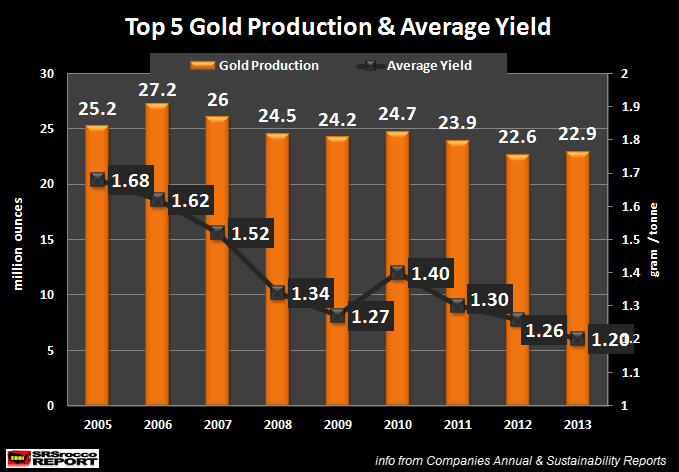
However, the top five gold miners’ average yield declined another 5% in 2013.  If we look at the chart below, the top five gold miners (Barrick, Newmont, AngloGold, Goldfields* & Goldcorp) average yield fell from 1.26 grams per ton (g/t) in 2012 to 1.20 g/t in 2013.

(*Note:  GoldFields spun-off three mines into a new company called Sibanye Gold in 2012.  The data below includes both companies listed as GoldFields.)

Top 5 Gold Production & Average Yield 2005-2013

Furthermore, the average gold yield for the group declined from 1.68 g/t in 2005 to 1.20 g/t in 2013.  Which means these miners lost 0.48 g/t in just eight years… a 29% decline.  That might not sound like a lot, but if we do the math… it’s a substantial loss.

The next chart provides the astonishing blow to the gold mining industry.  In 2005, the group processed 464 million metric tons of ore to produce 25.2 million ounces of gold at an average yield of 1.68 g/t.  In 2013, this same group processed 592 metric tons of ore (27% more), to produce 22.9 million ounces of gold.


This is the negative side of the gold mining industry.  Moreover, the amount of waste rock removed is even greater.  For example, Newmont reported the following data in their 2007 & 2013 Sustainability Reports;

Newmont Statistics

2005 Gold Production = 8.2 million oz
2005 Total Waste Rock = 425 million tonnes
2005 Waste Rock/Production Ratio = 52 metric tons/ gold oz
2013 Gold Production = 5.5 million oz
2013 Total Waste Rock = 620 million tonnes
2013 Waste Rock/Production Ratio = 113 metric tons/ gold oz

Newmont doubled the amount of waste rock generated to produce an ounce of gold in 2013 than it did in 2005.  This wasn’t a straight increase over the eight year time-span.  However the waste rock/ production ratio was 86 metric tons per ounce of gold in 2012… 65% higher than 2005.

The more waste rock Newmont has to remove, the more energy is consumed in the process.  In 2005, Newmont consumed 19 gallons of diesel in its operations to produce one ounce of gold.  By 2012, this increased to a staggering 31 gallons per ounce…. a 63% increase in seven years.
As we can see, falling ore grades become a very expensive factor for the mining industry.

Not all the top five gold miners suffered a decline in average yields in 2013.  Barrick, Newmont and AngloGold saw a drop in average yields in 2013, while GoldFields (include Sibanye Gold) and GoldCorp reported a slight increase.
The company who suffered the largest decline in yield was AngloGold:

AngloGold Production & Average Yield 2005-2015

AngloGold’s average yield fell 15% in 2013 compared to 2012, while Newmont declined 10% and Barrick at 6%.  Even though these declines seem quite large, I imagine we may actually see a leveling off or increase in yields from these companies in 2014.

Unfortunately, high-grading their mines to remain profitable at lower prices is only a temporary solution. Worse yet, the link provides information on how this method can leave a great deal of gold in the ground due to selecting the high-grade ore while leaving low-grade ore uneconomical to extract.
So, if these top gold miners decide to high-grade their mines, we may see a leveling (or slightly rising) of yields in 2014.  However, this may actually speed up the decline rates in yields further down the road.

I am waiting for data to be released by two companies so I can update my chart on the average diesel consumption per ounce from the top five gold miners.  With the majority of results already in… I can honestly say, diesel consumption per ounce in 2013 will hit a new record high.

As ore grades continue to decline, the cost to produce gold will inevitably rise.  Some readers believe the higher energy price will be the factor to push the value of gold to new highs.  Actually, I don’t believe this will be the case.
The world cannot afford high oil prices.  We may experience temporary OIL PRICE SPIKES, but I doubt the price of a barrel of Brent crude will continue to rise towards $200.

The price of gold and silver will rise to extreme levels in the future not on the back of higher oil prices, but rather due to a falling oil supply and its impact on the $100+ trillion of worthless paper-mache floating around the world’s markets.


Tuesday, May 6, 2014

The invasion of the resource zombies


 (image from WikiHow - Creative Commons license)


You probably heard that new ideas are "are born as heresies and die as superstitions". But it can be worse than that: there are ideas which simply refuse to die and, like zombies, continue forever haunting the human mindscape. One of these ideas is that the problem with mineral resources consists in "running out" of something. A typical manifestation of this zombie-idea is a recent article by Matt Ridley which appeared on "The Wall Street" journal with the title "The World's Resources Aren't Running Out"

I can hardly imagine a more unhelpful article than this one: it contains all the platitudes typical of this field, including the almost obligatory smear at the Club of Rome on the basis of the idea that "The Limits to Growth" study of 1972 had predicted that by now we should have run out of mineral resources (and, of course, we didn't). Pure legend; that study never said anything like that. It is just another zombie-idea haunting the human mindscape.

But, apart from platitudes and legends, the article by Matt Ridley is wrong because it is based on a classic strawman: the one that says that we should worry about "running out" of mineral resources. It is not so. Let me say it emphatically, assuredly, and unequivocally: we are NOT running out of anything. That's not the problem; the real problem with resources is diminishing economic returns. It means that we have extracted the "easy" (i.e. inexpensive) resources and that now we are forced to extract from "difficult" (i.e. more expensive) resources. Let me show you what's happening with an example: the case of silver extraction.


This image, from the blog "SRSrocco Report," says it all. In less than 10 years, the yield of silver extraction went down to nearly half of what it was at the beginning. That is, we need today to process almost twice as much rock than it took 10 years ago to extract the same amount of silver. And, of course, processing rock is expensive. We are not running out of silver: production has remained more or less constant over the past decade, but extracting it costs more. This is just an example; as I discuss in my recent book "Extracted", all mineral resources are showing the same problem: diminishing yields of extraction.

Now, you can rhapsodize about new technologies as much as you want (and as Matt Ridley does in his article) but there is a real problem here. To extract minerals, you need to drill, lift and, grind rock and that takes energy and resources (read: money). Technology can make many things, for instance wonderful smartphones, but you can't grind rock with smartphones. Technology, just like almost everything else, suffers of the problem of diminishing returns (I discuss this point in detail in a recent article of mine).

So, there is a reason for the increasing prices of all mineral commodities - it is diminishing economic returns. Unfortunately, however, some minds tend to be infected by the virus of the resource zombie that tells us that there is nothing to worry about. But there is a lot to be worried about: if something costs more, then you may not be able to afford it. In such case, you might as well say that it is not there (or even that you "ran out" of it).

So, it is not a good idea to sit back and hope that the wonders of technology will free us from resource depletion: no problem can ever be solved if you refuse to admit that it exists. Then you can find solutions in the form of higher efficiency, substitution, recycling and more. It can be done, but we need money, planning, and sacrifices. More than all, we need to shoot the resource zombie in the head and recognize the problem in order to act on it.


H/t SRSrocco report


Thursday, March 13, 2014

Cassandra changes name


In almost five years on the Web, "Cassandra's legacy" had a reasonable success, reaching an average of some 30,000 page views per month and a total of about 850,000 page views. But, as you see from the figure, in the past year or so, the number of contacts has been declining. Cassandra has peaked.

Many things have been changing in the world and it is time to take notice. We are seeing is a "leopard spot" pattern of peaking. Some countries are still growing, others have peaked and are declining. It depends on the availability of natural resources, on the structure of the economy, and other parameters. Countries which are importing most of their mineral commodities - such as Italy - are the most affected; others are doing better, so far. In any case, nothing ever remains the same. This blog, too, must change.

I have already changed the name of Cassandra's Italian sister - the blog named, today, "Effetto Risorse" (resource effect). I was sorry to discard the beloved Cassandra name but, with the new title, the Italian blog experienced a real boom in attention. Apparently, "Cassandra" has a negative ring to it. It is not Cassandra's fault, of course; after all, she had been always right in her predictions. But we need to take into account how most people feel, so a new name is in order also for the English version.

Accordingly, I renamed the blog from the title of my new book which will be available next month "Extracted". The name says it all, I think: we have extracted our way to prosperity but now we are entering an age of diminishing returns from extraction. We will have to learn how to live with less. This blog will explore this transition.

______________________________________

Note added after the publication of this note. I received a few comments from people who think that the name "Extracted" doesn't really sound right. Which may well be the case: not being a native English speaker, I have troubles in getting the exact "feeling" of this or that word in English. So, the title of the blog can be changed (although not any more that of the book!). If you have ideas or suggestions, please let me know in the comments or write to me at ugo.bardi@unifi.it


Wednesday, March 12, 2014

Depletion is winning


Charles A.S. Hall, Jessica G. Lambert, and Stephen B. Balogh
Energy Policy, Volume 64, January 2014, Pages 141–152


"The decline in EROI among major fossil fuels suggests that in the race between technological advances and depletion, depletion is winning. Past attempts to rectify falling oil production i.e. the rapid increase of drilling after the 1970 peak in oil production and subsequent oil crises in the US only exacerbated the problem by lowering the net energy delivered from US oil production (Hall and Cleveland, 1981). Increasing prices, thought by most economists to negate depletion through increasing incentives for exploitation, cannot work as EROI approaches 1:1, and even now has made oil too expensive to support the high economic growth it once did."


Sunday, November 20, 2011

The empty Earth

And here is my new book, just published on Nov 15th. The Italian title sounds like, "The Emptied Earth", but in English it sounds better to me as, "The empty Earth." In any case, I think you can imagine from the title what the book is about. It is the history of mining on this planet; it starts from the first flint mines dug in limestone more than 10,000 years ago, arriving the modern mining rush that is, literally, emptying the earth of its mineral treasures accumulated over billions of years of geological activity.

I am sorry that most of you won't be able to read this version, but I am working at an edition in English planned for March of next year (not the same book, it will be a version reworked for the international readership). For those of you who can read Italian, you can find a description of the book at the site of the Editor and also on my Italian blog.

Who

Ugo Bardi is a member of the Club of Rome, faculty member of the University of Florence, and the author of "Extracted" (Chelsea Green 2014), "The Seneca Effect" (Springer 2017), and Before the Collapse (Springer 2019)