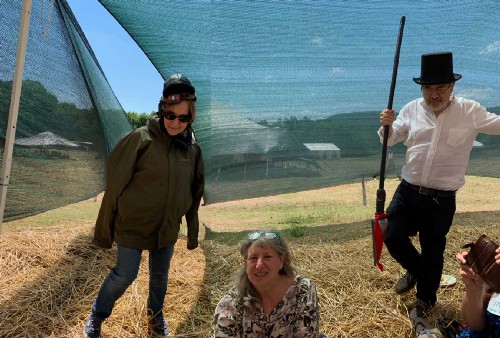
From left to right in the photo, Ishmael, Captain Ahab, and Captain Peleg. Actually, the top-hatted, harpoon-bearing person in the center is me (Ugo Bardi) giving a talk on sustainability in Bagnaia, Italy, on July 17, 2019. Near me, Albert Bates (right in the photo) and Simone (left in the photo -- sorry that I don't know his last name).
Some people see whales as nothing more than an economic resource. But, for many of us, whales are an endless source of fascination. Herman Melville, in particular, may have been the first person in history who tried to see the world from the viewpoint of a whale, as he does in his "Moby Dick" novel. It is not an easy task, surely, what can whales see with their small eyes, located the sides of their gigantic heads? But, once you start to follow this line of thought, you discover a whole new world where whales see the world not with their eyes but with their sophisticated sonar system.
Whales and men are truly alien to each other, even though they had a common ancestor, a furry creature living at the time of the dinosaurs, more than 60 million years ago. From then on, the ancestors of the two species lived in completely different environments, unaware of each other, until the hominin known as "homo sapiens" took to the waters and started a true war on whales. It started perhaps as early as in Neolithic times, but its pace and violence enormously increased in recent times. And the whales are losing it.
Why this war? Why did we need to erase entire populations of whales, such as the "Right Whale" of which just a few are left alive in the Earth's oceans? The question is deeper than it seems and it can't be solved simply in terms of optimizing the exploitation of an economic resource that just happens to be in the form of a giant sea mammal. Who gave us the right to think of these creatures as resources?
The story is long and it is one of the subjects of the book I am writing with my colleague,
Ilaria Perissi, that should be titled "
The Empty Sea" (sorry that it will be in Italian). Let me just say that I am working on it on the basis of the concept of "
biotic regulation" developed by Victor Gorshkov and Anastassia Makarieva. It can be seen as a "strong" version of the concept of Gaia proposed by James Lovelock. The idea is that all the elements of an ecosystem are tightly coupled with each other and it is that the reason for the ability of the ecosystem to maintain itself in relatively stable conditions.
Something that Makarieva and Gorshkov don't emphasize is that, in order for the system to work as a control system, the elements composing it must communicate with each other. There follows that if we need to maintain the Earth system reasonably stable, we don't just need to optimize whaling for human needs -- we need to communicate with whales. It means, within some limits, becoming a whale, or at least trying to understand what a whale is. It is, in the end, a question of empathy, not of economics.
I don't claim that all this is completely clear to me, as I said, I am still working on it. Anyway, giving talks on things you don't completely understand -- yet -- is a way to improve. This is what I did last week in Bagnaia where, among other things, I had a chance to meet Albert Bates in person. Albert wrote a comment on my talk that I am reproducing below. As he notes, not everything in this story is completely clear. Indeed, learning is always a journey, not a destination
(h/t Cristina)
______________________________________________________________________
It was a dried gourd that brought whales to the edge of extinction in the 19th Century.
For some time now I have been writing in this space that our Achilles Heel as a species may have come at a fork along our evolutionary biology pathway many millions of years ago. Relatively few others of our fellow creatures decided to follow our lead, and for good reason. We decided to sweat.
Having sweat glands conferred an immediate advantage, the type of advantage our kind also seems to select for, rather than thinking through the more distant implications. Only primates — such as humans, monkeys, and apes — and horses have skin covered by sweat glands to regulate their body temperature through evaporation of water. Maximum sweat rates of an adult human can be 2-4 liters per hour or 10-14 liters per day. Dogs and cats, which have just a few such glands, accomplish temperature regulation by panting, which evaporates water from the moist lining of their oral cavity. Elephants manage it with capillaries in their giant, flapping ears (Woolly Mammoths, unfortunately, lacked those and were hunted to extinction).
As bipedal athletes, our ancestors could not dash as fast as deer, boar, or zebras but had the advantage of sweat. We could keep up a fast pace longer than our prey could. As the prey overheated, they were forced to slow down. As we overheated, we only needed to refill our water reserve— hence the gourd. It became as important as the spear. Fear, anxiety, stress, and pain can also cause us to sweat because our biological instincts kick in and prepare us to run.
I was delighted to have the chance to experience Ugo in person when he gave a lovely workshop entitled, La Grande Transizione — Da Dove e Per Dove (The Great Transition — From Where and To Where) at the annual convergence of GEN-Europe in Comune di Bagnaia, Italy, this week. What was surprising was not what he said, because he left many of the questions he raised unanswered, but how he lectures.
Describing how Herman Melville developed his empathy for the whale, Bardi donned Ahab’s top hat and fastened his sister-in-law inside a raincoat so that her arms were replaced by empty sleeves for fins, then set out with a spear to chase her around the tent.
How did these small humans in their rowed boats kill these leviathans, he asks. Why didn’t these mammals, who were much faster and stronger, merely swim away? He holds up the gourd.
In whaling, the gourd takes the form of an empty oak cask, attached to a line. If the harpooner can toss a barbed dart into the thick skin of the whale as it passes his boat, the whale is doomed. The barb may cause some superficial bleeding but is not fatal by itself. Attach a cask to its line, however, and now the whale is unable to dive to safety. As it swims, pursued by the rowboat, the drag of the line wears it out. Eventually, the boat overtakes the whale and delivers the coup de grâce, usually by a lance driven through the creature’s heart.
In a 2004 post to the Oil Drum, Bardi wrote:
In
his 1878 book, Alexander Starbuck cited several factors for the decline
of production of the whale fisheries in times that for him were recent.
He seems to have believed that it was not the extermination of the
whales that caused the decline but, rather, the increase of the human
population which led to “an increase in consumption beyond the power of
the fishery to supply.” But it was also clear to him that the cost and
the length of voyages had increased beyond reasonable limits. He did
cite “the scarcity and shyness of whales” as a problem, but he stops
short of saying that the whale stock was depleted beyond recovery. Most
likely, the concept of “extinction” was alien to him, as it was to most
of his contemporaries.
Our
perception problem with crude oil is equivalent to that of Starbuck,
and indeed it is perhaps more severe. The concept of the terminal
depletion of a mineral resource is alien to us, since there have been no
worldwide precedents. In addition, we are apparently just near the
midpoint on the production curve, so we still have to experience the
peak, the associated price rise, and the decline. What the future has in
store is uncertain: perhaps an energy equivalent of the “rock oil” of
Starbuck’s times will materialize in the near future. But if it does not
materialize we will have to live with depletion and before long begin
to see lamps going out.
So what is our lesson here? Bardi never really got to that, but my takeaway was that we humans have immense technological hubris but little empathy. Bardi said we have developed empathy for honeybees, pandas, and whales but are unlikely to do that for mosquitoes and cockroaches. Unless we can imagine ourselves within the web of life, instead of seeing ourselves as its masters, we are doomed.
I think we risk destruction by many separate routes. We can fill our gourds to slake our thirst, but these days the water is likely contaminated with microplastics. The plastic spear Bardi used to illustrate his whale story is killing more whales now when it is discarded than Ahab could have with forged iron at the tip of a wooden pole.
One real problem we will face stems from that evolutionary decision about sweat glands that our ancestors made.
Orcas, thanks to subcutaneous fat stores, can withstand water temperatures ranging from 0° to 30–35°C (32–95°F). Certain species of tardigrade, including
Mi. tardigradum, can withstand and survive temperatures ranging from –273 °C (near absolute zero) to 150 °C in their
anhydrobiotic state. Humans have no such tolerance.
Certain sharks, tuna, billfishes, birds and mammals, including ourselves, are endothermic, or “
warm-blooded” in common parlance. We have a larger number of mitochondria per cell than ectotherms, enabling us to generate heat by increasing the rate at which we metabolize fats and sugars. If we get too hot, we sweat. If we get too cold, we shiver, sit in strong sunlight, bundle in furs, or burn fat faster.
To sustain higher metabolism, we need several times the food intake of ectothermic animals. Endothermism has its advantages, such as a constant core temperature for optimum enzyme activity. We are not only ourselves under the skin but an entire community. Our human microbiome is optimally advantaged at 37°C (98.6°F).
But endothermism also has disadvantages. If we get too hot we try to slow our metabolic burn. That is what happens during sleep when our core temperature drops typically 1°C. It’s also why the greatest threat to life during heat waves may be during the night when bodies cannot stay cool enough to survive.
When relative humidity is 100%, sweating does nothing to cool us. Hotter air can store more water than colder air. When the human body is exposed to constant temperatures of approximately 55°C (131°F) longer than a few hours, death is almost inevitable. In the early stages, we may try to slow heat generation by ceasing activity. If the heat persists, the effects of our diminished metabolism damage our central nervous system first, especially the brain and those parts concerning consciousness; then heart rate and respiration decrease; judgment becomes impaired as drowsiness supervenes, becoming steadily deeper until we lose consciousness. Mammalian muscle becomes rigid with heat rigor at about 50°C (122°F), with that sudden rigidity of the whole body rendering life impossible.
Humans may catch lethal hyperthermia when a
wet-bulb temperature (heat index) is sustained above 35°C (95°F) for six hours. In these conditions, if the temperature of the surroundings is greater than that of the skin, the body actually
gains heat by radiation and conduction. Peter Sinclair
writes: “Stepped outside yet today? Today in the midwest is what a normal summer day will be like in a few decades.”
National Geographic: “In less than 20 years, millions of people in the United States could be exposed to dangerous “off-the-charts” heat conditions of 127 degrees Fahrenheit or more….”
Sadly, hyperthermia occurs in birds, insects, fishes, land animals, and plants of course, too. The
sacred lotus (
Nelumbo nucifera) can sustain 20 degrees C (36 degrees F) above air temperature while flowering by breaking down starch in their roots, consuming oxygen at a rate of a flying hummingbird, but lacks a similar ability to cool itself. Many plants do not flower, do not fruit, and do not reproduce themselves when it is too warm.
We will need better tools than gourds if we are going to survive this time. We need to discover empathy. And then plant a whole lot of trees.