Showing posts with label empire of lies. Show all posts

Sunday, April 14, 2019

The Empire of Lies: How we are collapsing in the same way as the Roman Empire did.


(Image source: Wikipedia) The Devil is sometimes said to be "The Father of Lies." It is an apt definition for a creature that doesn't even exist except as a figment of human imagination. Satan is an evil egregore that we ourselves created, a creature that seems to loom larger and larger behind the current chronicles. The recent arrest of Julian Assange is just the latest deed of an Empire that seems bent on truly creating its own reality, something that, in itself, wouldn't necessarily be evil but that becomes so when it implies destroying all other realities, including the only true one. 

Initially, I thought to comment the recent news about Assange by reproducing a post "The Empire of Lies" that I published here about one year ago, where I described how the transition from the Roman Empire to the Middle Ages had taken place, in large part, because people just couldn't trust their Imperial rulers anymore. The Roman Empire had become an empire of lies and it was left to Christianity to rebuild the trust that the old empire had squandered - the Middle Ages were far from being "Dark Ages."  But, eventually, I thought to publish something I had in mind about how the Roman Empire and the modern Western Empire are following parallel trajectories in their habit of telling lies as they move toward their respective Seneca Cliffs.

So, here it is my assessment of the Roman Collapse, based on the excellent book by Dmitry Orlov, "The Five Stages of Collapse." Just one note: in the book, Orlov doesn't describe the post-collapse phase of the Soviet Union that ended with Russia becoming again as a prosperous and united country, as it is nowadays. It was a good example of the "Seneca Rebound" -- there is life after collapse and there will be new life after that the Evil Empire of lies will be gone.


The Five Stages of Collapse of The Roman Empire.

By Ugo Bardi


Dmitry Orlov wrote "The Five Stages of Collapse" as an article in 2008 and as a book in 2013. It was an original idea for that time that of comparing the fall of the Soviet Union with that of the United States. Being an American citizen born in Russia, Orlov could compare the two Empires in detail and note the many similarities that led both to follow the same trajectory, even though the cycle of the American Empire is not over, yet.

To strengthen Orlov's analysis I thought I could apply the same five stages to an older Empire, the Roman one. And, yes, the five stages apply well also to that ancient case. So, here is my take on this subject.

To start, a list of the five Stages of Collapse according to Orlov.

  • Stage 1: Financial collapse.
  • Stage 2: Commercial collapse.
  • Stage 3: Political collapse.
  • Stage 4: Social collapse.
  • Stage 5: Cultural collapse.

Now, let's see how these five stages played out during the fall of the Roman Empire.

Stage 1 – Financial Collapse (3rd century AD). The Roman Empire’s financial system was not as sophisticated as ours, but, just like our civilization, the Empire was based on money. Money was the tool that kept together the state: it was used to pay the legions and the bureaucrats and to make the commercial system supply the cities with food. The Roman money was a physical commodity: it was based on silver and gold, and these metals needed to be mined. It was the Roman control over the rich gold mines of Northern Spain that had created the Empire, but these mines couldn’t last forever. Starting with the 1st century, the cost of mining from depleted veins became an increasingly heavy burden. By the 3rd century, the burden was too heavy for the Empire to carry. It was the financial collapse from which the Empire never could fully recover.

Stage 2 – Commercial Collapse (5th century AD). The Roman Empire had never really been a commercial empire nor a manufacturing society. It was specialized in military conquest and it preferred to import luxury items from abroad, some, such as silk, all the way from the other side of Eurasia, from China. In addition to legions, the Empire produced only two commodities in large amounts: grain and gold. Of these, only gold could be exported to long distances and it soon disappeared to China to pay for the expensive imports the Romans were used to buy. The other product, grain, couldn’t be exported and continued to be traded within the Empire’s border for some time – the supply of grain from the African and Near Eastern granaries was what kept the Roman cities alive, Rome in particular. After the financial collapse, the supply lines remained open because the grain producers had no other market than the Roman cities. But, by mid-5th-century, things got so bad that Rome was sacked first by the Visigoths in 410, and then by the Vandals in 450, It recovered from the 1st sack, but the second was terminal. The Romans had no more money left to pay for the grain they needed, the commercial sea lanes broke down completely, and the Romans starved. It was the end of the Roman commercial system.

Stage 3 – Political Collapse (late 5th century AD). The political collapse went in parallel with the commercial collapse. Already in the late 4th century, the Emperors had become unable to defend Rome from the Barbarian armies marching across the empire and they had retired to the safety of the fortified city of Ravenna. When Rome was sacked, the Emperors didn’t even try to do something to help. The last emperors disappeared by the late 5th century but, already decades before, most people in Europe had stopped caring about whether or not there was some pompous person in Ravenna who wore purple clothes and claimed to be a divine Emperor.

Stage 4 – Social Collapse (5th century AD). The social collapse of the Western Empire went in parallel with the disgregation of the political and commercial structures. Already during the early 5th century, we have evidence that the Roman Elites had gone in “escape mode" – it was not just the emperor who had fled Rome to take refuge in Ravenna, patricians and warlords were on the move with troops, money, and followers to establish feudal domains for themselves where they could. And they were leaving the commoners to fend off by themselves. By the 6th century, the Roman State was gone and most of Europe was in the hands of Germanic warlords.

Stage 5 - Cultural collapse (starting in the 6th century AD). It was very slow. The advent of Christianity, during the 3rd century, had not weakened the Empire's cultural structure, it had been an evolution rather than a break with the past. The collapse of the Empire as a political and military entity didn't change things so much and for centuries people in Europe still considered themselves as Romans, not unlike the Japanese soldiers stranded in remote islands after the end of the second world war .(in Greece, people would still define themselves as "Romans" well into the 19th century). Latin, the imperial language, disappeared as a vernacular language but it was kept alive by the Catholic clergy and it became an indispensable tool that kept Europe culturally united. Latin kept a certain cultural continuity with the ancient empire that was only very gradually lost. It was only with the 18th - 19th centuries that Latin disappeared as the language of the cultural elite, to be replaced by English nowadays.

As you see, Orlov’s list has a certain logic although it needs to be adapted a little to the collapse of the Western Roman Empire. The 5 stages didn’t come one after the other, There was more than a century lapse between the 3rd-century financial collapse (stage 1) and the three subsequent stages arriving together: commercial, political, and social collapse. The 5th stage, the cultural collapse, was a drawn-out story that came later and that lasted for centuries.

How about our civilization? The 1st stage, financial collapse is clearly ongoing, although it is masked by various accounting tricks. The 2nd stage, commercial collapse, instead, hasn't started yet, nor the political collapse: the Empire still maintains a giant and threatening military force, even though its actual efficiency may be doubted. Maybe we are already seeing signs of the 3rd stage, social collapse but, if the Roman case is a guide, these three stages will arrive together.

Then, how about the last stage, cultural collapse? That's a question for a relatively far future. For a while, English will surely remain the universal language, just as Latin used to be after the fall of Rome, while people may keep thinking they still live in a globalized world (maybe it is already an illusion). With English fading, anything may happen and when (and if) a new Empire will rise on the ashes of the American Empire it will be something completely different. We can only say that the universe goes in cycles and that's, evidently, the way things have to be.



Sunday, September 2, 2018

How Can They Lie to us so Blatantly? The Strange Case of Wealth Inequality in Russia


The figure is taken from the "Independent" dated 23 November 2016. It is an example of propaganda techniques based on spin and omission. We live today in a true Empire of Lies. 

(note: this article was modified after having received a comment from "Alien Observer")


By mere chance, I happened to stumble into the graph you see above. It bothered me: can it really be that Russia is, by far, is the most unequal country in the world? It just didn't fit with what I know of Russia. Yet, the power of well-presented graphic information is such that for a while I tried to rationalize these data in my mind. Maybe the fall of Communism really caused some kind of terrible unbalancing of the Russian society. Scratching my head, I thought that I had to check the data.

Perusing the Internet on this matter, I found several other 2016 reports in the mainstream media about the alleged high inequality of the Russian society. In a 2016 article on CNN, you can read that "Russia is the most unequal major economy in the world," while on "Radio Free Europe" they say that "wealth disparity in Russia is unparalleled."

But there is something wrong with these reports. I checked with the World Bank, I checked with the "World Inequality Database," I checked with the Statista site. I even checked the  CIA Factbook, not exactly people known for their sympathies for those evil Russians. The result was always the same: Russia is NOT the most unequal country in the world. "Inequality" is a wide-ranging concept that can be measured in various ways but, in general, Russia is ranked at about the same level as the United States and at much lower levels of inequality than countries like India or Brazil.

So, what are these reports based on? CNN doesn't provide links to their sources, but they refer to a company called "New World Wealth." Radio Free Europe cites one Mr. Tony Shorroks of a company called "Global Economic Perspectives." Neither source seems to be very reliable. A company called "New World Wealth" has a Web Site but, frankly, it looks like a fake company: their "reports" are simply links to the site of a bank in Mauritius and, in any case, none of them says anything about social inequality in Russia. As for Mr. Shorroks' company, it seems to exist in London, but it doesn't even have a Web address - it is hard to think that it can perform an independent economic analysis of the Russian Federation.

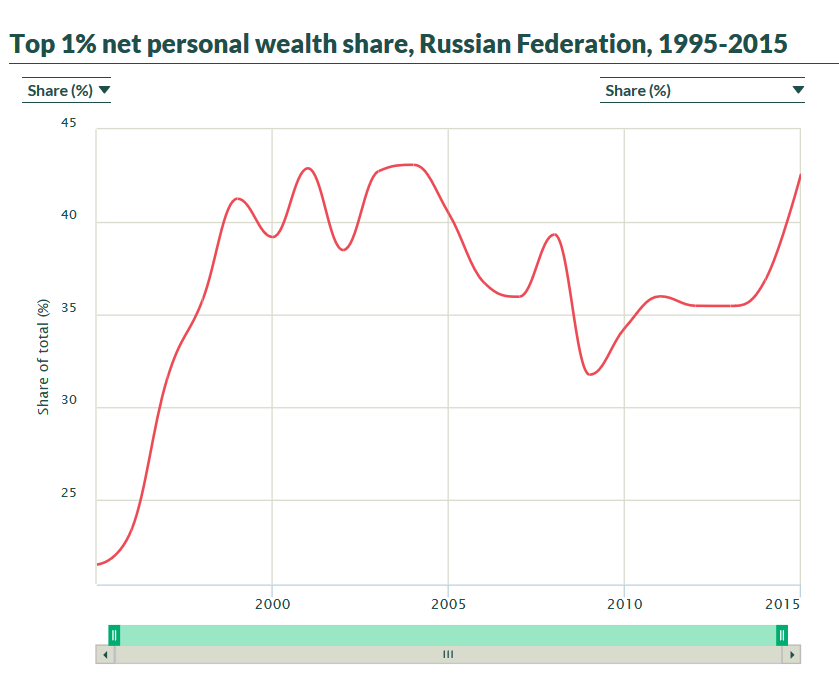
How about the data on the Independent? The number provided for Russia just doesn't seem to be right. According to the World Inequality Database, the share of wealth of the top 1% of the Russian population is around 42%, not 74.5%. Again, they don't provide a link but, after some work, the 74.5% value can be found buried in a table at page 145 of a report published by Credit Suisse (h/t Alien Observer). How is it that this number is so different than others is probably because of the data the Credit Suisse use are incomplete, as they themselves say. In any case, the wealth of the top 1% is a very partial tool to measure how unequal a society is. It only tells you something about the existence of an upper crust of super-rich people, whose wealth is very difficult to estimate anyway. It tells you nothing on how wealth is distributed among the rest of society, the poor and the middle class.

So, among the data available in several reports, the Independent chose the only number they could find that gave them the possibility of denigrating Russia -- conveniently forgetting to cite all the others. But that's the way propaganda works. Good propaganda - better defined as "perception management" - is not about telling lies, it is about distorting the truth, typically, by means of the three basic propaganda techniques: omission, spin, and saturation. Here, we have a classic case: the data which agree with a certain interpretation are cited (spin), the others are ignored (omission).

The interesting point, here, is that I could find nothing on the Web that challenged these stories about inequality in Russia. It seems that most people are too busy and distracted to have the time and the inclination to check the data they read in the media. So, the concept of "high inequality in Russia" just flashes up in people's perception and then it becomes part of a diffuse worldview.

So, here we are: the whole issue is not so much about Russia, it is about how blatantly they can lie to us and get away with that. How about much darker things for which we have no reliable sources? How can we believe in anything we read in the media? And note that this is not the kind of fake news diffused by amateurs on the social media. These are news appearing on major media outlets which, by the way, often claim to be fighting fake news.

Maybe lies are not a bug but a feature of our society. It seems to be true that we can "create our own reality," as an aide to Donald Rumsfeld is reported to have said at the time of the invasion of Iraq. So we are creating a true "Empire of Lies" and that's not a good thing.


___________________________

Some more info on inequality in Russia. Here is a graph from the "World Inequality Database"


As you can see, inequality in Russia increased after the fall of the Soviet Union but, later on, it started to go down with the economic recovery. Recently, however, it went up again, most likely because of the strain on the economy imposed by the international sanctions. Still, the current value of about 42% for the 1% share doesn't compare with the 74.5% value given by the Independent. 

Here are, instead, the data for the US.
The graph is a little outdated. Today, the 1% share in the US is higher than it was in 2014 and about the same as it is in Russia. Note also that these data are only about personal wealth but say nothing about other factors, such having a health insurance, which is provided for free by the state to Russian citizens, but not to American ones. About the growing inequality trend, maybe it is correlated to the oil production peak in the US - in any case, today the level of inequality in the US is close to that of England in the 18th century.


Wednesday, December 7, 2016

Italy's Referendum: the Great Defeat of Matteo Renzi, as commented by Leon Tolstoy


Matteo Renzi, Italy's prime minister, portraited as Napoleon Bonaparte on the front cover of an Italian magazine of a few years ago. For some reason, successful leaders tend to embark in risky enterprises that put their leadership at stake and, often, they fail utterly. It happened to Napoleon with the invasion of Russia and it happened to Matteo Renzi with the recent constitutional referendum that ended up with a disastrous defeat for him.


There is a clear parallel between the results of the Italian constitutional referendum of Dec 4th, 2016 and those of the Brexit referendum and the defeat of Hillary Clinton in the US. In all cases, we saw devastating failures for the mainstream media. People refused to listen to the messages beamed to them. They had the feeling of being swindled and probably they knew that, when you start suspecting that you are being swindled, you probably are. And they reacted accordingly.


Something is deeply changing in the world. Top-down, government-controlled propaganda has been used with great efficacy for more than a century, but now it is being defeated by bottom-up, viral information that ebbs and flows in the Web. Is it a good thing?  For sure, the defeat of the Empire of lies is a good thing, but it is also true that the  opposite of a lie is not necessarily the truth. All we can say is that it is happening and that the old ways don't work anymore.

On this point, perhaps it is worth re-reading Tolstoy when he describes the surprise that Napoleon felt at the battle of Borodino, during the Russian campaign, when he, too, found that the old ways didn't work anymore.


_________________________________

Alexander Tolstoy: "War and Peace", Book 10, Chapter XXXIV

Napoleon was experiencing a feeling of depression like that of an ever-lucky gambler who, after recklessly flinging money about and always winning, suddenly just when he has calculated all the chances of the game, finds that the more he considers his play the more surely he loses.

His troops were the same, his generals the same, the same preparations had been made, the same dispositions, and the same proclamation courte et energique, he himself was still the same: he knew that and knew that he was now even more experienced and skillful than before. Even the enemy was the same as at Austerlitz and Friedland- yet the terrible stroke of his arm had supernaturally become impotent.

All the old methods that had been unfailingly crowned with success: the concentration of batteries on one point, an attack by reserves to break the enemy's line, and a cavalry attack by "the men of iron," all these methods had already been employed, yet not only was there no victory, but from all sides came the same news of generals killed and wounded, of reinforcements needed, of the impossibility of driving back the Russians, and of disorganization among his own troops.

Formerly, after he had given two or three orders and uttered a few phrases, marshals and adjutants had come galloping up with congratulations and happy faces, announcing the trophies taken, the corps of prisoners, bundles of enemy eagles and standards, cannon and stores, and Murat had only begged leave to loose the cavalry to gather in the baggage wagons. So it had been at Lodi, Marengo, Arcola, Jena, Austerlitz, Wagram, and so on. But now something strange was happening to his troops.

Despite news of the capture of the fleches, Napoleon saw that this was not the same, not at all the same, as what had happened in his former battles. He saw that what he was feeling was felt by all the men about him experienced in the art of war. All their faces looked dejected, and they all shunned one another's eyes- only a de Beausset could fail to grasp the meaning of what was happening.

But Napoleon with his long experience of war well knew the meaning of a battle not gained by the attacking side in eight hours, after all efforts had been expended. He knew that it was a lost battle and that the least accident might now- with the fight balanced on such a strained center- destroy him and his army.

Saturday, November 12, 2016

Trump: the Defeat of the Empire of Lies


In 2003, the Western Media were able to convince almost everyone that the evil dictator Saddam Hussein was stockpiling weapons of mass destruction in Iraq. The success of this propaganda operation was so spectacular that it led one of the aides of George W. Bush to declare that "now we create our own reality." It was the true founding statement of the Empire of Lies.

But the power of creation does not reside with mere human beings and it may well be that the Gods took umbrage at this manifestation of hubris. During the latest US presidential campaign, Donald Trump and Vladimir Putin were lumped together and subjected to the same demonizing treatment that earlier on had been reserved to Saddam Hussein. But, simply, it didn't work. The whole campaign backfired, badly. The extent of the defeat that the Empire of Lies suffered is staggering.

Unfortunately, the fact that Donald Trump was elected largely as a reaction against previous lies doesn't make him a good president and not even someone whom we can trust. We may have learned to recognize lies, but it seems that we haven't yet learned to recognize the truth. The pendulum may be swinging too far and we are now branding perfectly correct theories as hoaxes and conspiracies. This is the case of climate change, that Donald Trump has defined as a hoax. The extent of the damage that the Trump presidency could do to humankind by policies that ignore the climate threat is staggering, too.

So, will we ever learn to find our way in the universe of lies in which we live? Difficult to say, but we live in a condition in which the ancient Romans already found themselves long ago. The post below, published early this year, may help us to understand the problem.


From "Cassandra's Legacy", Monday, February 8, 2016


The Empire of Lies


The Trajan Column was built in order to celebrate the victories of the Roman Armies in the conquest of Dacia, during the 2nd century AD. It shows that the Romans knew and used propaganda, although in forms that for us look primitive. In those times, just as in ours, a dying empire could be kept together for a while by lies, but not forever.  


At the beginning of the 5th century AD, Augustine, bishop of Hippo, wrote his "De Mendacio" ("On Lying"). Reading it today, we may be surprised at how rigid and strict Augustine was in his conclusions. A Christian, according to him, could not lie in any circumstances whatsoever; not even to save lives or to avoid suffering for someone. The suffering of the material body, said Augustine, is nothing; what's important is one's immortal soul. Later theologians substantially softened these requirements, but there was a logic in Augustine's stance if we consider his times: the last century of the Western Roman Empire.

By the time of Augustine, the Roman Empire had become an Empire of lies. It still pretended to uphold the rule of law, to protect the people from the Barbarian invaders, to maintain the social order. But all that had become a bad joke for the citizens of an empire by then reduced to nothing more than a giant military machine dedicated to oppressing the poor in order to maintain the privileges of the rich. The Empire itself had become a lie: that it existed because of the favor of the Gods who rewarded the Romans because of their moral virtues. Nobody could believe in that anymore: it was the breakdown of the very fabric of society; the loss of what the ancient called the auctoritas, the trust that citizens had toward their leaders and the institutions of their state.

Augustine was reacting to all this. He was trying to rebuild the "auctoritas", not in the form of mere authoritarianism of an oppressive government, but in the form of trust. So, he was appealing to the highest authority of all, God himself. He was also building his argument on the prestige that the Christians had gained at a very high price with their martyrs. And not just that. In his texts, and in particular in his "Confessions" Augustine was opening himself completely to his readers; telling them all of his thoughts and his sins in minute details. It was, again, a way to rebuild trust by showing that one had no hidden motives. And he had to be strict in his conclusions. He couldn't leave any openings that would permit the Empire of Lies to return.

Augustine and other early Christian fathers were engaged, first of all, in an epistemological revolution. Paulus of Tarsus had already understood this point when he had written: "now we see as in a mirror, darkly, then we'll see face to face." It was the problem of truth; how to see it? How to determine it? In the traditional view, truth was reported by a witness who could be trusted. The Christian epistemology started from that, to build up the concept of truth as the result of divine revelation. The Christians were calling God himself as witness. It was a spiritual and philosophical vision, but also a very down-to-earth one. Today, we would say that the Christians of late Roman times were engaged in "relocalization", abandoning the expensive and undefendable structures of the old Empire to rebuild a society based on local resources and local governance. The age that followed, the Middle Ages, can be seen as a time of decline but it was, rather, a necessary adaptation to the changed economic conditions. Eventually, all societies must come to terms with Truth. The Western Roman Empire could not do that, It had to disappear, it was unavoidable.

Now, let's move forward to our times and we have reached our empire of lies. On the current situation, I don't have to tell you anything that you don't already know. During the past few decades, the mountain of lies tossed at us by governments has been perfectly matched by the disastrous loss of trust in our leaders on the part of the citizens. When the Soviets launched their first orbiting satellite, the Sputnik, in 1957, nobody doubted that it was for real and the reaction of the US government was to launch their own satellites. Today, plenty of people even deny that the US sent men to the moon in the 1960s. They may be ridiculed, they may be branded as conspiracy theorists, sure, but they are there. Perhaps the watershed of this collapse of trust was with the story of the "Weapons of Mass Destruction" that we were told were hidden in Iraq. It was not their first, nor it will be their last, lie. But how can you ever trust an institution that lied to you so brazenly? (and that continue to do so?)

Today, every statement from a government, or from an even remotely "official" source, seems to generate a parallel and opposite statement of denial. Unfortunately, the opposite of a lie is not necessarily the truth, and that has originated baroque castles of lies, counter-lies, and counter-counter lies. Think of the story of the 9/11 attacks in New York. Somewhere, hidden below the mass of legends and myths that have piled up on this story, there has to be the truth; some kind of truth. But how to find it when you can't trust anything you read on the Web? Or think of peak oil. At the simplest level of conspiratorial interpretation, peak oil can be seen as a reaction to the lies of oil companies that hide the depletion of their resources. But you may also see peak oil as a scam created by oil companies that try to hide the fact that their resources are actually abundant - even infinite in the diffuse legend of "abiotic oil". But, for others, the idea that peak oil is a scam created in order to hide abundance may be a higher order scam created in order to hide scarcity. Eve higher order conspiracy theories are possible. It is a fractal universe of lies, where you have no reference point to tell you where you are.

Eventually, it is a problem of epistemology. The same that goes back to Pontius Pilate's statement "what is truth?" Where are we supposed to find truth in our world? Perhaps in science? But science is rapidly becoming a marginal sect of people who mumble of catastrophes to come. People whom nobody believes any longer after they failed to deliver their promises of energy too cheap to meter, space travel, and flying cars. Then, we tend to seek it in such things as "democracy" and to believe that a voting majority somehow defines "truth". But democracy has become a ghost of itself: how can citizens make an informed choice after that we discovered the concept that we call "perception management" (earlier on called "propaganda")?

Going along a trajectory parallel to that of the ancient Romans, we haven't yet arrived at having a semi-divine emperor residing in Washington D.C., considered by law to be the repository of divine truth. And we aren't seeing yet a new religion taking over and expelling the old ones. At present, the reaction against the official lies takes mostly the form of what we call "conspiratorial attitude." Although widely despised, conspirationism is not necessarily wrong; conspiracies do exist and much of the misinformation that spreads over the web must be created by someone who is conspiring against us. The problem is that conspirationism is not a form of epistemology. Once you have decided that everything you read is part of the great conspiracy, then you have locked yourself in an epistemological box and thrown away the key. And, like Pilate, you can only ask "what is truth?", but you will never find it.

Is it possible to think of an "epistemology 2.0" that would allow us to regain trust on the institutions and on our fellow human beings? Possibly, yes but, right now, we are seeing as in a mirror, darkly. Something is surely stirring, out there; but it has not yet taken a recognizable shape. Maybe it will be a new ideal, maybe a revisitation of an old religion, maybe a new religion, maybe a new way of seeing the world. We cannot say which form the new truth will take, but we can say that nothing new can be born without the death of something. And that all births are painful but necessary.

Wednesday, November 9, 2016

Why do the Poor Vote for the Rich? Trump, Berlusconi, and the Empire of Lies


Trump and Berlusconi: the rich voted by the poor


The results of the US elections were not so surprising for me; after all, I live in a country where politics has been dominated by a financial tycoon, Silvio Berlusconi, for more than 20 years. Berlusconi and Trump share many characteristics, but the most curious one is that they are rich and that the poor vote for them. Why is that? Are the poor stupid or what?

But the poor are not stupid. It is true that they are badly misinformed by the Western media, but they also perceive that they are facing a true Empire of Lies and that they are being lied to, consistently, brazenly, and gleefully. There are plenty of studies (*) showing that people detect lies not on the basis of rational considerations, but on a much simpler test: consistency. They take into account what a person does, not so much what that person says.

In other words, if you want to help the poor and gain their trust, you have to be poor. That's why Franciscan monks wear a brown tunic, pledge to own nothing, and are forbidden even to touch money. If you want to have the vote of the poor, you don't have to arrive at such extremes, but you have to be consistent: what you are has to be in agreement with what you say. And, if you are rich, you shouldn't even try to disguise yourself as being poor. As I said, the poor are not stupid.

That was the problem of the Italian Communist Party that was supposed to represent the workers. Over the years, it came to be led by wealthy people who claimed to represent the workers, but who were not workers; they were at best well-paid bureaucrats; at worst, thieves. Eventually, the workers started voting for Berlusconi en masse and the Italian Communist Party was swept away from history. It turned into the present "Democratic Party," a mongrel that we could define as "Berlusconi 2.0".

Berlusconi was brash, silly, nasty, politically incorrect, a womanizer, and more, but he mainly said what he thought, he was not lying. People perceived that he was not the front man for someone else. Now, over 80 and mostly retired from politics, he could probably come back and win again.

It is very much the same thing for Donald Trump. You may hate what he says, but there is little doubt that he says what he thinks; he is not lying. It was exactly the opposite for Hillary Clinton, who was perceived as having much to hide, despite what she kept saying. And, in the end, it makes sense to prefer an honest son of a bitch to a smooth-sounding liar, no matter how pleasant is what she says. (**)

So, things went the way they should have. One thing that should never surprise us about the future is that it always surprises us. Will we ever learn that?


(*) If you have the time to read the book "Big Gods" by Ara Norenzayan, do so. It is an eye opener in this matter.

(**) Remarkably, it was the right-wing Berlusconi government that created the Italian solar industry. Then, the (theoretically) left-wing government of Matteo Renzi destroyed it. Renzi killed tens of thousands of jobs in the solar industry while, at the same time, maintaining that he was creating jobs. Did I say "Empire of Lies"...... ?


Who

Ugo Bardi is a member of the Club of Rome, faculty member of the University of Florence, and the author of "Extracted" (Chelsea Green 2014), "The Seneca Effect" (Springer 2017), and Before the Collapse (Springer 2019)