In 2008, I published a post on "The Oil Drum" (reproduced below) where I tried to predict the behavior of crude oil prices on the basis of a comparison with the historical case of whale oil. In the first half of the 19th century, whale oil was an important commodity used mainly as fuel for oil lamps. It was, theoretically, a renewable resource, but whales were killed so fast that they didn't have enough time to reproduce and reconstitute their numbers. So, whale oil behaved as if it was a nonrenewable resource: it suffered of depletion. As I reported in the post, its production showed a symmetrical, bell shaped curve and a clear "Hubbert peak."
In 2008, we were nearly at the end of a phase of rapid growth of oil prices; a trend that - at the time - seemed to be unstoppable. But I made the point that prices could not keep rising forever. I stated that:
"...the historical data for whaling tell us that an exponential rise of the prices is not the only feature of the post-peak market. The prominent feature is, rather, the presence of very strong price oscillations. We can attribute these oscillations to a general characteristic of systems dominated by feedback and time delays. Prices are supposed to mediate between offer and demand, but tend to overcorrect on one side or another. The result is a succession of demand destruction (high prices) and offer destruction (low prices)"
It seems that this is exactly what we are seeing for crude oil: very strong price oscillations. Just a few months after that my post was published, oil prices did indeed collapse. Today, we are seeing something similar and we tend to interpret the present downward cycle as the result of strategic choices or conspiracies, but this is mostly an illusion (the illusion of control). Rather, it seems that the market cannot regulate production as a function of progressive depletion without these cycles of demand destruction and offer destruction which eventually lead to a decline in production. Comparing with the behavior of whale oil prices, we see that in the future we may expect further oscillation and an overall trend of growth in the years after the production peak. However, prices should eventually stabilize, at least on the average.
In this comparison, we need to take into account that there is a fundamental difference to take into account when comparing the case of whale oil and that of crude oil. Whereas whale oil was smoothly replaced by a cheaper and more abundant resource (kerosene), no such possibility is in sight for crude oil. Eventually, however, what changes is just how much people are willing to pay for something. People were still buying whale oil when kerosene was dominating the market; they were willing to pay a moderate premium for a product that was perceived as of superior quality. In the case of crude oil, people may be willing to pay a lot of money to obtain a product they desperately need. Yet, there is a limit even to desperation: prices cannot rise to infinity. After a certain point, people will simply have to consume less. This seems to be what's happening right now in many regions of the world; for instance, in Italy, oil consumption has declined of 35% over the past 10 years.
So, in the future, oil prices may not rise as much as it could be feared, but may well rise high enough to make oil unaffordable for many of us.
__________________________________________________________
Here is the article I posted on "The Oil Drum" in 2008 (I corrected a few typos present in the original version)
Crude Oil: how high can it go? (19th century whaling as a model for oil depletion and price volatility)
Posted by Ugo Bardi on May 15, 2008 - 9:59am in The Oil Drum: Europe
Tags: gaussian, hubbert curve, oil, oil prices, peak oil, whale oil [list all tags]
19th century whaling is today one of the best examples we have of a complete cycle of exploitation of a natural resource.
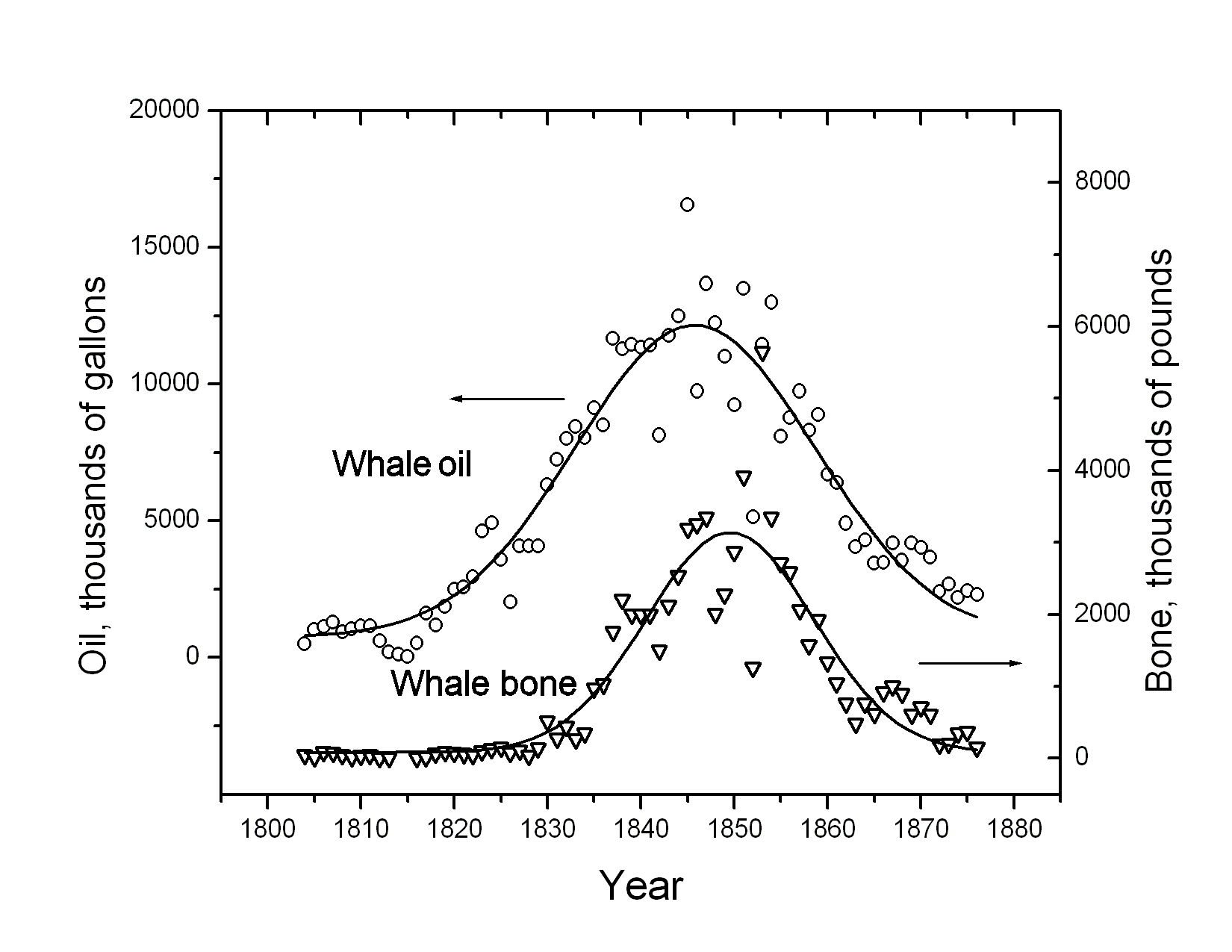
The production curves of whale oil and whale bone in the United States in 19th century (data from "History of the American whale fishery" by A. Starbuck, 1878). Both show a clear bell shaped Hubbert's curve. Click to enlarge.
A few years ago, I appeared in TV for the first time in my life. Oil had just passed 38 dollars per barrel and I was invited to speak in a national financial channel as the president of the newly formed Italian section of ASPO. When I said that I expected oil to rise well over 40 $/bl soon, everyone in the TV studio looked at me as if I had just said something very funny. All the other experts there, hastened to contradict me and said that 38 $ per barrel was just a spike, speculation, and that prices would soon go back to "normal."
Seen in retrospect, it was an easy guess that oil prices had to rise. You only had to know a little about Hubbert's theory. As I am writing these notes, oil prices stand at around 120 dollars per barrel and may well keep rising. But for how long? The problem with Hubbert's model is that it is good for predicting production, but it tells you nothing about prices.
There are all sorts of economic models that attempt to predict prices, but their record is very poor. So, maybe the answer can be found in historical examples. If we can find a resource that has peaked and declined to zero or near zero production in the past, then its historical prices could give us some idea of what to expect today for oil.
There are many resources that have peaked and declined at the regional level; crude oil in the United States is a good example. But the price of US oil doesn't depend only on US production; it is affected by imports from other regions of the world. So that's not useful for understanding price trends at the global level. What we are looking for is a global resource that has peaked worldwide or, at least, in an economically isolated region.
After much searching, the best example that I could find is not that of a mineral resource, but of a biological one: whaling in the 19th century. Whales are, of course, a renewable resource, but if they are hunted much faster than they can reproduce, they behave as a non renewable resource; just like oil. We have good data about whaling compiled in books such as Alexander Starbuck's "History of the American whale fishery" (1878). In Starbuck's times there was no such thing as a "global market" for whale products. But the reach of the whaling ships was worldwide and the effects of whale depletion were felt in the same way by all markets in the world. So, we can take the prices reported by Starbuck as directly affected by the behavior of the production curve.
So, here are the results for the two products of whaling; whale oil and "whale bone". Whale oil was used as fuel for lamps, whale bone was a stiffener for ladies' clothes, fashionable in the 19th century.
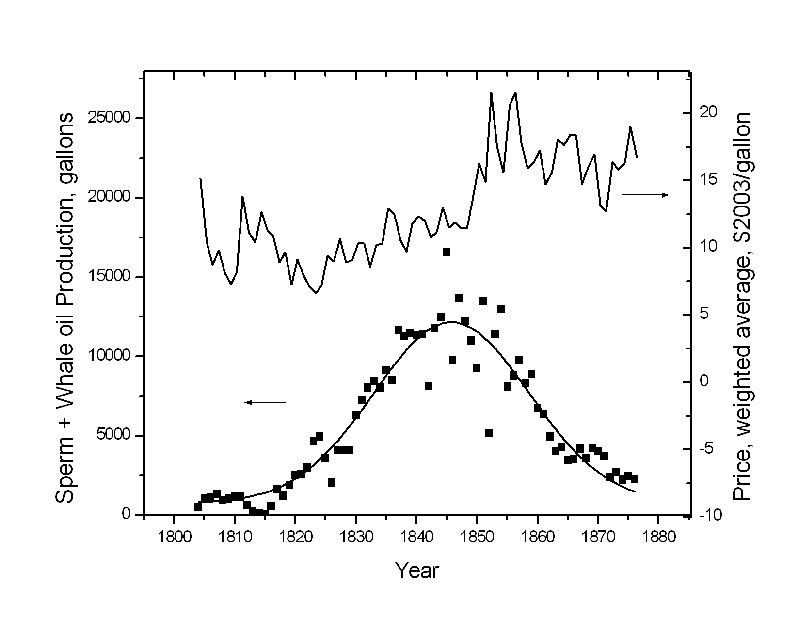
Whale oil production and prices (adjusted for inflation) according to Starbuck's data.
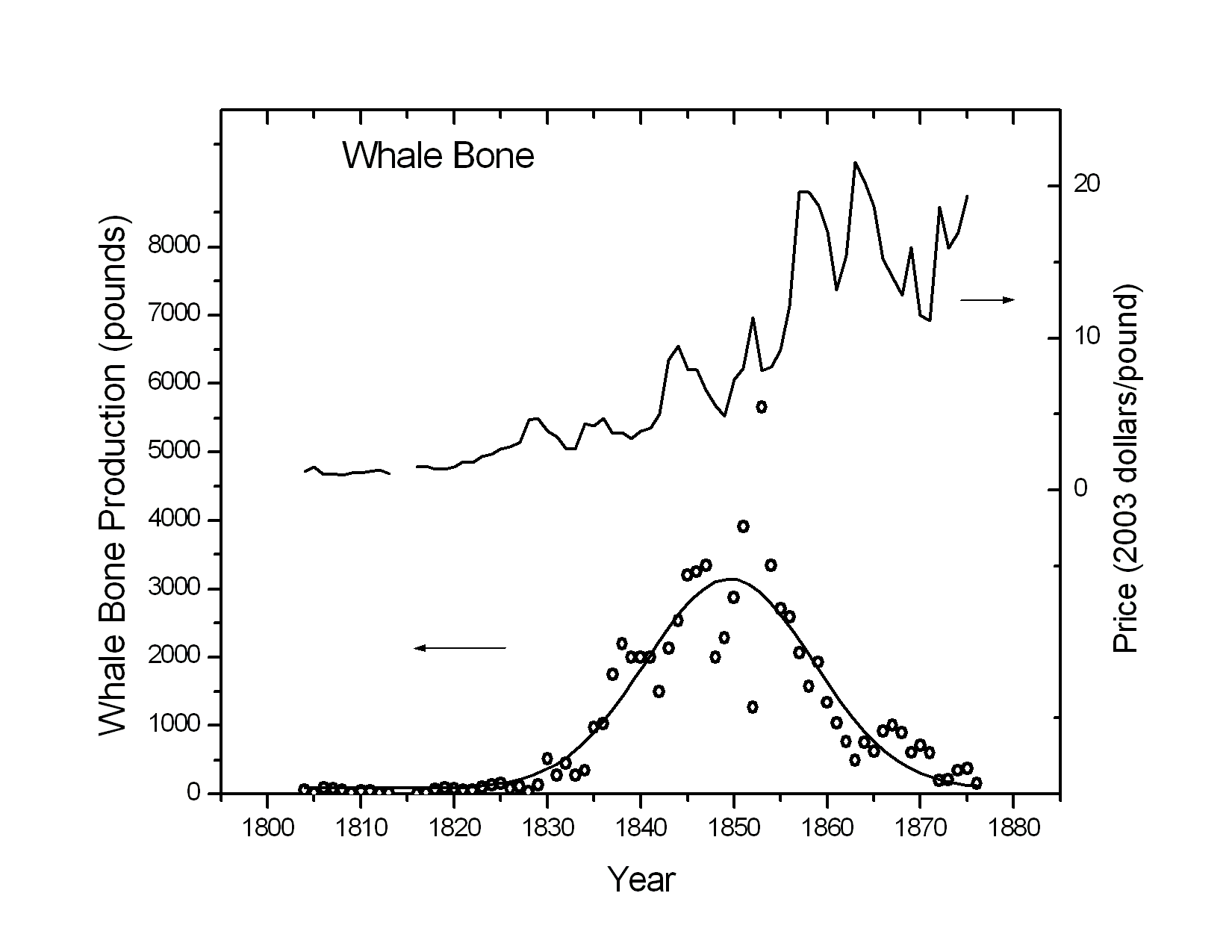
Whale bone production and whale bone prices (adjusted for inflation) according to Starbuck's data.
The results are clear: whaling did follow a Hubbert style "bell shaped curve", approximated in the graphs with a simple Gaussian. Whales did behave like a non renewable resource and some studies say that at the end of the 19th century hunting cycle, there remained in the oceans only about 50 females of the main species being hunted: right whales.
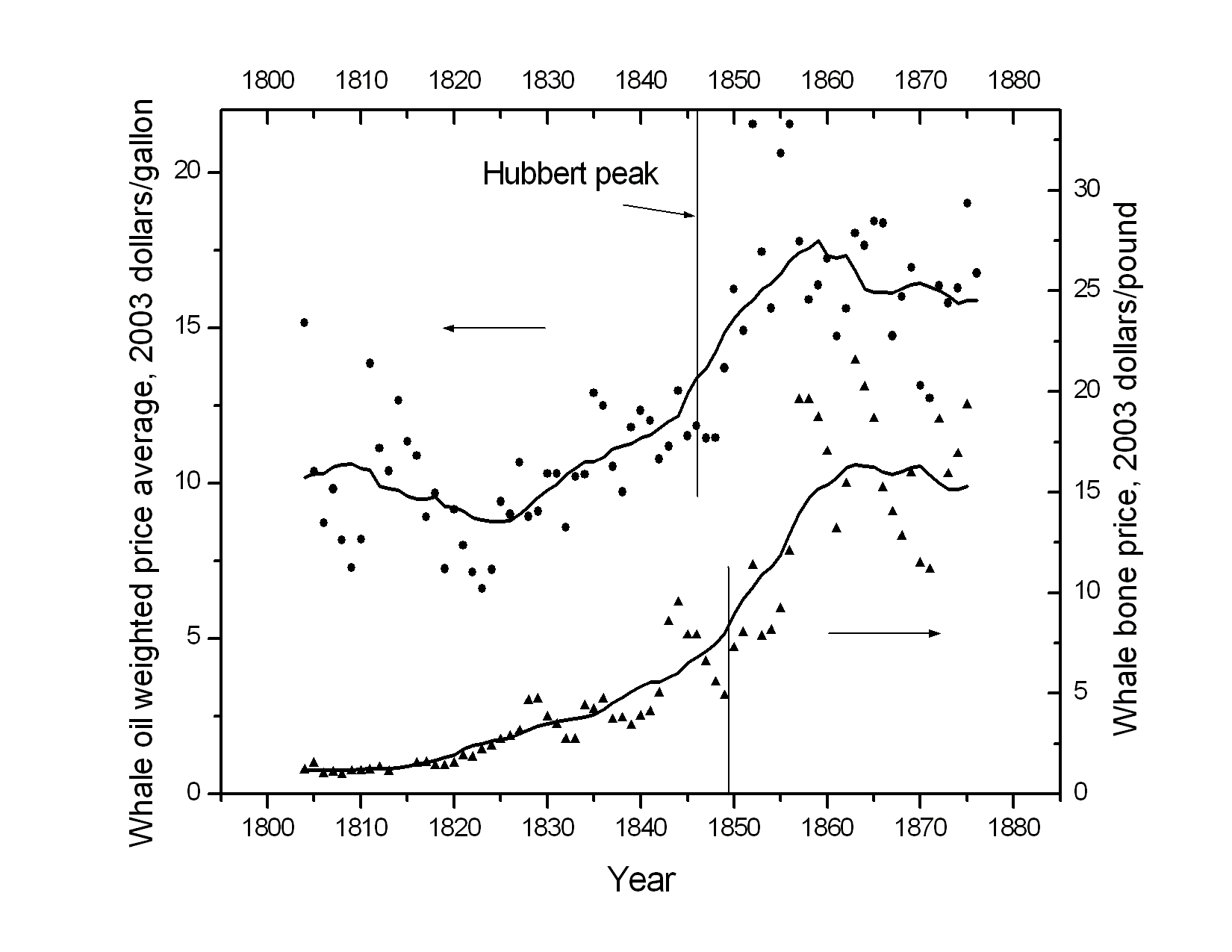
Now, looking at the historical prices, we see an increase in the vicinity of the peak for both whale oil and whale bone. For whale oil we see a spike after the peak, for whale bone the trend is smoother. In both cases, the smoothed growth is nearly exponential. We can see this exponential trend in the smoothed data.
Smoothed whale bone and whale oil prices (adjusted for inflation).
It seems that what we are seeing now for crude oil parallels the historical data for whale oil and whale bone. There are also differences; for instance the prices of whale oil didn't rise so much as crude oil has been doing lately. On the average, for whale oil we see a doubling of the price, followed by a plateau. For whale bone, we see a much larger increase, more than a factor of 10 from the beginning to the end of the whaling cycle. This increase is comparable to what we are seeing today for crude oil.
There is a reasonable explanation for these differences. First of all, neither whale oil nor whale bone were so crucial for life in the 19th century as crude oil is today for us. There were alternative fuels for lamps: animal fat or vegetable oil, a little more expensive and considered as inferior products; but usable. Then, starting in the 1870s, crude oil started to be commonly available as lamp fuel. It probably had an effect in keeping down the price of whale oil. For whale bone, instead, a replacement didn't really exist except for steel, which was probably much more expensive during the period that we are considering. But stiffeners for ladies' clothes were hardly something that people couldn't live without.
In comparison, crude oil is such a basic commodity in our world that it is not surprising that prices have risen so steeply. Airlines, for instance, have no choice in between collapsing and buying oil at any price. For other activities, the conditions of the choice may not be so stark, but still we can't survive without oil. If the exponential rise of oil prices were to continue unabated for a few more years, we would be seeing some kind of demand destruction, indeed.
But the historical data for whaling tell us that an exponential rise of the prices is not the only feature of the post-peak market. The prominent feature is, rather, the presence of very strong price oscillations. We can attribute these oscillations to a general characteristic of systems dominated by feedback and time delays. Prices are supposed to mediate between offer and demand, but tend to overcorrect on one side or another. The result is alternating cycles of demand destruction (high prices) and offer destruction (low prices).
What we are seeing at present with crude oil is, most likely, one of these price spikes. Eventually, it will overdo its job of curbing demand and turn into a price collapse. We can imagine how, in the collapsing phase, everyone will start screaming that the "oil crisis" of the first decades of the 21st century was just a hoax, just as it was said of the crisis of the 1970s. Then, a new upward spike will start.
Here, too, the history of whaling can teach us something in terms of the difficulty that people have in understanding depletion. In Starbuck's book, we never find mention that whales had become scarce. On the contrary, the decline of the catch was attributed to such factors as the whales' "shyness" and the declining "character of the men engaged". Starbuck seems to think that the crisis of the whaling industry of his times can be solved by means of governmental subsidies. Some things never change.
In the end, the history of whaling tells us that what is happening now with crude oil shouldn't have taken us by surprise. The future can never be exactly predicted but, at least, it can be understood from the lessons of the past. One of these lessons, however, seems to be that we never seem to be able to learn from the past.
__________________________________________
I reported the results of this study on whaling for the first time at the ASPO conference in Lisbon in 2005. Later on, I published a complete paper in "Energy Prices and Resource Depletion: Lessons from the Case of Whaling in the Nineteenth Century" by Ugo Bardi, Energy Sources part b. Volume 2, Issue 3 July 2007, pages 297 - 304. You can find it on line here
If you like to play with Starbuck's data, here is the complete set .


