Italy fights on against the epidemic. But it is a difficult battle

While things keep changing with the Covid-19 epidemics, I thought I could jot down a few considerations on the politics of emergencies. It is about Italy, but I think there are lessons in this story valid for all Western Countries. In the picture, the current prime minister of Italy, Mr. Giuseppe Conte. He has been doing reasonably well in handling the crisis.
There was a moment, a few weeks ago, when I was scared. Truly scared. The Italian Right had started mounting a hate campaign that exploited the coronavirus threat. The gist of the campaign was that the coronavirus was a threat brought to Italy by those filthy Chinese, known for their disgusting eating habits. And the African immigrants were doing the same. Although they were not yet carrying the virus, they soon would because they, too, are filthy and are known for their disgusting eating habits. All that was not happening by chance: it was planned in order to exterminate the Italian people and replace them with immigrants from Africa. The plan involved also the Islamization of the country and the adoption of the Sharia law.
 I am not kidding, this is what you could read in some newspaper titles. The one shown here is from "Libero," Feb 13th, one of the national newspapers. The title says, "Technical tests of extermination," with the subtitle "the government eases the diffusion of the virus." Make no mistake: they were accusing the government of planning to exterminate the Italian population. Then, of course, they were careful in avoiding to state that too explicitly, but that was the message vehicled to their readership.
It is well known that the Right has its political base in the least educated fraction of the population, and it seems clear that many of them were truly alarmed. The reaction on social media was virulent (an especially appropriate term, in this case). In many cases, posts were written by people unable to write in correct Italian, but that didn't prevent them from venting their anger against those Communists, Greens, do-gooders (buonisti), Islamists, Terrorists, and other enemies of the people. Just an example, here.

This one says, "Down with this government of idiots who segregated the Italians and not the Chinese. Honorable suicide or state suicide for all of them, including the president." I don't know how much of what could be read was genuine: in part, it was surely the work of paid trolls, maybe of bots. So, this Mr. "Venesian" probably doesn't really exist. But that was the tone and the substance of most comments on social media.
You can see why I was scared. I don't think that the leaders of the Right really planned to exterminate anyone, they were just asking for the resignation of the current government, maybe for new elections that they hoped to win. But these things tend to go out of hand, as Maximilien Robespierre discovered in 1794. I noted the danger in a post that I wrote on Feb 23, where I compared the situation to that of the man-hunts against the "plague-spreaders" during the great plague of Milan, during the 17th century.
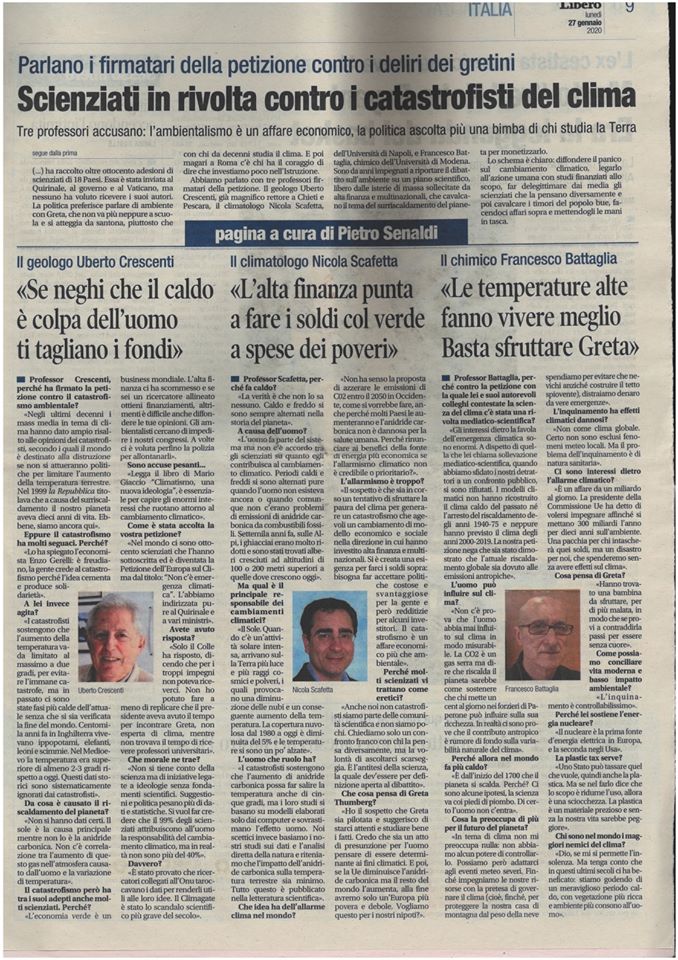
 But, with the progress of the epidemics, the leaders of the Right discovered that they had placed themselves in a no-win position. Their strategy had backfired on them. You don't ask the resignation of the government when you face a national emergency -- it is a no-no: you look like a subversive, to say the least. So, they abruptly changed their tune: you can see the title of the same Libero newspaper of Feb 20. "Virus, now they are exaggerating. Calm down!" (*) Most trolls disappeared from the Web, not just an impression of mine, it was confirmed by quantitative data. At the same time, the Right abandoned all the stories about the planned extermination, Islamization, and the like. Then, they asked to join the current government coalition to form a government of national unity. But, of course, they were told something like, "what? First you say we are criminals, then you want to join us? Did the coronavirus affect your brains?" In many ways, it was another personal defeat for Mr. Salvini, the leader of the Italian League, who showed once more his limits as a leader.
As the threat of the virus became clearer and more pressing, the government started to take serious action. Here, there is a rule that says that in an emergency, any leader can shine. That was true also for Mr. Giuseppe Conte, the prime minister, who managed to give a good impression of leadership, calling for national unity and joint efforts to save the country. Overall, it is a good moment: Italians are reacting well to the emergency, there are no complaints, no requests of exterminating anyone, citizens are trying to do their best by staying at home, as they are requested to do.
The situation is evolving: the government is gambling on the idea that quarantine can stop the diffusion of the virus. If it doesn't work, things may become difficult, to say the least. The Italian health care system is functioning and it is staffed with competent people, but it has been suffering from financial cuts and personnel cuts during the past decades. If it is overwhelmed and collapses, all bets are off. Anything can happen. Maybe we can make it. Just maybe.
Now, what can we learn from this story? Could we project it to other future emergencies, such as the looming climate crisis? With some caution, yes. The future is never like the past, but it rhymes with it. So, if some truly heavy climate crisis arrives, governments will be tempted to react first by blaming their opponents, as the Australian government did with the forest fires of this winter. In this case, they succeeded in passing the message that the Greens were to blame because they didn't want to cut trees - no trees, no fire. Isn't that obvious? But that was possible in Australia because the threat was limited. If towns had started burning, that strategy might have backfired, just like the attempt of blaming immigrants for the epidemic, as in Italy.
So, if Italy is an example, it may be that in case of a truly serious climate emergency, governments may finally decide to react and do something serious. At the same time, the same people who are now thundering against "climate alarmism" would fall in line and ask for national unity against the climate threat. As in the case of Italy, it will be late, probably too late, but it will be at least an attempt. Could it work? Who knows? It would be at least a fighting chance.
(*) Not everyone in Italy agreed to calm down. One Mr. Vittorio Sgarbi, member of the parliament and known as an art critic and art historian, improvised himself as an expert in epidemiology and uploaded a rant against alarmists and catastrophists, denying the existence of the epidemics and of the coronavirus, inviting everyone to go visiting the "red zone" of the epidemic, all that using a foul language (impossible to translate into English) and insulting everyone who disagrees with him. That's not so interesting in itself, but note that Mr. Sgarbi received little flak from the media for his statements. It may be that his opinions are still common with the Italian population.