Showing posts with label greta thunberg. Show all posts

Sunday, August 23, 2020

The Triumph of Catastrophism. How Greta Thumberg Carried the Day

Disclaimer: I am NOT saying here that the Covid-19 does not exist nor that people didn't die because of it. If you react with the term "denialism" you are only showing that you have no rational arguments to produce.


Do you remember that weird girl from Sweden? Yes, the one with the braided hair. What was her name? Greta something.... It is strange that so many people seemed to pay attention to what she was saying about things like climate change. Why should anyone be worried by that? Nobody cares about climate change anymore when there are much more important matters at hand with the great pandemic sweeping the world? And yet, strangely, nowadays people are doing exactly what Greta had told them to do.


Not long ago, I published on Cassandra's Legacy a post titled "The Great Failure of Catastrophism." In it, I argued that some 50 years of warnings from scientists had been completely ignored by the powers that be. I also argued that a relatively minor perturbation, as the one caused by the Covid-19 epidemic, had been enough to consign all worries about climate to the dustbin of the silly ideas that nobody should care about. 

But things keep changing and I am now amazed to see that humans are acting exactly as if they had listened to Greta Thunberg. Do you remember? She said we shouldn't use the plane, that we should travel less, use less energy, consume less. Exactly what's being done.

People are not flying anymore so much, they stopped most of their long distance traveling, the mass migration called "international tourism" seems to have disappeared for good. Some of the most polluting manufacturing operations are slowing down, and with that the exploitation of natural resources. The shale oil industry is dead and the whole extractive industry is going down the drain, too. Humans seem to have largely abandoned their beloved ritual of daily commuting and even professional sports have disappeared beyond the horizon of the events (although they weren't the most polluting activity around).

It is incredible: people would be howling their displeasure all the way to the moon if they had been asked to fly less for the benefit of the ecosystem and themselves, but now they are meekly doing exactly that out of fear of the coronavirus. 

You see, the young lady, Greta Thunberg, had been able to move a few things, but she was still operating within the old paradigm of communication. She was a leader in the same way as Joan of Arc was, long ago. The problem with leadership is that it attracts love and hate at the same time. Sometimes, a lot of hate. And the way to neutralize a successful leader is to pour hate on him or her. Do you remember what happened to Joan of Arc? That was what Greta Thunberg was risking and it is good for her that her cycle has been so short -- now she can be a normal girl for the rest of her life. 

But now, it is no more the time of leaders. The change we are seeing is being created by impersonal forces. There is nobody to hate about the coronavirus: you can't hate a small chunk of RNA that you can't even see. Viruses have no leaders, they don't care about anything, they are impervious to love and hate. What moves things onward nowadays is not hate, it is pure terror and you can't hate terror, you can only resist it or be crushed by it. And it seems clear that most of us are being crushed by terror. Terror is a primal force, almost impossible to resist.

The overall impression is that we are seeing enormous forces stirring. Forces that will change the world so deeply that, right now, we can't even vaguely imagine how. If you have time, do read the book by Shoshana Zuboff "Surveillance Capitalism." She correctly points out how the new technologies called "profiling" and "targeting" are generating a level of control over individuals that never existed before in history. So far, these technologies have been used for relatively harmless purposes such as sales and influencing electoral votes. What we see now is deeper and wider: it is raw power over people's minds. The enormous creature that's raising its ugly head has a name, and it is the World Wide Web. 

It is a huge beast we have nurtured and raised. Mr. Zuckerberg or Mr. Gates, or some of their colleagues may still think they can control it, but it is too late. Nobody who is human can control this thing anymore. We'll go where "it" will take us. And maybe, just maybe, this thing perceives that humans need to stop destroying everything on this planet, including themselves. Perhaps the head of the beast is not so ugly, after all? Who knows?

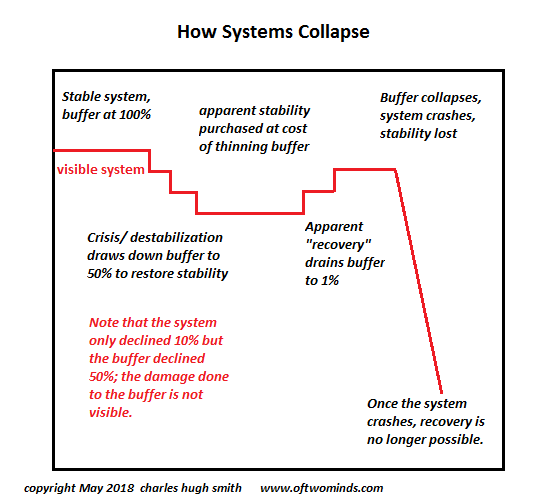
Then, of course, all what I said up to now will turn out to be wrong if we see the famed "recovery." Most people seem to think that once we have a vaccine for the dreaded little monster, everything will return to normal in the best of worlds. But that's questionable, to say the least. Someone who understands that there won't be a "normal" anymore is Charles Hugh Smith of the "Of two minds" blog. Below, let me report an excerpt from one of his recent posts where, among other things, you can find an excellent illustration of how the Seneca Effect works.

________________________________________________________________

The New Normal is De-Normalization

excerpt from Charles Hugh Smith's blog

 
What I mean by Denormalization is the complete dismantling of what was taken for granted as normal and the loss of any future version of normal. Consider sports as an example. We all know the Old Normal that millions hope will magically return: $100 million player contracts, millions in TV ad revenues, pro franchises worth billions of dollars, NCAA playoffs, etc.: a dominant kingdom in the nation's media and mindshare.
 
The dirty little secret that troubled the kingdom long before Covid-19 was a steady erosion in attendance at live games and in the viewing audience. Younger generations have relatively little interest in all the trappings and habits of Boomer sports manias. They'd rather watch the 3-minute highlight video on their phones than blow half a day watching games that are generally lacking in drama and are largely replaceable with some other game.
 
What few seem to notice is that the Old Normal had become insanely expensive, irksome and boring, activities that were habits coasting on momentum. Those embedded in the Old Normal acclimatized to the absurdly overpriced seats, snacks, beer, parking, etc. of live events and the insanely long commutes required to get to the venue and then back home, as their happy memories of $5 seats decades ago is the anchor of their lifelong devotion and habits.
 
The old fans coasting on ritual habituated to the cookie-cutter nature of the games, while those who never acquired the habit look with amazement at the seemingly endless dull progression of hundreds of interchangeable sporting events.
 
Advertisers will eventually notice that younger generations never acquired the habit of worshipping sports and so there is nothing to stem the collapse of the Old Normal but older fans, some percentage of whom will find they don't miss it once they fall out of the habit.
 
Some other percentage will find they can no longer afford to attend live games, or they'll realize they no longer feel it's worth it to grind through traffic or public transit just to sit for additional hours and then repeat the entire slog back home.
 
Another percentage will suddenly awaken to the artifice of the whole thing; they will simply lose interest. Others will finally realize the corporate machine (which includes college sports) has long since lost any connection to the era that they remember so fondly.
 
This same Denormalization will dismantle fast food, dining out, air travel, healthcare, higher education and innumerable other iterations of normal that have become unaffordable even as the returns on the lavish investments of time and money required diminish sharply.
 
How many of you deeply miss air travel? You're joking, right? Only certifiably insane people would miss the irksome hassle and discomfort, from the endless delays due to mechanical problems (don't you people keep any spare parts, or is it all just in time like every other broken system in America?), the seats that keep getting smaller as the passengers keep getting larger, the fetid terminals, and so on.
Like all the other iterations of normal, the entire experience has been going downhill for decades, but we all habituated to the decline because we were stuck with it.
 
What few seem to understand is all the Old Normal systems can't restabilize at some modestly lower level of diminishing returns; their only possible future is collapse. Just as fine-dining restaurants cannot survive at 50% capacity because their cost structure is so astronomical, the same is true of sports, airports, airlines, cruise lines, fast food, movie theaters, healthcare, higher education, local government services and all the rest of the incredibly fragile and unaffordable Old Normal.
None of these systems can operate at anything less than about 80% of full capacity and customers paying 80% of full pop, i.e. full retail. Since their fixed cost structures are so high, and their buffers so thin, there's nothing below the 80% level but air, i.e. a quick plummet to extinction.


Sunday, February 2, 2020

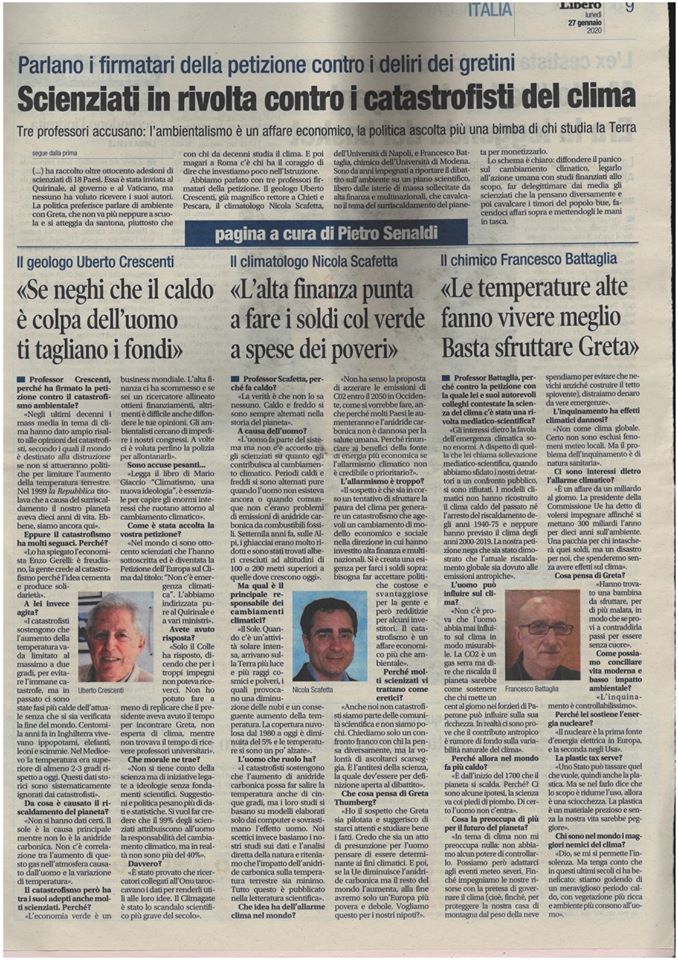
The Fight Against Climate Science. Why is Italy at the Forefront of the Battle?

The Italian Right sees climate science denial as a political weapon


The full page of a few days ago of the Italian newspaper "Libero Quotidiano" with interviews with three Italian scientists (Crescenti, Scafetta, and Battaglia) opposing climate science. The title says "scientists rebel against the climate catastrophists." As a newspaper, "Libero" is probably at an even lower level than that of such wonders of the gutter press as the "Daily Mail" in Britain and the "National Enquirer" in the US. The problem is that what we read on Libero now may be the harbinger of worse to come


Sometimes, my American friends tell me how lucky I am because I live in a country where the top politicians haven't embraced climate science denial as they did in the US. It must be wonderful, they say, not to have a president like Mr. Trump, nor to have to expose yourself to the hate of the deniers for expressing your opinions on climate.

It is true that, so far, Italy has managed to escape the worst political monstrosities that took over the debate on climate in the US. So far, most high-ranking Italian politicians maintained a low profile, preferring to have climate science attacked by lower level henchmen of theirs. The same strategy has been used by most European politicians.

But, clearly, things are changing: climate is becoming a politically explosive issue. Some lobbies are starting to understand that they are going to lose big if something serious is ever done to face the climate crisis, and they react by anti-science propaganda campaigns. Even ordinary citizens are starting to perceive that their economic (maybe also physical) survival is at stake. Many of them tend to react with the first of the five stages of grief: denying the existence of the problem. And the right is starting to consider if they can profit from the situation to obtain political gains.

Italy seems to be at the forefront of the trend. Immediately after the recent regional elections, a setback for the right, the Italian Right-Wing Media started a new campaign that targeted climate science. Earlier on, they had managed to find a small group of scientists who were willing to declare that climate change doesn't exist, or that it is not a problem, or that it is an excuse to have us pay more taxes, you know, the usual arguments. A declaration in this sense obtained less than 100 signatures, mostly by retired geologists and people with no formal qualifications in science. It was diffused also outside Italy, where it gained some 500 signatures. (read here the details, in Italian).

This story is now all over the right-wing newspapers again, together with daily attacks against Greta Thunberg, part of an ongoing smear campaign against climate science. All this is remarkable: even in Trumpland, there doesn't appear to exist such kind of politically coordinated action against science that makes use of a group of elder scientists who, apparently, don't care about destroying their own reputations. So, why is this happening in Italy?

Right now, Italy could be defined as a backwater province of the Global Empire. But it is far to be a quiet backwater: quite the opposite. Social tensions are on the rise, the economy is not going well, unemployment is widespread, politicians are as bad as they may be, and struggling to become even worse. On top of all that, Italians score poorly with literacy and numeracy skills.  Most Italians can read and write, but their ability to understand a written text is low. In short, Italians are angry and they can't understand what's hitting them. They are the ideal target for the kind of hate campaigns that target someone or something as being the "enemies of the people" to be eliminated.

Several targets for a major hate campaign seem to be under testing: immigrants, Muslims, intellectuals, Communists, Angela Merkel, the Euro, the European Union, the banks, and more. And, of course, also climate science and climate scientists. The tests are being performed right in front of us and we'll see how effective the campaign against science will be. If it is successful, it may teach a thing or two to right-wing organizations in other countries.

There have been other occasions in history for Italy to be a laboratory to test new political ideas. It happened when Machiavelli experimented for the first time with the idea of a "citizen army," later on with Mussolini and his Fascist party, then with Berlusconi and his media-based political success, and more. So, it will be interesting to see how the climate debate evolves in Italy in the near future. And, as usual, living in interesting times is a curse.


Monday, January 20, 2020

How to Predict the Future: Confessions of a Modern Cassandra


Telling the truth has always been dangerous and the original Cassandra, the Trojan prophetess, had to suffer the consequences for what she said. But there is a more interesting question: how did she manage to be right while everyone else got it wrong? Here I tell you of my experience as a modest 21st century Cassandra, with my blog. (if you like to hear the story told by the prophetess herself, you can read it here and here.)


It is traditional at the start of a new year to make predictions, but this time I would rather go back to what I have been doing for the past more than 15 years of blogging and social media activity. I have been dealing with several different subjects and, in some cases, I made predictions or I offered my assessments. How right (or wrong) was I?

I think my record was not so bad as a Cassandra. And from this record, I think there are three rules for good (let's say decent) predictions:

1. Always trust thermodynamics
2. Always mistrust claims of marvelous new technologies
3. Always remember that the system has unpredictable tipping points

So, below you'll find a list of what I think were my main successes and failures.
___________________________________________________________________


So, let's start with where I was right.  


2002 - The Hydrogen Economy is a Hoax. 2002 is the year when Rifkin published his book titled "The Hydrogen Economy." I had been working on hydrogen and fuel cells for some time while at the Lawrence Berkeley Laboratory, in Berkeley, and I knew very well that things were not so easy as Rifkin painted them in his book. But, in the beginning, I have to confess that I tried to follow the crowd in search of research grants. Then, I thought it over and I decided that I had to say what I thought: this idea won't work. And I was right: 20 years later, no trace of the hydrogen economy, no hydrogen vehicles on the road, no production of hydrogen from renewable energy. Here is a 2007 post of mine on this subject

2003. No Nuclear Weapons in Iraq.  I don't think I had a blog at that time, but I did write an assessment of mine in Italian on whether it was likely that Iraq could have had WMDs in the form of nuclear weapons. My conclusion was that it was not possible: Iraq lacked the conditions and the infrastructures needed. As a result, I was vilified and insulted in various ways and told that if I loved Saddam so much, why didn't I go live in Iraq? But you know how it ended. I haven't been able to find that article of mine, but it is mentioned in this post.

2005. The compressed air car (Eolo) is a scam.  The car running on compressed air is an idea that remained alive in Europe for some 10 years, starting in 2005. A French inventor, Guy Negré, claimed that he could mass-produce a vehicle that he called the "Eolo" that could compete with other technologies in terms of price and performance. I was skeptical from the very beginning on the basis of some simple calculations. And I was right. No matter how I was insulted by some diehard followers of the Eolo, more than 10 years later, Mr. Negré is no more with us, but his Eolo car never appeared on roads.

2005. Electric Cars are the future. Already in 2005, I bought myself an electric scooter and I started writing articles where I promoted electric vehicles as a good technology that could alleviate several problems we have: traffic, pollution, climate change, etc. I was right in thinking that EVs would become fashionable, even though it took some time for decision-makers to understand the point. Even today, EVs face strong resistance from an unholy alliance of oil companies, carmakers, and environmentalists. But they are going to replace traditional vehicles in the coming years.

2008. Oil prices will go down. You remember how, in 2008, oil prices had started a rally leading the barrel to be priced at $150. There was a moment of panic in which everyone was expecting prices to keep climbing even higher. They forgot that prices are the result of a compromise between offer and demand and that, since demand cannot be infinite, prices can't, either. So, in 2008 I published a post on "The Oil Drum" where I argued in this sense and I proposed that prices would go down. It was what happened.

2011. Andrea Ross's e-cat is a scam. In 1989, I had witnessed the first claims of "cold fusion." The story swept through the scientific world like a tsunami, but it turned out to have been a mistake. It also triggered infinite attempts of imitation, some of which were outright scams. One was the story of the "E-Cat" invented by Andrea Rossi in Italy. After some initial attempts of assessment, it was clear to me that it was a total hoax, and I said that more than once. Actually, it should have been clear to everybody, but Rossi generated a group of faithful followers who engaged, among other things, in insulting and vilifying the unbelievers  - I never received so many insults in my life as I did from this bunch of madmen. Now, almost 10 years after the first claim by Rossi that he would soon start mass-producing his machine, I think it can be said that it was a hoax. Find the story here.

2011. The Limits to Growth was Right! In 2011, I published my first assessments of the story of "The Limits to Growth," study and later on, a book titled "The Limits to Growth Revisited," my first book in English. I re-examined the whole story how of the study was rejected and demonized, widely described as containing "wrong predictions". I concluded that there was nothing wrong in the book and that its rejection was one of the first examples of a negative PR campaign designed to discredit scientific results that were considered harmful to some political or industrial lobby. My assessment was among the first studies that led to a re-evaluation of the study that's still ongoing. It is still early to say if one or another of the 12 scenarios published in the 1972 book was "right" but there is no doubt that the study is now considered a milestone in the understanding of complex systems, as it deserves to be. In this sense, I had made a correct prediction.

2016. The "Sower's Way:" Photovoltaic Energy is the future. Here, I have been always a sustainer of PV energy, since 2005, when I placed PV panels on the roof of my house. I think I was right too, especially when PV reached "grid parity" with other technologies producing electric power. But it is moving onward. I marked the "2016" date because it is when I published a paper dealing with the concept of the "Sower's Way," that is, that we need to invest fossil energy to build up the new renewable energy infrastructure. We are moving in that direction, although facing a dogged resistance by groups of greenies who have decided that we all have to die in the darkness.


Now some cases in which I turned out to be wrong.

 
2003 -- Peak oil in 2010. Here, I don't think I ever made a peak date prediction myself, but I have been a "peak oiler," among other things the president of the Italian section of ASPO, the association for the study of peak oil. So, I share the blame for the two mistakes that peakers made. The first was to focus on the "peak" as if it was an equivalent of the apocalypse and spending inordinate amounts of time to try to predict the exact date when it would arrive. The second was to underestimate the importance that "non-conventional" oil could have had. We didn't realize that shale oil is not so much an economic resource as it is a strategic dominance weapon. There have been several predictions (including mine) that the shale "bubble" was going to burst, but so far it has not.

2005 -- EROI is a metric that can help us choose the best alternatives for the future.  When I discovered the concept of EROI (energy returned on energy investment) or EROEI (energy return on energy invested), developed by Odum and Hall, it was a small epiphany for me: here was an objective, scientific, rational way to evaluate the best technologies for the future. I wrote my first paper on the subject in 2005. That text became rather popular in Italy. But I didn't imagine what the reptilian part of human brains could do when it understood what EROI was and what could it be used for. The concept was stretched, massacred, mongrelized, cut to pieces and made into a stew, and more. Whoever had an interest in making a certain technology look good could find ways to juggle the numbers and assign to it a high EROI. The reverse was also possible if one wanted to demonize a certain technology. So, you can find studies that assign an EROI <1 to photovoltaics and > 100 to nuclear energy, and also the reverse. At this point, EROI has become a useless metric, destroyed by too much politics applied to it.

2009 -- High Altitude Wind Energy. In 2009, I published on the Oil Drum a positive assessment of high altitude wind energy, in particular of the prototype being developed in Italy, the Kitegen. I was way too optimistic. High altitude wind power turned out to be much more difficult to develop than it had seemed to be at the beginning. There is nothing in the idea that goes against the laws of physics but, evidently, there are big problems, probably related to the control of the kites. Today, 10 years later, high altitude wind energy remains an unfulfilled promise, even though there still exist companies engaged in the field. I continue to think that this technology can play a role in the future, but it won't be the game-changer it seemed to be 10 years ago.

2019 - Greta Thunberg: the unexpected storm.  In 2018 I published a post in which I examined the trends of the "climate change" meme, concluding that the public interest for it was declining and that soon nobody would have been interested in it anymore. I was wrong: in 2019 Greta Thunberg appeared, changing everything. As I wrote in a later post, I made the classic mistake that all forecasters make: thinking that past trends will also be future trends. Sometimes it is true, at times it is deadly wrong, as in this case. It is curious to note how the young Swedish lady has been playing in the real world the role that Asimov's character, "The Mule" played in the "Foundation" series: something outside statistics and unpredictable by models.

____________________________________________________

There may be more things wrong and right that I said, after all, I calculated that I infested the Web with something like 3 million words, up to now! So, if you remember something I wrote that was egregiously wrong or right, tell me in the comments, I'll see to add it as a note to this post.

Overall, maybe I could have done better, but I think that if Lady Cassandra is seeing me from wherever she is now, in Hades, she may be nodding in approval!


Monday, December 23, 2019

Polyphonic Music and the Angst of the West: A Christmas Post


Sicut Cervus, by Pierluigi da Palestrina, published in 1604. It sings Psalm 42 of the Vulgata Bible. Maybe this old motet can be seen as a Christmas gift from the Western culture to the rest of humankind


With the waning of the Middle Ages, Europe was coming out of a terrible period. The crusades had ended with a series of crushing defeats and the tremendous war effort had backfired, generating famines and the black death pandemics that killed more than 100 million Europeans. It is estimated that around 45–50% of the population perished, in some areas probably closer to 75–80%.

Yet, Europe rebounded from the disaster -- perhaps because of it. As I described in a previous post, with the 15th century the European population restarted growing, faster than before. It was probably because it could find intact natural resources that the previous collapse had left free to regrow: forests and arable land.

The 15th century was the time of the Renaissance, an age that was the start of the incredible expansion that led Western Europe to dominate most of the world after a few centuries of conquests. But the tumultuous expansion was not without internal struggle: every European state wanted a slice of the overseas bounty. Eventually, the competition would generate the great struggles of the 17th century, with Europe turning against itself with the 30-years war, the witch-burning age, and other disasters. Much before that happened, the older European cultural unity had been lost: Latin, the old universal language that had bound Medieval Europe together, was rapidly losing ground. It wasn't needed anymore.

But, before disappearing, Latin had a last moment of glory. It was the age of polyphonic music in Western Europe, a kind of delicate, sophisticated, intricate, incredibly beautiful kind of music never seen before in the world. Not that polyphony didn't exist before, it was possibly the most ancient kind of music in human history. But the Western European version that lasted from ca. 1400 to 1600 CE, was something different. Earlier on, Gregorian music -- monophonic -- had been mostly an embellishment of the sacred Latin words of the Bible. With polyphony, music asserted itself in an age when Latin was not understood anymore.

To be sure, polyphonic music was still sung in Latin and it often had religious subjects, but it was a completely different story. It was an expression of the European willingness to expand into new realms. Just in the same way as the European galleons were exploring new lands, European polyphonic music was exploring new harmonies and new ways of communications: lacking a shared language, music had to come to the rescue. Polyphonic music could be religious, but it was not necessarily so. It could take the form of a madrigal, a secular kind of music.

For some two centuries, a new harmony, never heard before, resonated in Europe. Then, as the political struggle became harsher and wider, polyphony gave way to symphonic music, better suited to the tragic and violent age that started with the great carnage of the 30-years war and expanded all the way to the disasters of the two world wars of the 20th century. It lasted until English became the new universal language. With English, music could become again linked to the human voice and to words that could be understood. A modern genre such as the rap is, after all, a return to the Gregorian approach to music as an embellishment of human language. 

Today, polyphonic music is still alive and well as a religious form of music in Eastern Europe, but it is a relic of a bygone time in Western Europe and in all the regions that recognize themselves under the wide label of "The West." Yet, we can still appreciate the technical mastery of the composers of that time, one of them was Pierluigi da Palestrina, who composed Sicut Cervus, from Psalm 45 of the Bible.

Actually, the Sicut Cervus is not just a beautiful harmony, it is something more. Its theme is a thirsty deer looking for water. It says, Sicut cervus desiderat ad fontes aquarum, ita desiderat anima mea ad te Deus.” Which you can translate as: “As a deer longs for a spring of water, so my soul longs for you, oh God.” And that, I think, can express the burning desire of the West, the angst for something that Westerners themselves don't understand but have been seeking for centuries with such a reckless enthusiasm that they set half of the world on fire. And, whatever it was that they were seeking, it seems clear that they didn't find it. Today, the parable of the Western world domination seems to be mostly concluded, even though it still flares here and there. But there remains to us something distilled from so much ardor, the music of a remote age when our ancestors had managed to create something eerie and beautiful that we can still admire, today: polyphonic music.

I noted in a previous post how all human cultures have treasures that they cherish and revere. These treasures are not the property of anyone but gifts for everyone. In that post, I cited Greta Thunberg, the young bearer of the rights of the planet, as a gift that the West may be able to offer to the world nowadays. But also a treasure from the past, Western polyphonic music, can be seen as a gift to all humankind. Will we ever see a time when human cultures will exchange only gifts and not bombs? We are not there yet but, who knows? For the time being, the West seems to be still desperately searching for something, but nobody knows exactly what.


Thursday, December 12, 2019

On Greta Thunberg: A Letter to my Non-Western Friends


Dear non-Western friends,

first of all, let me tell you that I understand your perplexity about Greta Thunberg. I understand how you see this latest stunt of the Western Media of naming her "Person of the Year." From your viewpoint, it looks just like another trick of the West, one among many. And I understand that it makes you even more suspicious that the whole story of climate change is nothing but a hoax created by the Western Empire to maintain its grip on the whole planet.

Yes, I understand. But I would like to ask you to make an effort to understand us, the Westerners. You see, sometimes I have a feeling that one of the characteristics of Hell could be that the people who are in it don't realize that they are in Hell. It would be truly wicked, but it was a Western poet, Baudelaire, who said that the best trick of the devil is to convince you that he doesn't exist. So, if Hell is a place where you are told lies about everything, including that you are not in it, then we Westerners are truly living in Hell, at least a certain kind of hell.

It is not just lies, it is the kind of lies. The Western media have evolved into a machine for manufacturing fear and hatred. Anyone, any group, any belief, can be destroyed by this machine. And you cannot do much to fight back. If you doubt the official narration, you are a conspiracy theorist. If you plead for peace, you are Putin's stooge. If you protest against your government, you are a terrorist. If you deny the role of the West in leading the world, you are a traitor. And, on top of that, most Westerners are convinced that propaganda is a thing of the non-Western world and that their media are free and independent. Indeed, Baudelaire was right.

Of course, don't make me say that the non-Western world is a Paradise of truth. All nations, all states, all cultures, have their biases, their filters, their entrenched beliefs, and, in many cases, their propaganda machines. Every one of us, Westerners and non-Westerners, sees the world through the filters that our culture, our traditions, and our media place in front of us.  But you, non-Westerners, have a possibility that's denied to us, Westerners. You can use English to peer into the Western media without being embedded in it. And, as I said, I understand that often you don't like what you see.

And so, we are back to Greta Thunberg. Of course, I understand that this girl is not a "grassroots" phenomenon as some might want to believe. She is supported by a top-class team of media experts, she couldn't possibly fight the Western Media Behemot alone. And I understand that her message may be misunderstood, mongrelized, and exploited for yet another round of greenwashing. I know that.

But that's not the point. It is how the appearance of Ms. Thunberg has been both amazing and unexpected. If she is a product of propaganda, then it an unusual kind of propaganda. It would be the first time in many decades that our media are presenting to us a message that's not based on the idea of something or someone evil to be destroyed. This girl crashed through all the media barriers with just a simple message: the truth about climate change. She wasn't telling us to kill or hate anyone, she was just telling us to work together to ensure that her generation could have a future. And she carried the message with an inner force, a way of posing herself, a capability of saying things straight that was nearly unbelievable. It is amazing how she attracted upon herself all kinds of insults, abuse, and curses, but nothing really stuck on her. You remember Ronald Reagan's "Teflon presidency"? Well, this girl is not just Teflon coated: she wears a Mythril armor like the heroes of the trilogy of the ring.

I understand that it is possible that this girl will disappear from the mediasphere in a short time, as it happens for most ideas over the Web, nowadays. But she may turn out to be something more, maybe not the specific person of Greta Thunberg, but in the message she represents. A strong message telling humankind to respect the things that make humankind live: our planet and all the living beings in it.

Let me tell you of something I learned not long ago when I was in Iran. It was the time of the Arbaeen, the commemoration of the martyrdom of Imam Husayn ibn Ali, forty days after the Day of the Ashura. Someone told me (or maybe I read somewhere) that "Imam Husayn is a figure that we Shi'ites offer as a gift to the whole humankind as an example of virtue and of justice." And that struck me as something worth remembering. In all cultures, we have something or someone we revere as a treasure: a person, a poem, a work of art, a way of seeing the world. And these treasures, I think, we should share with the rest of humankind as gifts.

Now, of course, I don't have the authority to say what the entity we call "The West" should or should not do. For sure, we shared with the world plenty of poisoned gifts in the past. But this girl, Greta Thunberg, might be a true treasure, a gift we could offer to the rest of the world. For once, there would come from the West a message of peace and harmony. Could that really happen? Difficult to believe, sure, but it is a great hope.


Your friend from the West

Ugo


h/t Chandran Nair

Monday, October 7, 2019

The Public Interest in Climate Change Reaches and All-Time High. Greta Thunberg Conquers the Memesphere


Greta Thunberg is having a phenomenal success as
 climate messenger. Good targeting, flawless performance, the right person at the right moment.


A little more than one year ago, I wrote a post titled "Why, in a Few Years, Nobody Will be Talking About Climate Change Anymore." It turned out that I was completely wrong: Greta Thunberg changed everything. My mistake was the typical one we all make when we try to predict the future. As I tend to say, "the surest way to make wrong predictions is to extrapolate past trends." And I fell into the trap myself!

Look at what happened: the interest of the public in climate change had been fading for years and then, suddenly, it started rising. Now it is the highest level ever reached in the Google Trend record.


Isn't that fantastic? The Greta Thunberg meme, alone, changed the worldwide trend. There is no other explanation for the restarting interest in climate.

So, what's happening? Let's see if we can learn something from my wrong prediction. First of all, I based my prediction on the data from Google Trends that showed a constant and robust decline of the public's interest in climate change. It had been ongoing for more than a decade and it seemed logical to me that it would continue to do so. I noted also how the Trump government was practicing the propaganda technique known as "deception by omission." It seemed to be successful in generating a self-reinforcing feedback that led the public to forget about climate change, distracted by other issues.

Then, bang! Complex systems always take you by surprise and Greta Thunberg surely surprised everybody. What made her so successful in a task where the best scientists in the world had failed? The birth and the development of the Thunberg meme will be studied for years to come: it is truly a remarkable innovation in a memesphere where, so far, only negative memes seemed to have a chance to affect the public opinion (Climategate is an example). Surely, Ms. Thunberg was supported by a top-notch public relations agency. They did everything right from the beginning: the target, the delivery, the positioning. But it was the person, Greta Thunberg, who was absolutely perfect in her role: flawless on all occasions.

At the same time, the forces of darkness trying to stop Greta Thunberg managed only to propel her further forward. A large number of angry old men made fools of themselves by insulting her. Many so-called "experts" on climate could only show their ignorance. Most attacks against her backfired, also because the young lady turned out to be both smart and resilient.

But there is more, here, than a flawless P.R. operation. The time had come for a major memetic transition. Most of us were expecting it as the result of some climate disaster, hurricanes, sea-level rise, heat waves, this kind of things. But we were hit by every sort of climate disasters and the result was the opposite: in the wake of each terrible event, the public interest in climate change diminished!

Again, we should have expected that: the memesphere behaves very much like complex physical systems, it undergoes phase transitions. If you ever worked with this kind of systems, you surely noted how phase transitions occur, or do not occur, mostly when they please. If the conditions are not right, the chemical compound that took you months of work to synthesize will refuse to condense and precipitate. Or, it will do so when you don't expect that to happen. The memesphere does the same: when the conditions for the diffusion of a meme are right, it will diffuse. Otherwise, it won't.

So, Greta Thunberg was the right meme at the right moment. And, as all good memes, it diffused explosively. And now what?

Memes have a limited lifetime in the memesphere -- it is because they are akin to living creatures and they consume the resources that make them live. They flare up rapidly and then decline slowly. If nothing changes, this is the destiny of the Greta Thunberg's meme -- it might be hastened by ongoing demonization campaign: if there is something that modern Western propaganda can do is demonizing people. After decades of operation, they have learned to do it well.

So, there is a definite chance that Greta Thunberg will fade away and disappear from the memesphere, as her enemies surely hope. But that's not necessarily her future. It is also possible that the meme will mutate, becoming more structured, more propositive, more engaging. It seems that it is what's happening: Greta Thunberg is updating her message and she is starting to propose actual solutions to climate change with a recent video in which she promotes reforestation. That video has some problems and so far it didn't have a big impact, but it is a step in the right direction.

And here we are: complex systems always surprise us, and surely we are in for more. But with Greta around, the future is not anymore so bleak as it seemed to be just a few months ago.


On Greta Thunberg as a climate meme, see also this previous post of mine

Thursday, May 2, 2019

Climate Science Deniers Start Feeling the Heat. Now it is Foot-Dragging Time!


Greta Thunberg is both a cause and an effect in the great shift that's ongoing in the public opinion about climate change. Climate science deniers are feeling the pressure and they are preparing to change their strategy. No more denying that AGW exists and that it is a danger for all of us. It is time to move to foot-dragging for profit. 


A post by Tim Ball on the despicable WUWT blog is well worth reading because it summarizes the plight of climate science deniers in the current debate. Ball says that he calls it quits because:

"you are asking people to believe that a small group of people managed to deceive the world into believing that a trace gas (0.04% of the total atmosphere) was changing the entire climate because of humans. In addition, that group convinced many others to participate in the deception. The public view is that deceiving so many is just not possible. "
Stark clear: Ball perfectly summarizes the problem for him and his band of science-deniers: how could anyone believe what they are saying? With Greta Thunberg bursting into the debate, their position is rapidly becoming untenable. So, they are shifting away from discussing whether AGW exists or not. Ball says,
"I decided to stop trying to educate people about the global deception that is AGW. ... The challenge now is to help people understand the differences between deceptively derived policies, and what is the best, most adaptive, most profitable, and most rewarding strategy for survival of the individual, business, or industry. "
And I couldn't have said it more clearly. Ball and his ilk are preparing for a war of attrition against the attempt to do something to save humankind before it is too late, all in the name of the "most profitable" strategy. 


(I know, I know, I shouldn't link to anti-science blogs, but this one is a must read -- anyway I put a no-follow clause on it. Note also a recent post by Michael Barnard on Medium that notes the same thing as I did)


Friday, April 26, 2019

Greta Thunberg heavily insulted by an Italian newspaper. She's smashing all the mediatic barriers!


The front page of the Italian newspaper "Libero" of April 18. The main title says "La Rompiballe va dal Papa," translatable as "The pain in the ass Girl goes to see the Pope." The red text "vieni avanti Gretina" elegantly plays on the similarity in Italian of the diminutive "Gretina" (little Greta) and "cretina" (cretin).


"Libero" is an Italian newspaper, in terms of level, it is probably below such egregious insults to human intelligence as the British "The Sun" and the "Daily Mail." Similar, but perhaps even worse, than Fox News in the US. So, being insulted by "Libero" is a mark of honor, to say the least.

But, as I argued in a previous post, these and other insults show that Greta Thunberg is smashing through the media: she is a memetic equivalent of the Chicxulub meteorite and she has a chance to destroy the intellectual dinosaurs that populate the earth nowadays.

Of course, the battle is still to be fought, but it is impressive how fast Greta is growing in the memesphere: note how she is pushing down to irrelevance such evil characters as John Bolton and Mike Pompeo.


Will Greta's action last? Difficult to say: so far she has been able to arouse the worst rabble existing in the mediasphere and they are spitting their lungs out in their screams against her. But they can do much worse than screaming and they will do their best to destroy her and what she represents. It will be a difficult battle for them, though. Maybe Greta is burning her candle on both ends, sure, but it is such a lovely light!


If you can read Italian, at this link you can find a commented list of the insults that Greta received in Italy.


Saturday, March 16, 2019

The Thunberg Effect Seems to be in Full Swing: Will it Last?


This young lady, Greta Thunberg, is breaking all the memetic barriers: the effect is weak but already evident. Most likely, we'll see it growing in the coming days. It might be the start of an epochal change in the way the challenges ahead are perceived.

On the other hand, expect a reaction from the Powers That Be to put this girl back in her proper place. Interesting times ahead, as always.....


Monday, February 25, 2019

Winning the War of Climate Communication. Is Greta Thunberg the Memetic Weapon we Needed?


Who speaks on behalf of young people about climate? Greta Thunberg does. She is the embodiment of the concept that what matters in communication is not the message but the messenger. Only a believable messenger can pass a believable message. And she is believable: she has a direct stake on the issue, it is HER future she is defending, just as the future of the people of her age. She is defending her future from old people who think only of their immediate satisfaction. They are the virus destroying the planet, she is the cure.


Years ago, I think it was in the mid-1980s in Berkeley, I was berated at length and in colorful terms (to say the least) by a young mother for not having buckled up her 4 years old daughter, a classmate of my son, while I was transporting her in my car. As partial justification for my inexcusable wickedness in that occasion, I can say that, as far as I can remember, at that time there was no mandatory seat belt law in California (and also that the car I drove at that time, a Dodge Dart, was so old that I think it didn't have seat belts in the back seats!). But never mind that:  I was wrong and she was right.

The story of that day in Berkeley came to my mind more than once in the debate on climate change. You see, today we tend to think as obvious that seat belts are saintly things that save lives. But it was not so obvious in the 1970s and in the 1980s: we forgot about that, but there was a strong debate on the matter with some people maintaining that there was no proof that seat belts actually saved lives. According to a 2006 article by John Adams, risk expert of the University College London, mandating the use of seat belts in 18 countries resulted in either no change or actually a net increase in road accident deaths.

Think about that using the eyes of those people who deny the validity of climate science: you could ask what proof do we have that seat belts make you safer? Of course, we can play as much as we like with crash tests using sophisticated dummies, but hey, those are just models! You know how these debates go over the Web, once they start, they never arrive at a conclusion. And nothing is done.

So, why do we wear seat belts but don't do anything about climate change? It is because there are people like the lady who berated me in Berkeley who want everybody to wear seat belts. They are parents, siblings, spouses, they have a stake in the safety of the members of their families, they don't care so much about subtleties, demonstrations, and statistics, they can see that if their child is belted she won't smash into the windshield with her head in case of a collision. If you argue that they are wrong, they will say you are a monster (as I was told I was, that time in Berkeley) and they'll be perfectly right. It is because these people have argued, pushed, and worked in favor of seat belts that today there are mandatory seat belts laws.

Now, about climate change: who is arguing about people's safety? Mostly, scientists. And there lies the snag: scientists do not have a direct stake in the issue of climate. Most scientists, old or young, seem to be interested mostly in their carers. And if the climate situation is so bad as scientists say they are, why do they still take planes to attend their silly international meetings? Scientists are not here to save the planet: they are there to write papers, speak at conferences, teach formulas to their students, they are just boring people.

In practice, scientists are the worst possible messengers to pass the climate change message. Not surprisingly, they haven't had too much success, as we all know. Imagine that if -- that day in Berkeley -- instead of a young woman berating me I had been facing a white-haired scientist showing me data and diagrams. I am a polite person, but I am sure I could have told him something not so polite, instead of the apologies I told to the mother of my son's friend.

That's the problem, and it can be solved only by a change of paradigm in the memetic struggle: We need to change the message, but more than that we need to change the messenger. And there we are: Greta Thunberg. You see the difference? She has a stake in the issue: it is her future that's being jeopardized by old men, the future of her generation. She has a right to speak, she has a duty to speak, she has the force to speak, and she does that. And the message she carries is extremely strong. It is a meme that diffuses in the memesphere and even the dark forces of denial will have a hard time stopping it.

Of course, it is not enough to be young, to be intelligent, to be motivated to succeed in this task. The memetic war is no child's play. It is a deadly struggle, even though, normally, only virtually so. But even a smart young lady as Greta Thunberg needs to be supported - in a certain way "weaponized." And that's what has been done by the people of "wedonthavetime." She is not just a different messenger, she carries a different message: it is "I want you to panic" -- it is a much powerful message than the edulcorated version carried by scientists ("see, folks, we don't want to trouble you but, well, there might be a little problem...").

Greta Thunberg is now an awesome memetic weapon to fight the battle against the dark forces of ignorance and of denial.

We still have a chance.


___________________________________________________

How to neutralize Greta Thunberg. I think that today just the thought of Greta Thunberg scares the bejesus out of the people of the anti-science crowd but I am sure they are already thinking of strategies to fight her. So far, the best they could concoct has been to ignore her, but some kind of smear campaign is likely in the near future. It was already done 50 years ago to silence Rachel Carson, the author of "Silent Spring" by defining her a "histerical priestess of nature". Already a few days ago, Ms. Angela Merkel hinted that Greta Thunberg is part of a hybrid warfare attack waged by the Russians against Europe: you can't imagine what these evil Russians are capable of! And, of course, if Ms. Thunberg makes the smallest slip in one of her speeches that can be twisted and packaged in order to make her look racist or anti-semitic, then she is dead in the water. But the most effective campaign against Greta Thunberg might come from her potential allies, people on "the left" who think she is not radical enough and that the very fact that she is helped by PR experts is an insult to the intelligence of humankind. Among this nefarious band, the deranged people belonging to the NTHE (near term human extinction) sect are the worse. They believe that we are going to go extinct soon anyway, so there is no need to do anything and we can continue to live as we did before and so Ms. Thunberg and her ilk should just stay quiet, go home, and die in silence. They are very vocal and could do real damage, fortunately, so far they are a tiny minority


Sunday, January 27, 2019

The Making of Greta Thunberg: Memetic Weapons for the Meme War


If I say that this young lady, Greta Thunberg, is a meme I mean no disrespect for her -- we all are memes! Actually, I think she is a great girl. But the story of how this particular meme was pushed up into becoming an important feature of the planetary memesphere is teaching us so much of how our world works. And how fundamental is memetics as a science. Truly, read on. You'll learn of things you wouldn't have suspected existed!!


Ladies and Gentlemen, first of all, let me introduce to you the study on memetics performed by myself and these two wonderful coworkers of mine, Sara Falsini and Ilaria Perissi. Everyone loves their own brainchild and I do love mine (ours): so, allow me to say that this work may be the first (at least one of the first, I believe) that uses system dynamics for the quantitative study memetics (many have made qualitative connections). Maybe it will open up a whole new field of study, but let me tell you this story.

So, what is a meme? A meme is a meme is a meme (as Gertrud Stein never said): a wonderful concept! Think of the blind crocodiles in sewers of New York, that was a pre-internet meme. Or, for a more recent one, "Obama was not born in the US." A meme is not just an idea, but an idea that reproduces itself -- analogous to the gene in biology. It was invented by Richard Dawkins in 1976 and he probably didn't suspect what can of memes he was opening.

Later on, Daniel Dennett said, "a human being is an ape infested with memes." Now, pause a moment to think of this sentence: isn't it wonderful? One of those sentences you look at, you pause for a moment to think about, and then -- poof! -- your view of the world is changed. The beauty of the universe is that you can keep learning new things and, boy, there are so many!

The point of memes is that they can "go viral" in the memesphere -- the Web -- you know this already. But what makes memes go viral? Well, there comes the fascinating thing we discovered in our paper: in biology, there is only one way to go viral: by infection. In memetics, there are two ways. One is the properly viral mode, that is, with the virus jumping from a host to another. The other is the "fallout" mode - it is like when an atomic weapon kills people by radiations -- everyone is affected at the same time. Here is the description we give in our paper

In the present study, for the first time, we discuss and compare the birth of a meme and its dynamic propagation both on the internet and in mass media environments. To grasp this fundamental difference in the meme’s origin, we built simple and intuitive models, with the system dynamic (SD) methods. SD models are particularly useful in representing the structure of complex systems, especially the non-linear systems, in which the properties-of-the-whole system are different from the properties that characterize the system’s constituent elements so that the behaviour of the whole cannot be explained in terms of a combination of the behaviour of the single parts. The result of our study reveals that the origin of a meme can be due to two different activities: internet propagation or media bombardment.
 ... memes have characteristics that genes do not have. In particular, memes can be “planted” in the mediasphere using a top-down mechanism based on scattershot diffusion on the part of the mass media. This behaviour can be seen as parallel to that of the radioactive cloud generated by a nuclear incident. The distinction between these two mechanisms can be useful to understand whether a specific meme is the result of a “natural” interest of the public that derives from its special virtues or has been diffused as a top-down operation designed to influence the public or the consumers of a specific product.


And here we are: looking directly into the belly of the great beast that is the memesphere -- the great cauldron of human thought as it boils, it quivers, it festers in the giant ecosystem we call the World Wide Web. And we can see the birth of the little beasts we call memes. Some grow by infecting one node after the other, some by being pushed from above: by that giant beast infecting the memesphere, what we call the "media" or the "mainstream media" (MSM). And what the MSM want to grow, grows.

Let me show first at a meme that grew virally: "Gangnam Style" (you remember the Korean song, popular a few years ago). Here it is, fitted with the system dynamics model


But you don't need a quantitative model to note how the viral propagation mode shows a typical exponential growth mode at the beginning: here is the same meme, Gangnam, on a different scale. It has an induction time -- it is clear. It grew by infecting one node after another, just like biological viruses do with cells.


That's not the case for a fallout mode meme. It has no induction time: it is born instantly, pushed by the MSM. Here is an example, Bataclan, the terror attacks in Paris, in 2015.

You see? No induction time. It grows from zero to the maximum in no time.


But we were speaking about Greta Thunberg, right? What kind of meme is she? Well, let's look for her memetic essence on Google Trends, and there you go:


You see how quick is the growth of the meme? It is a fallout mode, not a grassroots mode. Not so sharp as for Bataclan others but, clearly, there was some force pushing her on the Web.

But this was obvious from the beginning. We know exactly where the Greta Thunberg meme comes from: it is a creation of a Swedish company called "We Don't Have Time." The story is told by Cory Morningstar, and also by Nicolas Casaux, I haven't checked all the details, but these descriptions make sense to me, especially in view of the curve from Google trends. In short, Greta Thunberg is a memetic weapon.

That doesn't mean we should share Cory Morningstar's criticism. After all, the relation of Greta Thunberg and the company called "We Don't Have Time" is open for everybody to see -- it is no secret. Besides, the enemies of humankind are using the same memetic weapons, but in secrecy. Look at this


Yes, Climategate, the famous "scandal" that purportedly proved that all the world's scientists had formed a conspiracy to invent a non-existing danger for their personal advantage. Look at how fast the curve grows: there is almost no induction time. Not a grassroots emergence, someone has been pushing this meme. The MSMs were immediately involved to diffuse something that, in itself, was just boring: who would have cared about the personal messages that some scientists had exchanged? But who was that "someone" pushing? We don't know -- and probably we never will. The dark side of the memesphere fights against humankind and they use memetic weapons.

So, folks, this is a memetic war that we are fighting. We are fighting for our survival and we need weapons: no war in history was ever won using just moral superiority. If Greta Thunberg is a memetic weapon, then she is a good meme, created for a good purpose. And let's go on and fight.


h/t Philippe Gauthier and Nicolas Casaux

Who

Ugo Bardi is a member of the Club of Rome, faculty member of the University of Florence, and the author of "Extracted" (Chelsea Green 2014), "The Seneca Effect" (Springer 2017), and Before the Collapse (Springer 2019)