Showing posts with label climate science. Show all posts

Sunday, February 2, 2020

The Fight Against Climate Science. Why is Italy at the Forefront of the Battle?

The Italian Right sees climate science denial as a political weapon
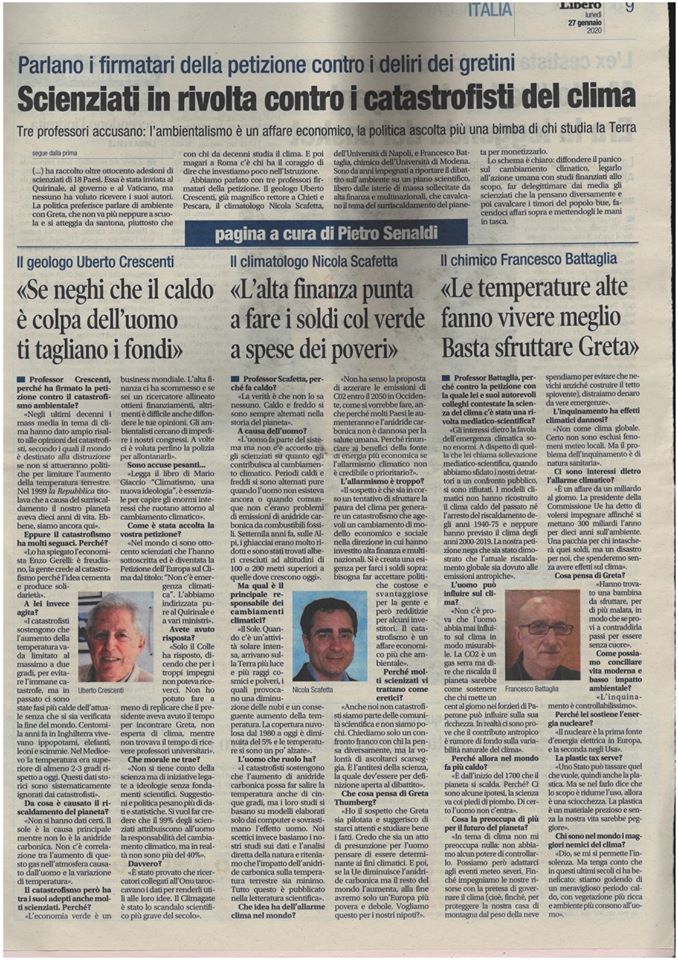


The full page of a few days ago of the Italian newspaper "Libero Quotidiano" with interviews with three Italian scientists (Crescenti, Scafetta, and Battaglia) opposing climate science. The title says "scientists rebel against the climate catastrophists." As a newspaper, "Libero" is probably at an even lower level than that of such wonders of the gutter press as the "Daily Mail" in Britain and the "National Enquirer" in the US. The problem is that what we read on Libero now may be the harbinger of worse to come


Sometimes, my American friends tell me how lucky I am because I live in a country where the top politicians haven't embraced climate science denial as they did in the US. It must be wonderful, they say, not to have a president like Mr. Trump, nor to have to expose yourself to the hate of the deniers for expressing your opinions on climate.

It is true that, so far, Italy has managed to escape the worst political monstrosities that took over the debate on climate in the US. So far, most high-ranking Italian politicians maintained a low profile, preferring to have climate science attacked by lower level henchmen of theirs. The same strategy has been used by most European politicians.

But, clearly, things are changing: climate is becoming a politically explosive issue. Some lobbies are starting to understand that they are going to lose big if something serious is ever done to face the climate crisis, and they react by anti-science propaganda campaigns. Even ordinary citizens are starting to perceive that their economic (maybe also physical) survival is at stake. Many of them tend to react with the first of the five stages of grief: denying the existence of the problem. And the right is starting to consider if they can profit from the situation to obtain political gains.

Italy seems to be at the forefront of the trend. Immediately after the recent regional elections, a setback for the right, the Italian Right-Wing Media started a new campaign that targeted climate science. Earlier on, they had managed to find a small group of scientists who were willing to declare that climate change doesn't exist, or that it is not a problem, or that it is an excuse to have us pay more taxes, you know, the usual arguments. A declaration in this sense obtained less than 100 signatures, mostly by retired geologists and people with no formal qualifications in science. It was diffused also outside Italy, where it gained some 500 signatures. (read here the details, in Italian).

This story is now all over the right-wing newspapers again, together with daily attacks against Greta Thunberg, part of an ongoing smear campaign against climate science. All this is remarkable: even in Trumpland, there doesn't appear to exist such kind of politically coordinated action against science that makes use of a group of elder scientists who, apparently, don't care about destroying their own reputations. So, why is this happening in Italy?

Right now, Italy could be defined as a backwater province of the Global Empire. But it is far to be a quiet backwater: quite the opposite. Social tensions are on the rise, the economy is not going well, unemployment is widespread, politicians are as bad as they may be, and struggling to become even worse. On top of all that, Italians score poorly with literacy and numeracy skills.  Most Italians can read and write, but their ability to understand a written text is low. In short, Italians are angry and they can't understand what's hitting them. They are the ideal target for the kind of hate campaigns that target someone or something as being the "enemies of the people" to be eliminated.

Several targets for a major hate campaign seem to be under testing: immigrants, Muslims, intellectuals, Communists, Angela Merkel, the Euro, the European Union, the banks, and more. And, of course, also climate science and climate scientists. The tests are being performed right in front of us and we'll see how effective the campaign against science will be. If it is successful, it may teach a thing or two to right-wing organizations in other countries.

There have been other occasions in history for Italy to be a laboratory to test new political ideas. It happened when Machiavelli experimented for the first time with the idea of a "citizen army," later on with Mussolini and his Fascist party, then with Berlusconi and his media-based political success, and more. So, it will be interesting to see how the climate debate evolves in Italy in the near future. And, as usual, living in interesting times is a curse.


Sunday, November 24, 2019

Denigrating "The Limits to Growth" is Still a Popular Pastime. But can we Learn Something From it?


Many people seem to be surprised when I tell them that I follow the abominable science denial blog "Watts Up With That" kept by Alan Watts. Yes, it is abominable, sometimes, but it has one feature that makes it stand a couple of notches above the other science denial blogs: it is almost never boring, It has the same fascination that you can find in a well-done evil character of a literature piece, think of Shakespeare's Iago in Othello. And sometimes you can learn something even from WUWT: if nothing else about how your enemies think and behave.


The first report to the Club of Rome, the 1972 study titled "The Limits to Growth," is one of the typical bugaboos of those people we call "denialists," people who deny the main findings of climate science. The study didn't consider global warming explicitly, but its results relative to pollution could be seen as hinting at the problem. So, it is not surprising that the same attitude of denial embraces both studies on resource depletion and climate change. No surprise that, in the 1980s, "The Limits to Growth" started to be the target of a denigration campaign that's continuing nowadays in parallel with the one ongoing against climate science. I told the "Limits-Bashing" story in my 2011 book "The Limits to Growth Revisited."

The story is not over. Today, I found Limits-bashing alive and well in a post by Eric Worrall on "Watt's Up With That" (WUWT). The post starts with a citation from an article by Annabel Crabb on ABC news describing the split on climate change that took place 10 years ago in the Australian parliament. The story is not so easy to decipher for someone who is not Australian, but Ms. Crabb attributes the collapse of bipartisan policies on climate change on the actions of MP Andrew Robb who, apparently, had been an early supporter of the ideas of the Club of Rome but who later reversed his position.

Crabb reports:
He (Robb) mentions that when he was a much younger man, he was "a great student" of the Club of Rome, an association of scientists, bureaucrats, politicians and public thinkers who in 1972 published the book Limits To Growth, warning that the world's resources could not withstand the depredations of ceaseless economic growth indefinitely.

Limits To Growth is still the highest-selling environmental book in the history of the world, having sold 30 million copies in more than 30 languages.

But Robb's early fascination with the work gave way to distrust of its conclusions and primitive computer modelling; he says its warnings of resource exhaustion and economic collapse towards the end of the 20th century were overstated.

"The thing they didn't talk about was technology. That you could find gas 300 kilometres offshore, for example, and find a way to bring it onshore. Because of this, the Club of Rome — which was quite a reputable group of people — looked more and more ridiculous as the years rolled on."

The Club of Rome has its critics and its defenders; Limits To Growth was commonly derided by the 1990s as a misguided Doomsday scenario, but has enjoyed something of a renaissance lately. The CSIRO published a paper in 2008 finding that the book's 30-year modelling of consequences from a "business as usual" approach to economic growth was essentially sound.

But what's not deniable is that this work influenced one young man who grew up to be one member of a parliamentary party with a singular role to play in one vote on a policy that would either change or not change the course of a country.

In the end, Ms. Crabb arrives at the surprising conclusion that if the Australian parliament failed to adopt environmental policies it was a fault of a Club of Rome. A bit of a flight of fancy to say the least. It seems more likely that Mr. Robb just thought that a little "Limits-Bashing" was appropriate to justify his actions of 10 years ago. So, he engaged in a few remarkably statements for someone who claims to have been a "Great Student" of the Club of Rome. For instance, the Limits study never said that the collapse of the world's economy was expected "toward the end of the 20th century." (and, about one of Ms. Crabb's statements, 30 million copies sold for The Limits to Growth is a wildly exaggerated number).

More interesting than the somewhat convoluted Australian story is the reaction of Eric Worrall on WUWT. Apparently, he had never heard of the work of Graham Turner, so he engages in a somewhat rambling criticism of The Limits to Growth where he cites Turner more than once. The surprising thing is that Worrall doesn't engage in the usual sneers against the Club of Rome. No, Worrall makes several mistakes, evidently he doesn't know much about dynamic modeling nor about the specific study he is criticizing, but, considering the standards of the WUWT site, it is a reasonably balanced text.

But I said that you can often learn something from WUWT. What is that you can learn in this case? A typical trick they play: they publish a post that looks superficially balanced, but they know that it is a bait for their commenters who will then proceed to state what climate science deniers really think. With this post, as for many others on WUWT, the real learning experience is to read the rabid comments. Just as an example, about Turner's work, we read that "CSIRO is a cesspool of socialist academics including some IP theft specialist employees working for China; yes really!"

And we keep going and we keep learning 


Thursday, May 2, 2019

Climate Science Deniers Start Feeling the Heat. Now it is Foot-Dragging Time!


Greta Thunberg is both a cause and an effect in the great shift that's ongoing in the public opinion about climate change. Climate science deniers are feeling the pressure and they are preparing to change their strategy. No more denying that AGW exists and that it is a danger for all of us. It is time to move to foot-dragging for profit. 


A post by Tim Ball on the despicable WUWT blog is well worth reading because it summarizes the plight of climate science deniers in the current debate. Ball says that he calls it quits because:

"you are asking people to believe that a small group of people managed to deceive the world into believing that a trace gas (0.04% of the total atmosphere) was changing the entire climate because of humans. In addition, that group convinced many others to participate in the deception. The public view is that deceiving so many is just not possible. "
Stark clear: Ball perfectly summarizes the problem for him and his band of science-deniers: how could anyone believe what they are saying? With Greta Thunberg bursting into the debate, their position is rapidly becoming untenable. So, they are shifting away from discussing whether AGW exists or not. Ball says,
"I decided to stop trying to educate people about the global deception that is AGW. ... The challenge now is to help people understand the differences between deceptively derived policies, and what is the best, most adaptive, most profitable, and most rewarding strategy for survival of the individual, business, or industry. "
And I couldn't have said it more clearly. Ball and his ilk are preparing for a war of attrition against the attempt to do something to save humankind before it is too late, all in the name of the "most profitable" strategy. 


(I know, I know, I shouldn't link to anti-science blogs, but this one is a must read -- anyway I put a no-follow clause on it. Note also a recent post by Michael Barnard on Medium that notes the same thing as I did)


Thursday, December 20, 2018

Not Even a Blip: The Great Flop of Climategate #3

The results of a "Google Trends" examination of the number of searchers for the term "Climategate." The large peak in 2009 was generated by the wave of interest created by the release of the first batch of e-mails exchanged among climate scientists. A few weeks ago, a new batch of mails was released, but it generated no interest: not even a blip in the curve.


You remember the "Climategate" story, don't you? It was in November 2009 when a batch of private e-mail messages exchanged by climate scientists was stolen and diffused over the Web. The bruhaha that resulted was unbelievable and the messages were described as the "proof" that Climate Science was an elaborate hoax, a conspiracy created by scientists in order to gain money, prestige and influence.

The peak you see at the beginning of this post is a plot from "Google Trends," it shows how the Climategate term literally exploded in the memesphere. Today, after nearly 10 years, we could legitimately scratch our heads at thinking what there was so interesting in this story that deserved so much time and so much discussion. Really, there was nothing in those emails-- on the whole, they were as boring as mail messages among scientists could be (*).

So much overhyped was the Climategate 'scandal' that the later attempts to resuscitate it were hit by the memetic curse of irrelevance. A new batch of e-mails exchanged among climate scientists was released in 2011, it was termed "Climategate #2" and it is barely visible as a small peak in the Google Trends curve (see above). Then, a third batch was released just a few weeks ago, this time by the force of an FOIA directed at the University of Arizona.

The result? Not even a blip in the Google Trends curve (see the figure above). Nothing, zero, zilch, nul, nada, niente. The infamous blog what's there that's up? tried to raise interest in these mails, but the results were dismaying. The posts on the subjects generated a few hundred comments from hardcore science deniers, but it doesn't seem that anyone could find anything interesting to say. It is part of the harsh laws of memetics: nothing goes viral if there is not a good reason for it to do so.

So, Climategate seems to have died not with a bang, but with a whisper, as it was probably unavoidable. But that raises the question of why such an uninteresting story raised so much interest. There is only one possible explanation for this, it was a Dark Public Relations (DPR) job. Someone paid for having the Climategate story to go viral and it worked beautifully. Indeed, from the results we reported in a recent paper that we (myself and my coworkers Perissi and Falsini) published in Kybernetes, we can say that this growth was not generated by a bottom-up 'viral' mechanism, but by a top-down 'fallout' mode generated by the media. As I argued in a previous post, a concerted (and financed) defamation campaign against climate science started in 2006, the Climategate story was part of it.

Now, the concerted effort of defamation of climate science seems to have faded, as shown by the failure of keeping the Climategate story alive. It may be because there is no money available to push the mainstream media to rekindle the interest in this subject and that, in turn, may be because there is no need to defame climate science anymore. The DPR operation has been a success: the legend that climate change is a hoax is by now entrenched in a significant fraction of the public, especially in the US. Once they are 'encysted" memes may have a long life and they may well kill their host, I this case, the victim will be humankind, unable to react effectively against the threat of global warming. Indeed, the laws of memetics aren't just harsh -- they can be deadly.


______________________________________________________________


(*) In 2016, Aaron Bandler tried to pick up again the Climategate story in an article titled "Nine Things you Need to Know About the Climate Change Hoax"appeared on the Daily Wire, where he endeavored to explain why and how the Climategate mails proved that Climate Science is a hoax. The first item of his list is titled "The Climategate scandal proved that key data involving man-made climate change was manipulated."

Oh, yeah? So, what is this "proof"?  -- read carefully the whole article by Bandler and scratch your head. There is strictly nothing in the article that comes directly from the Climategate mails -- yep, not a single citation, not an excerpt, not a summary, nothing-nothing. The "nine things you need to know" are either posterior to the Climategate story or unrelated to it. There is nothing in the Climategate mails that could even vaguely prove that climate science is a hoax. Nothing interesting here, move along, folks.


Monday, August 27, 2018

So, You Think Science Will Save the World? Are You Sure?

I understand that by publishing this post I may be giving ammunition to the anti-science crowd. But we can't just hide in the ivory tower and tell people that science is perfect as it is. We need deep reforms in the way science is done.


In Italy, we have a term for those who engage in a task much too big and too difficult for them. We call them a "Brancaleone Army" (Armata Brancaleone), a term coming from the title of a wonderful 1966 Italian movie where an Italian self-styled knight tries to lead a ragtag army of incompetent fighters. The sad conditions of science nowadays sometimes look to me like the story of the Brancaleone army.


What is truth? These famous words come not from a scientist but from a politician, Pontius Pilate, governor of Palestine in Roman times. As a politician, Pilate knew very well how truth could be twisted, stretched, sliced, cooked, flavored, and rearranged in many ways in order to be sold to people. Things are not different, today. In politics, truth is what you perceive to be true. After all, isn't it true that we can create our own reality? (a US government official is reported to have said that at the time of the invasion of Iraq, in 2003).

Eventually, the Roman Empire drowned in its own lies, it was an epistemological collapse. Something similar may happen to us: we cannot continue for long to ignore reality, believing that we can manufacture our own, and deceive everyone in the process.

But how about science? Isn't science able to tell us what reality is according to its much-praised "scientific method?" In principle, yes, but science is far from being a perfect truth-seeking machine. The attacks that science is receiving from all quarters have some justification: as scientists, we cannot claim to be able to save the world if we don't clean up our act first.

A critical element of the soft belly of modern science is the process called "Peer Review." If you are not familiar with this procedure, let me explain it to you. The idea is that when scientists want to diffuse the results of their studies in the form of a "paper", they will submit it to a "peer-reviewed" journal. Their manuscript will be sent to a number (typically 2 or 3) anonymous reviewers - scientists working in the same field - who will recommend rejection or publication and, in the latter case, changes to improve the paper. (for details, see this excellent paper by Jon Tennant)

So far, so good: if everyone does their best to do the reviewing job, the process might provide good results. And, indeed, peer review is supposed to be the "golden standard" of science. The typical accusation that climate scientists direct to their critics is that their papers are not peer-reviewed: they are often published in politically motivated blogs, and they lack the rigor that real scientific papers have. This is often a correct viewpoint, climate science is one of the most advanced and vital fields of science, today, and the criticism made at it is normally of poor quality and politically biased.

But there is a problem: the gold standard called Peer Review is neither gold nor a standard. First of all, it doesn't prevent bad science from filtering through. It is always possible with some effort and some patience to find a favorable combination of reviewers and editors and manage to publish on a serious journal a paper that's wrong from top to bottom. It has happened and some cases are truly a scandal. You can see this one, for instance, where the authors invented out of whole cloth a completely new nuclear physics based on shaky (to say the least) experimental evidence, and all in order to explain phenomena that had other, perfectly good, explanations.

At this point, get ready for a surprise: Scientific Journals have NO WAY to remedy a mistake. Once a paper is published in a peer-reviewed journal, it is enshrined in the corpus of "officially approved science." Unless there are evident scams involved, such as plagiarism or fake data, the fact that most scientists in the field think that the paper is wrong is not sufficient to have it removed. The best that other scientists can do is to submit a comment to the editors - who will be usually as happy to publish it as they are happy to see their dentist. Then, the authors of the commented paper will be able to submit their counter-comments and the whole process will only serve to give them more visibility - and that's exactly what happened with the paper I was telling you about.

On the other side of the peer review process, the filter makes it nearly impossible to publish innovative ideas, especially for young researchers. Reviewers are a self-selected group, often formed of elderly gentlemen, whose purpose seems to be to make sure that nothing that contrasts with their views goes through the filter. To say nothing about the incredibly slow, time-consuming, and frustrating process of dealing with reviewers who understood nothing of one's work but nevertheless think that they can demolish it, even poking fun at it. Reviewers can always manage to transform a perfectly good paper into an ugly mongrel just because they want to throw their weight around. The worst is when they won't be happy until they have imposed their views on the authors, forcing them to write the paper the way they (the reviewers) want.

How about standards in reviewing? Again, brace for a surprise: there are none, zero, zilch, null. The whole process is carried out in secrecy, the authors don't know who is the person who has somehow gained the right to abuse them from a comfortable anonymity position, there is no standard for what kind of criticism is supposed to be acceptable or not, nor for what kind of rebuttal is supposed to be acceptable or not. The editors can do whatever they want with a submission and normally there is no procedure that an author can follow to protest against what they see as an unfair treatment of their paper.

Now, would you assign to someone the job of - say - designing a plane on the basis of this review method? Would you fly in it once it is built? So, if you are a scientist, do you think that you can save the world in this way? And peer review is not the only problem plaguing modern science!

You may wonder how come that scientists - who are supposed to be so smart - behave in such a sloppy manner when it is question of publishing their results. I am baffled by myself on this point; the only thing I can propose is that they are good at whatever they are specialized in, but not necessarily in all fields. In other words, many scientists can be defined as "Idiot Savants," interested only in their narrow specialized field. The final result is something like the Brancaleone Army I was mentioning at the beginning of this post.

Fortunately, science is not yet the scam it is accused to be, for instance, by those engaged in rejecting climate science. But, if we don't do something fast to improve, we risk seeing science perceived by everyone to be a scam. And  didn't we say that in politics truth is what you perceive to be true?


This post was inspired by a paper by Jon Tennant. http://fossilsandshit.com/the-state-of-the-art-in-peer-review/  and by a post by Jem Bendell


And here is the original Brancaleone in action!

Monday, August 13, 2018

Why is it so Easy to Deceive People? The Strange Case of the Cooling Trend of the United States


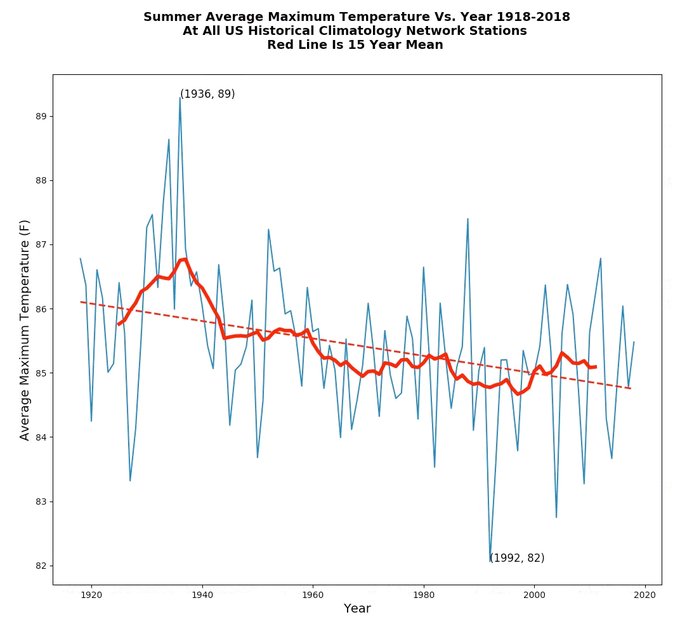
The figure above, showing a cooling trend in the United States, was posted by Steven Goddard (aka Tony Heller) on his blog with the remarkable title of "The Deplorable Climate Science Blog" (actually there is a slightly different one on the blog, right now, but it is simply a difference in the smoothing procedure). The author claims that this graphic is based on real data and that turns out to be true: but is it a honest graph?


The world is becoming more and more complicated. And the more complicated it is, the more difficult to understand it becomes. And there appear more and more opportunities to deceive people: we are all swamped by the news and have neither the competence nor the time to verify what the media serve to us.

So, this August, Mr. Tony Heller, writing under the pen name of Steven Goddard, published on his blog the graph you see above, showing a clear cooling trend in the United States. Make no mistake, these are real data, or so they are said to be. And they do show that summers have been cooling. But what about heat waves we are experiencing nowadays? Just an impression, apparently, because the data say otherwise. Then, what about global warming? An illusion, probably a fraud.

The graph is having a certain diffusion in the social media. An earlier version was even picked up by James Delingpole in his Breitbart news site. It quickly became a growing meme, scoffed or cheered depending on the attitude of the people commenting on it. As usual, the debate on climate on the social media is little more than a shouting match. It took some work by an expert, Tamino, on his "Open Mind" blog to dissect the story of this graph and show the tricks behind it. Tamino's whole post is reproduced below.

Basically, Steven Goddard's post is a textbook example of two well-known propaganda methodsCarlo Kopp describes the technique called "deception by omission" noting that it works when "the victim has poor a priori knowledge or no a priori knowledge or understanding of what the attacker is presenting to be a picture of reality" He also notes that deception by omission is often accompanied by "deception by spin" which consists in presenting only the information favorable to a certain viewpoint of a certain issue.

Note that neither deception by omission nor deception by spin require lying. It is all a way to present (or not to present) the data. This is what Goddard does, carefully choosing the data available on the NOAA site and presenting only those supporting the idea that the US has been cooling, not warming, during the past century or so. That's just not true, but the trick of these things is the ability to demonstrate a wrong thesis by using real data.

And that's what is truly impressive: how little it takes to deceive people. All that was needed to create a wholly new alternate reality was some patience and a high school level ability to manipulate data. No need for Goddard to be a government agent or to be paid by the PTB. All he needs is to be a lone troll with a stone ax to grind.

Now, stop for a moment and think: what if the real spooks were to engage in deceiving us for good? I mean, governments have resources and competencies in propaganda infinitely larger than those of a single person. What could they do to us if they were to direct us to a completely wrong perception of reality? Do you remember the story of the "weapons of mass destruction" at the time of Saddam Hussein? Now they can do much better than that. Yes, they can deceive us. And probably they do - they are doing that right now.

So, what's happening? The anthropologist Roy Rappaport spoke about "diabolical lies," defined as lies which tamper with the very fabric of truth.  Maybe our whole civilization is being destroyed by lies, diabolical or not, and we desperately need a new epistemology to rebuild trust in our institutions and in ourselves as human beings. This is the task that the early Christian thinkers had engaged in at the time when another civilization, the Roman one, was being destroyed from inside by the very truths it had been built on - by then become diabolical lies. As Poul Anderson said, "all evil is rotten good" and that may well describe our situation.

At this point, I can only propose to you to read Tamino's post, below. At least, it clarifies a section of our perception of the universe.

___________________________________________________________________

USA Temperature: can I sucker you?


Suppose I wanted to convince people that temperature in the USA wasn’t going up, it was going down. What would I show? Let’s try yearly average temperature in the conterminous U.S., also known as the “lower 48 states” (I’ll just call it “USA”):


Well that won’t do. It shows that temperature has been rising, not falling. By the way, I’ve included two trend estimates. The blue straight line is a linear trend estimate and it’s going up. The red curvy line is a nonlinear trend estimate, it has gone up and down and up, and is now rising fast. Scary fast. That definitely won’t do.

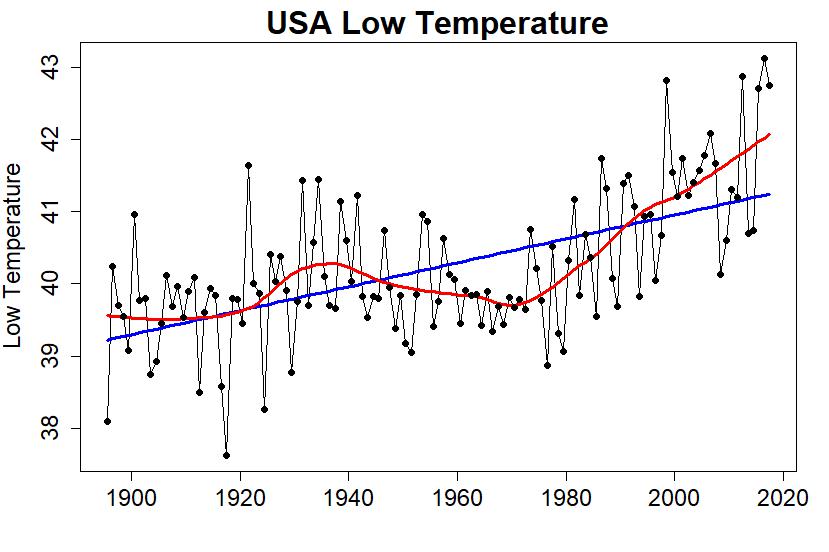
But wait! The temperature shown is the mean temperature, which is the average of the high and low temperatures. What if I tried just low temperatures?


That won’t do either. Scary fast.
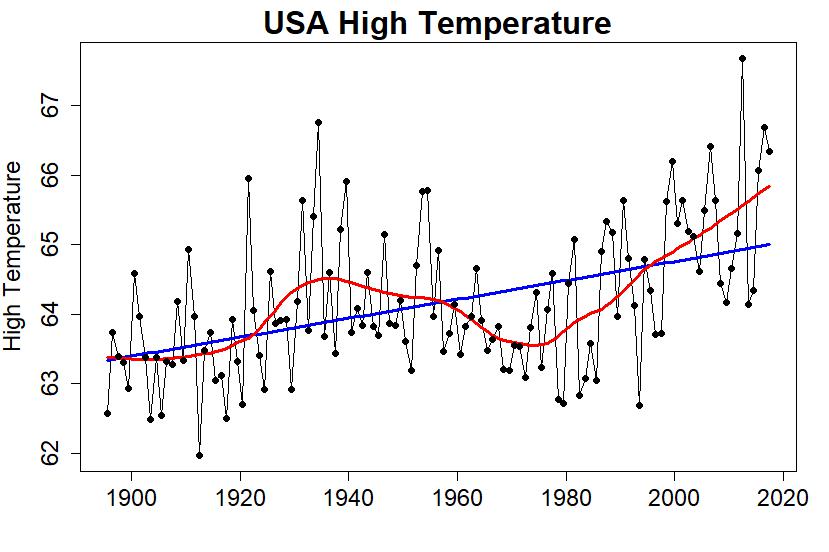
How about high temperatures?


That still won’t do, but it’s a little better. There’s a more pronounced hump in the 1930s — that’s the dustbowl era. Could I maybe make the most of that?

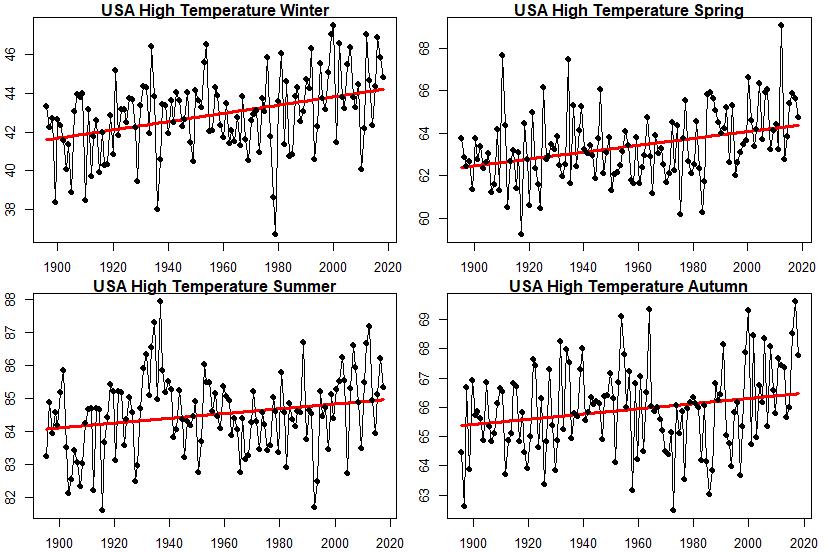
Let’s try this: look at high temperature during the different seasons of the year. After all, we know winter has been warming faster than summer, maybe summertime only — or maybe at least one of the seasons — will give a more useful “sucker people” picture. Here are the average high temperatures for all four seasons separately:


Now we’re getting somewhere! Summer high temperature has still been increasing overall, but that hump during the 1930s (the dust bowl era) is far more pronounced. Maybe I could make something of that?

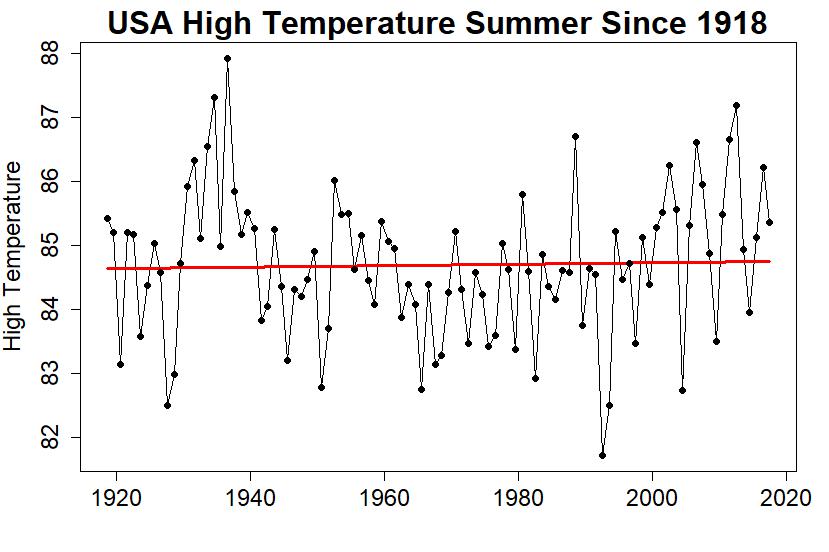
Perhaps I could just get rid of some of the data I don’t like. I can’t get rid of the most recent stuff — then people will figure out I’m trying to sucker them. How about I get rid of some of the early stuff? I’ll start with 1918, instead of starting when the data actually start (1895). That leaves this:


Finally! I’ve got a graph that looks like there’s nothing to worry about, where the linear trend is so small you almost can’t tell it’s still (barely) rising, and I only had to pick one of 12 possible combinations (mean/high/low temperature over winter/spring/summer/autumn) and leave out the early data to get it. Clever.

Even so, the trend is still going up even if just barely. And that’s the linear trend; the nonlinear trend looks like it might be rising noticeably lately, maybe even getting close to as hot as the summer of the dust bowl era. Could I fix that?

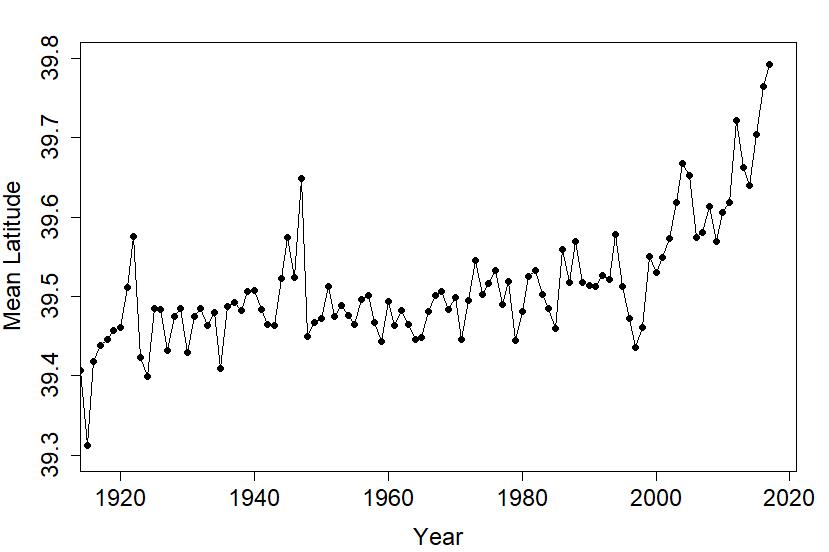
Of course I can! Instead of using the USA temperature data from the “experts,” those people at NOAA (the National Oceanic and Atmospheric Administration) who think they’re so good at it just because they’ve spent decades studying all that “math” and learning how to do it “right,” I’ll just take the raw data and form a simple average. Those NOAA people will tell you that isn’t right, that over the years new stations have come online and old ones have retired so you have to take that into account. They’ll talk about fancy-schmancy math stuff like “area weighting.” That’s all just NOAA tricks, aren’t they just a bunch of frauds? We can completely ignore the fact that over the years the average location of all the contributing stations has moved slightly northward to colder territory:

Heck we can completely ignore everything that they’ve learned about how to do it right … mainly because if we just take a simple, naive average we’ll get what we want.

There’s a graph going around the internet from Steve Goddard a.k.a. Tony Heller, claiming to show that temperature in the U.S. has been declining, using only high temperatures, using only summertime temperatures, using only data since 1918, based on a simple average without taking into account new stations coming online or old stations retiring or area-weighting or any of that “expert” stuff:


Imagine that.


Monday, February 5, 2018

What if we could REALLY convince the public that climate change is a threat?


Maybe one day some really gigantic-awful-horrible-monstrous-humungous climate related disaster will hit us. And that, at that moment, people will stop playing the boiling frog and will be forced to admit that climate change is real and we have to do something about that. 

Unfortunately, plenty of gigantic-horrible-etc. disasters have already hit us, but the public doesn't seem to have taken notice. But never mind, we might be hit by the really big one. And, if it happens, do you think people will come to the scientists and tell them "we are so sorry, now we understand you were right all along"?

I have the impression that it will be rather something like what you see in the clip, below. It will be something like what the woman says, "God is going to destroy this Earth and there is nothing you silly scientists can do about that with all your scientific blah-blah."

And I have this terrible feeling that she may be right.


Video from "Ars Technica")


Thursday, January 18, 2018

How to convince the public of the danger of anthropogenic global warming


Last year, the vagaries of life led me to chair a commission charged with examining the candidates for the admission to the Italian Chemists Association. It was a rather formal exam that was supposed to provide the successful applicants with the legal status necessary, for instance, for certifying chemical analyses. Overall, the applicants did poorly, but one of them, a young lady, did much better than the others. So much that I thought I could encourage her to do even better. So, let me tell you about a question I asked her during the examination.


Me. Dear candidate, I would like to conclude this exam with a question that may be a little outside your area of expertise, but which I think will give you a chance to show your understanding of some basic concepts of chemistry. The question is: can you propose an experimental test that would prove that human-generated greenhouse gases are warming the Earth?

Candidate...............................................................................................................................................................................................................................................................

Me. It is not such a difficult question. I am only asking you to apply to the problem what you know of chemistry and of spectroscopy.

Candidate...............................................................................................................................................................................................................................................................

Me. Let me help you. Maybe you can start by telling me something about the thermal effects occurring when you expose an infrared active gas to infrared radiation.

Candidate...............................................................................................................................................................................................................................................................

Me. I am sure that you heard about global warming. Can you tell me what is the mechanism of the so-called "greenhouse effect"?

Candidate..........................................................................................................................................................................................................................................................

Me. Well, I guess that it is time for the commission to retire to examine your application. You did well with the other questions, so don't worry.

____________________________________________


Now some comments:

- The question of the "proof" that humans are causing the observed warming is not an easy one to answer and indeed is a favorite question by anti-science trolls. For instance, this recent post on "Carbon brief" claims to bring this proof but if you examine it carefully, you'll note that it only proves the existence of a correlation between the CO2 concentration in the atmosphere and the temperature. Which is a strong indication in favor of the current interpretation of global warming but, strictly speaking, not a proof. Correlation, as it is well known, doesn't mean causation. Conversely, you can find a good discussion on the empirical evidence of anthropogenic global warming based on spectroscopic measurements in this post on skeptical science. This is what I hoped the candidate would have been able to devise by herself.

 -  The students that come out of our classes are persons who know so much about so little that, if the trend continues, soon they'll know everything about nothing. The young lady I had been telling you about went through five years of training in chemistry at a high-level university (at least in terms of Italian standards). Yet, she had learned strictly nothing about climate change, an issue that involves the physical survival of humankind (and of that young lady as well). The decline in the preparation of students is a qualitative consideration of mine, but it is confirmed by almost everyone I know who is involved with what we call "higher education," and not just in Italy. How it has happened that universities transformed themselves from enlightening institutes into brain-dumbing machines is beyond me to understand. But I think it is, mostly, because our society doesn't reward people for being smart (unless it is Putin's fault - as always).

-  Climate science is difficult. The basic principles of climate science are not so difficult, but their implementation in the real world is devilishly complicated. Try to answer the question of why the stratosphere cools when the troposphere warms and you'll see what I mean. Devilish, indeed. So, when I read someone proposing to educate the public in order that they may understand climate science, well, it is a laudable idea, but so difficult to be impossible. There are some valiant efforts, such as the "climate kids" site created by NASA, but, really, most of the well-intentioned people who are convinced that anthropogenic global warming is real, think so because they trust the scientists. It is mostly a question of trust, not of data.

- Our strategic plan seems to have been, so far

1. We educate the public in science and in Climate Science in particular.
2. A majority of people understand that Anthropogenic Climate Change is real and dangerous.
3. They elect wise and enlightened leaders.
4. The world leaders act swiftly and effectively against Climate Change.
5. The problem is solved.

Hmmmmmm . . . .


Thursday, August 31, 2017

The Conspiracy of the Stonecutters: is Climate Science Denial going through a Seneca Cliff?


In a recent article on WUWT, Tim Ball describes climate science as the result of a "cabal" devised by the Club of Rome as a way to promote world socialism. He is confusing the Club of Rome with the sect of the "Stonecutters" of "The Simpsons". They really seem to be running out of serious arguments. 


Sometimes I think about how difficult it must be to be a climate science denier. I have been studying climate science for years and I can tell you that it is tough stuff and that climate scientists are smart people who have been building their competency over decades of work. Climate science deniers can have a good time telling each other their beliefs in their sites frequented only by like-minded people. But only those of them suffering from a near terminal Dunning-Kruger syndrome can think they can debate a true climate scientist on climate science. No way.

So, I can almost sympathize with climate science deniers: they face a nearly impossible task. And one good example of their plight is a recent article by Tim Ball on WUWT. Worth reading because it is, in a way, honest. Ball writes (emphasis mine):

I know from experience that after you explain to an audience what and how the anthropogenic global warming (AGW) deception was achieved the next question is inevitable. What was the motive? Unless you answer that question, people become a little more skeptical but remain, at best, undecided. They can’t and don’t want to believe that scientists would be involved in anything nefarious or even misleading. They can’t believe that so many of them were misled, which is why the 97% consensus claim was so effective.

Truly pathetic, isn't it? Put yourself in the shoes of poor Tim Ball. Imagine that you are trying to explain to a group of adult people that, say, the Tooth Fairy really exists and that she has been kidnapped by Santa Claus who keeps her hidden in a secret igloo near the North Pole. Something like that. Wouldn't that be difficult?

Ball doesn't seem to be touched by the idea that he is dealing with normal people who may well be right in their skepticism. So, he proceeds with a desperate attempt to demonstrate the undemonstrable. He says that, clearly, people are skeptical about the idea that tens of thousands of scientists are all conspiring against the American people but, hey, this is not a "conspiracy", it is a "cabal", defined as "A small group of intriguers, especially one formed for political purposes."

What is the difference between a conspiracy and a cabal? Basically, none, except in the mind of Ball who seems to think that by using the term "cabal" he has dodged the objection that a conspiracy on climate would have to be too large to be kept hidden. He doesn't seem to realize that the problem remains unchanged: how is it possible that so many scientists in the world are involved in the conspiracy...er, cabal, and nobody ever talked about it?

Never mind that, Ball tries to substantiate his idea by digging into the corpus of legends that arose in the 1970s after the publication of "The Limits to Growth", the much maligned 1972 report to the Club of Rome. At that time, the Club was accused of the worst possible things, including to be initiating a conspiracy to take over the world. None of these accusations could ever be substantiated and, clearly, if the Club had really been planning to take over the world, they haven't been very successful in almost 50 years of attempts.

But Ball is undeterred; according to him, the Club of Rome is the culprit of everything. He is confusing the Club with the "Stonecutters" of "The Simpsons". But why would the Club be pushing their cabal? Obvious: they wanted (and they still want) to promote world socialism. Again, if that was the plan, they don't seem to have been very successful. Don't you think it would be easier to convince people that the Tooth Fairy really exists?

If you followed me up to here, I guess that, like me, you don't know whether you should laugh or get angry. Surely, it is such a pathetic story that one is tempted to laugh. But, then, if you think of the kind of disaster we are facing (and the Hurricane Harvey is only one of them), you see that people are suffering and dying because of climate change. And you may well get angry at people like Tim Ball are arguing that nothing should be done because they attribute everything to an obscure cabal devised by a group of white-haired people who collected in a smoke-filled room nearly 50 years ago in order to promote socialism.

Hopefully, a Seneca Cliff in the public opinion on climate will take care of this group of conspiracy theorists.


The most recent (March 2017) Gallup poll results on climate change. This can be seen as a "Seneca Cliff" in reverse. A hard core of unbelievers maintain their position, but the overall opinion is clearly tilting in the direction of thinking that climate change is real and it is a serious problem. 


For a detailed rebuttal of Tim Ball's post, see "The Hot Whopper"


Sunday, December 18, 2016

There is only one culture: bringing back science into the fold of humanism


Yesterday, I was invited to give a talk at a public meeting on the usual themes: climate change, resources, pollution, and the like. This time, a question I received from the audience caused me a small enlightenment that I am describing here as I remember it (h/t Lorenzo Citti for having organized this interesting meeting) (image source)


Thanks for this question - it is a very interesting question: "are we teaching enough science to our children?" And I can tell you that it is much more than an interesting question, it caused some small earthquake in my mind. Truly, I had a flash of understanding that I had never had before and right now I completely changed my view of the world. It happens to me: the world changes so fast and I do my best to follow it.

Your question is so interesting because it has to do with the idea that there are two cultures: a scientific one and a literary one. As a consequence, some of us think that instruction is unbalanced in one or the other direction: maybe we teach too little science to our children, maybe too much. The whole idea goes back to someone named Snow who proposed it in the 1950s. He was not wrong, I think, but there were problems with the idea. The concept of the two cultures can be intended as meaning that we need somehow to bridge the gap that exists in between. Or, and I think that's what happens most often, it can be interpreted as meaning that one of the two cultures is superior to the other. That can generate a competition between the two and divide people into two different tribes: literates and scientists.  We are very good, as human beings, at dividing ourselves into separate tribes fighting each other. And that's bad, as you can imagine. Actually, it is a disaster. Snow was a scientist and he decried the scientific ignorance of literates. On this, he was right but in the long run the result was that literates despise scientists as illiterate boors and scientists despise literates as feebleminded ignorants.

Now, I had been thinking about all this and, as I said, today I had this flash that focused my mind on a concept. I think we have to say this clearly: this story of the "two cultures" is an idiocy. It must end. There is only ONE culture, and that's what we may call "humanism," if nothing else because we are all humans. That is, unless someone in the audience today is an alien or a droid. In such case, would you please stand up? No......? Apparently, we are all humans in this room and so we call our culture "humanism" (or, sometimes, "arts and humanities")  How else would you call it?

So, there is really no reason for considering modern science a separate culture rather than part of the human culture that we call humanism. I am saying this as a scientist: science is part of what I would like to call human "sapience", what the ancient called "sophos"; that we translate as "wisdom" "sapience," or "knowledge." The term philosopher just means someone who loves sapience. And that's what we are; scientists or non-scientists, the very fact that we are here today, engaged in this discussion. means that we love knowledge: we are all philosophers. And that's a good thing to be; sapience is what makes us human and that's why we speak of humanism.

So, why do science and scientists sometimes pretend to be a separate branch of knowledge? Well, it has to do with another concept that comes to us from the Greek philosophy. It goes under the name of techné that we may translate as "craftsmanship" and that originates the modern term "technology". Here lies the problem.

Five minutes ago, someone asked me about hydrogen powered cars. I answered that they have been a complete failure and that was it. But I ask you to go a little more in depth with this question. Why do many of us think these things are important: hydrogen cars, a hydrogen powered economy, and lots of strange things we hear as proposed by scientists and that are said to be able to "solve our problems." Why is that? There is a reason and it goes back to a period in history when scientists found that they were able to devise some clever gadgets: you remember the "atomic age", right? It started more or less from there. Then there was the space age, the information age, and so on. There was this great wave of optimism when we really thought that science would bring us a new age of happiness and prosperity - it was the triumph of technology over everything else. The triumph of techné over sophos.

That period of optimism is still with us: anything that you say that disputes the sacred cow of economic growth is answered with "the scientists will think of something." Climate change? Resource Depletion? Pollution? Not really problems if you have the right gadget to solve them. And this brings, sometimes, the question "do we teach enough science to our children?" It is a result of the opinion that, in order to solve our problems, we need more gadgets and that, in order to have more gadgets, we need more science and that, in order to have more science, we need to teach more of it to our children. I think this is not a good idea. I think we have too many gadgets, not too few. And all these gadgets either don't work or cause more problems than those they are supposed to solve. Think about that: we wanted flying cars and we got killer drones, we wanted freedom and we got body scanners, we wanted cheap energy and we got Fukushima, we wanted knowledge and we got 140 characters, we wanted a long life and we got Alzheimer. The more gadgets we have, the worse the situation becomes.

Don't get me wrong: I am not saying that technology is bad in itself. We all live in heated spaces, we use electricity, when we have a headache we take an aspirin, and we use a lot of useful devices in our everyday life. I am not telling you that we should run to the woods and live as our stone-age ancestors - not at all. Being good craftsmen is part of being human. It is just that this fascination with gadgetry is generating multiple disasters, as we have been discussing today: from climate change to all the rest. One of these disasters is the decline of science, with scientists often turned into those raucous boors who feel they have to send out a press release every month or so to describe how their new gadget will save the world.

It can't work in this way. We need to take control of the technology we use, we need to stop being controlled by it. And I think the first step for retaking control is to bring science back into the fold of humanism. I am saying this as a scientist and as someone who loves science - I have been loving science from when I was a kid. Modern science is a beautiful thing; well worth being loved. It has been telling us so much that's worth knowing: the history of our planet, the origin and the fate of the universe, the thermodynamic engines that make everything move, and much more. We need to see science as part of the human treasure of knowledge and we need to love knowledge in all its forms. And, as I said at the beginning, someone who loves knowledge is a philosopher and that's what we can all be and we should be; because it is our call as human beings. If we want to save the world, we don't need gadgetry, we need to be what we are: human beings.


See also this comment on my "Chimeras" blog

Tuesday, April 7, 2015

Why democracy doesn't work (and how to fix it)


(image source)

This post is not supposed to be a proposal for reforming democracy. Any real reform seems to be impossible in a world where the main (and perhaps the only) rule seems to be "don't even think of changing anything important" (DETOCAI). This said, I noticed a recent article by Dean Burnett on "the Guardian" that attempted to answer the question of why people keep electing idiots. That set my mind in motion and I came up with some considerations based on the effect of "public relations" (PR) on the democratic process. I don't claim to be an expert in PR, but, if you deal with climate change, as I often do, it is impossible to miss the role of PR in a debate that has been based on lies and exaggerations aimed at demonizing science and scientists. So, this post is mainly a reflection of mine on the importance of PR in our world.


There seems to be no category more badly vilified and despised than that of politicians. Yet, theoretically voters can vote for whoever they want; why do they keep electing people they despise? (It sounds like the old joke: 'a masochist is someone who likes the things he hates'). Are most voters masochists; or what?

I think there is an explanation for this apparently bizarre behavior of voters. It has to do with the PR methods used in election campaigns and, in particular with negative advertising that has generated a general self-inflicted vilification on all politicians. Let me explain.

In public relations, there are two basic approaches to promote one's ideas or products: a negative one and a positive one. The negative approach (demonizing your opponent) is usually much more powerful and more effective than the positive approach (idolizing your friend). There have to be deep psychological reasons for this, but it is the way things are (*).

The problem with negative advertising is the same you have with chemical weapons: it works wonders, but it can backfire. This is something that the armies of the first world war armies learned when the wind blew back on them the gas they had directed against their enemies.

Indeed, negative ads are so powerful - and so dangerous - that they are almost never used in commercial advertising (**). Think of what would happen if, say, Pepsi were to mount a campaign based on the accusation that Coke gives you cancer. And imagine that Coca Cola were to retaliate by saying that Pepsi causes heart attacks. Not a good idea, obviously: would anyone ever try a soft drink again? It is a well known principle: if you throw it at the fan, it will spread all around.

But in politics? The same constraints do not apply. In politics, the market size is fixed: it is a seat in parliament (or in the city council, or whatever). It doesn't matter how many people show up at the voting booths, someone will always get that seat. For a politician, negative PR carries no risk of shrinking the market, hence, it is a fundamental tool. It is well known: vilifying your opponent works wonders (***). But, of course, if everyone uses it the result is the generalized demonization of all politicians. Again, you see the effect of throwing it at the fan; it does spread all around.

So, it is likely that the widespread mistrust of politicians is the result of a long series of demonization campaigns that have led the public to conclude that all politicians are thieves, liars, psychopaths, sex maniacs, bumbling idiots, and the like. Maybe some of them deserve to be defined in this way, but the problem is that these vilification campaigns keep away honest people from running. And this is the problem with democracy, in a nutshell.

Can we do something to improve? In principle, yes. After all, most governments have enacted laws designed to protect customers from misleading  advertising. Often, ads disparaging a competitor's product are forbidden and even comparative advertising is strictly regulated. But no such rules apply to politics, where everything goes and arriving to similar regulations seems to be just unthinkable.

Could we use a different tactic? Could we make negative campaigning a bad idea for those who use the method? We could, for instance, make the political "market" more similar to the commercial market in the sense that the total number of seats in parliament is like the market size for a product. That is, the number of seats in parliament could be proportional to the number of people who actually vote. So, if only half of the voters show up, then only half of the seats are assigned. The remaining ones go vacant, or maybe are assigned by a national lottery. In this way, politicians would be wary of using tactics which risk to reduce the market size (i.e. the number of seats assigned).

So, we could think of ways to fix democracy. But the problem is not that there is anything wrong with democracy. The problem is with PR - and negative PR in particular. We are not going anywhere in any field until we understand the awesome power of negative PR on our perception of the world. It is truly a weapon of mind destruction, witness how effective PR has been in attacking climate science and climate scientists and in convincing a large number of people that climate change is a hoax.

There is only one good weapon against this kind of PR: it is remembering that, as Baudelaire said, "The devil's best trick is to persuade you that he does not exist."


________________________________________________

(*) about the higher power of the negative, see for instance "Bad is stronger than good".

Baumeister, Roy F.; Bratslavsky, Ellen; Finkenauer, Catrin; Vohs, Kathleen D.
Review of General Psychology, Vol 5(4), Dec 2001, 323-370http://psycnet.apa.org/index.cfm?fa=search.displayRecord&uid=2001-11965-001

(**) A well known case of negative commercial advertising may be the "where's the beef?" campaign used by Wendy's in 1984 to disparage the sandwiches marketed by their competitors, McDonald's and Burger King. Note, however, that it was not really a negative ad; it was, rather, a comparative ad ('our hamburgers are bigger than theirs'). Nevertheless, it was it was aggressive enough that it was picked up by Walter Mondale who successfully used the same slogan against his adversary in the primaries of that year.

(***) About negative campaigns in politics, there is plenty of documentation on the Web. You can start, for instance, from this article in Wikipedia. 


Who

Ugo Bardi is a member of the Club of Rome, faculty member of the University of Florence, and the author of "Extracted" (Chelsea Green 2014), "The Seneca Effect" (Springer 2017), and Before the Collapse (Springer 2019)