Showing posts with label resources. Show all posts

Saturday, September 16, 2017

The Donut Has a Hole in The Middle: Kate Raworth Speaks at The Summer Academy of the Club of Rome in Florence


Kate Raworth speaks at the 1st Summer Academy of the Club of Rome in Florence, Sep 2017


Kate Raworth is best known, nowadays, for her book titled "Doughnut Economics, Seven Ways to Think Like a 21st-Century Economist." In Florence, she gave a very professional presentation that was very appreciated by the participants. But I remained unconvinced.

The gist of Raworth's idea is that, historically, economics as a science has been shaped in such a way to look like physics; considered by the founders of economics as an example to follow. According to Raworth, this interpretation has distorted economics, making it unable to describe the real world and to do anything to avoid the troubles we are facing, from inequality to financial collapses. 

This is a correct position: economics tends to have an approach similar to that of the physics of 19th century (or even older). It is an approach that works well for simple, linear systems, such as Newton's apple when it falls down. But Newtonian physics cannot describe the biology of an apple, just as it can't describe the behavior of the complex, non-linear system we call "the economy". 

So far, so good: a lot of people are complaining about the shortcomings of the current interpretation of Economics; the problem is what to replace it with. It would seem to be obvious to use the modern approach based on the science of complex systems, sometimes called "biophysical economics", pioneered by the authors of the "Limits to Growth" study of 1972. It is not an easy approach, but it seems to be bringing results

The problem with Raworth's book - and with her speech - is that it correctly identifies the problem, but provides no credible alternative. The book is full of qualitative diagrams and discoursive suggestions, but few real world data. Many of the recommendation that Raworth provides are attractive, but they are never quantified, just as the "doughnut" that gives the title to the book. It is a nice diagram, but how to apply it in practice?

As I said, I remain unconvinced about this doughnut idea. It seems to be lacking something fundamental; maybe it is because it has a hole in the middle. 

In the following, I reproduce my previous comment on Raworth's book. 


by Ugo Bardi

Doughnut Economics: a step forward, but not far enough


Doughnut Economics, by Kate Raworth (Chelsea Green, 2017) is an interesting book that goes in the right direction in the sense that it promotes a circular economy, But it leaves you with the impression that it missed that extra step that would have led it to define the goal in the right way. Bridging the gap between standard economics and biophysical economics is still far away.

So, what is this "Doughnut" that gives the title to the book? Initially, I had imagined that it was supposed to be a sort of mandala representing the concept of circular economy. But that doesn't seem to be the case: circular mandalas often represent the cyclical movement of a wheel, but the doughnut doesn't (as, indeed, most doughnuts are not supposed to be used as wheels). Here is how it is represented in the book:
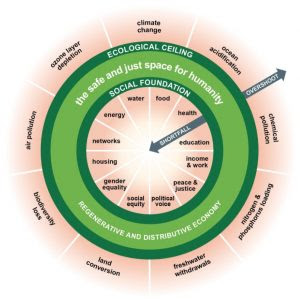

It is described as "a radically new compass for guiding humanity this century." Ambitious, to say the least, but how is that supposed to work, exactly? Maybe I am missing something, but I not sure I can understand why the numerous concepts appearing in the figure should be arranged in a "doughnut."

The problem with the doughnut is not so much understanding why it is shaped like a doughnut, but what it lacks. Look at the outer ring; you will see 10 sectors, all related to pollution: climate change, ocean acidification, chemical pollution, etc. Something is conspicuously missing and it is not a minor element of the overall picture. It is natural resources and, in particular, non-renewable resources (*)

Natural resources, their depletion, and the related concept of "overshoot" are not just missing from the doughnut, they go mostly unmentioned and unnoticed in the whole book. To give you an example, Raworth mentions only once the 1972 study "The Limits to Growth" that was the first to pinpoint the resource problem. In a discussion of less than two pages, I think her position can be summarized by the following statements:
Mainstream economists were quick to deride the model's design on the basis that it underplayed the balancing feedback of the price mechanism in markets. If non renewable resources became scarce, they argued, prices would rise, triggering greater efficiency in their use, the wider use of substitutes, and exploration for new sources. But in dismissing World 3 and its implied limits to growth , they too quickly dismissed the role and the effect of what the 1970s model simply called pollution ... World 3's modeling of pollution turned out to be prescient.... recent data ... find that the global economy seems to be closely tracking its business-as-usual scenario.
As it is often the case in this book, Raworth's statements need some work to be interpreted because they are always nuanced; if not vague, as when she says one should be "agnostic" about economic growth (**). Here, the interpretation seems to be that The Limits to Growth may have been right, but only because it took into account pollution. Instead, its treatment of non-renewable natural resources was wrong because depletion can be completely neutralized by market factors. Raworth doesn't seem to realize that she is contradicting herself, here: if the "business as usual" scenario produced good results in terms of comparison with the real world's economy, it is because it contained depletion as a major constraint. World 3 could also be run in the hypothesis of infinite natural resources, with pollution the only constraint, but the results would not be the same.

That's the thread of the whole book: natural resources are not a problem; we should be worried only about pollution. Raworth doesn't link the concept of the circular economy to recovering non-renewable resources; she proposes only in relation to abating pollution, with the corollary that it also brings about also better social equality. This is not wrong; it is true that a cyclical "regenerative" economy would be able, in principle, to reduce or eliminate pollution. Still, it is curious how the question of mineral resources is so conspicuously missing in the book.

Kate Raworth is described in the book flap as a "renegade economist", but she still reasons like an economist. The idea that the price mechanism will make depletion always irrelevant is old and it goes back to the 1930s, when the so-called "functional model" was presented, stating exactly what Raworth describes. The idea is that market factors will always re-adjust the system and magically make depletion disappear. By now, the functional model is deeply entrenched in the standard economic thought and there seems to be no way to dislodge it from its preheminent position.

The interesting point is that not only economists tend to dismiss depletion as irrelevant. In recent times, the whole "environmental movement" or the "Greens" have taken exactly the same position. All the debate about climate change is normally based on the supposition that minerals, and in particular fossil fuels, will remain cheap and abundant for the current century. If this is the case, it makes sense to propose to spend untold amounts of money for carbon capture and sequestration (CCS) rather than for renewable energy. It goes without saying that, if this assumption turned out to be wrong, the whole exercise of CCS, if it were undertaken at the necessary scale, would turn out to be the greatest resource misplacement of resources in human history, possibly even worse than nuclear energy.

Why is that? As a puzzle, it is difficult to solve. In principle, resource depletion and its negative effects would seem to be easy to understand. Easier than the complex chain of physical factors that leads from the emission of greenhouse gases to disastrous events such as sea level rise, heat waves, hurricanes, and the like. Maybe it is just a question of the lifetime of memes. The meme of depletion started before that of climate change and it is now in its downward trend. Whatever the case, we seem to be locked in a view of the world that misses some fundamental elements of the situation. Where this special form of blindness will lead us is all to be seen. 

Getting back to Raworth's book, despite the criticism above I can also say that it is worth reading for its broad approach and the wealth of concepts it contains. Its discussion on how the science of economics came to be what it is nowadays is, alone, worth the price of the book. Although it misses part of the problem, it may open up new views for you.


(*) You may also have noticed that the concept of "overpopulation" is missing in the doughnut. On this point, Raworth maintains in the text that if people are given the possibility of having a life free of deprivation, they won't reproduce like rabbits - a concept on which I tend to be in agreement; even though its practical implementation in the current world's situation is problematic, to say the least.

(**) The idea of a "zero growth" or "steady state" society would seem to be a fundamental feature of a circular economy, but it is barely mentioned in the book

Wednesday, June 7, 2017

Interview with Ugo Bardi: Climate, Fossil Fuels, Resources and All That

The MEDEAS project team at a recent meeting in Barcelona. At the center, the project coordinator, Jordi Solé, Another group of well-intentioned people engaged in saving the planet. Yes, we know it is difficult: we are doing our best. 


This interview was recorded this February and is reported here from the site of the European Project MEDEAS, only minimally edited. Take into account that none of the people involved (interviewers and interviewed) are native English speakers and you can understand why the grammar and the syntax are, well, let's just say "not perfect". Then, as in all non-edited interviews, the flow of the concepts is also far from being perfect. However, I thought to reproduce it here because it contains much of what I have been trying to say, lately. Maybe you'll find it interesting (U.B.)


On 17th February 2017, during MEDEAS first General Assembly in Brno, Czech Republic, Ugo Bardi from INSTM, partner of MEDEAS Project was interviewed by Mikuláš Černík for Deník Referendum, an independent online newspaper focused on social and environmental issues. The interview discussed how science nowadays can address challenges as climate change and possible limitations of resources for the transition to a low-carbon economy. The whole interview can be found below in English, while the original version is published in the newspaper’s webpage


INTERVIEW WITH PROF. UGO BARDI (UNIVERSITY OF FLORENCE, ITALY), IN BRNO, CZECH REPUBLIC (17.2.2017) DURING MEDEAS GENERAL ASSEMBLY.

Your main topic is resource depletion. Since the release of your book on the Limits to Growth, how has the situation changed?

The thread that runs through everything I study is resource depletion in the broadest sense. You can restrict its sense to minerals, which is to take the core meaning, but then there is also climate change. Climate change can be seen as the depletion of the atmosphere’s ability to absorb greenhouse gases without overheating. So it’s also depletion—everything’s a question of depletion. And everything is a question of resources. People have spoken about limits to growth, which at one time was a very innovative concept, but these limits on growth derive from limits on resources, and that’s something we’re still working on.

You’re writing a blog called the Cassandra Legacy. How did you, as a scientist, decide it was necessary to write a blog?

Because many people speak about there being two cultures, humanist culture and scientific culture. And in my modest opinion, this is completely wrong. There are no two cultures, there is only one culture. And so a scientist should be within the limits as much as possible, should be a humanist as much as possible within the limits, should know something about hard science such as thermodynamics and physics, and so on. But unfortunately our world has fallen into the trap of overspecialization, which means that a lot of people study so much that eventually they know everything about nothing—which is the definition of a specialist. So we have specialists who know absolutely everything about nothing, which is a little useless in my opinion. So we need a modern view of science, and this is a concept that some of us are working on. It’s a new conceptualization that tends to deemphasize what we call “reductionist science”. To emphasize what we call “systemic science”, which looks at changes at the whole-system level. Because if you are a reductionist, you would say What is the problem? I’m slowly running out of fuel for my car. So you say, No problem, hydrogen will fix everything. If you follow a systems approach, you say well, okay, maybe hydrogen is a way to change the system, but how will the system react? I think that’s a fundamental part of the MEDEAS project we’re working on. To take a systems approach. We have a valuable collaborator in Brno as well. We’re sure we can get this done.

Do you think that, as a scientist, when you publish a scientific paper, it has any impact on a broader readership and on the general public and policymakers? How do you perceive the relationship between science and politics?

There is no difference. Scientific communication is just one of many kinds of communication. And that has to do with the fact that we communicate within a system. The world—call it the mediasphere or the cybersphere or the brainsphere—the world is a huge system in which ideas, comments, novelties, the news and everything moves and competes in a space. All these things grow, they evolve, they change and they take over spaces, and that’s the most “systemic system”, if you like. It is hugely interesting to study, and that’s what we’re doing. You might not have noticed, but my coworkers and I are developing models for dissemination, for spreading ideas in the websphere, the world wide web, in the mindspace. What we’ve discovered is that your message—you want to know the theory of messaging my coworkers and I are developing? Messages are made up of two parts—the message itself and the communicator who sends it. So the message must be simple enough that it can reproduce, but that’s not enough. The message has a signature that makes it recognized as ‘self/nonself’ and if it is not recognized as “self” it is discarded and the whole attempt to transmit it is useless. So what you do when you send the message is you send yourself. And that’s it. You don’t always hit people with facts. The relevant fact is you, because you are relevant. If you are relevant, you send a message which is understood. You need to understand who is sending the message, you need to understand what a person is. So if you don’t know what you are, you can’t send the message.

This leads me to the next question. Don’t you think that, when scientists put out messages to the public, the public may believe in their correctness and yet feel that what they say is overly pessimistic? That they’re not enough to make them change their behaviour? I’m talking about alarmism. Some people argue that when you scare people too much, as a consequence they won’t be willing to change their behaviour. Do you agree?

This is because most scientists are children when it comes to communication. They know very little, nothing in this field. I won’t use the term ignoramus, but the definition is that when you don’t know anything about something, you are an ignoramus on that topic. Scientific education doesn’t cover communication. So when you try to do work in a field you’re ignorant of, you may achieve zero. And you’re likely to make mistakes. Just think of riding a bicycle for the first time. You don’t know what a bicycle is, what pedals or brakes are, and so on. You don’t really know how a bicycle works. You fall off the bike straightaway. This is what happens when scientists try to communicate all these pessimistic things about climate science to the public. They’re using the wrong communication model. Their message—its penetration—doesn’t depend upon pessimism or optimism. This is a mistake. Think about Christianity. What is the message? It is that there will come an apocalypse. And it is spread easily. Even though it’s predicting an apocalypse. Because Christians knew much better - the old, the ancient Christians, they knew how to promulgate their message. They were able to emphasize the messenger. If you’re willing to get eaten by lions, then the message is important for you, it carries weight. But you must be ready to be eaten by lions to demonstrate the message is real and that, I think, scientists are not willing to do for Climate Science. Maybe we don’t need to arrive to that point but the essence is the same - it doesn’t matter if the message is optimistic or pessimistic. The power is not in the message, it’s in the messenger. The messenger must be believable and this is the problem with climate science. Scientists have made a lot of mistakes and they are presenting a contradictory message. Some scientists say, “don’t worry, we have the solution: you don’t have to do anything” and maybe they start babbling about hydrogen or nuclear energy or whatever. Other scientist say, “well, you have to make sacrifices” and they talk about investing in double paned glasses, using bicycles and the like. But these two messages are not compatible with each other. And if the messenger doesn’t send a coherent message, he or she is not believed.

What about the term peak oil—which was much more widely used in the recent past than it is today. Could you tell us how this term has evolved in public debate?

It’s a good example of how to spread a message. Generally because the message was simple: just two words. “Peak oil”. It has a ring to it, it was interesting, and it was simple enough to spread. And spread it did. These messages have a cycle. They peak, and then they go down. But I think the spread of this message was successful in the sense that it was not only viral, but became part of our culture. Its greatest diffusion came around ten years ago. Then it lost popularity a bit because people had difficulty understanding the term. They see that oil isn’t expensive right now and think that’s because it’s abundant. But that changes. It’s like limits to growth. It was criticised, rejected, demonised, but it was a successful concept, because it is still with us. We debate it, maybe over a long period, but still we debate it. And that’s what we can do with messages. They don’t necessarily need to take over the world, but they remain with us. They can’t be ignored.

Could you also tell us something about the project you’re currently involved in? About MEDEAS; and how it is changing the debate?

MEDEAS is an extremely important project, as a next step after Paris. Paris COP21 told us what we should do, and it was a very good meeting with a huge impact because the communication was taken care of by people who knew what they wanted to do. To have a message which will take root, it must be simple. So Paris - we had thousands of people, hundreds of models, tens of thousands of scenarios, the whole climate science with uncertainties and things like that and final result was one number: 2 °C. You condense everything into something like a piece of genetic code which will then be unpacked. You send a little virus to the mind with a very tiny chink of genetic code. It takes up residency in your brain. It reproduces and grows.

So do you really think the Paris agreement is a step forward in tackling climate change?

Absolutely. It was a remarkable success because it was well packaged. But the numbers in it are not enough, because we don’t know how to achieve them. And that’s what MEDEAS is answering. We give you another number—how much it will cost? If we can afford it and the degree of sacrifice it entails. How much are you willing to pay for your survival?

Let’s imagine that we achieve a post-carbon future. Who will be the loser and who the winner in the transition?

Some scientists in the MEDEAS group have developed a concept they call Thanatia, which refers to a world not meant to be—one in which people have survived, but the planet has died in terms of minerals. This means there is no longer any ability to mine rare minerals, and these minerals are what allowed us to build our civilization. The result is a future that is completely different. There are no more mineral resources like oil and cobalt, because these mineral resources are concentrated—you can’t just find them anywhere you want. If you need something that you lack but someone else has, you may have to fight to get it. But in the future, this will no longer be done, because we will stick to resources that are abundant, like sunlight, silicon, aluminium, magnesium, etc. Society can be built in a locally-structured way that may give rise to less competition for resources and fewer wars.

In our country, the Czech Republic, if we want to achieve what was promised in the Paris agreement, we need to cut our coal consumption, despite its abundance as a resource. How would you advocate this position with the public?

I don’t think this is such a big problem. I mean, the Czech Republic is a very small part of the world and of what’s going on in the world. And if the world starts moving in a certain direction, the Czech Republic will follow. We have coal in Germany, in Poland, in Ukraine, and these regions are burning it. It has to be phased out slowly, and I think we are moving in that direction because the cost is really increasing. Coal is not as cheap as it seems. In the future, you won’t be able to afford to burn the coal, whatever the politicians may say. Mr. Trump said “we have a thousand years of coal” and this is an alternative fact, in other words, a lie. I think we will cease to burn coal sometime over the next decade or two. And hopefully we will do so because we have agreed to stop burning coal and also because we have agreed to deploy renewable energy and replace it.

So basically what you’re saying is, the sooner we make the move, the more we gain?

Yes, that’s correct. The change is going to take place anyway. People talk about problems and that’s bad. Once you say there are problems, you begin to think of solutions. But not all problems are problems, and not all solutions are solutions. If you remember the “Jewish Problem” at the time of Adolf Hitler, well, once you start to say the Jews are a problem, you start thinking of the solution, and the solution they found was a very bad idea – as we all know. So we don’t have to think in terms of problems/solutions – that may lead us to very bad ideas. Instead, we must emphasize change. That change is ongoing, and you have a choice: either you go along with the change, or you reject it. If you reject it, the change will change you, and you will not be happy but will be swept away by the change. In other words, you can solve a problem but there is no solution for a change. There is only one way to face change: to adapt to it.

Ok, thanks very much.

You’re not going to ask me anything about Italian football...?

Tuesday, February 21, 2017

MEDEAS: The Next Step after the Paris Climate Agreement


Jordi Solé, coordinator of the MEDEAS project speaks in Brno (Czekia) on Feb 15th, 2017. The European project MEDEAS has the ambitious goal of providing the tools necessary to put into practice the 2015 Paris agreement on climate


Let me start with something to dispel the confusion about what models are for. When you deal with complex, adaptive systems, models are NOT meant to predict the future. As John Gall said in his book on complex systems, "systems always kick back" - to which I may add, "and sometimes they kick back with a vengeance". (another way to express this concept is "forecasting always fails.")

But if dynamic models cannot predict the future, what are they good for? Simple, they are about being prepared for the future. Think of the Paris climate treaty of 2015. It was the result of millions of runs of various climate models, none of which claimed to predict "the" future. But these models are tools to prepare for the future; they tell you what may happen, depending on what you do. They are tools to shape political decisions. Out of all those runs, a goal was extracted, a setpoint, a number: "we don't want temperatures to rise of more than  2 °C and, for that purpose, there is a limit to the amounts of fossil fuels we can burn." It was a political decision that took into account not just what the models say, but what could be concretely achieved in the real world.  No model would give you that number as an output.The Paris agreement was a masterpiece of diplomacy and of communication strategy because it concentrated so much noise into a simple, stark, number: a goal to reach.

And there we stand: with Paris, we set the goal, but how do we get there? This section of policy planning was poor in Paris, where the best that could be done was to line up the INDCs, the intended nationally determined contribution; that is how single countries think they could reduce emissions. That's not planning, it is a first stab at the problem; it shows the good will to do something, but no more. As they stand, the INDCs won't get us far enough.

So, we are again at the task of getting prepared for the future. We know that we need to reduce carbon emissions, but how fast? Besides, it is not just a question of reduction, it is a question of substitution. We need to maintain the essential energy services to the world's population: surely, as a society, we can shed a lot of fat and keep going, but without a minimum of energy input, the system collapses. At the same time, we need to maintain the current input without exceeding the emissions limits. A difficult challenge, although not an impossible one.

Here, we need models, again. No model can tell you exactly how to get there, but models will tell you what is likely to happen given some choices and some decisions. And out of the models, you have to extract a concrete, politically feasible goal: how to invest the remaining resources into attaining the Paris objectives? In other words, what fraction of the world's GDP need to be invested in the transition to a renewable economy?

Giving an answer to this question is the ambitious task of the MEDEAS project which has now reached a full year of work and set up the basis for an extensive modeling effort. MEDEAS takes an approach mainly based on system dynamics, similar to the one of the well-known "The Limits to Growth" approach. It is not the only ongoing project in this area, others projects take different lines of approach. But in al cases the idea is to build up knowledge on what is needed for the transition. Some data are already available that tell us we need a major effort to replace fossil fuels fast enough. The transition that won't come by itself, pushed by purely economic forces. But we need to explore the issue more in depth before these considerations can be turned into a number that can be agreed upon by the interested parties. We need to take into account both what's needed and what is politically feasible. Then, we will have a goal to reach.

If you want to know more about MEDEAS, you can see the MEDEAS website. There is also a MEDAS newsletter, still in a preliminary phase. And, if you would like to be involved, contact me (ugo.bardi(strangething)unifi.it)


Below: an intense discussion held in Brno about the project with the coordinator, Jordi Solé from Barcelona and two Italian researchers from Florence, Sara Falsini and Ilaria Perissi. 


Sunday, November 27, 2016

Tiffany's fallacy: the mineral pie is shrinking, and most of what's left is in the sky


Audrey Hepburn in the 1961 movie: "Breakfast at Tiffany's." From the title of the film, I take the concept of "Tiffany's fallacy": it is not enough to see jewels on the other side of the window to have them. You have to pay for them. The same is true with mineral resources. There may be plenty of oil reserves on paper, but if you want them, you have to pay for their extraction. What follows is a slightly modified excerpt from my upcoming book "The Seneca Effect." 


In the debates that deal with energy and fossil fuels, it is rather common to read or hear statements such as “oil will last for 50 years at the current rate of production.” You can also hear that “we still have one thousand years of coal” (Donald Trump stated exactly that during the US presidential campaign of 2016). When these statements are uttered at a conference, you can sometimes hear the sigh of relief of the audience, the more pronounced, the surer the speaker appears to be. This reaction is understandable if the assessment of a long duration of fossil fuels were to correspond to what we can expect for the future. But can we, really?

The essence of propaganda, as it is well-known, is not so much telling lies, but presenting only one aspect of the truth. That's true also for the depletion debate. Saying that a certain resource will last decades, centuries, or more is not a lie, but not the truth, either. These numbers are based on only one aspect of the problem and on highly simplified assumptions. It is the concept of “reserves to production ratio” (R/P), a number that gives you a duration in years of the resource, supposing that the amount of reserves is known and that extraction will continue at the current rates. Normally, the results of these estimates have a comfortable ring to it. According to the 2016 BP report, the global R/P ratio for crude oil calculated for “proven reserves” was around 50 years, that for natural gas about the same, whereas coal was found to have an R/P ratio of more than a hundred years. If the “possible reserves” are added to the estimate, coal turns out to have an R/P ratio of the order one thousand years or even more.

Most people understand from these data that there is nothing to be worried about oil for at least 50 years and, by then, it will be someone else's problem. And, if we really have a thousand years of coal, then what's the fuss about? Add to this the fact that the R/P ratio has been increasing over the years and you understand the reasons for a rather well-known statement by Peter Odell, who said in 2001 that we are “running into oil” rather than "running out" of it. In this vision, extracting a mineral resource is a little like eating a pie. As long as you have some pie left, there is nothing to be worried about. Actually, the peculiar pie that's crude oil has the characteristic that it becomes bigger as you eat it.

If that sounds too good to you, you are right; this optimistic vision that sees mineral resources as a pie is also firmly placing it in the sky. Just to raise a nagging question, let me cite a report that appeared in 2016 on Bloomberg (not exactly a den of Cassandras), titled “”Oil Discoveries at a 70-year low”.


The data show that the amount of oil discovered during the past decades is way below the amount that's being produced, an assessment that is not changed by some recent, much publicized and overemphasized, discoveries. The situation is about the same with most mineral resources; the R/P ratios keep producing reassuring values: decades of availability, at least. But the number of discoveries keeps diminishing, well below the replacement rate that would be needed to keep production ongoing. See, for instance, this figure, courtesy of André Diederen

So, what's going on, here? If these resources are there, how come that we can't find them? Is this a conspiracy of the oil companies to keep oil prices high? A hoax that the Greens propagate in order to get people to vote for them? An attempt by a cabal of evil scientists who are aiming at obtaining research grants for their depletion studies? If one of these is the case, the coalition of these mighty powers seems to have been especially inept because the past few years have seen oil prices collapsing. But the crude oil world is especially ripe with conspiracy theories; including the one that sees oil as “abiotic” and being continuously formed in enormous amounts in the depths of the Earth – a “fact” that everyone would know were it not for the conspiracy of the oil companies, the Greens, the scientists, etc. That's just one of the many legends pervading the Internet. Just one more expression of our teleological approach to problems that consists in finding evil human agents for explaining them.

But there is no cabal, no hoax, no conspiracy in the estimates of oil and of other mineral resources. The problem is that using the R/P data to assess the future of mineral resources is misleading and it may easily lead you to a dangerous feeling of complacency. It is something that I call “Tiffany’s fallacy”. You probably remember the 1961 movie “Breakfast at Tiffany’s” that features the character played by Audrey Hepburn having breakfast while looking at the jewels on display in Tiffany’s windows. There is no doubt that there is plenty of gold on the other side of the glass, but it would be a fallacy to assume that one is rich just because of that. To get that gold, one must pay for it (or use dangerous and risky methods to get it). That’s the problem with the industry statistical estimates of “reserves.” These reserves are there, probably, but it takes money (and a lot of it) to find them, extract them, and process them. And it is not just a question of money, it takes material resources to extract minerals: drills, trucks, rigs, and every sort of equipment, including transportation and, of course, people able to use all of it. These are things that cannot simply be printed or obtained by magic financial tricks such as “quantitative easing”.

Mineral resources are nothing like a pie that you can eat until you have some of it. They are more like Tiffany's jewelry that you may get only if you have the money to pay for it. And the price of any commodity is directly related to its cost. It costs money to produce anything and nothing is produced if it can’t return a profit when it is sold on the market. So, in the case of minerals, extraction costs keep increasing because, of course, we extract the cheapest resources first. At some moment, we may find that we cannot afford anymore to pay for these costs. And when something costs more than what you can afford, you may as well say that you "ran out" of it, no matter what you read in terms of reserves that should exist somewhere underground.  The mineral pie is shrinking and most of what's left is in the sky.


Monday, May 2, 2016

Trump, the unavoidable: is political polarization destroying democracy?


Image from Pew Research Center. The increasing polarization of the US electorate has destroyed all the previous certitudes in politics, generating the unavoidable rise of Donald Trump.


The hurricane named Donald Trump has taken everyone by surprise by going against all the established rules in politics. So far, candidates were always trying hard to avoid taking extreme positions; aiming for the center of the political spectrum was seen as the way to win, and it worked. But Trump has taken exactly the opposite strategy, always aiming to positions that not long ago would have been seen as extreme and even unspeakable. But he is having success. How can that be?

For everything that exists, there must be reasons for it to exist, and this universal rule must be valid also for Donald Trump. And, indeed, the rise of Trump should be seen not only as having reasons to exist, but even as unavoidable. Let me try to explain why.

In 1929, Harold Hotelling developed a model of spatial competition among firms that today is still well known and takes his name. The idea is sometimes described in terms of what the best location for selling ice cream on a beach. Assuming that customers are distributed evenly along a linear beach, it turns out that the best position for all of them is to cluster exactly at the center. Something similar holds in politics: it is called the Hotelling-Downs model. It says that, in a political competition, the most advantageous position is at the center. This is a well known and traditional political strategy; those who are at the center win elections.

So, did Donald Trump disprove the Hotelling-Downs model with his strategy based on taking extreme position? No, but all models work only within the limits of the assumptions that produced them. If the assumptions change, then the models change as well. The Hotelling-Downs model, as it is commonly described, works on the assumption that voters' preferences tend to cluster in the middle of the spectrum of political views, something like this


Image source


Imagine that the horizontal axis describes the voters' preferences about, say, war and peace. At the two extremes of the diagram there are absolute warmongers and absolute pacifists, At the center, there is a majority that takes an intermediate position; preferring peace but not ruling out war.

This was the situation up to not long ago for most issues. But the recent data indicate a remarkable ongoing transformation, something more like this:

(image from Pew research center)

You see how the preferences among American voters are splitting into two halves. Liberals and conservatives are becoming more and more different, a split that may increase in the future.

In a previous post of mine, I interpreted this trend as the result of the growing impoverishment of society, a phenomenon that increases the competition for the remaining resources. The increased polarization derives from the fact that some categories or social classes tend to find it easier to gather resources by stealing them from those who have them rather than creating them out of natural resources (e.g. banks vs. citizens or the elites vs. the middle class). If this interpretation is correct, political polarization is here to stay with us for a long time.

The problem is that polarization has deep political consequences. If society is split into two ideologically incompatible halves then the mechanism of the "primaries" enhances the split even more. The Hotelling-Downs model still holds, but separately for the two halves. At this point, in order to win votes, a candidate may be better off by aiming for one of the two peaks, either at the left or at the right; a position that's in practice obligatory with the primaries, where voters are split into two halves as well.

Indeed, Donald Trump has been playing king of the hill in the republican hump while pushing most of the other candidates in the Republican desert of the center. The only Republican rivals that survived Trump's onslaught are those, like Ted Cruz, who are competing with him for the same rightmost peak. Something similar has generated the relative success of Bernie Sanders on the opposite side of the political spectrum; even though that may not lead him to the nomination. So, Donald Trump was really an unavoidable phenomenon.

And now? It seems increasingly likely that Trump will obtain the Republican nomination by means of his successful polarizing tactics. But, in order to win the presidency, Trump should abandon the safe but limited hill on the right and try to conquer the center. But can he really do that after such an aggressive and divisive nomination campaign? Trump has nearly supernatural communication skills, but this may be too much even for him. The problem is that the President of the United States is supposed to be the president of everyone, not just of those who voted for him. But, we already saw a dangerous crack in this arrangement with President Obama, when a considerable number of people seemed unable to accept the idea of having a black president. As president, Donald Trump would be likely to generate similar reactions from a different section of the public. That could produce a split in society that, euphemistically, we could define as a little difficult to manage.

But, again, Trump is not the cause of anything, he is just the unavoidable result of the rising internecine competition within an increasingly poorer society. He may fail in his bid for the presidency, but the social and political factors that created him will remain. And these factors might easily lead to something much worse than Trump if the economic situation deteriorates further, as it probably will.

So, where is the institution we call "democracy" going? It is difficult to say, but, in order for democracy to exist, there must exist certain conditions, in particular a reasonably equitable distribution of wealth in society. And this is something that we are rapidly losing. As we slide down the Seneca Cliff, democracy may be rapidly lost as well.


Thursday, March 10, 2011

Joseph Tainter: talking about collapse


Joseph Tainter speaks at the conference “Advances in Energy studies” in Barcelona, in October 2010.  Tainter is an outstanding presenter: he speaks slowly, clearly, and in a deep voice. Once you start listening to him, you are hooked; you can't miss a single world of what he says – not even if you don't like it. Indeed, at the end of the talk, we had someone from the back rows shouting, “some more optimism, please!” Understandable, perhaps, but it is said that a pessimist is someone who has had to listen to too many optimists.


At the end of his monumental study titled “Decline and Fall of the Roman Empire” Edward Gibbon discusses the question of whether what happened to the ancient empire could happen in modern times, that in the late 18th century, when Gibbon was writing. His answer is that it could not; new hordes of barbarians couldn't destroy the civilized world because of gunpowder, cannons, modern armies and the like.

It is clear that Gibbon saw the Roman collapse as mainly a military event:  the Romans were overwhelmed by one wave of Barbarians after the other. But, like many other historians before him, Gibbon chronicled events without normally interpreting them in the sense we give today to the term - that is finding social, economic or political reasons to explain what happened.

Gibbon, living in the thriving and expanding world of 18th century Britain, just couldn't see that there was much more in the Roman collapse than a simple military problem. It would take time for historians to see the collapse of the ancient world as something related to our own destiny. With collapse impending, or perhaps already started, we can start seeing that the Roman times are a foggy mirror of our times.

Joseph Tainter is the historian who, today, has grasped this relation better than anyone in the past. He is well known for his book “The Collapse of complex societies” (1988) and for the articles he has written on this subject. Here, I am summarizing the talk that Tainter gave at the "Advances in Energy studies”  conference in Barcelona, in October 2010. It was not the first time that I heard him speak and I had read his book (and more than once!). But every time you hear Tainter speak, you have this sensation that he is going deeper and deeper into the problem; that he can present more and more evidence of the relevance of the past for the present. History does not necessarily repeats itself, but when facing similar challenges, people of all ages will tend to react in the same way. That's the relevance that history has for us today and, in particular, the history of the decline and fall of the Roman Empire.

Tainter's main point is related to complexity. He does not exactly define the term, but it is clear from the context that he means all the economic, social, bureaucratic, and military structures that societies create. Complexity is the characteristics of what we call “civilization”. Tainter dismisses the view – that he calls the “progressivist” viewpoint – that complexity is the automatic result of the availability of resources; mainly energy. Correctly, he says that complexity creates resources just as resources create complexity. Tainter doesn't use the terminology of system dynamics, but if we see things within that framework, then we can say that complexity and resources are in a feedback relationship with each other. Resources allow the creation of more complex societal structures and these structures help exploiting resources faster and more efficiently.

In earlier works, such as in his 1988 book, Tainter dismissed also the idea that collapse, intended as a rapid reduction of complexity in a society, could be caused by resource depletion. He would define it as related only to the diminishing returns of progressively increasing complexity. In his talk in Barcelona, however, I think that I can interpret his view in terms closer to the “depletionist” viewpoint. In this sense, Tainter's point is that there is a strong relationship between resources and complexity. It is clear that complexity cannot exist without resources - not for a long time, at least. But the relationship is far from being linear: with resources diminishing, complexity does not decrease – on the contrary it keeps increasing. It is the result of the benefits that complexity gives: resource depletion can be counteracted by increasing complexity, but only up to a certain point and with ever-reducing returns. At some moment, returns become negative, society cannot support any longer its complex infrastructures and the result is collapse.

In his talk in Barcelona, Tainter gave the example of the Roman Empire during the 3rd century A.D. At that time, the Empire faced a serious military crisis: invasions of foreign peoples and internal civil wars. The crisis was solved by Diocletian by doubling the size of the army, increasing taxes and enlarging bureaucracy; overall it was a considerable increase in complexity. Transforming the Roman Empire into a sort of an early version of the Soviet Union was a solution – of a kind – that retarded collapse of a couple of centuries but that, in a certain way, made it unavoidable. The Roman Empire could not afford such a large army and, eventually, it destroyed itself in the attempt of maintaining it. Not unlike the modern Soviet Union.

According to Tainter, we are doing more or less the same. Perhaps our society is not so heavily military oriented as the Roman one, but we are reacting to the crisis much in the same way. Despite all the talk of “saving” or “conserving” resources, it is clear that our society is not doing anything like that. We strive, certainly, towards more efficiency, but the resources that are saved in some areas of the economy are used in some other areas. Being more efficient in extracting resources means that we are running out of resources faster. Being more efficient in using resources means that we are able to create more complex structures that use those resources faster. It is the so called “Jevons paradox” in its strongest form.

The Romans could never fully understand what was befalling on them and they went down kicking and screaming, always thinking that a few more legions could solve all the problems. That was also because they had no structures – research centers, universities or the like – that could alert them. We do have such structures and we have had good warnings since the time when “The Limits to Growth” was published, in 1972. But we also have structures built expressly to demonize and destroy those who bring warnings, we call them “media spin" or "media based consensus building". These structures have been efficiently used to play down the warnings we had from “The Limits to Growth” and are being used now to play down the warning about global warming that we are received from climate scientists. So, having computers is not a great advantage for us over the Romans. It seems that we are going their way.

You can read an excellent summary of Tainter's book "The Collapse of Complex Societies" written by Anatoli Karlin. Some (long) ruminations of mine about the fate of the Roman Empire can be found in this post on the oil drum, titled "peak civilization". You can find Tainter's slides for his 2010 Barcelona presentation at this link.
 .

Wednesday, March 2, 2011

The time machine of the 1960s


Last year, I gave a talk in a meeting in Parma, Italy. I had prepared a presentation on crude oil but, when I arrived there, I saw that my audience was mainly composed of young students, probably not very interested in statistics about oil. So, I had to change subject and tone and the idea of speaking about a "Time Machine" came to my mind. Here is the result; it is not a transcription but a version written from memory where I try to maintain the style of an oral presentation.


Ladies and gentlemen, thanks to all of you for being here. From what I can see, many of you are university students and some of you look so young that you have to be in high school. It is nice for me to have such an audience, sure, but you are also a problem. You see, I had come here with my presentation on crude oil. I had data on reserves, production trends, that kind of things. But, now that I see you, I think you won't be interested so much in that, especially in a meeting which has to do with people's right to food. You are interested in the future; that's the reason why you came here. And in my opinion, crude oil belongs to the past.

One thing that I should tell you, anyway, is that we still have oil to extract and burn. Oil is not going to run out tomorrow and not even in a year or ten years. But things are changing fast and oil is not any more so abundant as it used to be. We are moving towards a world where there will be less and less oil to burn - and that is the future you'll see; the future in which you'll live.

So, I had with me this presentation nicely prepared in Power Point, but I won't show it to you. I think that Power Point is an evil thing; made by Sauron or by someone like him - once you have spent a lot of time preparing your presentation, then it is hard to change it - to change tone and subject. But I know that my presentation won't be so interesting for you and so I'll leave my slides where they are and I will talk to you about a completely different subject. I'll tell you about time travel; actually how time travel was invented in the 1960s. Well, not exactly "time travel," but something like it. But let me explain.

First of all, let me ask you to imagine a future not too remote from now. Think of the time when you'll start "shopping," so to say, for a good subject to do your PhD work on. For many of you it will be in a few years from now; perhaps some of you are doing that right now. So, let's imagine that you go to see professor Deriu, our host today, the organizer of this conference, and he tells you, "well, you know, we have just developed a time machine here in our lab at the University of Parma. It can take you to the future of a hundred years from now. Would you like to do your PhD work on this?"

How about that? You are young and you are all interested in the future. And, a time machine that takes you to the future, wow! that would be something!

Of course, no matter how good a researcher is professor Deriu, I think he hasn't arrived yet to developing a time machine; one that takes you to the future and back. But maybe it could be built. I don't know if there are physical reasons preventing it to exist; but I know that - if it were ever built - it could only take you to "a" future, not to "the" future. The future, after all, is in our hands; it depends on what we do. So, if a time machine takes you to the year 2110, then you come back and you do something based on what you learned in your trip; then the future must change. So, when you go back to 2110, what you see is completely different. That is, after all, the theme of the movies of the series "Back to the Future," but not just of that movie. Plenty of science fiction has been written on this theme: you go to the future, see how it is, then you come back and you do something to change it. The future can never be exactly predicted, it is not fixed.

Now, as I said, a time machine doesn't exist today; maybe it will never exist. But something like the story I have been asking you to imagine took place in the late 1960s - many of you weren't even born at that time. It happened at the Massachussets Institute of Technology, the MIT, in Boston, where someone named Jay Forrester was working.

I think you'll like to hear a little about Jay Forrester. He was born - if I remember correctly - in 1918. He has traveled quite a stretch in time! And, last time I wrote to him, he answered to me via email - though he is in his 90s, his mind is still sharp. We are all time travelers, after all, and if you are lucky you travel in comfort - not forever though, but that's another problem. Anyway, Jay Forrester has been a pioneer of computer science: he led a team who developed a new computer memory that became the standard for computers in the 1950s and 1960s. At that time there was no such thing as a "personal computer." There were those big computers; you know, big cabinets occupying several rooms and with technicians in white coats running around. And these big computers were much less powerful than your laptop, today. Things change as you travel in time.

Anyway, Forrester was interested in many things; one was the future. Of course, he didn't have a real time machine. But he had this idea that he could use the computers he had built as something that could "see" the future, although not really predicting it - that, as I said, is not possible. His idea was to study the future. It is something different. In science, when you study something, you do it as a function of the parameters of the system. Say, when you study a chemical reaction, you do such things as changing concentrations, type of reagents, that kind of changes. And then you see what happens. So, when you study the future, you change some of the parameters and you see what happens. You play the game "what would happen if..." And that is what Forrester had developed: a model of the world that could be run in the memory of a computer and generate different futures depending on the parameters in input. Each one is what you call a "scenario." In a way, it is a time machine, although it is a virtual one. But it can describe a possible future, a destination you could find yourselves traveling to .

So, imagine you were a PhD student working in Forrester's lab in the 1960s. I guess the atmosphere must have been very exciting. They had these new computers, very powerful for the time, and they were using them to study the future. It would have been great to be there and to work on these models.

The story, at this point, has to do with someone named Aurelio Peccei - you probably never heard of him as well. He was Italian and he was at the head of a group of people who referred to themselves as the "Club of Rome." They had started with the idea that they wanted to do something to help the poor in the world. But they soon discovered that it was not an easy task - of course we all know it is not. One basic question was, "do we have enough resources for everybody on this planetr?" In other words, what are the limits to the resources on earth? Obviously, that was a difficult question to answer. So, what happened was that Peccei met Forrester in Italy, at a meeting on the shores of Lake Como. That was in the late 1960s. Peccei was impressed by Forrester and probably Forrester was impressed by Peccei. They met again in Switzerland, later on, and in the end they decided that the model that Forrester was developing was just what was needed to solve the question that the Club of Rome was asking.

So, one of Forrester's students took up the task of making a big model of the whole world for the Club of Rome. His name was Dennis Meadows. At that time he wasn't a student any more, he was 28 years old, but he was young anyway. And so the research called "The Limits to Growth" was started. Dennis Meadows collected a group of young people and they started modeling the whole world for a future that spanned more than 100 years, up to the end of the 21st century. I am sure that they were absolutely thrilled by the challenge. I am sure that all of you would be thrilled. It was an incredible chance: use the computer as if it were a time machine and explore the future of the world! In the past few years, I have had the chance of meeting some of the people who worked on that project in person. Now, of course, they are in their 60s or 70s; but they maintain a lot of enthusiasm for these studies. The had the chance to see how their scenarios have fared over almost 40 years of comparison with the real world. As I said, we are all time travelers.

So, what did they find with their virtual time machine? The results are described in a book titled "The Limits of Growth" which was published in 1972, almost 40 years ago. Today, if you heard about that study, you probably heard that it was all wrong. That it was a flawed study based on wrong data and that it had predicted that the world should have ended - maybe - in the 1990s and that, of course, didn't happen. Or, if you never heard about it, you may wonder why - if it was so new and important.

Here, you have to be careful. You probably know the old say about computers: "garbage in, garbage out". It is true and it is a good warning. As I said before, if you are using the computer as a time machine, you must be aware of the limitations of a time machine. If you expect the computer to be able to predict the future, you'll be sorely disappointed. The future depends on what we do and if we decide to do one thing rather than another, then the future will change. That's the basic idea of what people call "scenario planning". You don't try to predict what the future will be. You try to figure out what it may be and act in consequence.

That, believe me, is a lot. You read newspapers and the feeling is that nothing of what happens could be imagined just the previous day - let alone predicted years before. You get the impression that we live in a world where politicians surge every day to meet some challenge that was utterly unexpected, and they gain much press coverage in the process. But it is not like this. Computers give you a tremendously powerful tool to manage the future. Not tomorrow's future, of course. If I could predict what will happen tomorrow, and I could predict it exactly, well, I would be somewhere else, of course. But in the past 10 years or so I have been working with this kind of models and I am impressed at the insight that they can give to you. In the past few years, nothing of what happened has really surprised me - it is almost scary. Of course, I can't predict the exact year when something will happen, or details of what is going to happen, but I can have a general idea of what is in store for us.

As I said, it is a little scary to have tools that can give you some idea of the future. That is because the future is not always bright - of course. And that brings us back to "The Limits to Growth," the study made in 1972. The study was not "wrong" as some people said later on - the problem was that the future it saw for humankind was not bright at all. And people didn't like that. So, rather than thinking "how can I make the future brighter?" they decided that the study was wrong. It happens all the time - it is a tough life for those who chose this job: exploring the future.

Anyway, the authors of "The Limits to Growth" did a good job in exploring many possibilities for the world's future. But most of their scenarios had a "robust" feature, something that didn't change much as a function in changes of the parameters in input or of the model itself. That was collapse of the world economy. And if the economy collapses, a lot of things must collapse with it, including the human population. There was a scenario in the study that was called "base case", or "standard run" - the one which had as parameters data which were the best available and that assumed that the world - meaning the way people behave - wouldn't change too much over time. Well, this scenario produced the start of the collapse of the economy for around 2010 -2020.

Now, I think you start understanding where I am heading to. In practice, I am arriving to the same concepts that I could have shown to you from my power point presentation on crude oil. You see, collapse is the result of a number of things happening right now; in front of your eyes. Less and less crude oil; and that forces people to pay more for it. And, eventually, we'll arrive to a point where we can't afford it any more. And that is not just a problem with crude oil - it happens with all mineral resources. If minerals are what keeps the world's economy running, then you'll see it collapse. And there is another resource which is gradually running out; it is the capability of the atmosphere to absorb the products of combustion of oil and of fossil fuels. As you know, the consequence is we are gradually heating the whole planet - that's no good for the economy, either. And for us all; too. 

So, this is what we are seeing around us. Things are starting to collapse - maybe not exactly collapsing - but surely there are all those ominous creaks that you hear when a structure is near collapse. The economy, the prices, all those things that happen. I could give you more data; but I think the general picture should be clear to you. We have been growing at the expense of the natural capital of our planet and now we are being asked to repay it, with the interests. All that was known from a long time ago, with that 1972 study "The Limits to Growth".

Now, there is one thing I have to tell you. It is that the people of my generation - those who are in their 50s or older - they are those who are now managing things in the world and they have used up a lot of what there was of oil and of all the rest. And they are planning to use up everything that is left. That means that when you'll be my age there won't be much left for you to use.

Maybe I should apologize to you for what my generation has been doing. But the previous generations did the same and yours will try to do the same - with what little there will be left. So, let's take that as a fact of life. People just don't know how manage resources on this planet and they tend to shift the burden of their mistakes on the future generations. It is the game they call the musical chairs and - in your case - I am afraid that you may be the ones left standing at the end.

So, you'll probably have a rough trip to the future; as I guess you already knew. What I can tell you is that you all have a good time machine inside you head - as long as you use it. You have to use it because plenty of people, out there, are trying to cheat on you; telling you that there is nothing to worry about. But you don't really need complicated computer models to understand what's happening and in which direction we are going. Just use your brain.  It will be a difficult road, but if you know where you are going, you can make it. I wish you a nice trip! 


I wish to thank prof. Marco Deriu of the University of Parma for having given to me a chance to speak at the meeting "Il Clima della Democrazia" in October 2010

Who

Ugo Bardi is a member of the Club of Rome, faculty member of the University of Florence, and the author of "Extracted" (Chelsea Green 2014), "The Seneca Effect" (Springer 2017), and Before the Collapse (Springer 2019)