Showing posts with label catastrophism. Show all posts

Sunday, August 23, 2020

The Triumph of Catastrophism. How Greta Thumberg Carried the Day

Disclaimer: I am NOT saying here that the Covid-19 does not exist nor that people didn't die because of it. If you react with the term "denialism" you are only showing that you have no rational arguments to produce.


Do you remember that weird girl from Sweden? Yes, the one with the braided hair. What was her name? Greta something.... It is strange that so many people seemed to pay attention to what she was saying about things like climate change. Why should anyone be worried by that? Nobody cares about climate change anymore when there are much more important matters at hand with the great pandemic sweeping the world? And yet, strangely, nowadays people are doing exactly what Greta had told them to do.


Not long ago, I published on Cassandra's Legacy a post titled "The Great Failure of Catastrophism." In it, I argued that some 50 years of warnings from scientists had been completely ignored by the powers that be. I also argued that a relatively minor perturbation, as the one caused by the Covid-19 epidemic, had been enough to consign all worries about climate to the dustbin of the silly ideas that nobody should care about. 

But things keep changing and I am now amazed to see that humans are acting exactly as if they had listened to Greta Thunberg. Do you remember? She said we shouldn't use the plane, that we should travel less, use less energy, consume less. Exactly what's being done.

People are not flying anymore so much, they stopped most of their long distance traveling, the mass migration called "international tourism" seems to have disappeared for good. Some of the most polluting manufacturing operations are slowing down, and with that the exploitation of natural resources. The shale oil industry is dead and the whole extractive industry is going down the drain, too. Humans seem to have largely abandoned their beloved ritual of daily commuting and even professional sports have disappeared beyond the horizon of the events (although they weren't the most polluting activity around).

It is incredible: people would be howling their displeasure all the way to the moon if they had been asked to fly less for the benefit of the ecosystem and themselves, but now they are meekly doing exactly that out of fear of the coronavirus. 

You see, the young lady, Greta Thunberg, had been able to move a few things, but she was still operating within the old paradigm of communication. She was a leader in the same way as Joan of Arc was, long ago. The problem with leadership is that it attracts love and hate at the same time. Sometimes, a lot of hate. And the way to neutralize a successful leader is to pour hate on him or her. Do you remember what happened to Joan of Arc? That was what Greta Thunberg was risking and it is good for her that her cycle has been so short -- now she can be a normal girl for the rest of her life. 

But now, it is no more the time of leaders. The change we are seeing is being created by impersonal forces. There is nobody to hate about the coronavirus: you can't hate a small chunk of RNA that you can't even see. Viruses have no leaders, they don't care about anything, they are impervious to love and hate. What moves things onward nowadays is not hate, it is pure terror and you can't hate terror, you can only resist it or be crushed by it. And it seems clear that most of us are being crushed by terror. Terror is a primal force, almost impossible to resist.

The overall impression is that we are seeing enormous forces stirring. Forces that will change the world so deeply that, right now, we can't even vaguely imagine how. If you have time, do read the book by Shoshana Zuboff "Surveillance Capitalism." She correctly points out how the new technologies called "profiling" and "targeting" are generating a level of control over individuals that never existed before in history. So far, these technologies have been used for relatively harmless purposes such as sales and influencing electoral votes. What we see now is deeper and wider: it is raw power over people's minds. The enormous creature that's raising its ugly head has a name, and it is the World Wide Web. 

It is a huge beast we have nurtured and raised. Mr. Zuckerberg or Mr. Gates, or some of their colleagues may still think they can control it, but it is too late. Nobody who is human can control this thing anymore. We'll go where "it" will take us. And maybe, just maybe, this thing perceives that humans need to stop destroying everything on this planet, including themselves. Perhaps the head of the beast is not so ugly, after all? Who knows?

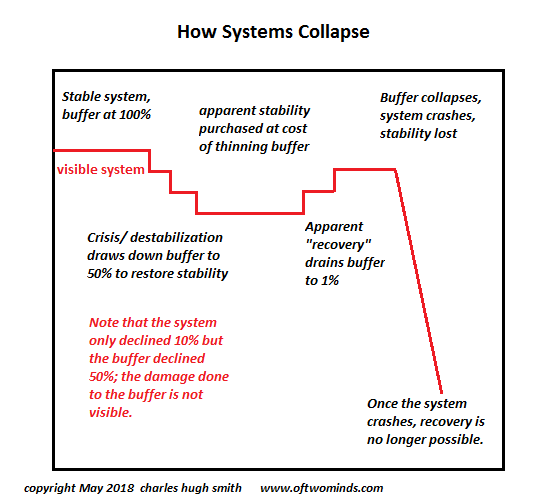
Then, of course, all what I said up to now will turn out to be wrong if we see the famed "recovery." Most people seem to think that once we have a vaccine for the dreaded little monster, everything will return to normal in the best of worlds. But that's questionable, to say the least. Someone who understands that there won't be a "normal" anymore is Charles Hugh Smith of the "Of two minds" blog. Below, let me report an excerpt from one of his recent posts where, among other things, you can find an excellent illustration of how the Seneca Effect works.

________________________________________________________________

The New Normal is De-Normalization

excerpt from Charles Hugh Smith's blog

 
What I mean by Denormalization is the complete dismantling of what was taken for granted as normal and the loss of any future version of normal. Consider sports as an example. We all know the Old Normal that millions hope will magically return: $100 million player contracts, millions in TV ad revenues, pro franchises worth billions of dollars, NCAA playoffs, etc.: a dominant kingdom in the nation's media and mindshare.
 
The dirty little secret that troubled the kingdom long before Covid-19 was a steady erosion in attendance at live games and in the viewing audience. Younger generations have relatively little interest in all the trappings and habits of Boomer sports manias. They'd rather watch the 3-minute highlight video on their phones than blow half a day watching games that are generally lacking in drama and are largely replaceable with some other game.
 
What few seem to notice is that the Old Normal had become insanely expensive, irksome and boring, activities that were habits coasting on momentum. Those embedded in the Old Normal acclimatized to the absurdly overpriced seats, snacks, beer, parking, etc. of live events and the insanely long commutes required to get to the venue and then back home, as their happy memories of $5 seats decades ago is the anchor of their lifelong devotion and habits.
 
The old fans coasting on ritual habituated to the cookie-cutter nature of the games, while those who never acquired the habit look with amazement at the seemingly endless dull progression of hundreds of interchangeable sporting events.
 
Advertisers will eventually notice that younger generations never acquired the habit of worshipping sports and so there is nothing to stem the collapse of the Old Normal but older fans, some percentage of whom will find they don't miss it once they fall out of the habit.
 
Some other percentage will find they can no longer afford to attend live games, or they'll realize they no longer feel it's worth it to grind through traffic or public transit just to sit for additional hours and then repeat the entire slog back home.
 
Another percentage will suddenly awaken to the artifice of the whole thing; they will simply lose interest. Others will finally realize the corporate machine (which includes college sports) has long since lost any connection to the era that they remember so fondly.
 
This same Denormalization will dismantle fast food, dining out, air travel, healthcare, higher education and innumerable other iterations of normal that have become unaffordable even as the returns on the lavish investments of time and money required diminish sharply.
 
How many of you deeply miss air travel? You're joking, right? Only certifiably insane people would miss the irksome hassle and discomfort, from the endless delays due to mechanical problems (don't you people keep any spare parts, or is it all just in time like every other broken system in America?), the seats that keep getting smaller as the passengers keep getting larger, the fetid terminals, and so on.
Like all the other iterations of normal, the entire experience has been going downhill for decades, but we all habituated to the decline because we were stuck with it.
 
What few seem to understand is all the Old Normal systems can't restabilize at some modestly lower level of diminishing returns; their only possible future is collapse. Just as fine-dining restaurants cannot survive at 50% capacity because their cost structure is so astronomical, the same is true of sports, airports, airlines, cruise lines, fast food, movie theaters, healthcare, higher education, local government services and all the rest of the incredibly fragile and unaffordable Old Normal.
None of these systems can operate at anything less than about 80% of full capacity and customers paying 80% of full pop, i.e. full retail. Since their fixed cost structures are so high, and their buffers so thin, there's nothing below the 80% level but air, i.e. a quick plummet to extinction.


Tuesday, November 5, 2019

"The Limits to Growth" continues to make waves


The Club of Rome is holding its annual meeting in Cape Town, South Africa. In the image, you see the co-president, Sandrine Dixon-Decleve, speaking
Now heading toward its 50th anniversary, "The Limits to Growth," the 1972 study sponsored by the Club of Rome, continues to generate interest. Past is the time of the "Limits-Bashing" fashion, when no one would dream to cite the study except to say that it was wrong. But there are still plenty of people who blindly repeat the legend that the study had predicted shortages that never occurred. As Daniel Dennett said, we are apes infested with memes and the Limits to Growth is an especially virulent one. 

Here, Marc Cirigliano writes a balanced review of the story, citing my book on the subject and giving some credit to one of the main critics of the study, Julian Simon, who in my opinion would deserve some more bashing but I admit that he may have been, at least, well-intentioned. 


By Marc A. Cirigliano

Popular journalism seems to have finally caught up with what the scientists have been telling us for well over five decades about the environment. You really can’t read anything in mainstream news or commentary without coming across articles about such ecological matters as overpopulation, pollution, resource use and climate change. The main topics related to these stresses include human excesses, noticeable changes that affect the day-to-day well-functioning of a society somewhere on the planet or the long-term viability of human life as we now know it.

It has not been an easy matter for science to get to the point where environmental problems are part of the grist of everyday reporting and opinion pieces. The opposition has been fierce, well funded and plays upon people’s primal fears.

Science discovers new ways of thinking about the world. Often, this is unsettling because with a new way of thinking, there comes change, and, with change, comes the possibility of loss. Sometimes the threat of loss may seem monumental, overwhelming, and, perhaps, even apocalyptic.

Change may portend personal dislocation, social change and economic upheaval. No wonder, then, that some people may see some aspects of scientific advancement as a threat. Further, people in authority may feel that a new scientific discovery threatens their very position of power within society.

One historic centuries old example is religion’s well-known and consistent opposition to a scientific explanation for the universe that upended the Christian one. Science told us the Earth was no longer the center of a God-designed universe. To threaten religion’s primacy even more, evolution upended the hexplanation that humans descended from Adam and Eve. In place of that, science said we descended from other life forms.

Religion freaked out even as the evidence mounted that science was correct.

Still today some clerics defend their authority over parishioners by still insisting the Bible is the undeniable authority in understanding the functioning of the universe, the origin of humans and the motive of humans in living on the planet. Some use it as a reason to oppose environmental reforms all together. Looking at the idea that informs the Abrahamic religions of Judaism, Christianity and Islam, Genesis 1:26 (NIV) gives use the dominion argument:

Then God said, “Let us make mankind in our image, in our likeness, so that they may rule over the fish in the sea and the birds in the sky, over the livestock and all the wild animals, and over all the creatures that move along the ground.”

Yes, the dominion argument is that God sanctioned humanity with using the earth as we see fit. Enironmental science puts forth a different view.We will come back to science as a threat to the authority of the status quo later.

A Major Environmental Warning from 1972


By the 1960s, science had established, or more precisely, environmental science had developed a proven explanation for the complex way ecosystem earth functioned. This explanation used the idea of population dynamics. Here, population growth, carrying capacity, overpopulation and population collapse—also referred to as a die-off or crash—were part of a pattern of life both in a segment of the environment or even on the planet as a whole. Bear in mind that as science developed its ideas on population dynamics, earth was in the midst of a population explosion never before seen.

In 1972, the Club of Rome received a report they had commissioned from four MIT researchers— Donella H. Meadows, Dennis L. Meadows, Jørgen Randers and William W. Behrens III—to study what they called the predicament of mankind. This team published The Limits to Growth (LTG), subtitled A Report for the Club of Rome’s Project on the Predicament of Mankind.

The researchers described their goal and the predicament they were proposing we fix:
The intent of the project is to examine the complex of problems troubling men of all nations: poverty in the midst of plenty; degradation of the environment; loss of faith in institutions; uncontrolled urban spread; insecurity of employment; alienation of youth; rejection of traditional values; and inflation and other monetary and economic disruptions. (10)
The LTG supplied a new way of looking at these problems, problems they labeled as the world problematique:

It is the predicament of mankind that man can perceive the problematique, yet, despite his considerable knowledge and skills, he does not understand the origins, significance, and interrelationships of its many components and thus is unable to devise effective responses. This failure occurs in large part because we continue to examine single items in the problematique without understanding that the whole is more than the sum of its parts, that change in one element means change in the others. (11)
In other words, each of these elements—poverty, environmental loss, social mistrust, overpopulation, job loss, alienated youth, etc.—is part of a system, with system defined as “a regularly interacting or interdependent group of items forming a unified whole.”

Consequently, instead of studying each of these problems separately from the system, the LTG proposed to study them as part of an environmental system. The way they examined this as a system was to develop a model, which they clarified as “simply an ordered set of assumptions about a complex system.” (20)

This was a new approach at that time in 1972.

Let us look at some of the specifics. TLG clarifies:

Our world model was built specifically to investigate five major trends of global concern-accelerating industrialization, rapid population growth, widespread malnutrition, depletion of nonrenewable resources, and a deteriorating environment. (21

The TLG draws a distinction between their approach and more traditional ones:

The model we have constructed is, like every other model, imperfect, oversimplified, and unfinished. We are well aware of its shortcomings, but we believe that it is the most useful model now available for dealing with problems far out on the space-time graph. To our knowledge it is the only formal model in existence that is truly global in scope, that has a time horizon longer than thirty years, and that includes important variables such as population, food production, and pollution, not as independent entities, but as dynamically interacting elements, as they are in the real world. (21-22)

TLG gives us three observations on how we may address these problems:

The present growth trends in world population, industrialization, pollution, food production, and resource depletion continue unchanged, the limits to growth on this planet will be reached sometime within the next one hundred years. The most probable result will be a rather sudden and uncontrollable decline inf both population and industrial capacity.  t is possible to alter these growth trends and to establish a condition of ecological and economic stability that is sustainable far into the future. The state of global equilibrium could be designed so that the basic material needs of each person on earth are satisfied and each person has an equal opportunity to realize his individual human potential. If the world's people decide to strive for this second outcome rather than the first, the sooner they begin working to attain it, the greater will be their chances of success. (23-24) TLG also acknowledges:
These conclusions are so far-reaching and raise so many questions for further study that we are quite frankly overwhelmed by the enormity of the job that must be done. (24)Addressing population growth, TLG zeroes in one of the reasons for the exponential population explosion in the 20th century:
With the spread of modern medicine, public health techniques, and new methods of growing and distributing foods, death rates have fallen around the world. World average life expectancy is currently about 53 years and still rising. On a world average the gain around the positive feedback loop (fertility) has decreased only slightly while the gain around the negative feedback. loop (mortality) is decreasing. The result is an increasing dominance of the positive feedback loop … (37)

In other words, several elements of the world system have enabled the population to grow exponentially. LTG explains further:

The exponential growth of demand for food results directly from the positive feedback loop that is now determining the growth of human population. The supply of food to be expected in the future is dependent on land and fresh water and also on agricultural capital, which depends in turn on the other dominant positive feedback loop in the system-the capital investment loop. Opening new land, farming the sea, or expanding use of fertilizers and pesticides will require an increase of the capital stock devoted to food production. The resources that permit growth of that capital stock tend not to be renewable resources, like land or water, but nonrenewable resources, like fuels or metals. Thus the expansion of food production in the future is very much dependent on the availability of nonrenewable resources. Are there limits to the earth's supply of these resources? (54)

One of the results of population growth caused by resource us is pollution. LTG points out:

Man's concern for the effect of his activities on the natural environment is only very recent. Scientific attempts to measure this effect are even more recent and still very incomplete. We are certainly not able, at this time, to come to any final conclusion about the earth's capacity to absorb pollution. We can, however, make four basic points in this section, which illustrate, from a dynamic, global perspective, how difficult it will be to understand and control the future state of our ecological systems. These points are: 1. The few kinds of pollution that actually have been measured over time seem to be increasing exponentially. 2. We have almost no knowledge about where the upper limits to these pollution growth curves might be. 3. The presence of natural delays in ecological processes increases the probability of underestimating the control measures necessary, and therefore of inadvertently reaching those upper limits. 4. Many pollutants are globally distributed; their harmful effects appear long distances from their points of generation. (69)

There is no doubt today that the deleterious effects of pollution are everywhere: the air, the water and the soil, all in the form of billions of tons of solid waste. All this not only affects people, but also animals, plants and, on a microscopic level, bacteria and viruses. In a simple overview of the systemic nature of the problematique, TLG links these issues together:
Of course, none of the five factors we are examining here is independent. Each interacts constantly with all the others. We have already mentioned some of these interactions. Population cannot grow without food, food production is increased by growth of capital, more capital requires more resources, discarded resources become pollution, pollution interferes with the growth of both population and food. (89)


The Crux of the Matter: “A Choice of Limits”

The heart of the problem has to do with the way that we solve social problems:

But the relationship between the earth's limits and man's activities is changing. The exponential growth curves are adding millions of people and billions of tons of pollutants to the ecosystem each year. Even the ocean, which once appeared virtually inexhaustible, is losing species after species of its commercially useful animals. (151)

After demonstrating the crisis facing the whaling industry around 1972, TLG points out that there were agreed upon limits to whaling to preserve the whale population. By extension, then, the report argues:

The basic choice that faces the whaling industry is the same one that faces any society trying to overcome a natural limit with a new technology. Is it better to try to live within that limit by accepting a self-imposed restriction on growth? Or is it preferable to go on growing until some other natural limit arises, in the hope that at that time another technological leap will allow growth to continue still longer? For the last several hundred years human society has followed the second course so consistently and successfully that the first choice has been all but forgotten. (151-153)

TLG make a point that they:

… are searching for a model output that represents a world system that is: 1. sustainable without sudden and uncontrollable collapse; and 2. capable of satisfying the basic material requirements of all of its people. (158)

To achieve a stable population, the number of births would more or less have to equal the number of deaths. TLG states:
Such a requirement, which is as mathematically simple as it is socially complicated, is for our purposes an experimental device, not necessarily a political recommendation. (159-160)

At the same that TLG discusses socially complicated limits, they acknowledge that:

Technological advance would be both necessary and welcome in the equilibrium state. A few obvious examples of the kinds of practical discoveries that would enhance the workings of a steady state society include:
  • new methods of waste collection, to decrease pollution and make discarded material available for recycling;
  • more efficient techniques of recycling, to reduce rates of resource depletion;
  • better product design to increase product lifetime and promote easy repair, so that the capital depreciation rate would be minimized;
  • harnessing of incident solar energy, the most pollution-free power source;
  • methods of natural pest control, based on more complete understanding of ecological interrelationships;
  • medical advances that would decrease the death rate;
  • contraceptive advances that would facilitate the equalization of the birth rate with the decreasing death rate.

TLG continues:

As for the incentive that would encourage men to produce such technological advances, what better incentive could there be than the knowledge that a new idea would be translated into a visible improvement in the quality of life?

They clarify the social reality of new inventions through history:

Historically mankind's long record of new inventions has resulted in crowding, deterioration of the environment, and greater social inequality because greater productivity has been absorbed by population and capital growth. There is no reason why higher productivity could not be translated into a higher standard of living or more leisure or more pleasant surroundings for everyone, if these goals replace growth as the primary value of society. (177-178)

TLG concludes:

If there is cause for deep concern, there is also cause for hope. Deliberately limiting growth would be difficult, but not impossible. The way to proceed is clear, and the necessary steps, although they are new ones for human society, are well within human capabilities. Man possesses, for a small moment in his history, the most powerful combination of knowledge, tools, and resources the world has ever known. He has all that is physically necessary to create a totally new form of human society-one that would be built to last for generations. The two missing ingredients are a realistic, long-term goal that can guide mankind to the equilibrium society and the human will to achieve that goal. Without such a goal and a commitment to it, short-term concerns will generate the exponential growth that drives the world system toward the limits of the earth and ultimate collapse. With that goal and that commitment, mankind would be ready now to begin a controlled, orderly transition from growth to global equilibrium. (183-184)


Why the Attacks on Limits in Particular and Environmentalism in General?


The Limits to Growth received strong criticism after its publication. It came in many forms. The Limits to Growth threatened specific groups. As Ugo Bardi explains:

In 1997, the Italian economist Giorgio Nebbia, noted that the reaction against the LTG study had arrived from at least four different fronts. One was from those who saw the book as a threat to the growth of their businesses and industries. A second set was that of professional economists, who saw LTG as a threat to their dominance in advising on economic matters. The Catholic world provided further ammunition for the critics, being piqued at the suggestion that overpopulation was one of the major causes of the problems. Then, the political left in the Western World saw the LTG study as a scam of the ruling class, designed to trick workers into believing that the proletarian paradise was not a practical goal. And this by Nebbia is a clearly incomplete list; forgetting religious fundamentalists, the political right, the believers in infinite growth, politicians seeking for easy solutions to all problems and many others.

So, when Limits came out, no doubt that business, industry, economists, religion, politicians, true believers in capitalism, and even workers thought that limiting growth would diminish their respective claims to authority and, most certainly, their lifestyle. This certainly fits, as asserted earlier in this article, that science is a threat to the authority of the status quo.


One Persistent Critic


Although there were many critics and criticisms, one of the most cogent and insistent came from economist Julian Simon. For example, Simon, in his 1995 Cato Policy Report “The State of Humanity: Steadily Improving,” continued his by then multi-decade rejection of the idea of limits to growth by asserting that [Italics added]:

We have seen extraordinary progress for the human enterprise, especially in the past two centuries. Yet many people believe that conditions of life are generally worse than in the past, rather than better.

I must say that nowhere in any environmental studies have I found that assertion, that “conditions of life are generally worse than in the past, rather than better.” Simon is setting this up as a straw man argument, which he easily demolishes with evidence on the improved living conditions of millions, if not billions, of people in our modern age.


In point of fact, these are ideas that TLG agrees with:

With the spread of modern medicine, public health techniques, and new methods of growing and distributing foods, death rates have fallen around the world. World average life expectancy is currently about 53 years and still rising. (37)

Hence, no sensible person, scientist or not, would assert what Simon claims they are asserting. In point of fact, the LTG was quite clear in stating that problems from overpopulation and pollution, plus potential shortfalls of resources, would become paramount well into the future:

…the limits to growth on this planet will be reached sometime within the next one hundred years. (23)
So, LTG is talking about 100 years from 1972, not as Simon claims. And, LTG does not assert, as Simon says they do, that that life is worse now than in the past. However, this is not to entirely dismiss what Simon says. He does develop a provocative thesis when he writes:

The most extraordinary part of the resource-creation process is that temporary or expected shortages -- whether due to population growth, income growth, or other causes -- tend to leave us even better off than if the shortages had never arisen, because of the continuing benefit of the intellectual and physical capital created to meet the shortage. It has been true in the past, and therefore it is likely to be true in the future, that we not only need to solve our problems, but we need the problems imposed upon us by the growth of population and income.

Simon clarifies why he thinks increased population is a benefit to mankind:

The most important benefit of population size and growth is the increase it brings to the stock of useful knowledge. Minds matter economically as much as, or more than, hands or mouths. Progress is limited largely by the availability of trained workers. The main fuel to speed the world's progress is the stock of human knowledge. And the ultimate resource is skilled, spirited, hopeful people, exerting their wills and imaginations to provide for themselves and their families, thereby inevitably contributing to the benefit of everyone.

Simon argues that over the long haul things would continue to get better just as they had been doing for the past two centuries:

The process operates as follows: More people and increased income cause problems in the short run--shortages and pollutions. Short-run scarcity raises prices and pollution causes outcries. Those problems present opportunity and prompt the search for solutions. In a free society solutions are eventually found, though many people seek and fail to find solutions at cost to themselves. In the long run the new developments leave us better off than if the problems had not arisen. This theory fits the facts of history.

This is actually fascinating, because when Simon writes that when things go bad, “those problems present opportunity and prompt the search for solutions,” he actually sounds like an environmentalist. And, he would seem to agree with LTG which says “technological advance would be both necessary and welcome...”


On another point, Simon misses the mark when he claims “there is little scientific literature on the relation of population to war.” Actually, according to Steven A. LeBlanc, there is sound evidence that “ecology and warfare intertwined today, just as they have been for millions of years.” LeBlanc explains:

The consequences of environmental stress will be scarce resources, and the consequences of scarce resources will be warfare. (Constant Battles, 12)

Simon, though, seems to go off his rocker in further explaining the need for and the capacity to invent solutions:

We have in our hands now--actually, in our libraries--the technology to feed, clothe, and supply energy to an ever-growing population for the next 7 billion years.
No doubt we do have the technology through knowledge in our libraries, but, 7 billion years? A bit of an exaggeration, perhaps.


Simon presents his argument as a universal for the ages, that we could apply his assertions to when he was writing, to 7 billion years in the future and to our now of 2019. As such, he would, at least up to now, be wrong. There is no indication that we have policy solutions to our current woes of overpopulation, seemingly insidious pollution (such as Roundup causing cancer, CO2 driving global warming or plastic refuse overwhelming both land and sea), and stresses over resource shortages, such as a lack of arable land and lack of water from droughts.


In fact, the very business and technical community that is creating the progress supporting our modern lifestyle is actually doing the opposite of Simon’s prediction that environmental problems would “prompt the search for solutions.” Business, in general, consistently lobbies against environmental action that effectively stops our politicians from taking any meaningful action. As we see today, President Trump is actually repealing environmental regulations.


Conclusion


The Limits to Growth raised key environmental concerns about population growth, pollution, depletion of resources and a deteriorating environment. These were ideas new to the public and new to policy makers in 1972. Today in 2019 they are foundational concepts in biology, ecology and environmental studies. The MIT researchers who wrote TLG studied these problems as part of an ecological system, not, in the then traditional way as isolated events. To top it off, we were given sound policy advice fifty years ago. Instead of listening, we tried to kill the messenger. To this day, it is advice ignored by policy makers.


Sunday, October 1, 2017

The Dirty Secret of Catastrophism Exposed


If you are a reader of this blog, you may have been wondering what fun is there in writing every day about catastrophes to come: peak oil, abrupt climate change, mega financial collapses, etc.  Why would anyone want to engage in that? Isn't that a lot of stress?

Good questions; and I think I can confess to you our (the catastrophists') dirty secret. First of all, you surely noticed that most catastrophists, though not all of them, are male. So, being one of them, I can tell you that it is all a trick to seduce women. It works like this: first, we convince our female target that the world is going to end soon. Then, why should she oppose having a little fun with us before it is too late? Simple, isn't it? But, before you think ill of me, let me also tell you that, a) I never tried that, b) it never works, and c) the lady is normally so stressed by the news of the impending doom that she fails to provide her best performance. (*)

That's a joke (of course!!). It came to my mind while reading some recent news about Guy McPherson, the main proponent of the idea of the "Near Term Human Extinction" (NTE), who has been accused of being a sex predator for having abused of a follower of his, a woman. About this story, let me say first that I stand by the rule that everyone should be assumed to be innocent unless proven guilty. Then, I can tell you that I see the near-term extinction of humankind as not impossible, although unlikely. This said, I think it is interesting to examine this story in some detail.

First of all, the row that erupted among the NTE followers was truly amazing for its verbal violence. Some people turned on Guy McPherson with a glee and a vehemence that I can only understand as the result of deep grudges that existed well before the story became known. McPherson's own defense, then, was weak and probably counterproductive. He didn't deny the accusations against him, rather, he erased his facebook page as if he was ashamed of something. Then, he vaguely spoke of "trolls" and "the deep state" having framed him and that surely didn't strengthen his position.

Clearly, there was a lot of stress to be vented out in the NTE group. Not surprising: if you go around telling people that humankind will go extinct in a few decades at most, it has got to have some effect on your nerves. One of the reactions to such a situation is for people to find some solace in being together with other people who share the same ideas. It is human but, in the case of the NTE group, it seems to have taken a certain "cultic" aspect. At least, I noticed that, in many cases, NTE-oriented people tend to close all arguments with the statement that "Dr. McPherson said so". That doesn't mean that the NTE idea has generated a suicide cult or something like that; it is just that a strong reliance on a charismatic leader it is typical of these cases. And, not rarely, cult leaders tend to misbehave in various ways, even though we have no proof that Guy McPherson did.

Within some limits, all of us, the catastrophists, may fall into the "cultic" trap and form tight groups of like-minded people. I notice it with what I write on this blog. Although I believe that our civilization is going to start declining in the near future (see my work on the "Seneca Effect"), I am far from being a hardcore doomer and sometimes I try to say that things are not so bad as some people say. In that case, I am often heavily criticized, apparently for denying the core ideas of the group (the cult). This effect is especially strong when I argue that renewable energy in the form of PV and wind can help us mitigate the unavoidable future decline. Some people seem to take this position as a personal insult and react consequently.

Again, it is understandable: for some people, it is less stressful to remain inside a group of like-minded people than venturing outside it. Yet, this is not good for one's mental health. We are not necessarily doomed and we can still do something and help others to mitigate the effects of the future decline. For this, we don't need to retreat into a cult (**).


(*) It is a version of the joke of the excuses of the lazy schoolboy for not having done his homework. It was because, a) he lost it, b) his dog ate it; and, b) he didn’t know it was assigned. (h/t Dmitry Orlov)


(**) An earlier version of this post included a video clip of the Beatles singing "A Little Help from My Friends". Some people overinterpreted it as if I was advocating the use of drugs to reduce the stress from catastrophism. Noting that the strongest drug I use is an occasional glass of Chianti wine, I thought it was better to remove the clip, just to avoid misunderstandings

Sunday, February 26, 2017

Catastrophism is popular, but not necessarily right. Debunking the "Hill's Group" analysis of the future of the oil industry


"The Hill's Group" has been arguing for the rapid demise of the world's oil industry on the basis of a calculation of the entropy of the oil extraction process. While it is true that the oil industry is in trouble, the calculations by the Hill's group are, at best, irrelevant and probably simply plain wrong. Entropy is an important concept, but it must be correctly understood to be useful. It is no good to use it as an excuse to pander unbridled catastrophism. 


Catastrophism is popular. I can see that with the "Cassandra's Legacy" blog. Every time I publish something that says that we are all going to die soon, it gets many more hits than when I publish posts arguing that we can do something to avoid the incoming disaster. The latest confirmation of this trend came from three posts by Louis Arnoux that I published last summer (link to the first one). All three are in the list of the ten most successful posts ever published here.

Arnoux argues that the problems we have today are caused by the diminishing energy yield (or net energy, or EROI) of fossil fuels. This is a correct observation, but Arnoux bases his case on a report released by a rather obscure organization called "The Hill's Group." They use calculations based on the evaluation of the entropy of the extraction process in order to predict a dire future for the world's oil production. And they sell their report for $28 (shipping included).

Neither Arnoux nor the "Hill's Group" are the first to argue that diminishing EROEI is at the basis of most of our troubles. But the Hill's report gained a certain popularity and it has been favorably commented on many blogs and websites. It is t is understandable: the report has an aura of scientific correctness that comes from its use of basic thermodynamic principles and of the concept of entropy, correctly understood as the force behind the depletion problem. There is just a small problem: the report is badly flawed.

When I published Arnoux's posts on this blog, I thought they were qualitatively correct, and I still think they are. But I didn't have the time to look at the details of the report of Hill's group. Now, some people did that and their analysis clearly shows the many fundamental flaws of the treatment. You can read the results in English by Seppo Korpela, and in Spanish by Carlos De Castro and Antonio Turiel.

Entropy is a complex subject and delving into the Hill's report and into the criticism to it requires a certain effort. I won't go into details, here. Let me just say that it simply makes no sense to start from the textbook definition of entropy to calculate the net energy of oil production. The approximations made in the report are so large to make the whole treatment useless (to say nothing of the errors it contains). Using the definition of entropy to analyze oil production is like using quantum mechanics to design a plane. It is true that all the electrons in a plane have to obey Schroedinger's equation, but that's not the way engineers design planes.

Of course, the problem of diminishing EROEI exists and can be studied. The way to do that is known and it is based on the "life cycle analysis" (LCA) of the process. This method takes into account entropy indirectly, in terms of heat losses, without attempting the impossible task of calculating it from first principles. By means of this method we can see that, at present, the EROEI of oil production is not so bad as described by Hill/Arnoux. It still provides a reasonable energy return on investment (EROEI) as you can read, for instance, in a recent paper by Brandt et al

But if producing oil still provides an energy return, why is the oil industry in such dire troubles? (see this post on the SRSrocco report, for instance). Well, let me cite a post by Nate Hagens:


In the last 10 years the global credit market has grown at 12% per year allowing GDP growth of only 3.5% and increasing global crude oil production less than 1% annually. We're so used to running on various treadmills that the landscape doesn't look all too scary. But since 2008, despite energies fundamental role in economic growth, it is access to credit that is supporting our economies, in a surreal, permanent, Faustian bargain sort of way. As long as interest rates (govt borrowing costs) are low and market participants accept it, this can go on for quite a long time, all the while burning through the next higher cost tranche of extractable carbon fuel in turn getting reduced benefits from the "Trade" creating other societal pressures.
Society runs on energy, but thinks it runs on money. In such a scenario, there will be some paradoxical results from the end of cheap (to extract) oil. Instead of higher prices, the global economy will first lose the ability to continue to service both the principal and the interest on the large amounts of newly created money/debt, and we will then probably first face deflation. Under this scenario, the casualty will not be higher and higher prices to consumers that most in peak oil community expect, but rather the high and medium cost producers gradually going out of business due to market prices significantly below extraction costs. Peak oil will come about from the high cost tranches of production gradually disappearing.
I don't expect the government takeover of the credit mechanism to stop, but if it does, both oil production and oil prices will be quite a bit lower. In the long run it's all about the energy. For the foreseeable future, it's mostly about the credit

In the end, it is simply dumb to think that the system will automatically collapse when and because the net energy of the oil production process becomes negative (or the EROEI smaller than one). No, it will crash much earlier because of factors correlated to the control system that we call "the economy". It is a behavior typical of complex adaptative systems that are never understandable in terms of mere energy return considerations. Complex systems always kick back.

The final consideration of this post would simply be to avoid losing time with the Hill's report (to say nothing about paying $28 for it). But there remains a problem: a report that claims to be based on thermodynamics and uses resounding words such as "entropy" plays into the human tendency of believing what one wants to believe. Catastrophism is popular for various reasons, some perfectly good. Actually, we should all be cautious catastrophists in the sense of being worried about the catastrophes we risk to see as the result of climate change and mineral depletion. But we should also be careful about crying wolf too early. Unfortunately, that's exactly what Hill&Arnoux did and now they are being debunked, as they should be. That puts in a bad light all the people who are seriously trying to alert the public of the risks ahead.

Catastrophism is the other face of cornucopianism; both are human reactions to a difficult situation. Cornucopianism denies the existence of the problem, catastrophism denies that it can be solved or even just mitigated. Both attitudes lead to inaction. But there exists a middle way in which we don't exaggerate the problem but we don't deny it, either, and we do something about it!


Wednesday, October 5, 2016

Malthus the prophet of doom: why bother with reading the original when you can simply cut and paste from the Internet?


An excerpt from the book I am writing, "The Seneca Effect," that contains a chapter dedicated to the Irish famines. Above, the reverend Thomas Malthus (1766 - 1834)


The demolition of Thomas Malthus' work in our times is often based on accusing him of having predicted some awful catastrophe to occur in the near future, sometimes on a specific date. Then, since the catastrophe didn't occur, there follows that Malthus was completely wrong and nothing in his work can be salvaged. It is a well-tested method that was used with great success against "The Limits to Growth", the report to the Club of Rome that appeared in 1972.

Except that Malthus never made the "wrong predictions" attributed to him, just as "The Limits to Growth" never made wrong predictions, either. There are no specific dates in Malthus' book "An essay on the Principle of Population" for where and when famines or other catastrophes should take place. For instance, Malthus says that,
Famine seems to be the last, the most dreadful resource of nature. The power of population is so superior to the power in the Earth to produce subsistence for man, that premature death must in some shape or other visit the human race. The vices of mankind are active and able ministers of depopulation. They are the precursors in the great army of destruction; and often finish the dreadful work themselves. But should they fail in this war of extermination, sickly seasons, epidemics, pestilence, and plague, advance in terrific array, and sweep off their thousands and ten thousands. Should success be still incomplete, gigantic inevitable famine stalks in the rear, and with one mighty blow levels the population with the food of the world.

— Malthus T.R. 1798. An Essay on the Principle of Population. Chapter 7, p 44

Doomerish, you can surely say, but not something that you can define as a "wrong prediction". Events similar to Malthus' description really occurred before Malthus times and in the “Essay” he normally refers to historical cases, especially those that had occurred in China.

So, Malthus was not babbling about dark and dire things to come; he was describing and analyzing events that were well known in his times. But few people, today, seem to be interested in looking up the original text and prefer to maintain that “Malthus was wrong” by repeating the legend. And, by the way, even if Malthus had been guilty of “wrong predictions”, that doesn't mean that infinite population growth could take place on a finite planet.

The other way to demolish Malthus's ideas is to paint him as evil, in the sense that he had proposed, or favored, mass extermination as a consequence of his ideas. This is, also, a common legend and also a great injustice done to Malthus. Over the great corpus written by Malthus, it is perfectly possible to find parts that we find objectionable today, especially in his description of “primitive” people whom he calls “wretched”. In this respect, Malthus was a man of his times and that was the prevalent opinion of Europeans in regard to non-Europeans (and maybe, in some cases, still is, as described in the book “Can Non-Europeans Think?” (Dabashi and Mignolo 2015).

Apart from that, Malthus’ writings are clearly the work of a compassionate man who saw a future that he didn't like but that he felt was his duty to describe. Surely, there is no justification in criticizing him for things that he never said, as it can be done by cutting and pasting fragments of his work and interpreting them out of context. For instance, Joel Mokyr in his otherwise excellent book titled “Why Ireland Starved”⁠ (Mokyr 1983) reports this sentence from a letter that Malthus wrote to his friend David Ricardo,


The land in Ireland is infinitely more peopled than in England; and to give full effect to the natural resources of the country, a great part of the population should be swept from the soil.

Clearly, this sentence gives the impression that Malthus was advocating the extermination of the Irish. But the actual sentence that Malthus wrote reads, rather (Ricardo 2005)⁠ (emphasis added):


The land in Ireland is infinitely more peopled than in England; and to give full effect to the natural resources of the country, a great part of the population should be swept from the soil into large manufacturing and commercial Towns.
So, you see that Malthus wasn't proposing to kill anyone, rather, he was proposing the industrialization of Ireland in order to create prosperity in the country. Nevertheless, legends spread easily on the web and you can see the truncated sentence by Malthus repeated over and over to demonstrate that Malthus was an evil person who proposed the extermination of the poor. I can't think that Professor Mokyr truncated this phrase himself, but he was at least careless in cutting and pasting something that he read on the Web without worrying too much about verifying the original source.

The Web, indeed, is full of insults against Malthus. You can find an especially nasty (and misinformed one) attack against him at this link where you can read that, yes, the Irish famine was all a fault of Malthus who misinformed the British government, who then refused to help the poor Irish, who then starved - all based on that truncated sentence.

Sometimes, I have the feeling that we are swimming in propaganda, drinking propaganda, eating propaganda, and even being happy about doing that.


___________________________________________________________

Dabashi H, Mignolo W (2015) Can Non-Europeans Think? Zed Books

Mokyr J (1983) Why Ireland Starved. Routledge, London and New York

Ricardo D (2005) The Works and Correspondence of David Ricardo. Liberty Fund, Indianapolis

Thursday, April 9, 2015

An interview with Cassandra


This blog, "Resource Crisis" deals mainly with depletion, climate change, and the ongoing systemic crisis. However, up to no long ago, it was known as "Cassandra's Legacy" and its Cassandric roots remain strong. After all, the Trojan prophetess, Cassandra, is a perfect metaphor of what's happening around us; with scientists trying to warn the public and governments of various impending disasters, and not being believed.

At present, my more "mythological" musings appear in a blog that I titled "Chimeras" There, I just published a post titled, "An Interview with Cassandra" that is at the same time a climate-fiction piece and a personal interpretation of the saga of Cassandra.

As a post, it is a bit long and perhaps also off-topic, so I won't publish it here. But I thought that the readers of this blog could be interested in reading it. At least, I can say that I had a lot of fun in writing it!

So, just click here to access my interview with the Trojan prophetess. 


Who

Ugo Bardi is a member of the Club of Rome, faculty member of the University of Florence, and the author of "Extracted" (Chelsea Green 2014), "The Seneca Effect" (Springer 2017), and Before the Collapse (Springer 2019)