Showing posts with label catastrophists. Show all posts

Sunday, August 23, 2020

The Triumph of Catastrophism. How Greta Thumberg Carried the Day

Disclaimer: I am NOT saying here that the Covid-19 does not exist nor that people didn't die because of it. If you react with the term "denialism" you are only showing that you have no rational arguments to produce.


Do you remember that weird girl from Sweden? Yes, the one with the braided hair. What was her name? Greta something.... It is strange that so many people seemed to pay attention to what she was saying about things like climate change. Why should anyone be worried by that? Nobody cares about climate change anymore when there are much more important matters at hand with the great pandemic sweeping the world? And yet, strangely, nowadays people are doing exactly what Greta had told them to do.


Not long ago, I published on Cassandra's Legacy a post titled "The Great Failure of Catastrophism." In it, I argued that some 50 years of warnings from scientists had been completely ignored by the powers that be. I also argued that a relatively minor perturbation, as the one caused by the Covid-19 epidemic, had been enough to consign all worries about climate to the dustbin of the silly ideas that nobody should care about. 

But things keep changing and I am now amazed to see that humans are acting exactly as if they had listened to Greta Thunberg. Do you remember? She said we shouldn't use the plane, that we should travel less, use less energy, consume less. Exactly what's being done.

People are not flying anymore so much, they stopped most of their long distance traveling, the mass migration called "international tourism" seems to have disappeared for good. Some of the most polluting manufacturing operations are slowing down, and with that the exploitation of natural resources. The shale oil industry is dead and the whole extractive industry is going down the drain, too. Humans seem to have largely abandoned their beloved ritual of daily commuting and even professional sports have disappeared beyond the horizon of the events (although they weren't the most polluting activity around).

It is incredible: people would be howling their displeasure all the way to the moon if they had been asked to fly less for the benefit of the ecosystem and themselves, but now they are meekly doing exactly that out of fear of the coronavirus. 

You see, the young lady, Greta Thunberg, had been able to move a few things, but she was still operating within the old paradigm of communication. She was a leader in the same way as Joan of Arc was, long ago. The problem with leadership is that it attracts love and hate at the same time. Sometimes, a lot of hate. And the way to neutralize a successful leader is to pour hate on him or her. Do you remember what happened to Joan of Arc? That was what Greta Thunberg was risking and it is good for her that her cycle has been so short -- now she can be a normal girl for the rest of her life. 

But now, it is no more the time of leaders. The change we are seeing is being created by impersonal forces. There is nobody to hate about the coronavirus: you can't hate a small chunk of RNA that you can't even see. Viruses have no leaders, they don't care about anything, they are impervious to love and hate. What moves things onward nowadays is not hate, it is pure terror and you can't hate terror, you can only resist it or be crushed by it. And it seems clear that most of us are being crushed by terror. Terror is a primal force, almost impossible to resist.

The overall impression is that we are seeing enormous forces stirring. Forces that will change the world so deeply that, right now, we can't even vaguely imagine how. If you have time, do read the book by Shoshana Zuboff "Surveillance Capitalism." She correctly points out how the new technologies called "profiling" and "targeting" are generating a level of control over individuals that never existed before in history. So far, these technologies have been used for relatively harmless purposes such as sales and influencing electoral votes. What we see now is deeper and wider: it is raw power over people's minds. The enormous creature that's raising its ugly head has a name, and it is the World Wide Web. 

It is a huge beast we have nurtured and raised. Mr. Zuckerberg or Mr. Gates, or some of their colleagues may still think they can control it, but it is too late. Nobody who is human can control this thing anymore. We'll go where "it" will take us. And maybe, just maybe, this thing perceives that humans need to stop destroying everything on this planet, including themselves. Perhaps the head of the beast is not so ugly, after all? Who knows?

Then, of course, all what I said up to now will turn out to be wrong if we see the famed "recovery." Most people seem to think that once we have a vaccine for the dreaded little monster, everything will return to normal in the best of worlds. But that's questionable, to say the least. Someone who understands that there won't be a "normal" anymore is Charles Hugh Smith of the "Of two minds" blog. Below, let me report an excerpt from one of his recent posts where, among other things, you can find an excellent illustration of how the Seneca Effect works.

________________________________________________________________

The New Normal is De-Normalization

excerpt from Charles Hugh Smith's blog
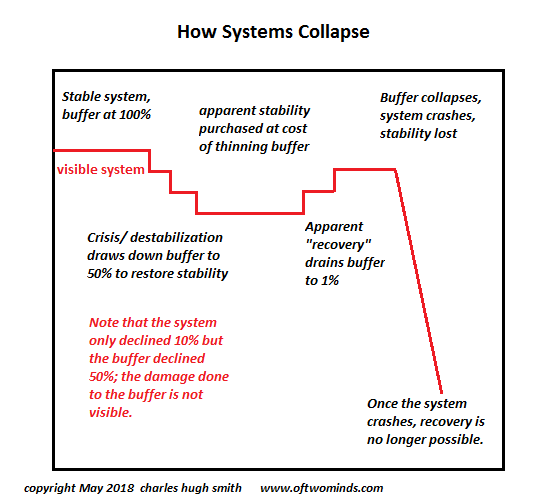
 
What I mean by Denormalization is the complete dismantling of what was taken for granted as normal and the loss of any future version of normal. Consider sports as an example. We all know the Old Normal that millions hope will magically return: $100 million player contracts, millions in TV ad revenues, pro franchises worth billions of dollars, NCAA playoffs, etc.: a dominant kingdom in the nation's media and mindshare.
 
The dirty little secret that troubled the kingdom long before Covid-19 was a steady erosion in attendance at live games and in the viewing audience. Younger generations have relatively little interest in all the trappings and habits of Boomer sports manias. They'd rather watch the 3-minute highlight video on their phones than blow half a day watching games that are generally lacking in drama and are largely replaceable with some other game.
 
What few seem to notice is that the Old Normal had become insanely expensive, irksome and boring, activities that were habits coasting on momentum. Those embedded in the Old Normal acclimatized to the absurdly overpriced seats, snacks, beer, parking, etc. of live events and the insanely long commutes required to get to the venue and then back home, as their happy memories of $5 seats decades ago is the anchor of their lifelong devotion and habits.
 
The old fans coasting on ritual habituated to the cookie-cutter nature of the games, while those who never acquired the habit look with amazement at the seemingly endless dull progression of hundreds of interchangeable sporting events.
 
Advertisers will eventually notice that younger generations never acquired the habit of worshipping sports and so there is nothing to stem the collapse of the Old Normal but older fans, some percentage of whom will find they don't miss it once they fall out of the habit.
 
Some other percentage will find they can no longer afford to attend live games, or they'll realize they no longer feel it's worth it to grind through traffic or public transit just to sit for additional hours and then repeat the entire slog back home.
 
Another percentage will suddenly awaken to the artifice of the whole thing; they will simply lose interest. Others will finally realize the corporate machine (which includes college sports) has long since lost any connection to the era that they remember so fondly.
 
This same Denormalization will dismantle fast food, dining out, air travel, healthcare, higher education and innumerable other iterations of normal that have become unaffordable even as the returns on the lavish investments of time and money required diminish sharply.
 
How many of you deeply miss air travel? You're joking, right? Only certifiably insane people would miss the irksome hassle and discomfort, from the endless delays due to mechanical problems (don't you people keep any spare parts, or is it all just in time like every other broken system in America?), the seats that keep getting smaller as the passengers keep getting larger, the fetid terminals, and so on.
Like all the other iterations of normal, the entire experience has been going downhill for decades, but we all habituated to the decline because we were stuck with it.
 
What few seem to understand is all the Old Normal systems can't restabilize at some modestly lower level of diminishing returns; their only possible future is collapse. Just as fine-dining restaurants cannot survive at 50% capacity because their cost structure is so astronomical, the same is true of sports, airports, airlines, cruise lines, fast food, movie theaters, healthcare, higher education, local government services and all the rest of the incredibly fragile and unaffordable Old Normal.
None of these systems can operate at anything less than about 80% of full capacity and customers paying 80% of full pop, i.e. full retail. Since their fixed cost structures are so high, and their buffers so thin, there's nothing below the 80% level but air, i.e. a quick plummet to extinction.


Friday, December 12, 2014

First, thou shalt not scare them


Watch the clip on youtube


A fundamental tenet of scientists and climate concerned people is that "you must not scare people about the climate threat". Sure: we all know that. It is reasonable, it makes sense, it is even obvious: if you say how bad you think the situation is, if you even mention the worst case hypothesis, they will close their ears singing to themselves "la-la-la!" while they run away. If you are not careful, they will not want to hear what you are telling them, and if they don't hear you they will do nothing. And if they do nothing, the problem will not be solved. It is standard practice in risk management.

So, we have always been careful to follow the instructions: avoid scaring people, avoid looking like scaremongers, avoid even hinting that things may be worse, much worse than anyone could imagine. We have been careful to end all warnings with a list of solutions; saying that, sure, it looks bad, but the problem will go away if you just insulate your home, buy a smaller car, and turn off the lights when you leave a room. What we need is just a little bit of good will.

To no avail: the climate problem is still there, bigger and more fearsome everyday. Nothing changes, nothing moves, nothing is being done. Nothing even remotely comparable to the scale of the threat. And, sometimes, you feel that you have had enough; you feel like screaming that this is NOT a problem you can solve with double-paned windows and smaller cars; it is NOT a problem for the next century; it is NOT a problem for another generation, It is here, it is now, it is big, it is damn big, and it is out of control. You feel like screaming that aloud.

So, the scene written by Aaron Sorking for "The Newsroom" is astonishing and refreshing at the same time. It is fiction, sure, it is something that will never happen, but it is an incredible jolt. It is a moment of truth, miraculously appearing in a place where it never appears: in the news. For instance:

"The last time there was this much CO2 in the air the oceans were 80 feet higher than they are now. Two things you should know: Half the world's population lives within 120 miles of an ocean." "And the other?" "Humans can't breathe under water."

I know, I know.... We should never, never even dream of saying this kind of things in public. We should not..... And yet.....


_______________________________________

Below, an excellent commentary on this scene by Randy Malamud on "The Huffington Post" (there is also a commentary by David Roberts on Grist which I found rather underwhelming)


Randy Malamud Headshot

It's The End of the World As We Know It


A scene on Aaron Sorkin's The Newsroom recently struck me, at first, as simply an astute and amusing commentary on global warming... until the real world chimed in with one of those life-imitating-art occasions suggesting that R.E.M.'s apocalyptic song is destined to be the soundtrack of our future.

First, the HBO moment: Anchor Will McAvoy (Jeff Daniels) interviews an EPA administrator (Paul Lieberstein, who will always be Toby Flenderson from The Office no matter what role he's playing) about a report that carbon dioxide levels have hit extremely dangerous new highs.

McAvoy begins in the usual mode for this sort of story, poised to emphasize the urgent threat of climate change while reinforcing the conventional platitudes that people need to take this seriously and work hard to remediate the problem.

His conversation, though, quickly goes off the rails.

"If you were the doctor and we were the patient," the anchor asks, "what's your prognosis? A thousand years, two thousand years?" The scientist's response takes him aback: "A person has already been born who will die due to catastrophic failure of the planet."

McAvoy: You're saying the situation is dire?

EPA guy: Not exactly. Your house is burning to the ground, the situation is dire. Your house has already burned to the ground, the situation is over.

McAvoy: So what can we do to reverse this?

EPA: Well there's a lot we could do...

McAvoy (interrupts): Good...

EPA: ...20 years ago, or even 10 years ago. But now, no.

McAvoy (becoming increasingly uncomfortable): Can you make an analogy that might help us understand?

EPA: Sure. It's as if you're sitting in your car, in your garage, with the engine running and the door closed, and you've slipped into unconsciousness. And that's it.

McAvoy: What if someone comes and opens the door?

EPA: You're already dead.

McAvoy: What if the person got there in time?

EPA: Then you'd be saved.

McAvoy: OK. So now what's the CO2 equivalent of the getting there on time?

EPA: Shutting off the car 20 years ago.

McAvoy: You sound like you're saying it's hopeless.

EPA: Yeah.

McAvoy: Is that the administration's position or yours?

EPA: There isn't a position on this any more than there's a position on the temperature at which water boils.

Then last week, an actual piece of journalism, the lead story in Monday's New York Times, confirms that things are indeed pretty much as desperate as Sorkin depicted on his pretend newscast. As the latest UN summit on greenhouse gases convenes in Peru, climate scientists report that a 3.6 degree rise seems inevitable, which they believe is "the tipping point at which the world will be locked into a near-term future of drought, food and water shortages, melting ice sheets, shrinking glaciers, rising sea levels and widespread flooding."

Flipping back to one last bit of patter from The Newsroom: The EPA administrator tells McAvoy, "The last time there was this much CO2 in the air the oceans were 80 feet higher than they are now. Two things you should know: Half the world's population lives within 120 miles of an ocean." "And the other?" "Humans can't breathe under water."

I propose that it is time for us to accept as a premise in whatever environmental discussions we have -- or indeed, in any deliberations on anything taking place in the future -- the fact that the world is coming to an end.

Well, not the world itself: The planet is actually pretty resilient, and will likely continue on its orbit unbothered by the warm spell; it's just people, along with most other life forms, that will disappear. Geologically, there's not so much to worry about; biologically, on the other hand, we have a situation.

Over the past decade -- since Al Gore's documentary An Inconvenient Truth brought global warming into the mainstream consciousness -- the rhetoric has been dire, but at least minimally hopeful: If we start doing this and stop doing that now, we can perhaps just barely salvage what is left of our ecosystem.

For a while it made sense, as Will McAvoy was trying to do on his newscast, to cling to a thread of hope in order to motivate reform and prevent people from descending into a paralyzing sense of helplessness.

But now it's time to accept our impending demise. Those are profoundly difficult words to write, but they are necessary: Our times demand a new rhetorical honesty. It is deceitful and irrelevant to sustain the charade that things may improve. Instead, it's time to start talking about how we will die.

(Maxine Kumin has a poem called "Our Ground Time Here Will Be Brief." It was.)

As depressing as this is, it has at least the virtue of being true, unlike the kick-the-can-down-the-road policies that pretend the solution for global warming lies in producing (someday!) cars that get 150 mpg and cities powered by wind farms. And expecting Westerners (the 12 percent of the world's population who consume 60 percent of its resources) to use less stuff.

If there's a silver lining, it is not a very satisfying one, but for what it's worth: I think it may prove refreshing, even exhilarating, to develop a new trope, a new truth, that lets go of the pretense that things will turn out ok.

"The progress narrative" that has undergirded Western culture for millennia was nice while it lasted, but it's also responsible for getting us where we are today, as it stoked the fantasy that we were invincibly moving ever forward, and that our rampantly voracious overdevelopment (exploration, imperialism, conquest, growth, "civilizing" nature) had no costs, no limits, no consequences.

As an English professor, I find it exciting to consider the possibilities for a new voice, a new style, a new writerly consciousness that may accompany and chronicle the winding down of our sound and fury.

Other cultures at similar points in their trajectory -- past the zenith, clearly waning yet close enough to the glories of the past -- have often produced keenly insightful literature and art. Being on the cusp of decline provokes incisive self-reflection -- as the Greeks called it, anagnorisis: recognition.

Cervantes achieved this in Don Quixote toward the end of Spain's Golden Age, as did T. S. Eliot in "The Waste Land," his report from the front lines of the cultural disintegration that accompanied the collapse of European imperialism and the War to End All Wars: "These fragments I have shored against my ruins."

On a personal level, we have lately begun to do a better job of dying, and of accepting death -- writing "death plans," forsaking heroic measures of resuscitation. So too as a species we may learn to accept the inescapability of our impending ecological fate. We can celebrate the bright spots from our past human heritage, acknowledge our follies, and finally, deal with it: It is what it is.

There will be a limited future audience for this brave new art, since we're hovering on the verge of extinction, but it will leave an interesting time capsule for whoever might come to recolonize the planet after we're gone.

"Anthropocene," a recently coined term for our present epoch, reflects the unique phenomenon of human impact that has changed (disrupted, ruined) the earth. Complementing this scientific assessment, a parallel aesthetic movement must acknowledge, better late than never, that we have irreparably fouled our nest.

We might demarcate our cultural expressions of this period as "epitaphal": our last words, as on a gravestone, inscribed with a solidity that will outlast our mortal frames and will announce for eternity (even in its conscribed scope) what kind of people we wanted to be and how we hoped we might be remembered.


Randy Malamud is Regents' Professor of English and chair of the department at Georgia State University.

Thursday, November 13, 2014

The Olduvai cliff: are the lights going out already?


Image from Li and Li, "international journal of remote sensing." h/t Colonel Cassad". The image shows the nighttime light pattern in Syria three years ago (a) and today (b).


Those among us who are diehard catastrophists surely remember the "Olduvai Scenario" proposed by Richard Duncan in 1989. The theory is a version of the peak oil idea, but focused on electricity production. It says that the gradual depletion of fossil fuels and mineral resources will gradually lead us back to the stone age ("Olduvai" from the area inhabited by our australopithecine ancestors). According to Duncan's update of his theory, the start of the precipitous decline ("Seneca style") might have started around 2012.


Clearly, we are not there, yet, and the new stone age still seems to be far away. But, there are some ominous symptoms that something bad this way comes. I stumbled into pictures of Syria now and three years ago, and they are impressive. The lights are going out there, already. And note that it was obvious from the beginning that the decline was to be accompanied by wars and internecine strife; just as what's happening in Syria. Surely, two pictures don't mean that the catastrophists are right; but surely they provide food for thought.


Who

Ugo Bardi is a member of the Club of Rome, faculty member of the University of Florence, and the author of "Extracted" (Chelsea Green 2014), "The Seneca Effect" (Springer 2017), and Before the Collapse (Springer 2019)