Showing posts sorted by relevance for query life expectancy. Sort by date Show all posts

Monday, March 25, 2019

Why worry about pollution if life expectancy keeps increasing? Ahem.... are you sure?

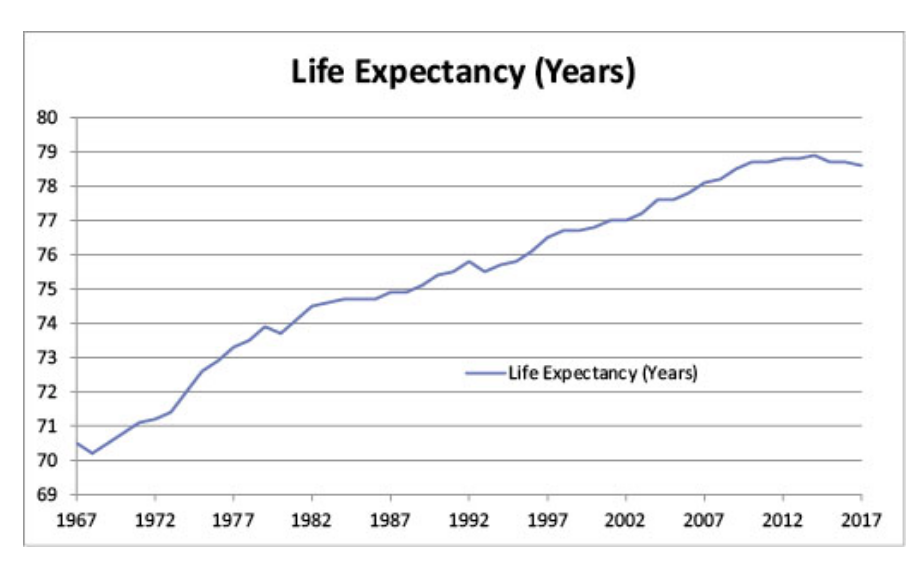
It seems clear that we won't get to reach Methuselah's age. In most Western countries, the average life expectancy has started decreasing from 2014 and we are, maybe, on the edge of a Seneca Cliff for longevity. It could be an effect of pollution, but not just that. Image source.


If you ever got into a discussion on the effects of pollution, you know what happens. You list the problems with heavy metals, from lead to mercury, pesticides, fine particles, plastics, everything that is -- or may be -- carcinogenic, including the deadly glyphosate, aka Roundup. Then, there comes always someone who says, "but all that cannot be so bad! After all, people keep living longer and longer!"

Alas, very, unfortunately, that doesn't seem to be the case anymore. Let me show you some data: let's start from the US (source).

And here are some data about European countries, from the World Bank


Clearly, the nearly linear trend of growth of the life expectancy at birth stopped around 2014 in most Western countries. To put things in perspective, it is not the same for other countries: both in China and in Russia, life expectancy is lower, but it keeps increasing. (again, data from the World Bank)


Before going on, a disclaimer: there is sufficient uncertainty in the data that the trend should be considered as weak. We are on a plateau that might see oscillations that could be interpreted as a return to growth.

But, clearly, something has happened in 2014 that interrupted a trend so stable that it was considered not only the way things were, but the way things had to be. What was that? Data from an article by Gilbert Berdine can tell us something about what's happening, at least in the US.


The mortality of old people keeps declining, what's causing the overall decline in life expectancy is the rising mortality of the young. Berdine comments as (highlighting mine):
The rising mortality rates for young people are attributed to suicides in general and opioid overdoses in particular. These are deaths of despair. . . . It is unclear what is causing despair in young people during a period of time when we are told that the economy is expanding.
We are told that the economy is expanding, yes, but something seems to be wrong with that. In some countries, such as Italy, the economy has been contracting for at least a decade. In the US, instead, the data show that the economy is skyrocketing upward, at least if measured in terms of the GDP. America is becoming great again, actually it never stopped being that (again, in terms of the GDP). So, why is the life expectancy going down in both countries?

What's making the young killing themselves by guns and drugs? Might pollution be affecting people's mental sanity? Yes, that's exactly the case. In a recent paper, Shin and others report that not only pollution causes "subjective stress, depressive disorders, health-related quality of life (QoL) and suicide." They don't speak about life expectancy but they say, "The risk of higher stress or poor QoL in subjects < age 65 increased with air pollution more than did that in subjects ≥ age 65"

So, it is clear that pollution is taking its toll on human health, especially among the young. That may explain the "despair" that Berdine considers the cause for the increased mortality. And there may be perfectly good reasons for the young to despair, even without the help of pollution. In any case, we may have reached a Seneca Cliff of life expectancy.

Another dream of our society that turned into a nightmare. Another chunk of future that we stole from our children and grandchildren. No wonder that they are not happy with us.


Tuesday, December 3, 2013

Peak Health?


Eurostat data for healthy life years expectancy (HLYE) in some European countries, as reported in a paper uploaded on arXiv in 2013 by Ugo Bardi and Virginia Pierini. Measuring "health" carries large uncertainties, but these data hardly conform to the common perception of an increasingly better health condition in Europe.


We all know that we are living longer lives, at least in rich countries. But are we also living healthier lives? This is not so evident. On the contrary, sometimes, it seems that the elderly are paying dearly for their extra years of life in terms of all sorts of chronic illnesses and handicaps.

However, this is just a qualitative perception that should be supported by data if we have to consider it as worth of attention. Unfortunately, the concept of "health" is rather difficult to define and measure; nevertheless there exist data reporting a parameter called "Healthy Life Expectancy" or "Healthy Life Years Expectancy" (HLYE) that measure the expected number of "disability free" years of one's life.

The analysis of these data is the subject of a paper that myself and my coworker Virginia Pierini recently uploaded on ArXiv. We found that according to the EUROSTAT data, several European countries (and Italy in particular) experienced a decline in the healthy life expectancy starting with 2003.

About these results, a disclaimer is in order. The only way to determine HLYE is to ask people how do they feel about their health. Their answer depends on their perception and also on the way the question is posed. So, what these data are measuring might be a decline in the way people perceive their health, rather than their actual health. And there is the further complication that in 2004 some elements changed in the way the measurement was performed. Indeed,  in a comment to an earlier paper by Gennaro et al, Piergentili suggests that the observed change in HLYE is an artifact of the measurement. But we can't rule out that some actual external change had modified people's health, or the perception of their own health. In the paper, we tentatively explored the possibility that this change could be related to the heat wave that hit Europe in 2003 - a phenomenon that, indeed, had a detectable effect on the data on standard life expectancy.

We are the first to say that the data we report are affected by a high uncertainty. But we also thought that these data were worth reporting, if nothing else as a question mark directed at the scientific community for comments. We are facing here a fundamental point: "health" is often considered as equivalent to life expectancy but it should be seen more correctly in terms of healthy life expectancy; also in relation to the changes that we are causing to our environment. Hopefully, this modest effort of ours could be a stimulus to study more this subject.


Monday, July 4, 2016

Equality and Sustainability: can we have both?


Guest post by Diego Mantilla


Recently, in this blog, Jacopo Simonetta raised a very important question: Would a fairer distribution of income worldwide diminish the damage humans are doing to the earth? His answer, that it would not and would actually make matters much worse, intrigued me. So, I decided to look at the best available data.

Simonetta specifically looked at the question of whether a fairer distribution of income would reduce global CO2 emissions. In 2015, Lucas Chancel and Thomas Piketty (henceforth C-P) wrote a paper and posted online a related dataset that dealt with the global distribution of household consumption and CO2e (carbon dioxide equivalent = CO2 and other greenhouse gases) emissions in 2013. The data are not perfect, but they are the best that exist. The C-P dataset captures the Household Final Consumption Expenditures (HFCE) values provided by the World Bank, using the distribution of income in Branko Milanovic's dataset (for the bottom 99 percent) and in the World Wealth and Income Database (for the top 1 percent). (Income is not the same as consumption, and C-P assume that the distribution of income is the same as that of consumption. Also, they assume that the same distribution of income that existed in 2008 also existed in 2013. Like I said, the dataset is not perfect).

The C-P dataset includes 94 countries, which cover 87.2 percent of the earth's population, about 6.2 billion people, who are responsible for 88.1 percent of global CO2e emissions. Generally speaking, C-P divide each country in “11 synthetic individual observations (one for each of the bottom nine deciles, one for fractile P90-99, and one for the top 1%).”

The following chart shows consumption per capita and CO2e emissions per capita in 2013 from the C-P dataset.

Figure 1. Consumption and CO2e emissions per capita by world consumption percentile in 2013. (Some percentiles are missing due to the fact that the country quantiles vary in size and sometimes extend beyond a given global percentile.) (Source: own elaboration from data of Chancel and Piketty (2015).)

The top 1 percent on the consumption scale spend an average $135,000 (2014 PPP dollars) and emit an average 72 tCO2e per person per year. The threshold for belonging to the top percentile is $54,000. Their consumption is equal to 18 percent of all the money spent by households around the world. Let's assume, for the sake of argument, that consumption equals income. If one were to take all the income of the top 1 percent and distribute it among the 99 percent, each person in the 99 percent would get about $1,400.

C-P assume a CO2e emissions to consumption spending elasticity of 0.9. A 10 percent increase in consumption means a 9 percent increase in CO2e emissions. This is a broad generalization, and C-P have a range of elasticities, but they chose that one because it is the median value of the estimates. Using that elasticity in the C-P dataset, if each person in the bottom 99 percent got $1,400 and those in the top 1 percent were left with nothing, global CO2e emissions would increase by 9 percent.

But, of course, the top 1 percent are only part of the problem. About 22 percent of the world's population lives with a consumption level above the global mean of about $8,000 per year. Let's assume that everyone had a level of consumption equal to the mean. Going back to the C-P dataset, if one averages the CO2e emissions of everyone within a consumption bracket ranging from $7,700 to $8,300, one gets an average emission of 6.15 tCO2e per person per year. If everyone had that kind of emission, global CO2e emissions would be practically the same they are today, but, needless to say, that would improve the lot of more than three-quarters of the world's population.

In short, a perfect distribution of income would have a negligible effect on global CO2e emissions.

There remains the question: At what level of consumption would CO2e emissions be reduced dramatically and would this level be compatible with a decent existence?

Cuba offers an interesting example. Moran et al. (2008) looked at the UN's Human Development Index (HDI) and the Ecological Footprint of 93 countries for 2003, and worked on the assumption “that an HDI of no less than 0.8 and a per capita Ecological Footprint less than the globally available biocapacity per person [one planet earth] represent minimum requirements for sustainable development that is globally replicable.” Their survey showed that only one country met both of those requirements, Cuba.

Cuba also has the second lowest fertility rate of the Americas, 1.61 births per woman. Only Canada's is lower. This means that a low-consumption society can be compatible with no population growth. The average Cuban eats 3,277 calories a day. Cubans have a life expectancy at birth of 79.4 years. This is above the United States and only 1.5 years below Germany. And Cuba's mean years of schooling are above Finland's. And only Monaco and Qatar have more doctors per capita than Cuba. Clearly, a level of consumption compatible with the finite planet that we have does not have to equal penury and destitution for everyone. I'm not saying life in Cuba is easy for everyone. It isn't, but at some point in the near future, those who live in the developed world and in the rich enclaves of the developing world are going to be faced with a choice between a Cuban lifestyle and, to quote Noam Chomsky, the destruction of “the prospects for decent existence, and much of life.”

I wanted to find out if the findings of Moran and colleagues were still true today, but I made one change. The HDI is built using three dimensions: life expectancy, education, and per capita income. This has always bothered me. A long, healthy life and an educated population are no doubt hallmarks of human development. But, is driving a Lexus a sign of human development? I think not. Therefore, I used the UN's data to build an index that looks only at life expectancy and education, which I'm calling the truncated human development index (THDI). (The calculation of the HDI is explained here. The THDI follows the same procedure used from 2010 onward, but it only takes the geometric mean of the first two variables.) In the following chart, I plot the THDI versus the Ecological Footprint, measured in the number of planet earths the inhabitants of a given country consume, using the most recent data.


Figure 2. THDI and Ecological Footprint of 176 countries. The red dot represents Cuba. (The THDI corresponds to 2014, the Ecological Footprint to 2012.) (Source: own elaboration from data of the UN and Global Footprint Network.)

There are only two countries in the vicinity of one earth that have a THDI higher than 0.8, Georgia and Cuba, the red dot. Of the two, Cuba has the highest THDI. It's interesting that Cuba has practically the same THDI as Chile, but Chile uses 2.5 earths. And it has practically the same THDI as Lithuania, but Lithuania uses 3.4 earths. Furthermore, Cuba uses as many earths as Papua New Guinea, but Papua New Guineans have an average of 4 years of schooling, Cubans 11.5. This is just to show the possibilities that exist for an egalitarian, sustainable society. As of late, inequality in Cuba has been on the rise. However, according to the World Bank, CO2 emissions per capita in Cuba are not substantially different today than they were in 1986, when Cuba's Gini coefficient was very low, 0.22 (Mesa-Lago 2005, page 184). In any case, I'm not advocating that we copy the Cuban model completely. I'm not defending Cuba's crackdown on individual liberties, freedom of speech among them. All I'm saying is Cuba is an interesting example of the possibilities that an egalitarian society offers. I, for one, would like to live in a society that is even more egalitarian than Cuba. It seems to me that there is no reason in principle why humans cannot build a society that is more egalitarian than Cuba and just as sustainable, especially when the alternatives are dire.

Cuba is not in the C-P dataset. It is hard to estimate the level of consumption of Cubans in dollars, because the statistics the Cuban government publishes are not comparable with those of the rest of the world, but last year the UN published a GNI per capita number for Cuba for 2014 that seems to be solid and comparable to other countries, 2011 PPP $7,301. That number is not directly comparable to the C-P data, because C-P looked at household consumption. Assuming that the share of GNI for household consumption published by Cuba's National Statistics Office is correct, one can estimate household consumption per capita in Cuba to be at around 2011 PPP $3,900. It's hard to translate that to 2014 dollars, because I don't trust the PPP conversion factor published by the World Bank, but let's assume that the consumption of the average Cuban is around 2014 PPP $4,000.

Going back to the C-P data, one can find that the average CO2e emission for a consumption bracket ranging from $3,700 to $4,300 is 3.14 tCO2e per person per year. If everyone in the world had that level of emissions, global CO2e emissions would be cut by half. And in a social system similar, but not identical, to Cuba's, no one would starve or be unschooled, and the lot of 61 percent of the world's population would improve.

To recap, an equal level of consumption for everyone around the world at the level of today's Cuba offers the possibility of substantially lowering human impact on the biosphere while at the same time maintaining a rather decent standard of living for all.

According to the Global Carbon Project, in 2014, “the ocean and land carbon sinks respectively removed 27% and 37% of total CO2 (fossil fuel and land use change), leaving 36% of emissions in the atmosphere.” If CO2 emissions were cut by half, all of them would be removed by the earth's sinks, and there would be no net addition of CO2 to the atmosphere.

It is worth pointing out that global mean consumption will reach the level of today's Cuba eventually. The question is will that happen before humans increase the global temperature to dangerous levels. Cubans today consume 6 barrels of oil equivalent per person per year of fossil fuels, which is what Laherrère (2015, page 20) forecasts humans will consume around 2075, after the peaks of oil, natural gas, and coal production. But, by that time, according to Laherrère's forecast (2015, page 22), humans would have emitted about 2,000 GtCO2 since 2015, 800 GtCO2 more than the maximum Rogelj et al. (2016) estimate we can emit to have a good chance of avoiding the 2 °C threshold. (Laherrère is skeptical about anthropogenic climate change, but I'm not endorsing his conclusions, just looking at his data.)


Diego Mantilla is an independent researcher interested in the collapse of complex societies and social inequality. He has a bachelor's degree in computer networking from Strayer University and a master's degree in journalism from the University of Maryland. He currently lives in Guayaquil, Ecuador.

Sunday, February 16, 2020

The Return of the Black Death? The Coronavirus as an Agent of Population Collapse

Always plan for the worst-case hypothesis!  


The four horsemen of the apocalypse by Albrecht Durer (1498): famine, plague, war, and death itself. For sure, the ancients understood that collapses come from a combination of several different factors. It is the essence of what I call the "Seneca Effect." Today, if the coronavirus remains isolated as a threat to human life, it won't cause a population decline. But if the other horsemen intervene, then things could change for the worse.


The data about the coronavirus epidemic are starting to look scary. Yes, the Chinese government has taken draconian measures. And it is also true that the spreading of the infection in China is slowing down. So, if nothing unexpected happens, it is likely that the epidemy will be contained. But, as we all know, the real world always has ways to surprise us. So, let's drop for a while the "likely" adjective and ask the uncomfortable question: what is the worst that can happen? Could we see a serious collapse of the world's population?  

As usual, if we want to understand the future, we need first to understand the past. So, let's look at some data for the greatest pandemics of the past, those that swept Europe during the Middle Ages and afterward:


European Population in history (from Langer, W. L. The Black Death. Sci. Am. 210, 114–121 (1964))


These data are somewhat uncertain, but there is a general agreement that the great plague of the 14th century (correctly termed "Black Death") wiped out about 40% of the European population, some say more than that. As worst cases go, this is surely one.

Could a new plague do the same to us? Why not? If it happened in the past, it could happen again. But, of course, it can happen only if similar conditions will occur. If we examine the case of the European plagues in detail, we see that they never struck at random times, they struck already troubled populations. Viruses and bacteria are opportunistic creatures that tend to expand when they find a weak target.

In the case of the 14th century Black Death, it hit Europe after the failure of the attempt to expand to the East with the crusades. Europe found itself overpopulated, in the midst of a social and cultural crisis, and with no way out. The result was a series of famines, internecine wars, and social and political turmoil that opened the door for the plague to strike. Something similar happened with the second main plague burst of the 17th century. It arrived after the 30-years war had destroyed the very fabric of European society, creating poverty, famines, and the displacement of entire populations.

The rule that pandemics come with famines holds also for the last (so far) great world pandemic: the Spanish flu of 1918-1920. It was associated with the extensive famines generated by the first world war. Unlike the case of the Black Death, though, the Spanish flu struck against a background of economic expansion and population growth. By all means, it was a disaster: it may have killed about 1-2% of the world population of the time (that is 20-50 million victims out of a population of about 2 billion). But it barely caused a dent in the population growth curves of the 20th century. Other modern epidemics, AIDS, Ebola, SARS, etc., either do not exist in the West or, as in the case of AIDS, are expanding only in poor countries suffering from lack of food and poor health care systems (again, so far).

Conversely, famines can cause extensive depopulation even when not associated with plagues. A good example is the Irish famine of 1848. It wiped out about half of the Irish population in a few years, but it was not associated with a specific human disease. Sometimes, you don't even need famines to cause depopulation: social and economic stress is enough. A good example in modern times is that of Ukraine, where the population started declining in the early 1990s and it is still declining after the loss of some 20% of the total. There were no epidemics nor famines involved: the Ukrainians died as the result of a combination of poor quality food, lack of health care facilities, bad government, depression, heavy drugs, alcohol, and more.


  Ukrainian population – data from the World Bank


There is a general rule, here: disasters never come alone (when sorrows come, they come not single spies, but in battalions). It is because when a complex system is in overshoot, it is fragile: it is sensible to even minor perturbations from the outside. These perturbations tend to generate a cascade of failures that brings the whole system down. It is the essence of what I call the "Seneca Effect" stating that growth is slow, but decline is rapid.  

Coming back to the coronavirus of today, we can conclude that it won't cause great disasters as long as it remains alone in attacking humankind. The world is not seeing large wars and it is not suffering from major famines. So, even if the virus were to spread outside China, maybe it could kill 1% of the current population. That would be a terrible disaster, of course, but it wouldn't change the growth trajectory of the world population, just like the Spanish flu didn't.

Yes, but, as I said at the beginning, reality has plenty of ways to surprise you. Maybe you don't need major famines or wars for a population to be weakened enough to be a good target for a viral attack. 

Think of pollution: in large part, it is a modern phenomenon. At the time of the Spanish flu, people were hungry, but not carrying in their bodies the amounts of heavy metals, pesticides, chemicals, microplastics, and other weird stuff we all have nowadays. And they didn't live in a hot world with 410 ppm of carbon dioxide in the atmosphere, as we do. To say nothing about the rapid decline of the health care services, the poor quality of the average diet, the spread of alcohol and heavy drugs, the health effects of depression, the damage done by bad governments, and don't forget the risk of being shot. 

As a result, the population of many Western countries seems to have started to move along the same trajectory that the Ukrainian population started to follow 30 years ago. Life expectancy has been declining in the West starting with 2014.

Life expectancy in selected Western countries. Data from World Bank


In addition to the already weakened population, there is another factor that may favor the plague horseman: the economic crisis that's being created by the fear of the virus. Don't forget that if nearly 8 billion people can survive in the world today, it is because they can purchase food and have it delivered to them by means of that stupendous commercial system that we call "globalization" and its container ships crisscrossing the oceans. But if people stop moving and goods stop being transported, then food will stop being shipped to the places where it is needed. As a result, one more of the four horsemen, famine, will start galloping. And the third horseman, war, may decide to start galloping too, taking with him the last one, death. Then, yes, we could see a new Black Death.

Don't forget that this is a scenario: a story that we are telling to each other. It is up to us to make sure that it remains a story and it doesn't become reality. The future is never predictable, we can only be prepared for it.


A comment by Ugo Bardi's personal troll, Mr. Kunning-Druger

"And here you are, Mr. Bardi. I knew you would have arrived to this: I figure that you and your friends of the Club of Rome must be very happy, now. Isn't the coronavirus exactly what you always wanted? From the very beginning, the Club of Rome has been working at planning the extermination of most of humankind. And now the flag of the enemies of humankind has been taken by the little monster called Greta Thunberg. But we know who you are and we know what you are doing. If your plan ever becomes reality, we'll know who are the criminals behind it."


Tuesday, November 5, 2019

"The Limits to Growth" continues to make waves


The Club of Rome is holding its annual meeting in Cape Town, South Africa. In the image, you see the co-president, Sandrine Dixon-Decleve, speaking
Now heading toward its 50th anniversary, "The Limits to Growth," the 1972 study sponsored by the Club of Rome, continues to generate interest. Past is the time of the "Limits-Bashing" fashion, when no one would dream to cite the study except to say that it was wrong. But there are still plenty of people who blindly repeat the legend that the study had predicted shortages that never occurred. As Daniel Dennett said, we are apes infested with memes and the Limits to Growth is an especially virulent one. 

Here, Marc Cirigliano writes a balanced review of the story, citing my book on the subject and giving some credit to one of the main critics of the study, Julian Simon, who in my opinion would deserve some more bashing but I admit that he may have been, at least, well-intentioned. 


By Marc A. Cirigliano

Popular journalism seems to have finally caught up with what the scientists have been telling us for well over five decades about the environment. You really can’t read anything in mainstream news or commentary without coming across articles about such ecological matters as overpopulation, pollution, resource use and climate change. The main topics related to these stresses include human excesses, noticeable changes that affect the day-to-day well-functioning of a society somewhere on the planet or the long-term viability of human life as we now know it.

It has not been an easy matter for science to get to the point where environmental problems are part of the grist of everyday reporting and opinion pieces. The opposition has been fierce, well funded and plays upon people’s primal fears.

Science discovers new ways of thinking about the world. Often, this is unsettling because with a new way of thinking, there comes change, and, with change, comes the possibility of loss. Sometimes the threat of loss may seem monumental, overwhelming, and, perhaps, even apocalyptic.

Change may portend personal dislocation, social change and economic upheaval. No wonder, then, that some people may see some aspects of scientific advancement as a threat. Further, people in authority may feel that a new scientific discovery threatens their very position of power within society.

One historic centuries old example is religion’s well-known and consistent opposition to a scientific explanation for the universe that upended the Christian one. Science told us the Earth was no longer the center of a God-designed universe. To threaten religion’s primacy even more, evolution upended the hexplanation that humans descended from Adam and Eve. In place of that, science said we descended from other life forms.

Religion freaked out even as the evidence mounted that science was correct.

Still today some clerics defend their authority over parishioners by still insisting the Bible is the undeniable authority in understanding the functioning of the universe, the origin of humans and the motive of humans in living on the planet. Some use it as a reason to oppose environmental reforms all together. Looking at the idea that informs the Abrahamic religions of Judaism, Christianity and Islam, Genesis 1:26 (NIV) gives use the dominion argument:

Then God said, “Let us make mankind in our image, in our likeness, so that they may rule over the fish in the sea and the birds in the sky, over the livestock and all the wild animals, and over all the creatures that move along the ground.”

Yes, the dominion argument is that God sanctioned humanity with using the earth as we see fit. Enironmental science puts forth a different view.We will come back to science as a threat to the authority of the status quo later.

A Major Environmental Warning from 1972


By the 1960s, science had established, or more precisely, environmental science had developed a proven explanation for the complex way ecosystem earth functioned. This explanation used the idea of population dynamics. Here, population growth, carrying capacity, overpopulation and population collapse—also referred to as a die-off or crash—were part of a pattern of life both in a segment of the environment or even on the planet as a whole. Bear in mind that as science developed its ideas on population dynamics, earth was in the midst of a population explosion never before seen.

In 1972, the Club of Rome received a report they had commissioned from four MIT researchers— Donella H. Meadows, Dennis L. Meadows, Jørgen Randers and William W. Behrens III—to study what they called the predicament of mankind. This team published The Limits to Growth (LTG), subtitled A Report for the Club of Rome’s Project on the Predicament of Mankind.

The researchers described their goal and the predicament they were proposing we fix:
The intent of the project is to examine the complex of problems troubling men of all nations: poverty in the midst of plenty; degradation of the environment; loss of faith in institutions; uncontrolled urban spread; insecurity of employment; alienation of youth; rejection of traditional values; and inflation and other monetary and economic disruptions. (10)
The LTG supplied a new way of looking at these problems, problems they labeled as the world problematique:

It is the predicament of mankind that man can perceive the problematique, yet, despite his considerable knowledge and skills, he does not understand the origins, significance, and interrelationships of its many components and thus is unable to devise effective responses. This failure occurs in large part because we continue to examine single items in the problematique without understanding that the whole is more than the sum of its parts, that change in one element means change in the others. (11)
In other words, each of these elements—poverty, environmental loss, social mistrust, overpopulation, job loss, alienated youth, etc.—is part of a system, with system defined as “a regularly interacting or interdependent group of items forming a unified whole.”

Consequently, instead of studying each of these problems separately from the system, the LTG proposed to study them as part of an environmental system. The way they examined this as a system was to develop a model, which they clarified as “simply an ordered set of assumptions about a complex system.” (20)

This was a new approach at that time in 1972.

Let us look at some of the specifics. TLG clarifies:

Our world model was built specifically to investigate five major trends of global concern-accelerating industrialization, rapid population growth, widespread malnutrition, depletion of nonrenewable resources, and a deteriorating environment. (21

The TLG draws a distinction between their approach and more traditional ones:

The model we have constructed is, like every other model, imperfect, oversimplified, and unfinished. We are well aware of its shortcomings, but we believe that it is the most useful model now available for dealing with problems far out on the space-time graph. To our knowledge it is the only formal model in existence that is truly global in scope, that has a time horizon longer than thirty years, and that includes important variables such as population, food production, and pollution, not as independent entities, but as dynamically interacting elements, as they are in the real world. (21-22)

TLG gives us three observations on how we may address these problems:

The present growth trends in world population, industrialization, pollution, food production, and resource depletion continue unchanged, the limits to growth on this planet will be reached sometime within the next one hundred years. The most probable result will be a rather sudden and uncontrollable decline inf both population and industrial capacity.  t is possible to alter these growth trends and to establish a condition of ecological and economic stability that is sustainable far into the future. The state of global equilibrium could be designed so that the basic material needs of each person on earth are satisfied and each person has an equal opportunity to realize his individual human potential. If the world's people decide to strive for this second outcome rather than the first, the sooner they begin working to attain it, the greater will be their chances of success. (23-24) TLG also acknowledges:
These conclusions are so far-reaching and raise so many questions for further study that we are quite frankly overwhelmed by the enormity of the job that must be done. (24)Addressing population growth, TLG zeroes in one of the reasons for the exponential population explosion in the 20th century:
With the spread of modern medicine, public health techniques, and new methods of growing and distributing foods, death rates have fallen around the world. World average life expectancy is currently about 53 years and still rising. On a world average the gain around the positive feedback loop (fertility) has decreased only slightly while the gain around the negative feedback. loop (mortality) is decreasing. The result is an increasing dominance of the positive feedback loop … (37)

In other words, several elements of the world system have enabled the population to grow exponentially. LTG explains further:

The exponential growth of demand for food results directly from the positive feedback loop that is now determining the growth of human population. The supply of food to be expected in the future is dependent on land and fresh water and also on agricultural capital, which depends in turn on the other dominant positive feedback loop in the system-the capital investment loop. Opening new land, farming the sea, or expanding use of fertilizers and pesticides will require an increase of the capital stock devoted to food production. The resources that permit growth of that capital stock tend not to be renewable resources, like land or water, but nonrenewable resources, like fuels or metals. Thus the expansion of food production in the future is very much dependent on the availability of nonrenewable resources. Are there limits to the earth's supply of these resources? (54)

One of the results of population growth caused by resource us is pollution. LTG points out:

Man's concern for the effect of his activities on the natural environment is only very recent. Scientific attempts to measure this effect are even more recent and still very incomplete. We are certainly not able, at this time, to come to any final conclusion about the earth's capacity to absorb pollution. We can, however, make four basic points in this section, which illustrate, from a dynamic, global perspective, how difficult it will be to understand and control the future state of our ecological systems. These points are: 1. The few kinds of pollution that actually have been measured over time seem to be increasing exponentially. 2. We have almost no knowledge about where the upper limits to these pollution growth curves might be. 3. The presence of natural delays in ecological processes increases the probability of underestimating the control measures necessary, and therefore of inadvertently reaching those upper limits. 4. Many pollutants are globally distributed; their harmful effects appear long distances from their points of generation. (69)

There is no doubt today that the deleterious effects of pollution are everywhere: the air, the water and the soil, all in the form of billions of tons of solid waste. All this not only affects people, but also animals, plants and, on a microscopic level, bacteria and viruses. In a simple overview of the systemic nature of the problematique, TLG links these issues together:
Of course, none of the five factors we are examining here is independent. Each interacts constantly with all the others. We have already mentioned some of these interactions. Population cannot grow without food, food production is increased by growth of capital, more capital requires more resources, discarded resources become pollution, pollution interferes with the growth of both population and food. (89)


The Crux of the Matter: “A Choice of Limits”

The heart of the problem has to do with the way that we solve social problems:

But the relationship between the earth's limits and man's activities is changing. The exponential growth curves are adding millions of people and billions of tons of pollutants to the ecosystem each year. Even the ocean, which once appeared virtually inexhaustible, is losing species after species of its commercially useful animals. (151)

After demonstrating the crisis facing the whaling industry around 1972, TLG points out that there were agreed upon limits to whaling to preserve the whale population. By extension, then, the report argues:

The basic choice that faces the whaling industry is the same one that faces any society trying to overcome a natural limit with a new technology. Is it better to try to live within that limit by accepting a self-imposed restriction on growth? Or is it preferable to go on growing until some other natural limit arises, in the hope that at that time another technological leap will allow growth to continue still longer? For the last several hundred years human society has followed the second course so consistently and successfully that the first choice has been all but forgotten. (151-153)

TLG make a point that they:

… are searching for a model output that represents a world system that is: 1. sustainable without sudden and uncontrollable collapse; and 2. capable of satisfying the basic material requirements of all of its people. (158)

To achieve a stable population, the number of births would more or less have to equal the number of deaths. TLG states:
Such a requirement, which is as mathematically simple as it is socially complicated, is for our purposes an experimental device, not necessarily a political recommendation. (159-160)

At the same that TLG discusses socially complicated limits, they acknowledge that:

Technological advance would be both necessary and welcome in the equilibrium state. A few obvious examples of the kinds of practical discoveries that would enhance the workings of a steady state society include:
  • new methods of waste collection, to decrease pollution and make discarded material available for recycling;
  • more efficient techniques of recycling, to reduce rates of resource depletion;
  • better product design to increase product lifetime and promote easy repair, so that the capital depreciation rate would be minimized;
  • harnessing of incident solar energy, the most pollution-free power source;
  • methods of natural pest control, based on more complete understanding of ecological interrelationships;
  • medical advances that would decrease the death rate;
  • contraceptive advances that would facilitate the equalization of the birth rate with the decreasing death rate.

TLG continues:

As for the incentive that would encourage men to produce such technological advances, what better incentive could there be than the knowledge that a new idea would be translated into a visible improvement in the quality of life?

They clarify the social reality of new inventions through history:

Historically mankind's long record of new inventions has resulted in crowding, deterioration of the environment, and greater social inequality because greater productivity has been absorbed by population and capital growth. There is no reason why higher productivity could not be translated into a higher standard of living or more leisure or more pleasant surroundings for everyone, if these goals replace growth as the primary value of society. (177-178)

TLG concludes:

If there is cause for deep concern, there is also cause for hope. Deliberately limiting growth would be difficult, but not impossible. The way to proceed is clear, and the necessary steps, although they are new ones for human society, are well within human capabilities. Man possesses, for a small moment in his history, the most powerful combination of knowledge, tools, and resources the world has ever known. He has all that is physically necessary to create a totally new form of human society-one that would be built to last for generations. The two missing ingredients are a realistic, long-term goal that can guide mankind to the equilibrium society and the human will to achieve that goal. Without such a goal and a commitment to it, short-term concerns will generate the exponential growth that drives the world system toward the limits of the earth and ultimate collapse. With that goal and that commitment, mankind would be ready now to begin a controlled, orderly transition from growth to global equilibrium. (183-184)


Why the Attacks on Limits in Particular and Environmentalism in General?


The Limits to Growth received strong criticism after its publication. It came in many forms. The Limits to Growth threatened specific groups. As Ugo Bardi explains:

In 1997, the Italian economist Giorgio Nebbia, noted that the reaction against the LTG study had arrived from at least four different fronts. One was from those who saw the book as a threat to the growth of their businesses and industries. A second set was that of professional economists, who saw LTG as a threat to their dominance in advising on economic matters. The Catholic world provided further ammunition for the critics, being piqued at the suggestion that overpopulation was one of the major causes of the problems. Then, the political left in the Western World saw the LTG study as a scam of the ruling class, designed to trick workers into believing that the proletarian paradise was not a practical goal. And this by Nebbia is a clearly incomplete list; forgetting religious fundamentalists, the political right, the believers in infinite growth, politicians seeking for easy solutions to all problems and many others.

So, when Limits came out, no doubt that business, industry, economists, religion, politicians, true believers in capitalism, and even workers thought that limiting growth would diminish their respective claims to authority and, most certainly, their lifestyle. This certainly fits, as asserted earlier in this article, that science is a threat to the authority of the status quo.


One Persistent Critic


Although there were many critics and criticisms, one of the most cogent and insistent came from economist Julian Simon. For example, Simon, in his 1995 Cato Policy Report “The State of Humanity: Steadily Improving,” continued his by then multi-decade rejection of the idea of limits to growth by asserting that [Italics added]:

We have seen extraordinary progress for the human enterprise, especially in the past two centuries. Yet many people believe that conditions of life are generally worse than in the past, rather than better.

I must say that nowhere in any environmental studies have I found that assertion, that “conditions of life are generally worse than in the past, rather than better.” Simon is setting this up as a straw man argument, which he easily demolishes with evidence on the improved living conditions of millions, if not billions, of people in our modern age.


In point of fact, these are ideas that TLG agrees with:

With the spread of modern medicine, public health techniques, and new methods of growing and distributing foods, death rates have fallen around the world. World average life expectancy is currently about 53 years and still rising. (37)

Hence, no sensible person, scientist or not, would assert what Simon claims they are asserting. In point of fact, the LTG was quite clear in stating that problems from overpopulation and pollution, plus potential shortfalls of resources, would become paramount well into the future:

…the limits to growth on this planet will be reached sometime within the next one hundred years. (23)
So, LTG is talking about 100 years from 1972, not as Simon claims. And, LTG does not assert, as Simon says they do, that that life is worse now than in the past. However, this is not to entirely dismiss what Simon says. He does develop a provocative thesis when he writes:

The most extraordinary part of the resource-creation process is that temporary or expected shortages -- whether due to population growth, income growth, or other causes -- tend to leave us even better off than if the shortages had never arisen, because of the continuing benefit of the intellectual and physical capital created to meet the shortage. It has been true in the past, and therefore it is likely to be true in the future, that we not only need to solve our problems, but we need the problems imposed upon us by the growth of population and income.

Simon clarifies why he thinks increased population is a benefit to mankind:

The most important benefit of population size and growth is the increase it brings to the stock of useful knowledge. Minds matter economically as much as, or more than, hands or mouths. Progress is limited largely by the availability of trained workers. The main fuel to speed the world's progress is the stock of human knowledge. And the ultimate resource is skilled, spirited, hopeful people, exerting their wills and imaginations to provide for themselves and their families, thereby inevitably contributing to the benefit of everyone.

Simon argues that over the long haul things would continue to get better just as they had been doing for the past two centuries:

The process operates as follows: More people and increased income cause problems in the short run--shortages and pollutions. Short-run scarcity raises prices and pollution causes outcries. Those problems present opportunity and prompt the search for solutions. In a free society solutions are eventually found, though many people seek and fail to find solutions at cost to themselves. In the long run the new developments leave us better off than if the problems had not arisen. This theory fits the facts of history.

This is actually fascinating, because when Simon writes that when things go bad, “those problems present opportunity and prompt the search for solutions,” he actually sounds like an environmentalist. And, he would seem to agree with LTG which says “technological advance would be both necessary and welcome...”


On another point, Simon misses the mark when he claims “there is little scientific literature on the relation of population to war.” Actually, according to Steven A. LeBlanc, there is sound evidence that “ecology and warfare intertwined today, just as they have been for millions of years.” LeBlanc explains:

The consequences of environmental stress will be scarce resources, and the consequences of scarce resources will be warfare. (Constant Battles, 12)

Simon, though, seems to go off his rocker in further explaining the need for and the capacity to invent solutions:

We have in our hands now--actually, in our libraries--the technology to feed, clothe, and supply energy to an ever-growing population for the next 7 billion years.
No doubt we do have the technology through knowledge in our libraries, but, 7 billion years? A bit of an exaggeration, perhaps.


Simon presents his argument as a universal for the ages, that we could apply his assertions to when he was writing, to 7 billion years in the future and to our now of 2019. As such, he would, at least up to now, be wrong. There is no indication that we have policy solutions to our current woes of overpopulation, seemingly insidious pollution (such as Roundup causing cancer, CO2 driving global warming or plastic refuse overwhelming both land and sea), and stresses over resource shortages, such as a lack of arable land and lack of water from droughts.


In fact, the very business and technical community that is creating the progress supporting our modern lifestyle is actually doing the opposite of Simon’s prediction that environmental problems would “prompt the search for solutions.” Business, in general, consistently lobbies against environmental action that effectively stops our politicians from taking any meaningful action. As we see today, President Trump is actually repealing environmental regulations.


Conclusion


The Limits to Growth raised key environmental concerns about population growth, pollution, depletion of resources and a deteriorating environment. These were ideas new to the public and new to policy makers in 1972. Today in 2019 they are foundational concepts in biology, ecology and environmental studies. The MIT researchers who wrote TLG studied these problems as part of an ecological system, not, in the then traditional way as isolated events. To top it off, we were given sound policy advice fifty years ago. Instead of listening, we tried to kill the messenger. To this day, it is advice ignored by policy makers.


Monday, September 18, 2017

Reducing inequality: does it still make sense in a world of more than seven billion people? Kate Pickett's talk at the Summer Academy of the Club of Rome in Florence


Kate Pickett spoke at the Summer Academy of the Club of Rome, in Florence, on Sep 9, 2017. (the picture above is from another meeting)


Inequality is a subject rarely touched in the mainstream debate. Is probably safe to assume that the general public doesn't know that inequality not only exists, but it is rapidly growing. When the subject appears, such as when you read about Bill Gates and his ilk, the issue is normally dismissed by noting that "today, the poor have cell phones and flat-screen TVs" or maybe that "life expectancy keeps increasing."

Yet, things are not so simple and inequality is not just a question of which toys people have access to. It is also well known that the rich live longer than the poor. Inequality is a relative phenomenon and it is correlated to the perception of one's status in society. Perceiving oneself as being part of a lower stratum of society has negative effects on people's health, self esteem, social skills, and more. Kate Pickett correctly noted these issues in her talk in Florence and she built up an impressive series of data showing how inequality is bad for society as a whole. It was a point that deeply resonated with her audience. 

Of course, it is unlikely that we'll ever be able to eliminate social inequality and surely Kate Pickett doesn't propose to turn our society into some kind of Marxist paradise. But, by all means, she is right when she says that it makes sense to reduce inequality or, at least, to stop its growing trends. The problem is how. Here, Pickett's talk was weak. 

Mainly, Pickett seems to propose a return to the progressive taxes of some decades ago, but a reform in this direction seems to go against the grain of everything that's happening in our world. If the rich are in control of society (and they are) how can we convince them to tax themselves more? That underlies a bigger and unsolved problem: what are the origins of the "Great U-Turn" in the early 1980s that changed the trend from diminishing to growing inuquality? We are dealing with a poorly understood phenomenon and we don't know how to act on it. 

But there is an even bigger problem with the idea of reducing inequality: it is the size of the human population. In the 1960s, the Club of Rome had started its existence on the basis of concerns for social inequality rather than those for which it would become better known later on, the limits to growth. At that time, there were less than four billion people on the Earth. But, today, the number of people has doubled to 7.5 billion and it keeps growing. The stress on the remaining natural resources has increased, just as the problem of pollution in the form of global warming and the associated climate catastrophe. 

In these conditions, how to reduce inequality? Increasing the consumption levels of the poor implies further increasing the burden on the natural system. Maybe that could be compensated by forcing the rich to reduce their consumption levels. Unlikely, to say the least, but, even if that were possible, it wouldn't change the trend of increasing exploitation of the already overexploited natural resources. Redistribute consumption is not enough, we need to drastically reduce it if we want to avoid the Seneca Cliff awaiting our civilization. 

We should have done that 50 years ago, when it was still possible and when Aurelio Peccei and other founders of the Club of Rome were proposing it. Now, it may be too late. This apparently unsolvable dilemma was examined by Jacopo Simonetta in a post that appeared on "Cassandra's Legacy" last year, reproduced below. (see also a comment by Diego Mantilla)


____________________________________________________________

Social Equality and the Destruction of the Planet

Cassandra's Legacy, Thursday, June 16, 2016

by Jacopo Simonetta

Exaggerated inequality is surely a major problem in today's societies, and it keeps increasing. I, too, certainly believe that this scandal must end, but the topic of the article is another one: is it true that redistribution of wealth would have a good effect on the Earth health? Many very influential people believe this, but I am not so sure.

Evidently, affluent people consume much more than poor people do, but how much? As far as I know, there are no studies correlating the environmental impact and social classes but, as starting point, we could compare how CO2 emissions change with income. (data Word Bank and Wikipedia respectively).  


Social equity and consumption: Comparison between per capita income (in blue) and CO2 emissions (in red). 


It is clear that CO2 emissions increase with income, but less than proportionally in the central part of the curve. In fact, in very low incomes, the increase in emissions is very fast against modest increases. Then they go up rather slowly, to return to peak with the very, very rich people. Important local fluctuations are also correlated to climate, geography, local traditions, social organisation and so on. 

Now, as a mental exercise, we can take for good the statement that 1% of the global population appropriates 50% of world income. This means that about 75 million people earn an average income of 500,000 $ per capita per year. So, let us imagine that we can distribute all this wealth among the remaining 99% of the world population (let's call it "Operation Robin Hood"). This means more or less 5,000$ per capita. Even for a large part of the western middle class, this would be a big help. For the majority of people this would drastically change one's life. Billions of people would finally eat to satiety, dress decently, live inside houses, send their children to school, heal the sick and much more. People a little higher in the income ladder could get a new car, go on holidays, and so on. 

Very good, but what would be consequences for the planet? 

Let's try to analyze the question. As a rough approximation, we can start classifying humanity in four meta-categories: the very rich (let us presume they are 1%, so about 75 millions); the affluent (let us presume 1 billion people); the Middle class (according to "The Economist", about 3 billion people); the poor (may be 2 billion), and the very poor (according to FAO, about 1 billion). 

Comparing per-capita income and emissions in different countries, and assuming that there are all the social classes in each country, we can argue that the very rich produce about 20 tons of CO2 each per year. The affluent 10 tons each; the middle 6 tons each, the poor 2 tons each, and the very poor 0,1 tons each. For a total amount of about 36 billion tons of CO2. “Operation Robin Hood" would lead to disappearance of the lower class and a perceptible improvement in the life style of the poor and the middle class. At the same time, also the super-rich would disappear, while nothing would change for the affluent people. 

And what would that mean in terms of total CO2 emissions? Well, we just multiply the per capita emissions by the total number of people per category. The result is a grand total of about 55 billions tons, that is a 50% increment with respect to the present emissions. Social equality doesn't seem to be so good for the planet.

But there is more: Operation Robin Hood would produce a sensible reduction in mortality, and probably an increment in natality too, among low wage people. So a sharp population increase, at least for one or two generations.

Evidently, that's just an example, not a realistic simulation. But the core conclusion, that a better life for the majority of people would be disastrous for the planet, is consistent with more sophisticated models available. In the 2004 edition (Limits to Growth: The 30-Year Update), the Meadows group published a scenario where they supposed that since 2002 the birth rate is 2 children per woman and industrial production is equally distributed to everybody at a level 10% more than the global mean in the year 2000. It means much less for rich people and much more for the poor.


Word3 scenario with birth control and equal distribution of goods.(From Meadows et al. 2004)


Skipping the details, we can see that in this scenario there is a period of abundance that lasts some 20 years more than it does in the basic scenario (Business as Usual). But later the system collapses in a very similar way. And note that none of the people asking today for a more equal wealth distribution don't want any sort of birth rate control. We have no published scenario of what the outcome of these hypotheses wold be, but is not hard to argue that with a growing population andntemporary wealth distribution the system would collapse very quickly. 

Another model that's relevant to our topic is "HANDY, From a scientific perspective this model, derived from an ultra-famous one by Lotka and Volterra, is too simplified to represent a system as complex as an advanced society. In particular, it neglects feedbacks existing between hierarchy, social complexity, specialization and the capability of the societal system to absorb low entropy from the outside. Unfortunately, this is one of the core feedbacks which shape the evolution of human societies. This largely reduces the viability of the model and explains the absurdity of some of the scenarios proposed. Anyway, "HANDY" has the merit of being the first model to try to introduce the social element inside a dynamic model. Here are some of the results of the model.


The above result is rather absurd since it implies that the elites keep growing even after the commoners have collapse. However, on the whole, the results of this model can be seen at least as the indication that a low level of inequality tends to shape more stable and resilient societies. In my opinion, a cursory glance at history seems to confirm this hypothesis. It is consistent also with what we have said before and with Word 3. A low level of inequality produces a more cohesive society and a highly legitimate leadership which tends to lower and to extend the peak phase of a society.

But, and this is the point, social equality is not sufficient to avoid systemic collapse if society is based on non-renewable resources.

After all, we have already seen all of this in the real world. Please observe the curves of USA and China CO2 emissions from 1990 and 2010.


The US economy trudged along with a low GDP increase completely concentrated in the top class, with a deterioration of the life level in the middle and low classes. The result has been a modest reduction in emissions.

In the same time, in China the life of the large majority of people improved and emissions skyrocketed. Because of that, the population too increased, in spite of a low birthrate. Just imagine to duplicate the China experiment: do you really believe that the Planet will survive?

Conclusions 

It is true that billionaires are rich and I am not; this makes it possible that they are greater experts than me about money and power. But, nevertheless, it seems to me that, historically, smart leadership have always managed to redistribute a part of their revenue in ways useful to consolidate their legitimacy and hence their political power. It means that a partial redistribution of incomes would be to the advantage, first of all, of the top class people. But this is a lesson that the present day élite, largely consisting of pirates and sociopaths, has apparently forgotten.

Secondly, such action surely would improve the life of the poor, but just for a short time because, if done worldwide, the experiment would end in an unimaginable global catastrophe. Does this mean we have to be thankful to our kleptocrats? I don't believe so. It means that the reduction of inequalities must be done by reducing the income of the very rich and not by improving the commoners' wages. But this perspective is refused by everyone: right and left, south and north, up and down.

Monday, July 27, 2020

Fighting Overpopulation: Ten methods to exterminate most of humankind


First of all, a disclaimer: I am not advocating the extermination of anyone! This post is just an attempt of mine to place myself in the boots of the bad guys who could think of doing such a thing and examine how they could do it. Could these scenarios occur for real? I don't know but, as I say at the beginning of this blog, "always plan for the worst case hypothesis"


You know that there are people whom we call the "powers that be" (PTB) who can do things that we commoners can't even dream of doing. Obviously, they can't miss the fact that for decades the world's best scientists have been speaking about a coming collapse of the global ecosystem, mainly because of climate change. So, would they act on this knowledge? And, if so, how?

Like everybody else, the PTBs think in terms of their personal survival and some of them reacted to the threat by buying desert bunkers and stockpiling food and weapons in there. But what if some of them decided to take a more proactive stance? When the PTB decide that something is to be done, they usually succeed by a combination of propaganda, money, and sheer force. And you don't have to think that they are especially smart. They may well reason in simplified terms: what is the cause of the coming collapse? Those pesky humans, of course. Then, an obvious solution is to get rid of most of them.

The bad guys who plan the extermination of humankind are a classic element of science fiction, but large scale exterminations are a constant of real history. So, what shape could a large scale extermination plan take, nowadays? In the following, I tried to provide an answer. I don't know if I am evil enough for the task and, fortunately, I am not in the position to implement any of these plans. Also, I am sure I am teaching nothing to people who are much more evil than me. But here is what I came up with. The list doesn't include ways to reduce natality, only straight extermination. No "Armageddon Machines" either, I am considering methods that would leave at least someone alive. The methods are classed from the least efficient to the most efficient.


1. Biological warfare. A much-touted weapon that never delivered the promises it made. It is very difficult to attack a healthy population with a pathogen sufficiently lethal to generate a true extermination. The recent Covid-19 epidemic shows the problem: it was highly contagious but not very deadly. Indeed, if it had been much more lethal, it couldn't have diffused so fast. In the end, it caused little damage. At the end of the current cycle, the number of victims will probably be around 2 million, maybe more, but that's hardly a way to exterminate humankind if you consider that every year in the world some 60 million people die and about 140 million are born. Then, there is a worse problem: even if a pathogen with the appropriate lethality and infectivity could be developed, how can the exterminators avoid being exterminated? They may have a secret vaccine, but vaccines are never perfectly efficient and pathogens rapidly mutate, making vaccines useless. Overall evaluation: It just doesn't work.
    2. Warfare. Wars can kill a large number of people but they normally stop short of exterminating whole populations. A state or coalition of states may wipe out the military forces of a less powerful coalition, but then the war is over and there is little incentive to keep killing civilians who are more useful as slaves than as cadavers. That's why in history wars are associated at most with a short term drop in population for the losing side. Besides, war is hugely expensive. You may use bullets, bombs, poison gases, or even just machetes, but you still have to manage armies, people, supplies, weapons, etc. All that just exterminate defenseless civilians? It makes little sense. Overall evaluation: too expensive.

    3. Mass Poisoning. Food or water poisoning is a time-tested killing method that can be applied at various scales. In the simplest case, you can drop some rat poison in your aunt's coffee to cash in on her inheritance. On a larger scale, you could try to poison the food supply or the water supply of an entire country. The problem is how to do that without the targets reacting to the threat. That may not be difficult with an old aunt, but not so easy with a whole country. One trick could be to use a slow poison that doesn't kill before at least a few years. Indeed, much of what people eat nowadays can be considered as poison: excess sugar, heavy metals, plastic microparticles, carcinogenic chemicals, and more. But most of these systemic poisons are too slow to be useful as mass-extermination weapons since they tend to kill people only after they had a chance to reproduce. Psychoactive drugs may do better, but they also tend to be too slow. For instance, in the case of heroin, perhaps the most powerful drug available today, the number of lost years of life expectancy for average users is around 18. So, if the life expectancy in the US is 79, it means that heroin addicts die at 60 on the average -- not fast enough for meaningful mass extermination. We would need something like the fictional "Vibr" psychoactive drug invented by Antonio Turiel that kills users in five years. Such a drug doesn't exist so far, but it may be possible to create it. If it were cheap enough, it would indeed be a weapon of mass extermination. Overall evaluation: promising but not yet practical.

    4. Climate Weapons. Altering the climate can surely kill a lot of people and that's exactly what the current global warming caused by human emission is geared to do in the coming decades. But this change will be long-lasting: we may not return to the pre-warming conditions before several tens of thousands of years have passed, and perhaps it will never happen. That's not what the PTB want: their objective is to get rid of most of the current population while leaving the planet mostly intact. Can we think of some climate weapon that would leave a habitable planet to the survivors? An interesting possibility is of engineering a "volcanic winter" by spreading large amounts of dust in the atmosphere, blocking the sun and starving people because of the damage to agriculture. In principle, the dust would settle after a few years and the planetary climate would return to what it was before. This scenario could be created by lobbing nukes into active volcanoes. The dust generated in this way should remain in the atmosphere long enough to starve to death most of the human population, while the rich would survive in their well-stocked bunkers. The main problem is how to calibrate the dust injection. If you exaggerate, you may damage the ecosystem so badly that it will need millions of years to recover, and you probably can't survive for so long in a bunker. Conversely, if the eruptions kill "just" a few billion people, the survivors won't be kind to you when they see you emerging unscathed out of your bunker. Overall evaluation: tempting, but too risky. 

    5. Weapons of mass destruction (WMDs). It is a very popular concept, but not easy to define. Apart from being used as a propaganda tool to demonize 2nd-rate dictators, what do we mean exactly with "weapons of mass destruction"? The answer seems to be weapons involving a large kills/cost ratio and that can be used on a large scale, the typical example is nuclear weapons. There is little else that could qualify as "WMD," maybe radioactive poisoning substances and powerful electromagnetic pulses could do the job, but both need to be triggered by nuclear explosions so one could as well use the real thing. There is no doubt that a large scale nuclear war would exterminate a lot of people. The problem is that, although these weapons in themselves are not very expensive, the damage they do to infrastructures is gigantic, among other things making large areas uninhabitable for decades or even centuries -- to say nothing about possible disastrous climatic effects. That's not what a rational exterminator would want. Overall evaluation: may work, but it is too destructive.
      6. Ethnic/political/ideological cleansing. It seems to be easy to convince people that their neighbors are evil because they speak a different language, their skin color is slightly different, or they tend to eat disgusting stuff. Sometimes, it happens even without the need of a propaganda operation. The result is often the extermination of a minority singled out as "bad," with the majority happily collaborating with the government in the task, or doing the extermination themselves. There have been many historical cases, the most recent one being the extermination of the Tutsi in Rwanda. Remarkably, that extermination was carried out by willing executioners who did the work for free and used weapons that weren't more sophisticated than machetes. So, it is a very cheap method of getting rid of a large number of people. The problem is that, for obvious reasons, a minority cannot normally exterminate a majority. So, in history, the method didn't normally result in an overall reduction of the population of the area where it was applied. Even the Rwandan disaster caused just a small bump in a population curve that later on restarted growing. Overall evaluation: risky and not very effective.

      7. Eugenics. Eugenic policies are not normally thought of as ways to exterminate large numbers of people, but that may well be their side effect. Typical methods used involve forced sterilization, but may arrive at the physical elimination of people judged to be a burden to society. In modern times, eugenics in the form of "involuntary euthanasia" was used in practice only in Germany, during the Nazi rule. The number of German citizens eliminated in this way can be estimated as of the order of 100,000, not enough to have an effect on the German population. But, given enough time, the idea of getting rid of the useless people who are just a burden for society could be expanded and used for true mass extermination. Imagine laws that sentence everyone to death after reaching a certain age. So far they have been only described in fiction, such as in the 1978 movie "Logan's run," but fiction has a certain way to trickle into reality. Overall evaluation: a promising method, but not proven. 

      8. Slaughterbots. Drones are the most fashionable weapon of our times and the concept of "slaughterbots" has been recently proposed: the idea is to build small and cheap drones that locate human beings and explode near their heads -- or do something equally nasty that kills people. Such small bots could cost no more than a smartphone and we know that more than 10 billion such phones were built since 2007. So, it would be reasonably possible to build billions of slaughterbots in a decade or so and spread them around the world. The poor would be the easiest to target, while the rich would be able to escape by having passwords to stop the bots, or simply hiding in suitable bunkers. Is it farfetched? Not at all: killer drones are being built right now. So far, they are very expensive and the reported number of people killed is in the range of a few thousands, at least officially. But the cost per kill ratio could be greatly reduced, just as it happened for cell phones. And, then, all the options are on the rotors. Overall evaluation: very promising and already in progress. 

      9. Famines. Famines are well-known mass killers. Perhaps the most interesting case is the Irish famine of the mid 19th century. The Irish population depended on a monoculture, the potato crop, and when it failed for a few years in a row, half of the population of Ireland was wiped out. Today, the world's crops are much more resilient and agriculture seems to be still able to produce large amounts of food. But the problem, as I described in a previous post, is not food production, it is food supply. The world's food supply is vulnerable to a single factor: the globalized marine transportation system that carries food from producers to consumers and fertilizers and pesticides from the manufacturers to the users. If this system can be disrupted, the likely result will be that several billions of people would die by starvation. Wrecking the transportation system could be obtained by a war or, even more simply, by a downturn in the globalized financial system. In several respects, famine is the perfect extermination weapon. It costs little in comparison to its effects, it kills the poor while sparing the rich, it has long-lasting effects. It may not even need a specific intervention by the PTB, since it may develop by itself. Overall evaluation: Among the most effective methods available. 

      10. Propaganda. "Consensus Building" (also known as "propaganda" or "psyops") is a set of technologies that define the structure and the functioning of the Western society. Propaganda seems to be able to convince people of just about anything, so could it be used for depopulating a country? Of course, it is hard to convince people to kill themselves, but it was attempted at least once in history. During the last phases of WW2, the British diffused postcards in Germany, supposedly issued by the German government, with detailed instructions on how to hang oneself (coded H1321 and H.1380). Nobody can say if the several thousand German civilians who committed suicide before the arrival of the allied troops did that as an effect of the British pro-suicide propaganda, surely it was an interesting attempt. But propaganda can be used in different and more creative ways. Typically, people can be convinced to do something that's contrary to their own interest if they are sufficiently scared that not doing that would lead to worse consequences. So, propaganda could convince most people in the US that a universal health care system is bad for them because it would be "communism". Then, propaganda can be used to convince people to eat unhealthy food, use health-damaging medicaments, refuse life-saving cures, and more. All that is being done right now, but the scare tactics can be stepped up with more rapid results. For instance, some people were so scared of the coronavirus epidemic that they thought it was a good idea to drink bleach to fight it. This effect was probably not expected, but ways to obtain it on a much larger scale could surely be developed. Overall evaluation: Still to be studied, but shows great promise. 
      ____________________________________________________________

      And here we stand. After this exercise, I thought I would feel shocked just because of having thought of these ideas. But, really, I wasn't. What you discover by thinking the unthinkable is that nothing is too evil that it wasn't thought at some time in history, and sometimes put into practice. Also, I am not really worried that I could inspire someone into being more evil than they already are. So, I leave this text here as an exercise. Hopefully, none of these methods will ever be used, but the future always surprises you.


      A comment from Ugo Bardi's personal troll, Mr. Kunning-Druger

      And I see, Mr. Bardi, that as usual, you are stupid enough to reveal the plans of your friends and acolytes. The people who are engaged in these extermination plans are not those you call the "PTB" but the greenies who have been engaged in that task since the idea was proposed for the first time by the evil group of which you are part, the Club of Rome. Fortunately, their predictions turned out to be all wrong and they were discovered and prevented from carrying out their plans. Now we know that there are no limits to growth and your evil ideas will keep being thwarted and it is good that it will be so. 

      KD


      Who

      Ugo Bardi is a member of the Club of Rome, faculty member of the University of Florence, and the author of "Extracted" (Chelsea Green 2014), "The Seneca Effect" (Springer 2017), and Before the Collapse (Springer 2019)