Showing posts with label Seneca. Show all posts

Sunday, October 18, 2020

The militarization of the Western Empire: How the COVID pandemic accelerated the process


Donald Trump may not have been not such a warlike emperor as previous Western Emperors have been (and probably will be). But, even assuming that Trump is trying to avoid wars, he cannot oppose the militarization trends of the Western economy that was boosted by the COVID-19 epidemics. 


History repeats itself - oh, yes! And sometimes it repeats itself so fast and so ruthlessly that it leaves you out of breath. Think of what's happening right now: the COVID; the lockdowns, the face masks, the limitations to movements: all that happened in a few months, and the world of last year looks so remote that it could be seen as part of the still ongoing Middle Ages. 

And, yet, there is some logic in what has happened. History may surprise you and it usually does (the only sure thing we learn from history is that people never learn from history). But whatever happens in history has a reason to happen. And what we are seeing is not unexpected. We have seen it already, stark clear and unavoidable: it is the militarization trend of a decaying society.

Let's go back to the Roman Empire, as always the paradigmatic story of a state that went through a full cycle of growth and collapse. The Roman world was not so technologically sophisticated as ours, but the basic needs of the citizens were the same and the Roman government provided many of them. You may have heard the expression "Panem et Circenses" (bread and circus games). That described two of the services that the Roman state ensured: the shipment of  wheat from Africa to the Roman cities and the various kind of games performed in the amphitheaters. 

But there was much more than that. The state built and maintained the roads that connected the different regions of the empire. It built and maintained the aqueducts that carried water to the cities. It took care of the coinage needed for the financial system that made commerce possible. Then, the main service was security: the government provided an internal justice system that guaranteed a certain degree of social security to the free citizens. The Romans also maintained an urban police (the vigiles) that served also as firefighters. And, as we all know, the legions were the backbone of the Roman society, in war and in peace. 

Of course, the Roman state had all the defects that states often have: it tended to harass, oppress, humiliate, rob, and overtax its citizens, But the Romans normally believed that a bad government was much better than no government, so they put up with a lot of stress as long as they could. Unfortunately for them, collapse was unavoidable. As the Empire's finances declined, the government became unable to pay for the services it had been providing.

The loss of government services in the Roman state was a complicated process that went on for centuries, sometimes gradually and sometimes in bumps. Coinage declined with the decline of the silver and gold mines and, by the 3rd century, commerce started declining, too. We have evidence that the Roman roads were already decayed so much that they were unusable by the early 5th century. Many aqueducts were in ruin by that time and that probably contributed to the depopulation of large cities: nobody can live in a city without working sewers. The last gladiatorial game in the Colosseum, in Rome, is recorded in 438 CE. Wheat was still shipped to Rome from Africa up to ca. 450 AD, but no later and, most likely, the other Roman cities in Europe had lost the supply of wheat from Africa much earlier. The loss of the supply of food was the last straw that sent the Empire to the dustbin of history a few decades later. 

But note an important detail: During the declining phase, the Roman government always gave maximum priority to maintaining its military potential intact. The data show that  Roman troops kept increasing in numbers up to the end of the 3rd century. We lack data for the last phase of decadence of the Western Empire, but we know that the Romans still kept armies and were paying for the maintenance of the walls defending the empire up to the early 5th century. As decline continued, the Western Empire was reduced to a giant machine that collected taxes and produced legions. The result was that even a terribly weakened Empire could put up a decent fight up to nearly the last moment of its existence. Just think of how a ragtag Roman army still managed to defeat Attila's Huns at the battle of the Catalaunian Plains in 451 AD. It was at the same time the last battle and the last victory of the Empire.

Now, let's move forward of about 1,600 years and we are in our times. The modern Western Empire has many points in common with the old Roman Empire although, of course, the range of services the state provides nowadays is much larger. Just think that the Romans had nothing like our public education system, not our public healthcare service. But, like the Roman state, the modern Western states provide food, water, transportation infrastructures, security, and entertainment. And, of course, a heavy military apparatus supposed to defend citizens from external invasions. 

Today, the West is in a situation similar to that of the Roman Empire at the start of its declining phase. With the economy tethering on the edge because of the gradual depletion of natural resources, there are many things that the Western governments can't afford anymore. You don't have to think that the imperial elites are especially smart, but they understand perfectly well the situation: the Western Empire can survive only as long as it can have access to exploit the resources it needs. And most of these resources are located in faraway places that are hugely expensive to control. Crude oil in the Middle East is a good example. In the competition for the world's resources, the West faces a giant and growing power: the Eurasian block, much better placed in terms of still available resources within its local sphere of influence. 

Right now, the West is still in an aggressive posture in military terms, but the leaders may decide to settle into a defensive position and hold on as long as possible. In either case, the Empire needs enormous amounts of resources to keep alive its overblown and inefficient military system. Because of this, some Western leaders may well be reckless enough to try something desperate, such as attacking Russia (preferably in winter, as it has been fashionable in the past). More easily, these resources can be found by taking them from other sectors of the Western economy. If you like to see the empire as a beast of prey, it is starting to eat itself.

Curiously, it has been the coronavirus crisis that pushed the process to accelerate at an unexpected speed. In less than one year, we saw the collapse or the rapid decline of several infrastructures that we were taking for granted up to now. Note that I am not saying that the virus was engineered on purpose in some military lab -- that's extremely improbable, to say the least. I just mean that the elites of the Western world are an opportunistic predator: they jump on whatever opportunities they can find. And there is no doubt that they exploited the coronavirus crisis to their own maximum advantage.

The first and the most illustrious victim of the virus scare was international mass tourism. The collapse  will probably be irreversible: read any description of what is today to visit Disneyland while wearing masks and keeping distances and you'll understand why. Mass tourism was unsustainable anyway, but the speed of its fall has been amazing.

Also, the collapse of the civilian airlines is well advanced and of much of the industry that produces private cars. They were all very expensive infrastructures that consumed a lot of resources for little purpose. Their collapses are taking with them the fossil fuel industry, but that's not a problem for the military. The remaining production can now be re-directed to military uses. 

Then, we have the rapid decline of the public education system. It had been already declining for a long time, but the pandemic showed how fragile is a system that costs a lot of money to the state and produces little that's useful. Do we really need to teach ordinary people how to read and write? They don't need that to play on TikTok and most of them are too fat to be useful as soldiers. All that we need is highly specialized technologists able to design and build weapons and top-level managers to handle the levers of the government machine. And that's where the remaining resources will be concentrated. 

How about the healthcare system? That, too, was badly hit and turned out to be terribly ineffective in stemming the first wave of the pandemic. One possible reaction would have been to strengthen the system with a badly needed injection of capital and a re-organization for better efficiency. But it was not done. Here, propaganda played its usual role in convincing people that what's bad for them is good for them. Have you ever heard a slogan like "fewer tanks and more hospitals?" Can you imagine one of the presidential candidates stating something like that? Of course not. 

Propaganda has been able to convince people that, if the healthcare system was unable to manage a problem that never was really overwhelming, it was not because the system was badly mismanaged and turned into a profit-making operation for a few fat cats at the top. No, it was the fault of the people who didn't wear their face masks or didn't wear them right. The pen is mightier than the sword when it is used to write propaganda.

And there we are: suddenly we find ourselves rapidly moving along a road that we hadn't realized we had taken. The system is moving to a condition that will eventually turn it into a mirror of what once was the Roman empire: a giant machine that collects taxes and produces legions.

And then what? Of course, the Empire will crumble. All empires do. They bankrupt themselves with excessive military expenses, they are like the fat man of the restaurant scene of the Monty Python (if you haven't seen it, it is here). And in our case, things will go even faster than in the past because we face not only resource depletion but also the collapse of the ecosystem. 

But history goes in cycles: there is no collapse that's not followed by a rebound. We don't know exactly what the world after the crash will be like, but after the great binge of fossil fuels is over, and with it the toxic dreams of dominance, we might be able to build a gentler and better world. And may the Goddess help us in this difficult task.


Sunday, October 11, 2020

Can we Predict Collapses Before they Happen? What we Learned from the Pandemic


My 2019 book "Before the Collapse." In it, I examined several scenarios of the future of humankind. Was I able to predict the current pandemic? Of course not in the details, but I think that I did note an important facet of the story: epidemics are never very deadly when they come alone. They become true killers only when they are associated famines.  In the case of the current coronavirus pandemic, the human population is not so badly debilitated by famines that we should have expected disasters comparable to those caused by ancient epidemics. So, we could have been better prepared if we had paid more attention to history. But the main thing we learn from history is that people never learn from history. And so it goes. This post includes a review of the book written by Daniel Ruiz.


After nearly one year from the start of the COVID-19 pandemic in China, we can say that, at the very least, we learned a lot from it. One lesson was that we should be much more careful about "model hubris", to think that because a model is complex and detailed, it can predict the future. This problem is well described in a recent paper by Saltelli et al. in a recent paper in "Nature." 

But perhaps the most important lesson we learned was how easy the future can surprise us and how our perception of it can be remote from reality. We tend to judge on the basis of our past experience, but our mental models are often poorly calibrated. When the COVID-19 started diffusing in the West, many people panicked, some seemed to think that it really was the end of the world. Maybe they had in mind as a model the great plague of the Middle Ages, an image that has been with us for centuries. 

As things stand, we can see that the coronavirus pandemic will be very far from being as deadly as ancient epidemics were. It is said that the "black plague" killed maybe 50% of the population of Europe during the 14th century, perhaps even more than that. For the current "plague" caused by the coronavirus, we may estimate that, if the current trends continue, the world may see perhaps 2 million deaths (we are now at about one million). For a world population of nearly 8 billion people, it is such a small number (about 0.025%) that it is even difficult to visualize it. Just to frame the number in context, consider that every year, there die in the world some 60 million people (and 140 million are born!). For a virus that has caused so much concern, it is surely an anticlimactic result.

But why such a big difference? Why the little SARS-COV 2 fared so poorly (from the viewpoint of the pathogen) in comparison with the Yersinia pestis, the bacterium that causes the bubonic plague during the Middle Ages? And why doesn't the deadly Yersinia return? It has not disappeared, it is reported to have caused more than 500 victims during the past few years. But it does not spread. 

It is said that it was Paul Samuelson who said "When events change, I change my models. What do you do?  (I changed one word). This is what we should do, too.

On this point, I can tell you that I examined the question of epidemics in my 2019 book "Before the Collapse" when I described how the world's population could be partly wiped out by various kinds of disasters. I correctly noted that epidemics are always associated with famines, typically following them. Disastrous pandemics never come alone.

Rethinking this matter more in-depth, it seems more and more clear to me that an epidemic can hardly affect populations of people who are well-nourished and in good physical conditions. That's especially after I started looking into the concept of "holobiont" and noting that we are true walking bags of bacteria and viruses, most of them harmless, many beneficial, but some potentially harmful -- even deadly -- but normally they remain dormant. 

But all that is needed to set these little critters in motion is that your body is weakened by something. A whole population can be debilitated by hunger and then it becomes an easy target for normally harmless creatures. That was the case of the Medieval plague that followed a period of extensive famines in Europe. Today, evidently, the 8 billion human beings living on this planet are still well-fed enough that they can fend off the attacks by most viruses and bacteria. For how long, it is all to be seen.

And here is a review by Daniel Ruiz of "Before the Collapse." It deals not just with famines and epidemics, but with a lot more things!


Book review: Before the Collapse. A Guide to the Other Side of Growth, Ugo Bardi (2019)[1]


by Daniel Ruiz [2]

http://magazine.cisp.unipi.it/

The overshoot of human activity is driving the planet from the stability of the Holocene to the instability of the Anthropocene. This includes physical changes like global warming, extinction of species, pollution, pandemics, rising oceans, wildfires, as well as other more directly human-driven catastrophes like the risk of nuclear war, mass migration, economic crises, resource depletion, or inequality. This perspective has encouraged the Academia to develop the new science of Collapsology, among whom Ugo Bardi is a pioneer.

Bardi presents Before the Collapse as a mainstream version of his previous book, The Seneca Effect (2017). He refers to the Roman Stoic philosopher Lucius Annaeus Seneca, who first theorized on collapse as a natural phenomenon rather than supranatural. Bardi clarifies that this fast and unexpected degradation is a feature of any complex system: health, careers, marriages, enterprises, banks, armies, economies, civilizations, resources, ecosystems, solid objects, etc., and regrets that our culture has not yet developed a “science of collapse” due to our blind belief in infinite growth. The purpose of the book is to analyse the phenomenon of collapse as well as to prepare for the aftermath. He proposes a “Seneca Strategy” to confront collapse: Attention, Avoidance (be prepared), Mitigation, Exploitation (get rid of the obsolete structures).

In the first Chapter Bardi insists on the necessity of models to help understand complex reality. These models should not be based on a heuristic/statistic method of projecting the past into the future, but on the scientific method which consists of splitting a system into subsystems, analyze them separately, and then build a model of how the whole system works. The climate change models, starting with the Limits to Growth (1972), is a good example of the success of this method. The statistical approach cannot predict tipping points or “black swans” like the economic crisis of 2008 or an eventual runaway greenhouse effect. The scientific approach is particularly important to study systems that cannot be reproduced in a laboratory, like climate. The models are then used to build future scenarios. Bardi points out that some politicians tend to ignore models for emotional reasons, or to hide their own mistakes, or because they are badly advised, or for “groupthink” or for “doom fatigue”.

Chapter 2 describes Sciences behind Complex Systems and Collapses. The science of complex systems only developed in the second half of the 20th century, as soon as adequate tools like computers were available. In the past, physical science could only describe systems with single equations. A system is considered complex if it contains energy and shows strong feedback effects, which can be enhancing or damping. Bardi defines the most important jargon of the complex systems field, like forcing, feedback, attractor, tipping point, carrying capacity, overshoot. Complex systems have the basic characteristics of living beings because they dissipate energy potentials through the trophic chain. EROEI (Energy Return on Energy Invested) gives a measure of the efficiency of the system. The MEP (Maximum Entropy Production) principle says that energy potentials dissipate fast. Only Networks can be complex systems. Bardi also explains some of the jargon of the network science like node, link, size, density, degree, clustering coefficient, topology, etc. Networks can have many arrangements, like: connected, lattice, random, fully-connected or cellular. Bardi introduces Amelia the Amoeba, which reproduces slowly in the Petri dish and then collapses of starvation and suffocation in its own excreta, as a metaphor for the way complex systems behave. Some of the possible growth modes of complex systems are: exponential, logistical, bell shaped or collapsing:

Chapter 3 is about the practice of collapse. It starts with the collapse of the Genoa cable-stayed Morandi bridge in 2018 as an example of the collapse of Engineered Structures. Bardi then describes how Financial Collapses happen: the very nature of money, through the stresses of the “market”, leads to debt and eventually to insolvency and bankruptcy. Bardi illustrates the process of Natural Disasters with the example of the Florence flood of 1966, and points out that large disasters are not frequent but cause massive damage. Regarding Mineral Collapses, Bardi elaborates on oil, which is scarce, has increasing extraction costs and is being outcompeted by renewable energies. Bardi also concludes, based on historical records, that Human Violence it is an inherent feature of the present human culture. Concerning Famines, Starvation and Depopulation, Bardi thinks that humans have been able to dramatically increase their population in recent centuries thanks to fossil fuels, but that this should change with the end of cheap energy and the depletion of fertile soil. Civilizations have arisen from the availability of abundant and cheap natural resources and they should collapse due to the “diminishing returns of complexity” and the rising costs of resources and pollution. According to Dmitri Orlov, the Soviet Union followed the pattern of financial, commercial, political, social and cultural collapses. However the ultimate collapse is that of the Ecosystem, with the best science available warning that we are on track for a temperature rise of 3-4ÂșC over the next decades, and that tipping points could push the planet into the condition of “hothouse earth”.

Chapter 4 deals with the Strategies for Managing the Collapse. Bardi starts by clarifying that production cannot be driven by technological progress only, but by the input of energy and resources. He advocates for fossil fuels to be used to develop renewable energies.

The Iago (from Shakespeare´s Othello) Strategy analyses how some evil individuals have imposed their interests to the rest of humanity through a mix of deception and force. Climate change denial by the elites is a good example of it. The present economic system, founded on greed, is also critiqued: it reduces the functioning of the world to the mechanics of the market, advocating for the overexploitation of finite resources while relying on hypothetical “backstop resources”, and endeavours to isolate the individuals in order to prevent collective action to protect the planet.

The next section deals with how to control the collapse of complex systems, and introduces the last Roman Empress Galla Placidia who, instead of trying to avoid the inevitable end of the Empire, helped to transition European society to the medieval system. The Edo period of Japan is another example of how a society can be prosperous without growth.

The last section develops the concept of the Seneca Rebound as the recovery after collapse. European society, after the four recorded historical collapses managed to rebound because the reduction of the population facilitated the restoration of energy sources in the shape of fertile soil and forests. Hopefully the next rebound, after the end of the fossil fuel era, will be energized by renewable sources.

Through a balanced mix of physical science and cultural references, Bardi announces in a clear and amenable manner the collapse that looms our civilization. With stoicism and ironic humour, he advises us not to resist the inevitable at all cost, but rather to get prepared for the next rebound. A second edition of this extremely interesting book, with additional editing and translation to other languages, would be highly welcome.


[1]Ugo Bardi is professor of physical chemistry at Florence University, focusing on natural resources and sustainable economy. He is a full member of the Club of Rome and has published extensively on resource depletion, including “The Limits to Growth Revisited”, “Extracted” and “The Seneca Effect”. He is a scientific advisor to several international and Italian institutions dealing with sustainable economy and contributes to scientific outreach through his blog “Cassandra’s Legacy” (www.cassandralegacy.blogspot.com).


[2]Daniel Ruiz, PHD, is a researcher in Peace Studies at Scuola Sant’Anna di Pisa (DIRPOLIS), focusing on the nexus between political and environmental crises. He is a former Director at the United Nations, and deployed for more than 20 years in conflict and disaster situations.

Tuesday, May 12, 2020

Small deaths and the real death: how humans are failing


Guest post by Federico Tabellini

This article was originally published last year on the Italian blog ‘Effetto Cassandra’. I repropose it here because I think the coronavirus crisis has made it somehow more relevant. The current situation raises new questions: is this new crisis just another ‘small death’ on a much wider scale? Or is it an opportunity to highlight the global ecological crisis we’ve been ignoring for decades? If it’s the latter, will the lights turn off once the emergency is over? Will the world return once more to blissful ignorance?

Seneca used to say that death, real death, is a process  lived day by day. Yet people deal with the real death only when its effects come to a head – when the proverbial last straw breaks the camel’s back, and the camel falls upon us with all its weight. Then, yes, we notice both the straw and the camel. Until then, however – or perhaps we should say, until now – the small deaths dominate our thoughts.

The difference between these small deaths and true death lies in three factors: spatial proximity, temporal proximity, and speed of execution. What's near worries us more than what's far, the present issues more than the future ones, the event more than the process. Such is human nature. We are biologically programmed to pay more attention to current events, the forthcoming ordeal, the tragedy that we can experience first-hand. We mourn the tree burning in the garden while the forest on the horizon is slowly eaten up by parasites.

The media and the political sphere, instead of compensating for this human weakness, inflate its effects. They concentrate on events because events have a wider audience. They sell more. On the front page, the terrible flood: 24 injured and 3 deaths. Facebook is grieving. The systematic accumulation of plastic in the oceans that risks compromising entire ecosystems forever? Page 15, after the sports section. On prime time, a special report on a local earthquake: six deaths and tens of people injured. At 2 a.m. a documentary on the sixth mass extinction: no meteorites this time, only pink apes with an insatiable hunger.

But it’s not our fault if the true death is slow and prosaic, boring, lacking dynamism. The media cannot be blamed if we struggle to stifle a yawn while looking at it. There are some who’ve tried hard to make it look more interesting. The most effective way is to transform it into an event: capture it in a dramatic instant, when it’s more photogenic, and present it as ‘news’. We’ve all seen the best snapshots: Earth Day, the latest fruitless international political meeting to fight climate change, Greta Thunberg. The most politically active among us took a step further to reverse the decline: they shared the news on Facebook. Unfortunately, their heroic efforts have yet to change the world.

And then there are the modern stage democracies [1], which function in more or less the same way. What matters here, again, is the audience. Politicians who propose short-term sectorial solutions to ephemeral problems – the small deaths – can reap rich rewards at the ballot box. Those who propose systemic solutions to hinder the deterioration of the ecosystems – the real death – are welcomed by a thunderous silence. The necessary complexity of such solutions, after all, is difficult to explain to an electorate concentrated on the here and now. It can’t be condensed into a TV interview, a tweet or a Facebook post. The fact that those solutions require time intervals much longer than those of a single political term to bear fruit doesn’t help, either. Proposing and implementing long-term solutions is simply not politically profitable.

‘But those solutions would save billions of lives in the coming centuries!’ 

Who cares? The men and women of the future cannot vote for the political leaders of the present. So let’s muddle on with yawn-proof marketing stunts! Preserving biodiversity in mountain areas? Useless, the most you’ll get is some praise from a few animal-rights activists. Instead, save a dog from a flooded area and tweet a picture with it. You too can become a national hero!

And this is how the world dies, you know? Not gunned down onstage, but one small piece at a time, far from the spotlights. In the meantime we, the pink apes, jump from event to event, like mosquitoes chasing lights around a Christmas tree. Imprisoned in the ephemeral. Absorbed in our little problems, or maybe fleeing from stress, seeking refuge in a shelter of entertainment and consumption. The camel is still standing, barely. For a few more years.


[1] The concept of ‘stage democracy’ and its profound effects on the political agendas of the states are explored in my book ‘A Future History of the 21st Century: how we overcame the crisis of civilization’.


Tuesday, November 12, 2019

Before The Collapse: The New Book by Ugo Bardi


My new book on collapse is out, published by Springer. You can find it at the Springer site at this link (priced in Euro) and at this link (priced in dollars). You can find it also on most Web sites that sell books.


Collapse is a popular subject nowadays, so I thought I could add some more confusion to the already ongoing mess by publishing this new book "Before the Collapse: A Guide to the Other Side of Growth."

If you follow the "Cassandra's Legacy" blog, you know that collapse is a subject that I touch frequently and that two years ago I published a book titled "The Seneca Effect," that made an explicit reference to the Roman philosopher Lucius Annaeus Seneca, whose work I took as the first mention in history of collapse as a normal feature of the universe. "The Seneca Effect" was not a difficult book to read but it was a technical book, dedicated to people interested in subjects such as system dynamics. It was also priced accordingly.

So, the second book was thought at the beginning as a simplified version of the first to be placed in the category of "trade books" destined to the general public (also at a lower price). But, eventually, as the text grew, it became a different book. It maintained some elements of the first, but it included new examples, new ideas, new subjects, and a new slant. It became a practical manual on how to deal with collapse, although it does not neglect some scientific elements of the story (and for this I have to thank my unicellular assistant, Amelia the Amoeba. You see her in the picture on the right, as she appears in the book. She is a nice girl except for her habit of eating human brains, but - hey! - nobody's perfect!)

So, the choice of the title, "Before the Collapse," to emphasize that we still have time to prepare for "The Other Side of Growth," the dreaded social and climatic collapse that, by now, appears unavoidable. Yes, but that doesn't mean we have to fall into the doom and gloom attitude that seems to be spreading among those who take the time to examine the situation. The gist of the book is that collapse is not an exceptional event, it is the way the universe works (collapse is not a bug, it is a feature). It is the way the universe uses to get rid of the old to make space for the new. And we badly need to get rid of the old things and ideas that have led us to where we are. As someone said, "collapse early and avoid the rush!" So, sometimes you can't avoid collapse, but you can always be prepared for it.

But "BTC" is not just about the "big one," the civilization collapse that we are fearing so much and for good reasons. Collapse, it seems, has a certain fractal character. There are big and small collapses and the small ones are more frequent and can affect anyone. So, BTC tries to help the reader to navigate among the perilous cliffs of life that involve such things as bankruptcy, natural disasters, structural collapses, wars (large and small), social unrest, business competition, zombie apocalypses and more. It is a sort of a smorgasbord of collapses: there is something for everyone.

Writing a book is a big effort and once you have a printed copy in your hand you always feel like you would have written it in a different way if you were to start anew. But books are books, this one is written and I hope you'll like it. I dedicated it to my two granddaughters, Aurora and Beatrice, who were both born while it was being written. While writing, I couldn't' avoid realizing that their life will be most likely way more "bumpy" than ours, but I don't despair for their future. Humans are an adaptable species and our descendants will adapt to the mess their ancestors created and, I hope, will find ways to clean it up.

And so, onward, fellow humans!


Sunday, September 30, 2018

Dealing With Collapse: The Seneca Strategy


The ruins of the Egyptian Pyramid of Meidum, perhaps the first large building to collapse in history (*). The collapse of large structures is part of a fascinating field of study that we may call "Collapsology." I already wrote a book on this subject, titled "The Seneca Effect" (Springer and Oekom 2017), available in English and in German. Now, I am writing a second book with Springer which expands and goes more in depth into the matter with the idea of being a "collapse manual" dedicated to how to understand, manage, and even profit from collapses. It should be titled "The Seneca Strategy" and it will be available in 2019. 


About 2,000 years ago, the Roman philosopher Lucius Annaeus Seneca wrote to his friend Licilius noting that "growth is slow, but ruin is rapid". It looks obvious, but it was one of those observations that turn out to be not obvious at all if you go in some depth into their meaning. Do you remember the story of Newton's apple? Everyone knows that apples fall from trees, isn't it obvious? Yes, but it was the start of a chain of thoughts that led Isaac Newton to devise something that was not at all obvious: the law of universal gravitation. It is the same thing for Seneca's observation that "ruin is rapid." Everyone knows that it is true, think of a house of cards. But why is it like this?

Seneca's observation - which I dubbed "The Seneca Effect" (or the "Seneca Cliff" or the "Seneca Collapse") is one of the key elements we need to understanding the developments of what we now call the "science of complexity." In the space of a few decades, starting since the 1960s, the development of digital computing has allowed us to tackle problems that, at the time of Newton (not to mention those of Seneca), could not be studied except in a very approximate way.

Using system dynamics, network science, agent-based modeling, and more, this new science has allowed us to penetrate a world that in a certain sense was familiar to us: the world of real things that are born, grow, and sometimes collapse in a ruinous way. The basic ideas in the behavior of complex systems are always the same, especially when dealing with collapses: complex systems are complex because they are dominated by the mechanism we call "feedback." Because of feedback effects, a large structure may collapse when just one of the elements that compose them fails. That may lead to the failure of the elements that surround it. These, in turn, cause the failure of other elements of the system, and so it goes. The result is what we call an "avalanche" and, as Seneca said, "ruin is rapid". 

One question I am often asked about system science is, "can we use it to predict the future?" Alas, there is a small problem with this question: we cannot have exact data on the future because the future doesn't exist (yet). But that doesn't mean that we can try to understand the future. After all, what is the future if not a fan of possibilities that we ourselves may decide to turn into reality? Seneca himself would probably have agreed with this concept: he was deeply involved in the Stoic philosophy. As a good Stoic, he knew that we must always be prepared for the future, knowing full well that ruin can come upon us at any moment. This is true for individuals as well as for an entire society. He himself experienced a "rapid ruin" when his former pupil, Emperor Nero, accused him of treason and ordered him to commit suicide. Seneca had no other choice but to comply. 

So, we can use mathematical models to describe the Seneca Effect, but they are mainly a quantification of ancient wisdom. It is not a question of predicting the future, it is a question of understanding it. And we can use the models to understand that the ecosystem in which we live is not a supermarket from which we can take what we need - and without even having to pay. It is a complex system, subject to the Seneca Collapse. And since we are also part of the ecosystem, when the ecosystem collapses, we collapse, too. Even a stoic like Seneca would have said that if we have a chance to avoid the climate collapse, we should try.

All these things, and many more, I put them together in the book published in 2017 that I titled "The Seneca Effect." Now I am writing another book that should be called "The Seneca Strategy" -- it should be published by Springer in 2019. This second book is more a "collapse manual" that can be used to manage collapses: that is, it explains how to avoid being destroyed by collapses, how to minimize damage, and even how to profit from collapses (hint: have your enemies collapse first!). What I said in my first book remains valid: collapse is not a bug, it is a feature of the universe!


_____________________________


(*) Of course, the collapse of the Meidum Pyramid was an inside job. Look at how the building crumbled: would you believe that it collapsed vertically, all in a symmetric heap? No way. And the witnesses of the collapse say that it fell as rapidly as an apple falls from a tree - which is just impossible. So, it was an inside job devised by Pharaoh Sneferu who had his acolytes strategically placing explosive charges within the pyramid. The Pharaoh wanted the pyramid to crumble so that he could accuse the King of Nubya of having thrown it down by having a charioteer throw his horses against the building at full speed. A classic false flag operation.


Monday, July 23, 2018

The Seneca Glass: Half Full or Half Empty?


Optimist: the glass is half full.

Pessimist: the glass is half empty.

Catastrophist. It will not be half full for long.

Cornucopian: We are running into water rather than out of it.

Oil executive: The more we drink, the more the water level grows.

Conspiracy Theorist: Water? What water? THEY want us to believe that there is water in the glass.

Chemtrail believer: Don't look at the water! Look up at the sky! Don't you see THEY are poisoning us?

Climate Science Denier: Scientists cannot predict the weather one week in advance, how can they say if the glass is full or empty?

Bad Pun Lover: A fish was swimming in the glass. It swam into the wall and said, "Damn!"

Thomas Malthus: You can only fill the glass at a linear rate, but people will drink from it at exponentially rising rates.

Harold Hotelling: When there will be no more water in it, we'll use beer as a backstop resource.

Robert Solow: the amount of water in the glass will keep growing exponentially.

Neoclassical Economist: when the water level will be low enough, market forces will create more.

Julian Simon: there is enough water in the glass to last for six billion years.

Colin Campbell: After you drink the water in the glass, there will be none left.

Charles Hall: the water return on energy invested (WROEI) declines as you drink it.

Gail Tverberg: Water is not really a renewable resource: you will always need fossil fuels to pump it into the glass.

Guy McPherson: All the water will have disappeared from planet Earth by 2030.

Donald Trump: We need to build a wall to keep the Mexicans from drinking our water.

Matsuo Basho: The old glass. A frog jumps into it. The noise of water.

William Shakespeare: The empty part of the glass is filled with the stuff dreams are made of.

Erwin Schroedinger: The glass is neither half full nor half empty - until you drink from it.

Jesus Christ: Have faith and walk on the stones, just like I do.

Lao Zi: A glass of a thousand gallons is filled starting with just one drop.

Buddha: The water is an illusion, just like the glass. And the drinker, too.

Lucius Annaeus Seneca: It takes a long time to fill the glass, but emptying it is rapid.


Monday, July 9, 2018

The Queen and the Philosopher: War, Money, and Metals in Roman Britain


  We know very little about Queen Boudica of the Iceni (20 AD (?) - 61 AD) and most of what we know is probably deformed by Roman propaganda. But we may still be able to put together the main elements of her story and how it was that she almost threw the mighty Roman Legions out of Britain. Above, a fantasy interpretation of the Celtic Queen from "galleryhip.com" (this post was inspired by a note of Mireille Martini)


You probably know the story of Queen Boudica. Tall, strong, and terrible, she was the embodiment of the fierce warrioress who fought - bravely but unsuccessfully - to defend her people from the oppression of an evil empire, that the Romans. It all happened during the reign of Emperor Nero, 1st century AD. 
 
The passage of time has turned these events into legends, deformed by the lens of propaganda. But maybe we can still discern the reasons for Boudica's rebellion and learn something relevant for our times. As it often happens in history, to understand why something happens, you only need to follow the money.  In this particular case, it is curious that the money that triggered the war may have been provided by no one else than Lucius Annaeus Seneca, yes, the Stoic philosopher. But it is a story that needs to be told from the beginning.

First of all, why were the Romans in Britain at the time of Queen Boudica? Simple: because of the British mineral resources. Britain had a long story of mining that went back to the Bronze Age and to even earlier times. The British mines could provide copper, tin, iron, lead, and even precious metals: gold and silver. These were all vital resources for the Roman Empire which used precious metals for coinage and all sort of metals for its various technologies.

The Romans already set foot in Britain at the time of Julius Caesar, in 55 BC. They set up a full-fledged invasion only in AD 43 under Emperor Claudius. But even before invading, according to  Strabo's Geography, there was a brisk commercial network that connected Rome to Britain. The Britons exported metals and imported luxury goods of all sorts, silk, olive oil, food, slaves, and more.

It was all part of the way the Romans managed their empire. Their expansion was not simply a question of a blitzkrieg war machine. Invading a foreign kingdom was preceded by a long period of cultural and commercial assimilation and it was attempted only when it could provide a financial return. That required a certain degree of economic development of the regions being assimilated. It didn't work with the Germans, who had no mines and only a relatively primitive economy. And they were also a tough military force, able to defeat even the mighty Roman war machine - they did that at Teutoburg, in 9 AD. So, the Romans shifted their attention to the wealthier and metal-rich Britain. It worked: the invasion of 43 AD was relatively easy in military terms. Afterward, the mines increased their production by means of Roman technology, commerce boomed, new Roman settlements were built, and Britain started being romanized.

But something went badly wrong in 60 AD, when the Romans suddenly faced a major rebellion of the Iceni people living in Eastern England, led by their redoubtable queen, Boudica. At the end of this post, you can read the details of the story as we know it, told by Jason Porath in a light-hearted style. Summarizing, when Boudica's husband, King Prasotagus, died, the Romans intervened, seized his lands, had his widow flogged, and his daughters raped. The queen was not amused and the rebellion started with all the associated atrocities. Eventually, the Romans managed to get the upper hand and Boudica killed herself.

But what made the Romans behave in a way that was nearly sure to spark a rebellion? Maybe it was just their lust for power, but there is a detail told by Dio Cassius (vol VIII, Cassius Dio, Roman History, 62.2) that can help us understand what happened. Cassius says that Seneca (yes, he was a philosopher, but also a rich man) had lent to the Iceni a large sum of money and that the Iceni were unable to return it. That suggests that the key to the story was money.

According to Dio Cassius, we are talking of 40 million sesterces. What kind of money is that? It is not so easy for us to visualize this sum, but we know that in those times a Roman legionary was paid nine hundred sestertii per annum. So, 40 million sesterces could pay some 50 thousand troops for a year - a large military force for the time. From this and other data, we could say - very roughly - that the value of a sesterce was of the order of 50 dollars. So, 40 million sesterces could be compared to some two billion dollars today. Clearly, we are discussing of a large sum for a small economy such as that of the Iceni tribe had to be.

We don't know what King Prasotagus had in mind to do with that money, but we know that something went wrong. Dio Cassius faults Seneca himself for having precipitated the rebellion by insisting to have his money back. That Seneca did that out of personal greed seems to be unlikely, as discussed by Grimal. Cassius was writing more than a century after the events and he may have wanted to cast Seneca in a bad light for ideological reasons. But that's just a detail,  what matters is that the Iceni (or, better said, the Iceni elite) defaulted on a large debt they had with the Romans.

In ancient times, defaulting on one's debt was a serious crime, so much that the early Roman laws punished it by having the debtor drawn and quartered. In Imperial times, there were considerably more lenient laws - but these laws very valid only for Roman citizens and Boudica was not one. In this light, flogging doesn't sound like an exaggerated punishment for defaulting on a large debt (2 billion dollars!). Even the rape of her daughters was not something unusual as a punishment for non-Roman citizens in those times. In any case, it is likely that the Romans didn't do what they did because they enjoyed torturing and raping women -- they used the default as an excuse to seize the Iceni kingdom. We can't even exclude that the loan was engineered from the beginning with the idea of annexing the kingdom to the Roman Empire.

Be it as it may, at this point, the Iceni elite had little choice: either lose everything or rebel against the largest military power of their time. Neither looked like a good choice, but they chose the one that turned out to be truly disastrous.

All that happened afterward was already written in the book of destiny - the archeological records tell us of cities burned to the ground, confirming the reports of initial Iceni victories told to us by Roman historians. Standard propaganda techniques probably caused the Romans to exaggerate the atrocities performed by the Iceni, just as the number of their fighters in order to highlight their own military prowess. Even Boudica herself was portrayed as a larger-than-life warrioress, but we can't even be completely sure that she actually existed. In any case, the revolt was bound to fail, and it did. In a few centuries, Boudica was forgotten by her own people: we have no mentions of her in the records from Celtic Britain. The Roman Empire faded, but the Roman influence on British customs and language remains visible to this day (and the ghost of the old queen may be pleased by the Brexit!).

What's most interesting in this story is the light it sheds on the inner workings of Empires. We tend to think that Empires exist because of their mighty armies - which is true, in part - but armies are not everything and in any case, the soldiers must be paid. Empires exist because they can control money, (or capital if you prefer). That's the real tool that builds empires: No money - no empire! 

And that takes us to the current empire, the one we call the "American Empire" or "the "Western Empire." It does have mighty armies but, really, the grip it has on the world is all based on money. Without the mighty dollar, it is hard to think that the large military and commercial network we call "globalization" could exist.

So, can we think of a modern equivalent of the Iceni rebellion? Surely we can: think of the end of the Soviet Union. It was brought down in 1991 not by military means but by financial ones. The debt the Soviet Union had with the West is estimated at US$ 70 billion, in relative terms probably not far from the 40 million sesterces the Iceni owed to the Romans. Unable to repay this debt, the Soviet elites had only two choices: dissolve or fight. They made an attempt to fight with the "August Putsch" in 1991, but it rapidly fizzled out. There was no chance for the Soviet Communists to make a mistake similar to the one Queen Boudica made, that is starting a full-fledged military rebellion against a much more powerful enemy. That was good for everybody on this planet since the Soviet Union had nuclear warheads which might have been used in desperation. Fortunately, history doesn't always repeat itself!

But, if history doesn't repeat itself, at least it rhymes and the ability of the Western Empire to use financial means to bring countries into submission is well documented. Another, more recent, case, is that of Greece: again a nation that couldn't give back the money it owed to the imperial powers. For a short moment, in 2015, it looked like the Greeks had decided to rebel against the empire but, in the end, the Greek elites chose to submit. The punishment for the Greek citizens has been harsh but, at least, their country was not bombed and destroyed, as it happens rather often nowadays when the Imperial Powers that Be become angry.

But for how long will the Western Empire remain powerful? Just like for the Roman Empire, its destiny seems to be a cycle of growth and decline - and the decline may have already started as shown by the failure of the attempt of bankrupting the heir of the Soviet Union, Russia (again, fortunately for everybody, because Russia has nuclear weapons). The globalized empire seems to be getting weaker and weaker every day. Whether this is a good or a bad thing, only time will tell.


A note added after publication: there are some curious coincidences in this story. Seneca was probably the most powerful man of the empire from ca AD 54 to 62, almost an emperor himself while Nero was still very young. It is during this period that the story of the loan to King Prasotagus took place and, then, the rebellion of Queen Boudica started. It is reported that Nero was so upset by the initial successes of the Iceni that he seriously considered ordering the legions to abandon Britain. So, let's see what we know: Seneca makes a big mistake, Nero is very angry because of that and, a few years later, he orders Seneca to commit suicide (AD 65) with the accusation of treason. Maybe it was really treason. Or maybe it was Boudica's ghost who took her posthumous revenge on Seneca!

______________________________________________________________________


Jason Porath - https://www.rejectedprincesses.com/princesses/boudica


. . .  the Romans, at the apex of their arrogance, set into action an outrageously poor set of decisions. Try to spot where things go off the rails:
  • They did not recognize Boudica’s claim to the throne because she was a woman.
  • They laid claim to all of the late king’s money.
  • Also to a ton of Iceni land.
  • And said that some money they’d given the late king was a loan, due back (with interest) immediately.
  • They then publicly flogged Boudica.
  • And raped her two daughters.
You can probably tell at this point that the rest of this story isn’t going to go well for the Romans.

The amazing thing is, this was totally in line with the (local) Romans’ line of stupid moves! When Boudica subsequently raised a mob and began marching on the nearby town of Camulodunum (essentially a veterans retirement home), several other Roman blunders came to light:
  • Camulodunum had dismantled its own defenses so more people could build houses.
  • They’d been overtaxing all the neighboring Britons, mostly because they could.
  • All the collected money had gone to building a fancy temple, which was effectively a giant middle finger to their subjugated neighbors.
  • Lastly, when the Romans got word that some rowdy barbarian lady was acting up, they laughed and sent 200 soldiers to scare her off. The 120,000 men she’d gathered laughed back and killed everyone in the city.
Fun science fact: if you apply a sustained fire to an entire Roman city, you can turn it into a molten pile of sickly red clay. This fact comes to us courtesy of Boudica, warrior scientist of the first century, and the 6-inch-thick layer of detritus that is current-day Camulodunum. She repeated her experiment with two other cities, including Londinium, the precursor to London. 

Along the way, her army, which had at this point become a roaming 230,000-man block party, killed an armed Roman legion, around 70,000 civilians, and became Rome’s worst nightmare. In order to understand how terrifying this was for Rome, one should understand some specifics of Boudica’s uprising:
  • They cut off the breasts of Roman noblewomen, sewed them to their mouths, and hung the bodies or mounted them on spears.
  • The Iceni decapitated people as a matter of religious principle. They’d embalm the heads of their enemies and mount them on chariots. The rest were thrown into rivers (and are still occasionally found to this day).
  • Rome was huge to the point of unwieldy at this point. Stories of an untrained mob wiping out veterans left and right raised the spectre of uprisings happening everywhere.
  • “Moreover,” a prominent Roman historian wrote, “all this ruin was brought upon the Romans by a woman, a fact which in itself caused them the greatest shame.”
Unfortunately, Boudica’s success had largely been predicated on surprise, and did not last long. When they went up against entrenched Roman soldiers, the Iceni fell apart. A mere 15,000 Romans were able to rout Boudica’s massive army, killing 80,000 in the process. So sure had the Boudican mob been of their victory that they’d brought their families out to the battlefield in wagons – wagons that later pinned them in from retreating.

Her methods are almost directly equivalent to tribal headhunters and religious extremists, but she’s held up as a vengeful heroine instead of deranged villain.

Boudica’s final fate is unknown. Some suppose she swallowed poison, and others that she was killed in battle. Her story was all but forgotten for centuries, until the rediscovery of documents from Roman historians. After that, she became a national hero of Britain in short order, soon appearing in textbooks, statues, and movies.


Monday, September 4, 2017

"The Seneca Effect" Published


Springer: The Frontiers Collection

The Seneca Effect

Why Growth is Slow but Collapse is Rapid

Authors: Bardi, Ugo

Presents wisdom from an ancient Roman Philosopher that you can use today. Explains why technological progress may not prevent societal collapse. Provides a true systems perspective on the widespread phenomenon of collapse. Highlights principles to help us manage, rather than be managed by, the greatest challenges of our times.
My new book, "The Seneca Effect" is now available, you can find it on the Springer site, or on Amazon and other on-line sellers. Excuse me if I define it as "monumental" but, really, it has been a lot of work and the book contains a lot of things, mainly explained on the basis of system dynamics. It goes from the crumbling of pyramids, the breakdown of everyday things, all the way to social and economic collapses, including famines, wars, and assorted catastrophes. Yet, it is not a catastrophistic book. It is just that catastrophes exist and we have to deal with them. And, if nothing old ever disappeared, nothing new could appear.

One thing I have to explain about this book is the relatively high price. This is part of Springer's policies; they are not mainstream publishers and they have different pricing policies. And, as you probably know, authors have little to say on this subject, although I think I managed to convince Springer to price this book at relatively low levels for their standards. Don't think I hadn't tried mainstream publishers but, apparently, books about collapse are a no-no with publishers, right now. Nobody wants to mention the subject and maybe there are good reasons. In ancient times, they said, "name the devil and the devil is here."

Also, I can send you a flyer for a 20% discount; just write me at ugo.bardi(thing-a-magig)unifi.it (valid until Oct 7, 2017). If it is still too expensive for you, if you follow the Cassandra blog or the Seneca blog, there are many things you can learn about system dynamics and collapses. It is truly a fascinating subject!

______________________________________________________________________

Here is a description of the book that you can find on the Springer site


The essence of this book can be found in a line written by the ancient Roman Stoic Philosopher Lucius Annaeus Seneca: "Fortune is of sluggish growth, but ruin is rapid". This sentence summarizes the features of the phenomenon that we call "collapse," which is typically sudden and often unexpected, like the proverbial "house of cards." But why are such collapses so common, and what generates them? Several books have been published on the subject, including the well known "Collapse" by Jared Diamond (2005), "The collapse of complex societies" by Joseph Tainter (1998) and "The Tipping Point," by Malcom Gladwell (2000). Why The Seneca Effect?

This book is an ambitious attempt to pull these various strands together by describing collapse from a multi-disciplinary viewpoint. The reader will discover how collapse is a collective phenomenon that occurs in what we call today "complex systems," with a special emphasis on system dynamics and the concept of "feedback." From this foundation, Bardi applies the theory to real-world systems, from the mechanics of fracture and the collapse of large structures to financial collapses, famines and population collapses, the fall of entire civilizations, and the most dreadful collapse we can imagine: that of the planetary ecosystem generated by overexploitation and climate change. The final objective of the book is to describe a conclusion that the ancient stoic philosophers had already discovered long ago, but that modern system science has rediscovered today. If you want to avoid collapse you need to embrace change, not fight it. Neither a book about doom and gloom nor a cornucopianist's dream, The Seneca Effect goes to the heart of the challenges that we are facing today, helping us to manage our future rather than be managed by it.

Friday, June 3, 2016

On being a Cassandra: more than 500 posts and continuing!


The Cassandra blog was started in January 2011 and has been growing, even though growth seems to have been slowing down during the past year or so. I am not sure how much the statistics provided by Blogspot are to be trusted, but they say that Cassandra has now around 60,000 hits per month for a total of nearly two million visits and 521 posts published. Not so bad for a blog kept by one person, without SEO tricks or anything like that.

About the posts published so far, the biggest impact was the post on the "Seneca Effect" that even generated a new blog specifically dedicated to the concept expressed by the old Roman philosopher that "increases are of sluggish growth, but ruin is rapid." It is also generating a whole book that I am trying to write. Hopefully, it will be published in early 2017.

Does this blog have an impact on the real world? Hard to say; probably not. The themes treated here remain something discussed only among a relatively small group of people whom the rest of the world ignores. But, after all, for a blog that bears the name of "Cassandra," that's something to be expected!

And if you would like to know something more about the ancient prophetess Cassandra, I am proud to present to you an interview with her, summoned from Hades!


Image from Cassandra Consulting

Wednesday, January 14, 2015

Seneca's pyramids: how fast did the Mayan civilization fall?


Monument building cycle of the Mayan civilization. From "Sylvanus G. Morley and George W. Brainerd, The Ancient Maya, Third Edition (Stanford University Press, 1956), page 66.". Courtesy of Diego Mantilla.


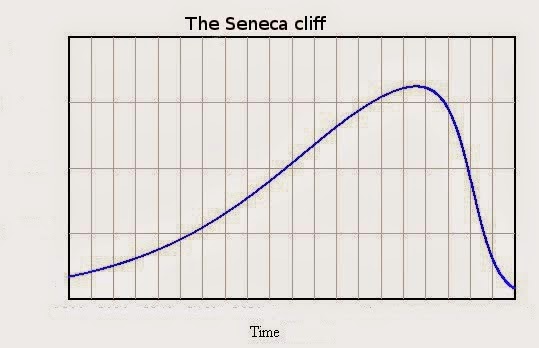
Once you give a name to a phenomenon, you can focus your attention on it and learn more and more about it. So, the "Seneca Cliff" idea turns out to be a fruitful one. It tells us that, in several cases, the cycle of exploitation of a natural resource follows a forward skewed curve, where decline is much faster than growth. This is consistent with what the Roman philosopher Lucius Annaeus Seneca wrote: "increases are of sluggish growth, but the way to ruin is rapid." With some mathematical tricks, the result is the following curve:


This curve describes the behavior of several complex systems, including entire civilizations which experienced an abrupt collapse after a long period of relatively slow growth. In my first post on the seneca cliff, I already discussed the collapse of the Mayan Civilization (*)


Here, you can see the the Seneca behavior, although the data for the Maya population density seem to be rather qualitative and uncertain. However, the data that I received recently from Diego Mantilla (see at the beginning of this post) are clear: if you take monument building as a proxy for the wealth of the Mayan civilization, then the collapse was abrupt, surely faster than growth.

Something similar can be said for the ancient Egyptians, although the data for pyramid building are more sparse and uncertain than those for the Maya. Finally, also the Roman civilization appears to have collapsed faster than it grew.

So, the Mayans didn't do better than other civilizations in human history. As other civilizations did, they moved toward their demise by dragging their feet, trying to avoid the unavoidable. They didn't succeed and they didn't realize that opposing the collapse in this way is a classic example of "pushing the levers in the wrong direction". It can only postpone collapse, but in the end makes it more rapid.

Will we do any better than the Mayans? One would hope so, but........


(*) Dunning, N., D. Rue, T. Beach, A. Covich, A. Traverse, 1998, "Human - Environment Interactions in a Tropical Watershed: the Paleoecology of Laguna Tamarindito, Guatemala," Journal of Field Archaeology 25 (1998):139-151.

Who

Ugo Bardi is a member of the Club of Rome, faculty member of the University of Florence, and the author of "Extracted" (Chelsea Green 2014), "The Seneca Effect" (Springer 2017), and Before the Collapse (Springer 2019)