Showing posts with label American Empire. Show all posts

Friday, January 10, 2020

Iran, Oil, and War: The End of the Carter Doctrine?

The "Oil Corridor," where the largest oil resources in the world are located. It was generated by events that took place during the Jurassic period. Those events can't be affected by politics, but they can affect politics.


For a while, the situation with the USA-Iran standoff looked like a scene in an old Western movie:  two drunken gunmen facing each other in the saloon. Fortunately, things calmed down and, for this time, it seems that no war on Iran is in sight, at least in the short term. Perhaps we have been lucky, perhaps some benevolent deity took care of the situation, or, perhaps, there is a logic in these events.

History often moves along the whim of leaders but even mad leaders must take into account reality. And this seems to be what happened in this case. It is possible that we are seeing the end of the "Carter Doctrine" that was stated in 1980. The idea was, and it is still today, that the control of the Middle East is of "vital interest" for the US. That was based on reality as it was in 1980, now reality is different and so there is a reason for the change. But let's see the whole story from the beginning.

It all started long ago, during the Jurassic period, when the slow sedimentation of an ancient sea created a strip of oil fields that goes from the Caucasus and the Caspian Sea, in central Eurasia, all the way South to Yemen, crossing Iran, Iraq, Saudi Arabia, and other states of the region. It is there that most of the world's oil is. More than 20% of all the oil produced today goes through the narrow strait of Hormuz, a critical point of the world's geopolitical map.

So, back to the early 1980s, the US had been the dominant world power for nearly four decades after the victory in World War II. As usual, geography is the mother of empires, and it was because of its vast national oil resources that the US could come to play that role. But oil production in the US had peaked in 1970 and was declining. No oil, no Empire. It was necessary to find new resources and the Middle East region was the richest in the world. A natural target.

The struggle for the Oil of the Middle East had already started in the 1950s, when the prime minister of Iran, Mohamed Mossadeq, was overthrown in 1953 by a coup orchestrated by the United States. Then, there was the period in which the US more or less controlled the Iran government using the Shah as a proxy. Then there came the Iranian revolution in 1978-79 and the result was the toppling of the Shah. At that point, in 1980, President Carter stated his "doctrine" -- really nothing more than a description of what had been going on up to then.

You know the troubled story of the Middle East in the years that followed. The disastrous Iraq-Iran war (1980 - 1988). The US going "boots on the ground" first in Kuwait in 1991, then invading Iraq in 2003. At that time (and also later on) it was fashionable to say that "boys can go to Baghdad, but real men want to go to Tehran." Maybe it was a joke, but it could have been deadly serious. It is part of the logic of empires to expand.

Eventually, the invasion of Iran never took place and it looks like it never will. It is, again, the way Empires function. They are like a tide, they ebb and flow. The American Empire flowed into Iraq, now it is ebbing back. Most commenters of the recent events agree that we are seeing the first stages of the US bringing their troops at home. It will take time, but it is written on the walls of the Martyr Monument in Baghdad. 

Apart from the antics of the madmen in power, there is a logic in the US abandoning Iraq. Someone, somewhere in Washington D.C., must have asked the question: "why exactly do we keep troops in Iraq?" Yes, why? The typical answer up to not long ago would have been "to secure the oil." But things have changed. The once very abundant oil resources of the Middle East are unavoidably being depleted. Some producers, Syria and Yemen, are already in terminal decline. Of the others, none has the capability of significantly increasing production and all are expected to go into decline in the coming years (you may have heard of the recent discovery of "53 billion barrels" of oil in Iran. Yes, and they also found a pot of gold at the end of the rainbow).

At the same time, the US really found a pot of black gold in shale oil, to the point that during the past few years they managed to increase their oil production to levels higher than the earlier 1970 peak. That shale oil is a good deal in economic terms is questionable, to say the least. But the US elites have become convinced not only that they are truly self-sufficient in terms of energy, but that this self-sufficiency will continue for the foreseeable future, perhaps forever because shale oil is seen as practically infinite. And they see shale oil as a strategic dominance weapon.

At this point, many things start making sense: the oil from the Middle East is not anymore a "vital interest" for the US as it was at the times of Jimmy Carter. So, why pay good money to keep troops there? Those troops are useful only to those spineless Europeans who still depend on oil imports, but why should America pay? Besides, in the current situation, American troops are just sitting ducks waiting for the next rain of missiles coming from those bearded fanatics. So, let's bring the troops back home. Then, we'll be able to assassinate anyone at will in the region without fearing for retaliation. 

And that seems to be how things stand, for now -- unless someone makes some mistake and the fireworks restart. But it is a confirmation that it is geography that creates empires and, also that the geography of oil keeps changing. We'll see more changes in the future, the only sure thing is that, unlike what some people believe, oil is not infinite.


Monday, December 30, 2019

The Collapse of the American Empire. What Future for Humankind?


These notes are not supposed to disparage nor to exalt an entity that has a history that goes back to at least a couple of millennia ago. Like all Empires, past and present, the Modern World Empire went through its parable of growth and glory and it is now starting its decline. There is not much that we can do about it, we have to accept that this is the way the universe works. On this subject, see also a previous post of mine "Why Europe Conquered the World "


For everything that exists, there is a reason and that's true also for that gigantic thing that we call sometimes "The West" or perhaps "The American Empire," or maybe "Globalization." To find that reason, we may go back to the very origins of the modern empire. We can find them in an older, but already very advanced, empire: the Roman one.

As someone might have said (and maybe someone did, but it might be an original concept of mine), "geography is the mother of Empires." Empires are built on the availability of natural resources and on the ability to transport them. So, the Romans exploited the geography of the Mediterranean basin to build an empire based on maritime transportation. Rome was the center of a hub of commerce that outcompeted every other state in the Western region of Eurasia and North Africa. This transportation system was so important that it was even deified under the name of the Goddess Annona. It was kept together by a financial system based on coinage, Latin as lingua franca, a large military system, and a legal system very advanced for the time.

Like all empires, though, the Roman one carried inside the seeds of its own destruction. The empire peaked at some moment during the 1st century of our era, then it started declining. It was the result of a combination of related factors: the depletion of the precious metal mines that deprived the Empire of its currency, the growth of the Silk Road that siphoned the Roman wealth to China, the overexploitation of the North-African agriculture that fed the Roman cities. No money, no resources, no food: the Empire could only collapse and it did.

The old Roman Empire left a ghostly shadow over Europe, so persistent that for almost two millennia people tried to recreate it one way or another. But it was not possible, again it was a question of geography. The Roman intensive agriculture had so badly damaged the North-African soil that it could never recover -- still, it hasn't. The loss of the fertile soil on the southern shore divided the Mediterranean sea into two halves: the green and still fertile Northern part, and the dry and barren Southern part. Nevertheless, there were several attempts to rebuild the ancient economic and political unity of the basin. The Arabic caliphate built a Southern Mediterranean Empire based on Arabic as the Lingua Franca and on Islam as the common cultural ground. But the expansion of Islam never reached Western Europe. Its economic base was weak: the North African agriculture just couldn't support the population level that would have been needed to control the whole Mediterranean basin. The same destiny befell, later on, on the Turkish Empire.

On the Northern side of the Mediterranean sea, Europe was a region that the ancient Romans had always considered mostly a periphery. With the Roman Empire gone, Northern Europe was freed to develop by itself. It was the period that we call the "dark ages," a misnomer if ever there was one. The dark ages were a new civilization that exploited some of the cultural and technological structures inherited from Rome but that also developed original ones. The lack of gold and silver made it impossible for Europeans to keep Europe together by military means. They had to rely on subtler and more sophisticated methods that, nevertheless, were patterned over the old Roman structures. Cultural unity was insured by Christianity, with the church even creating a new form of currency not based on precious metals but on the relics of holy men and women. The church also was the keeper of Latin, the old Roman language that became the European the Lingua Franca, the only tool that allowed Europeans to understand each other.

In this way, the Europeans created a gentle and sophisticated civilization. They could maintain the rule of law and they gave back to women some of the rights that they had lost during the Roman Empire. Witch-burning, endemic in the Roman Empire, couldn't be completely abolished, but its frequency was reduced to nearly zero. Slavery was formally abolished, although it never actually disappeared. Material wealth was de-emphasized, in favor of spiritual wealth, art and literature flourished as much as they could in a poor region as Europe was at that time. Wars didn't disappear, but the early Middle Ages were a relatively quiet period with the Church maintaining a certain degree of control over the worst excesses of the local warlords. The Arthurian cycle emphasized how errant knights were fighting to perform good deeds and to defend the weak. It was put in writing only in the late Middle Ages, but it had been part of the European dreamscape from much earlier times.

But things never stand still. During the Middle Ages, the European population and the European economy were growing together exploiting a relatively intact territory. Soon, the gentle civilization of the early Middle Ages gave way to something that was not gentle at all. With the turn of the millennium, Europe was overpopulated and Europeans started looking for areas where to expand. The crusades started with the 11th century and were a new attempt to re-unify the Mediterranean basin. Europe was even equipping itself with international structures that could have governed the new Mediterranean Empire: the chivalric orders. Of these, the Templars were an especially interesting structure: in part a military society, but also a bank and a cultural center, all based on Latin as lingua franca. The idea was that the new Mediterranean Empire would be governed by a supranational organization, not unlike the old Roman Empire.

But the crusades were an expensive failure. The military effort had to be supported by the main economic resources of the time: forests and agricultural land. Both were badly overstrained and the result was an age of famines and pestilences that nearly halved the European population. It was a new collapse that took place during the 14th century. It was bad enough that we may imagine that the descendants of the Sultan Salah ad-Din could have stricken back and conquered Europe, had they not been stabbed in the back by the expanding Mongol empire.

The European Population: graph from William E Langer, "The Black Death" Scientific American, February 1964, p. 117 -- note how growth is faster after the collapse than it was before.

But Europeans were stubborn. Despite the 14th century collapse, they kept using the same trick they had been using before to rebuild after a disaster: patterning new structures on the old ones. The Europeans were good warriors, skilled shipbuilders, excellent merchants, and always willing to take risks in order to make money. They keep doing what they were good at doing and, if they couldn't expand into the East, why not expand West, across the Atlantic Ocean? It was a wildly successful idea. Europeans imported gunpowder technology from China and used it to build fearsome weapons. With their newly mastered gunnery skills, they created a new kind of ship, the cannon-armed galleon. It was a dominance weapon: a galleon could sail everywhere ad blast away all opposition. A century after the great pestilence, the European population was growing again, faster than before. And, this time, the Europeans were embarking on the task of conquering the world.

Over a few centuries, Europeans behaved as worldwide marauders: explorers, merchants, pirates, colonists, empire builders, and more. They sailed everywhere and wherever they sailed, they dominated the sea and, from the sea, they dominated the land. But who were they? Europe never gained a political unity nor it embarked on an effort to create a politically unified empire. While fighting non-European populations, Europeans were also fighting each other for the spoils. The only supranational governing entity they had was the Catholic Church, but it was an obsolete tool for the new times. By the 16th century, the Catholic Church was not anymore a keeper of relics, it was a relic itself. The final blow to it came from the invention of the printing press that enormously lowered the cost of books. That led to a market for books written in vernacular language and that was the end of Latin as a European lingua franca. The result was the reformation by Martin Luther, in 1517: the power of the Catholic Church was broken forever. Now, European states had what they wanted: a free hand to expand where they wanted.

As you may have imagined, the result of this "battle royal" historical phase was a new disaster. The European states jumped at each other's throat engaging in the "30-years war" (1618 – 1648). Half Europe was laid waste, plagues and famines reappeared, food production plummeted down, and with it population. Europeans were not just fighting against each other in the form of warring states. European men were fighting against European women: it was the time of witch-burning, tens of thousands of innocent European women were jailed, tortured, and burned at the stake. With its forests cut and the agricultural land eroded by overexploitation, there was a distinct possibility that the age of the European world empire was over forever. It was not.

Just like a stroke of luck had saved Europe after the first collapse of the 14th century, another nearly miraculous event saved Europe from the 18th century collapse. This miracle had a name: coal. It was a European economist of the 19th century, William Jevons, who had noted that "with coal, everything is easy." And with coal Europeans could solve most of their problems: coal could be used in place of wood to smelt metals and make weapons. This saved the European forests (but not for Spain, which had no cheap coal and whose empire floundered slowly). Then, coal could be turned into food using an indirect but effective technology. Coal was used to smelt iron and produce weapons. With weapons, new lands were conquered and the inhabitants enslaved. The slaves would then cultivate plantations and produce food to be shipped to Europe. It was the time when the British developed their habit of tea in the afternoon: the tea, the sugar, and the flour for the cakes were all produced in the British plantations overseas.

And the cycle continued. The European population restarted growing during the 18th century and, by the end of the 19th century, the feat of conquering the world was nearly complete. The 20th century saw a consolidation of what we can now call the "Western Empire" with the term "West" denoting a cultural entity that by now was not just European: it encompassed the United States, Australia, South Africa, and a few more states -- including even Asiatic countries such as Japan which, in 1905, gained a space among the world powers by force of arms, soundly defeating a traditional European power, Russia, at the naval battle of Tsushima. From a military viewpoint, the Western Empire was a reality. There remained the need of turning it into a political entity. All empires need an emperor, but the West didn't have one, not yet.

The final phase of the building of the Western World Empire took place with the two world wars of the 20th century. Those were true civil wars fought for imperial dominance, similar to the civil wars of ancient Rome at the time of Caesar and Augustus. Out of these wars, a clear winner emerged: the United States. After 1945, the Empire had a common currency (the dollar), a common language (English), a capital (Washington DC) and an emperor, the president of the United States. More than all that, it had acquired a powerful propaganda machine, the one we call today "consensus building." It built a narrative that described WW2 as a triumph of good against evil -- the latter represented by Nazi Germany. This narrative remains today the funding myth of the Western Empire. The only rival empire left, the Soviet Empire, collapsed in 1991, leaving the American Empire as the sole dominant power of the world. Also that was seen as proof of the inherent goodness of the American Empire. It was then that Francis Fukuyama wrote his "The End of History," (1992) correctly describing the events he was witnessing. Just like when Emperor Octavianus ushered the age of the "Pax Romana," it was the beginning of a new golden age: the "Pax Americana"

Alas, history never ends and, as I mentioned at the beginning of this essay, all empires carry inside themselves the seeds of their own destructions. Just a few decades have passed from the time when Fukuyama had claimed the end of history and the Pax Americana seems to be already over. The Western world dominance had been based first on coal, then on oil, now trying to switch to gas, but all these are finite resources becoming more and more expensive to produce. Just like Rome had followed the decline of its gold mines, the West is following follow the decline of the wells it controls. The dollar is losing its role of world currency and the Empire is under threat by a new commercial system. Just as the ancient silk road was a factor in the collapse of the Roman Empire, the nascent "road and belt initiative" that will connect Eurasia as a single commercial region may give the final blow to the Globalized dominance of the West.

To be sure, the Western Empire, although in its death throes, is not dead yet. It still has its wondrous propaganda machine working. The great machine has even been able to convince most people that the empire doesn't actually exist, that everything they see being done to them is done for their good and that foreigners are starved and bombed with the best of good intentions. It is a remarkable feat that reminds something that a European poet, Baudelaire, said long ago: "the Devil's best trick consists in letting you believe he doesn't exist." It is typical of all structures to turn nasty during their decline, it happens even to human beings. So, we may be living in an "Empire of Lies" that's destroying itself by trying to build its own reality. Except that the real reality always wins.

And there we are, today. Just like the old Roman Empire, the Western Empire is going through its cycle and the decline has already started. So, at this point, we could hazard some kind of moral judgment: was the Western Empire good or bad? In a sense, all empires are bad: they tend to be ruthless military organizations that engage in all kinds of massacres, genocides, and destruction. Of the Roman empire, we remember the extermination of the Chartaginese as an example, but it was not the only one. Of the Western Empire, we have many examples: possibly the most evil one being the genocide of the North-American Indians, but such things as the extermination of civilian by aerial bombing of cities during WW2 was also impressively evil. And the (evil) Empire doesn't seem to have lost its taste for genocide, at least as it can be judged from some recent declarations by members of the American government about starving Iranians.

On the other hand, it would be difficult to maintain that Westerners are more evil than people belonging to other cultures. If history tells us something, it is that people tend to become evil when they have a chance to do so. The West created many good things, from polyphonic music to modern science and, during this last phase of its history, it is leading the struggle to keep the Earth alive -- a girl such as Greta Thunberg is a typical example of the "good West" as opposed to the "evil West."

Overall, all empires in history are more or less the same. They are like waves crashing on a beach: some are large, some small, some do damage, some just leave traces on the sand. The Western Empire did more damage than others because it was larger, but it was not different. We have to accept that the universe works in a certain way: never smoothly, always going up and down and, often, going through abrupt collapses, as the ancient Roman philosopher Lucius Seneca had noted long ago. Being the current empire so large, the transition to whatever will come after us needs to be more abrupt and more dramatic than anything seen in history before. But, just like it was the case for ancient Rome, the future may well be a gentler and saner age than the current one. And the universe will go on as it has always done.


Monday, October 21, 2019

The West Fades. The Center Quietly Returns: The New Silk Road


An image from the workshop on desalination and mineral extraction from seawater organized by Sharif University in Teheran this week. In the photo, you can see people from Oman (3), Iran (3), South Africa (1), India (1), and Bangladesh (1). It was not only a multi-ethnical group but also a Eurasia-centered one. It gave me some impression of the shifting balance of power in the world, from the West to the Center, and inspired this post. 


If you think about that, it is funny that we tend to define ourselves as "Westerners." Most civilizations and cultures in history have tended to see themselves as the center of the world, just think of China: it is supposed to be "the Middle Kingdom". This idea that we are on an edge is something that we've probably inherited from the ancient Greeks, when everything west of them was seen as a land of mystery, peopled with savages, monsters, and Gods. 

But the fact that we call ourselves Westerners doesn't mean we think we are a periphery of the world, not at all. Most Westerners seem to cherish the idea that we are the real center, the most advanced, enlightened, and powerful area of the world. The rest of is, well, it is mostly inhabited by turban-wearing barbarians, savage tribes, or, at best, ancient and decadent empires on their way to dissolution. These Non-Westerners need our guidance if they have to attain the nirvana as defined here: democracy and economic liberism.

But the world is vast and things change. Empires are born, reach their pinnacle of greatness and then collapse while still claiming that they will last forever. That may be the destiny of that great world empire, the "Western Empire," that started with the British and continues with the Americans. The center of the world may well be returning to what it used to be up to a few centuries ago, gravitating around that "geographical center" sometimes said to be in Egypt, sometimes in Turkey, sometimes in Syria. It doesn't matter where it is exactly: it is at the heart of the gigantic landmass of Eurasia, somewhere in the region we call the "Middle East."

Chess players know how important it is to dominate the center if they want to dominate the game. Not for nothing, indeed, the game of Chess was developed not far from the center of the world: somewhere in Persia. But to dominate the center, you need to be able to move in and out of it and in the real world that takes roads. In ancient times, the center of Eurasia was crossed by the Silk Road: a long and winding road that went through mountains and deserts, including also coastal sea lanes. It was the realm of commercial caravans with their camels slowly marching from one edge to the other of a Eurasian supercontinent and to Africa as well, carrying gold, silver, ivory, spices, silk, and much more.

The Silk Road lost importance and then disappeared with the arrival of the Westerners who monopolized commerce with their ships and power with their armies. The concept of national borders had never existed before but it was the death toll for the old caravans, now confined within states. Commerce was taken over by Westerners with their container ships, crossing the oceans in a gigantic network that created the empire we call sometimes "Globalization." Not just a commercial empire but a military one as well, dominated by the mighty armies of the West.

Empires are run by a combination of commerce and military power and it is the balance of costs and profits that keeps them together. The old Silk Road never turned into a continental empire because it was just too expensive to move armies along it on long distances. But the agile camel caravans provided the link that was needed for the road to remain open: a low-cost system that didn't need a military governance system and couldn't afford it anyway, Instead, the modern sea lanes of the current World Empire are kept together and controlled by the mighty carrier strike groups of the American Navy: nothing and nobody would even dream of challenging their power, so far. But the carrier group is a behemot that needs to be fed, and for how long will that be possible?

Things keep changing, as they have always been doing. The old Silk Road is being revamped with the name of the "Belt and Road" initiative. It is the revenge of the land over the sea: the lanes of the new silk road are nearly invulnerable to the naval power of the Westerners if nothing else just for the sheer vastity of the territory it connects. Think about that: the population of Eurasia and Africa, together, make almost 6 billion people. The rest of the world is a periphery. 

So, the Western domination may be fading and much of what we are reading in the news nowadays is a reflection of this decline. With the depletion of the resources that created the Western Empire, first coal, then oil, the center is returning where it used to be and the great road that links Eastern and Western Eurasia is going to be again the pulsating artery of the world. Maybe Eurasia will be crisscrossed by fast trains powered by solar energy, or maybe the old camels will return: solid, resilient, unstoppable.

And the Westerners? They will return to their ancient role of seafaring pirates: coming and going like storms, leaving little trace. Curiously, though, they'll be leaving a reverberation of their presence with the English language, initially carried into Eurasia by the American Legions, now the tool of choice by Eurasians to understand each other.

Perhaps English is the true reason for the use of the term "The West" since it did originate on the extreme Western edge of Eurasia. But that's just a quirk of history: once, at least four languages were spoken along the old silk road: Mongolian, Persian, Arabic, and Turkish, while Chinese and Greek were spoken at the two ends. English as the dominant language may make things simpler and continue being used during the 21st century, and even farther in the future. Or we may switch to some other language: perhaps "googlish" or some other pidgin language. Who knows? As always, life is a journey, not a destination.


Monday, February 11, 2019

What's Emperor Trump Doing? He is Busy at Splitting the Empire in Two


Donald Trump seems to be doing what Roman Emperors like Diocletian, Constantine, and Theodosius did long ago: splitting the empire into two halves. Trump may not have consciously decided to do that, but an Empire can only be as large as it can afford to be and the American Empire can't afford anymore to dominate the whole world.


Flavius Theodosius Augustus "The Great" (347- 395 CE) was the last emperor to rule over the whole Roman Empire. His success was probably due in large part to his habit of plundering Pagan temples for the gold he needed to pay his troops. But Pagan temples were a limited resource and Theodosius himself seemed to understand that when, shortly before his death, he partitioned the Empire between his two sons, Arcadius and Honorius. Afterward, the empire would never be united under a single emperor again.

The Roman Empire had been a strong centralized power during its heydays, but it never was very interested in creating an ethnical and linguistic unity among its subjects. The Roman authorities understood that it was less expensive to tolerate diversity than to force uniformity -- a typical policy of most empires. So, the Empire remained split into two main linguistic halves: the Latin-speaking Pars Occidentis and the Greek-speaking Pars Orientis. Theoretically, Latin was the official language but, in practice, the Empire remained a bilingual entity and, during the 2nd and 3rd centuries, the Roman elite would tend to speak Greek -- considered more refined and classy than Latin.

The split of the two sides of the Empire was not just linguistic, it was economic as well. The Pars Occidentis remained based on mineral wealth which, in turn, fueled the Empire's military power. The Pars Orientis was more based on commerce and manufacturing and it exploited its favorable geographical position as the terminal of the silk road that connected China to Europe. During the expansion period, the military strength of the West made it dominant but, with the exhaustion of the gold mines in Spain, it lost the resources needed to pay for its oversized military apparatus. In time, the Western Empire became unable to control even its own territory and it squandered its remaining resources in huge border walls. It collapsed and vanished during the late 5th century CE. The Eastern Empire lasted nearly one millennium longer but was never able to rebuild the power of the old Roman Empire.

Fast forward to our times, and it is clear that the American Empire is facing the same situation that the Romans were facing around the 2nd century AD. Like the old Western Empire, the American Empire's economy is mainly based on mineral resources: crude oil in particular. But, with the gradual exhaustion of these resources, the empire cannot afford to dominate the whole world anymore.

Emperor Trump seems to have an uncanny ability to understand the situation, even though he may not be an expert in Roman history. His actions are perfectly understandable in light of the plan of splitting the empire into two halves. One half (Pars Occidentis) will still be dominated from Washington, the other half (Pars Orientis) will have Beijing as its capital. The Western Part will retain the original Imperial language, English. The Eastern Part may switch to Chinese.

Consistently, Trump is planning to abandon Afghanistan and also Syria, both too far and too expensive to defend and he also was not interested in an all-out confrontation with North Korea. But he seems to consider South America as part of the Western dominion, so he is moving to take control of Venezuela. Trump is also acting to destroy the hegemony of the dollar as world currency. Apparently, the idea is that the Western Empire is safer from financial disasters if the dollar becomes the Western currency only. So, the economic sanctions enacted against Iran, Russia, and other countries are forcing the Eastern Empire to develop new currencies and financial systems independent of the dollar.

Clearly, Emperor Trump is facing strong resistance. Just as many Roman Emperors, he not completely in control of the Imperial military apparatus and a sizeable opposition is trying to maintain the American Empire alive in is most extended and expensive form: dominating the whole planet. But the direction is clear and the situation is simple: an Empire can only be as large as it can afford to be. The gradual depletion of the mineral resources and the increasing costs of pollution are making a global empire impossible.

The Globalized World Empire was a beautiful creature as long as it prospered, but it was burning the dynamite stick at both ends. The time of global dominance is gone and the Empire is now in a convulsive phase: retreat is the most dangerous military maneuver and it is best executed maintaining an aggressive posture. Which is exactly what Emperor Trump is doing with his threats of war. But it is also true that the game of chicken is the second most dangerous game known (the first is the Russian Roulette). So, the retreat of the Western Empire may not involve just a rapid Seneca Collapse, as it was the case for the old Roman Empire, but a final blast of fireworks in the form of a nuclear war which would end civilization as we know it. Not pretty, but that's the way things are.

There remains one point of contention: is Western Europe in the Orientis or in the Occidentis part of the Empire? Surely, Britain tends to remain part of the Western Empire because of its linguistic ties with the United States. But the non-English speaking parts of the former EU don't have this link and they have strong - practically unbreakable - ties with Russia as an energy supplier. So, they might become part of the Eastern Eurasian Empire.

It seems that Trump understands this point very well, too, and it is in these terms that you can interpret his lashing out at the NATO allies at last year's G7 meeting. Trump's message to the states once forming the European Union was simply, "Sorry, fellows, we can't afford to defend you anymore unless you pay us more money than you can afford to pay." In this sense, Western Europe could play the role of Britain and Dacia during the 3rd and 4th century CE, abandoned by the central Roman Government and left to fend off by themselves against the barbarian invaders. Who knows? History rhymes again and we might even have a new King Arthur.

________________________________________


Was the fall of the Western Roman Empire a Seneca Collapse? Yes, by all means it was. Look at this:


From Taagepera, Size and Duration of Empires, 1978 -- the vertical scale is in million square miles

See also "Can Donald Trump be the last world emperor?"

And you may also be interested at how Theodosius's daughter, Galla Placidia, managed to keep the Western Empire together even without plundering temples. The story is here.  

Note also that I used the term "understanding" but that doesn't mean that Trump consciously understands the deep reasons of why he is doing what he is doing in the sense of moving intentionally to the splitting of the empire. He is simply reacting to the stimuli he perceives and he moves accordingly. (which is, BTW, what we all do!!)


Monday, January 7, 2019

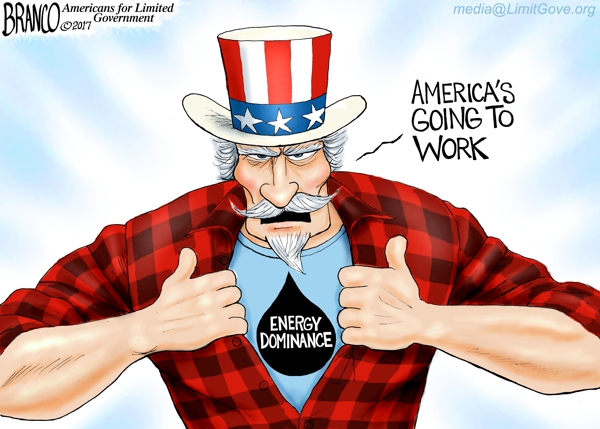
"Energy Dominance," what does it mean? Decoding a Fashionable Slogan


"Now, I know for a fact that American energy dominance is within our grasp as a nation.” Ryan Zinke, U.S. Secretary of the Interior (source)

"All Warfare is Based on Deception" Sun Tzu, "The Art of War"


Over nearly a half-century, since the time of Richard Nixon, American presidents have proclaimed the need for "energy independence" for the US, without ever succeeding in attaining it. During the past few years, it has become fashionable to say that the US has, in fact, become energy independent, even though it is not true. And, doubling down on this concept, there came the idea of "energy dominance," introduced by the Trump administration in June 2017.  It is now used at all levels in the press and in the political debate.

No doubt, the US has good reasons to be bullish on oil production. Of the three major world producers, it is the only one growing: it has overtaken Saudi Arabia and it seems to be poised to overtake Russia in a few years. (graphic source).


This rebound in the US production after the decline that started in the early 1970s is nearly miraculous. And the miracle as a name: shale oil. A great success, sure, but, if you think about it, the whole story looks weird: the US is trying to gain this "dominance" by means of resources which, once burned, will be forever gone. It is like people competing at who is burning their own house faster. What sense does it make?

Art Berman keeps telling us that shale oil is an expensive resource that could be produced at a profit only for market conditions that are unrealistic to expect. So far, much more money has been poured into shale oil production than it has returned from the sales of shale oil. "Energy dominance" seems to be just an elaborate way to lose money and resources. Again, what sense does that make?

But there is a logic in the term "energy dominance." It has to do with the way slogans are used in politics: a slogan is not just a compact way of expressing a certain political concept, it is often a coded message that hides much more than it says. So, we know that "bringing democracy" to a foreign country means to bomb it to smithereens. "Make America great again" means subsidizing the fossil fuel industry. "The Indispensable Country" means, "The American Empire." And more.

There is nothing wrong in using coded slogans: you only have to know how to decode them. So, "energy dominance" has to be decoded and turned into "military dominance." Then, things start making sense.

One quick note before you accuse me of being a conspiracy theorist: I am reasonably sure that there is no "control room" in a dark basement of the Pentagon or of the White House deciding long-term economic and military objectives. The decision mechanism of modern states is collective and networked. It is akin to that of anthills: there is nobody in charge, plenty of people push in different directions and, eventually, the giant structure may start moving in a certain direction.

So, the fact that so much money has been directed toward the exploitation of shale oil and gas doesn't mean that someone at the top decided that it was the thing to be done. It is simply, that investors tend to direct their financial resources where they think they'll have returns, and that may well be the result of a collective hallucination. Investing in shale oil is, basically, a Ponzi scheme but if Ponzi schemes exist there is a reason for them to exist. Even if investing in something doesn't generate overall profits, it moves money, benefits contractors, raises the GDP, and the more money is invested the more expectations of profits grow. And so it goes until the bubble bursts, but that may take time.

But there is more than that in this story: it is the military side. We all know that wars are won by the side that can pour more resources into the fight. It was in this way that the first and the second world war were won: the allies could produce more energy in the form of oil, coal, and gas. And, with these energy sources, they could produce more planes, tanks, cannons, bombs, bullets, and more that was thrown at the Germans until they gave up. Matthieu Auzeannau gives us plenty of examples of this mechanism in his book "Oil, Power, and War." The Germans were always lacking enough oil to power their military machine and that's why they were doomed from the beginning.

For the military, the lesson of the past world wars is that wars are won by the side which has the largest oil supply. And they remember it. So, if you want to attain military dominance, energy independence is not enough, you need to attain energy dominance.

Everything makes sense also in view of some recent results on the statistical patterns of wars. Wars, it seems, are correlated to the thermodynamic phenomenon of entropy dissipation in complex systems. The more energy there is to dissipate, the faster it is dissipated. And if this dissipation is really fast, it may take the shape of a war -- war is the fastest way to destroy (dissipate) accumulated resources. But, in order to dissipate resources, you need to accumulate them first, and that's the role of shale oil in the current situation.

Which means that shale oil is not a natural resource, it is a military resource. As such, it doesn't matter if it brings a profit or not for the investors. What matters is how it can be used to maintain and expand that gigantic social and economic structure that we call "Globalization" (another slogan that can be decoded as "the global empire").

As long as the production of shale oil increases, we face the risk of a new, major world war. We can only hope that the shale bubble bursts by itself first. One more good reason why a Seneca Collapse of oil production would be good for all of us.


Sunday, October 7, 2018

Could Donald Trump be the Last World Emperor? States and Empires After the End of the Fossil Age


Empires are short-lived structures created and kept together by the availability of mineral resources, fossil fuels in our times. They tend to decline and fall with the decline of the resources that created them, and that's the destiny of the current World Empire: the American one. Will new empires be possible with the gradual disappearance of the abundant mineral resources of the past? Maybe not, and Donald Trump could be the last world emperor in history.


A warlord named Sargon of Akkad was perhaps the first man in history to rule a true empire, around mid 2nd millennium BC in Mesopotamia. Before him, humans had been warring against each other for millennia, but the largest social structures they had developed were no larger than city-states. Gradually, new forms of social aggregation emerged: kingdoms and empires, structures kept together by a central government that, normally, involves a larger than life male figure, emperor or king, who runs the state machine using a combination of force, prestige, and gifts.

Sargon's Empire went through the normal destiny of the empires that came after it: glory and plunder at the beginning, then struggle, destruction and, finally, collapse. Nothing unusual for a cycle that would span millennia of human history. Taagenpera shows how empires come and go (image source)


The rise and fall of empires looks like a chemical reaction, flaring and then subsidizing, as a reaction running out of reactants -- then restarting when new reactants have accumulated. For empires, the reactants might have been mineral resources -- it may well be that Sargon's empire was the result of silver having become a standard medium of exchange in Mesopotamia. With silver, Sargon could pay his soldiers. With his soldiers, he could rob more silver. And, with more silver, he could pay even more soldiers -- and there you go: the road for glory and murder is open.

The Romans built up their stupendous empire using the gold and the silver of their mines in Spain. When the mines were exhausted, so was the Roman Empire, but it left such a deep impression that for more than a millennium people tried to rebuild it. Charlemagne built his Holy Roman Empire during the 9th century AD by means of newly discovered silver mines in Eastern Europe. Later on, during the 16th century, Charles V rekindled Charlemagne's idea with his empire on which the sun never sets, built on the gold coming from the Americas. But these empires, too, went through a cycle of growth and decline, in parallel with that of the resources which had created them.

The 20th century was the age of fossil empires. The British used coal to create the biggest and the most powerful empire ever built -- it faded away with the gradual decline of its coal production. Another ancient empire, Austria-Hungary, the last remnant of the concept of a European Empire, went to pieces during WWI, the only European state which didn't survive it. The attempt of Italy to re-create the Roman Empire in 1936 with the conquest of Ethiopia had the only effect of generating the shortest-lived empire in the history of the world, just five years. At least, the short saga of the Italian Empire could demonstrate that no empire can exist for long without abundant mineral resources available. With the end of WWII, only two large empires remained: the Soviet and the American one. Both were based on fossil fuels and, in particular, on the abundant crude oil they could produce. For a while, the Soviet Empire challenged the worldwide supremacy of the American Empire - but it had to give up and fold over when its oil resources became too expensive to extract and it was impossible to use them to fuel its military apparatus.

Today, the sole heir of some four and a half millennia of empire building is the American Empire, a stupendous structure that dominates the world's oceans and a large part of the world's land. But, as for older empires, the American one will last only as long as will be able to produce the resources that created it: fossil fuels. And the end can't be too far away: conventional oil production has been declining for decades in the US territory, while the production from shales can only postpone the unavoidable. It may well be that the mighty American Empire will soon follow the path of its predecessors. If this is the case, the collapse will be fast and brutal, the kind of collapse that we call sometimes "Seneca Cliff."

The whole political debate in the US reflects this situation. The Dems (or the Left) have come to embrace the Imperialist viewpoint, pursuing an aggressive foreign policy. The Reps (or the Right) are no enemies of the Empire, but many of them favor retrenching within the US national borders. There is a certain logic in these positions: the political base of the Dems is in the impoverished remnants of the middle class and, for them, the only hope of survival is the economic expansion that could come from plundering foreign countries. The Reps, instead, represent the elites and, for them, the easiest way of maintaining their dominance is to plunder the American middle class.

Donald Trump represents well the view of the elites. He seems to understand (or, at least, to sense) in which direction the wind is blowing and what he is doing, apart from the exaggerated boasting, is to try to turn the parasitic imperial economy of the United States into a self-standing national economy. Not an easy task and Trump may well fail in what he is trying to do. But history never fails: empires have always gone through a cycle of growth and collapse, it is just a question of time.

So, the American Empire is destined to go, but what will come after the fall? Most likely, we'll see a situation resembling that of the fall of the Roman Empire, when there were no resources to build another large empire and Europe moved back into an age of independent cities and statelets. Nowadays, many people seem to think that the disappearance of fossil fuels would bring a return of the Middle Ages. It might happen: large organizations need a lot of energy to run and, in addition, our civilization will be badly hit by global warming. The result may be the fragmentation of the current political entities, returning to nation-states or even back to city-states. There will not be another World Empire and Donald Trump could be, if not the last emperor, the last who ruled an empire as large as the current American one.

The return to Middle Ages could be avoided, at least in part, if humankind were to invest some of the remaining resources into building an energy infrastructure based on renewable energy, but, right now, it seems that these resources will be squandered in a new series of resource wars. And so it goes, it is the great cycle of history that moves onward. Humans struggle, fight, and quarrel, but the best efforts of mice and men come to naught when they try to keep things as they are and they have been. The only unchanging thing in history is that things always change.


Wednesday, June 20, 2018

Trump Takes Italy by Storm: the Rise of Matteo Salvini and of the Italian Right


Matteo Salvini, the leader of the Italian League and Minister of the Interior since June 2018. During the past few weeks, he has gained political prominence in Italy by adopting Trump's style and policies. Here, you see him together with the slogan "Italians First."


During the past few weeks, we have seen a true political revolution in Italy. Matteo Salvini, leader of the Italian League, has successfully exploited his new position of Minister of the Interior to gain personal prominence. The M5s movement had won the elections, this year, but it has been emarginated to a secondary role, while Salvini acts and looks like if he were the real Prime Minister. If new elections were held now in Italy, Salvini and the League would win hands down

All politics is, after all, about blame shifting. So, political success means simply finding someone to blame. Matteo Salvini was successful by adopting the same style and content that made the political fortune of Donald Trump. Both Trump and Salvini found a good target to blame with immigrants and foreigners in general. Both used harsh language, insults, callousness, and plain racism. Both found that the more shrill and violent their utterances were, the more they were approved by the public. It took a remarkably small effort to convince a large majority of Italians that all their troubles are caused by immigrants and, in particular, by the Roma people (less than the 0.2% of the Italian population). Salvini also capitalized on demonizing the Euro and the European Union, although he can't afford (so far) to exaggerate with insults and threats in that field. In any case, right now, it seems that 72% of Italians approve Salvini's actions
 
For everything that happens there is a reason and there has to be a reason for the outburst of hate and of racism in Italy. It has to do, probably, with the return of nation-states as protagonists in the world power game and with the ongoing disgregation of the American Empire. 

After the end of WW2, the European Union took the role of an agent of the American Empire to keep the European states under control. But the EU itself had to be kept under control, least it could become another empire that could have challenged the American supremacy. So, the EU wasn't allowed to develop an army, nor all the paraphernalia that would have turned it into a recognizable state, from an official language to a decent flag. It was an exercise in political acrobatics and it is remarkable that it worked reasonably well for more than half a century. 

But, today, the EU is weakened by the economic crisis and probably fatally wounded by the loss of Britain. All Empires tend to collapse in times of economic hardships, an even more likely outcome for a entity, the EU, which was a failed empire from the beginning. So, the old states are rising again - a trend that we see also outside Europe. Even in the US, Donald Trump is busy at turning the American Empire back into a nation-state. That changes many things, not necessarily for good.

Normally, empires are not racist and they don't engage in ethnical cleansing. They cannot afford that, since they are composed of heterogeneous entities which may need to be kept together by force. That makes Empires expensive: one of their characteristic is the large and costly military apparatus they are forced to maintain. Excessive military expenses is the most common cause of the collapse of empires. It happened to the Ancient Romans, just as it happened to the Soviet Union. And it is happening right now to the American Empire. It just can't survive for long without the influx of cheap energy and resources that created it.

Nation-states, instead, are relatively homogeneous entities in linguistic and ethnical terms, less likely to fragment in smaller pieces. What they need in terms of military force may be just a militia able to put down or exterminate ethnical or ideological minorities. That makes them less expensive and more resilient than empires. They can survive the economic hardships that shattered the most powerful empires in the world's history.

Nation-states often generate great enthusiasm among their citizens, but they are far from being benign entities. Their ethnical and linguistical homogeneity may be more a dream than reality and their survival may need to be propped up a poisonous mix of aggressive nationalism, hate, and racism directed against foreigners. It was one of the methods used in Italy by Mussolini's government in the 1920s and 30s, so it is not surprising that Mr. Salvini's government (formally known as Conte's government) is using the same methods today. As we know, hate and racism may not remain confined to insults.

And here we stand. The message that the current economic hardship is the result of resource depletion and of the negative effects of ecosystem disruption didn't pass, and maybe it never will. At this point, accusing Salvini or Trump of "populism" or of "racism" is not going to stop the trend. It is clear that their methods work wonderfully well. The skunk is out of the bag and we don't have to wait for long before other leaders will follow their example. A new round of ethnical cleansing in Western Europe, if not the start of a new European war, may be a plausible scenario for a non-remote future

But nothing is unavoidable. With enormous changes going on worldwide, with the ecosystem collapsing, with natural resources dwindling, with the human population still expanding, we may be rather facing a Seneca Collapse that will make short work of the European nation-states, just as the current crisis is destroying the American Empire. The future is never like the past and the only thing we are sure about it is that we cannot be sure of anything.


Saturday, April 25, 2015

The mind of empires: the story telling approach to strategy


This video is making the rounds on the Web. Here, Mr. George Friedman speaks of strategic matters in Europe and argues that the objective of the United States is to contain Russia in order to maintain their world empire. (note: this video has been removed from youtube after the publication of this post, but you can still find it at https://www.youtube.com/watch?v=ekiJVXba_o0


What is that motivates governments in taking decisions that so often turn out to be tragically wrong? The problem is that we have no data on the inner functioning of most governments; that is, we don't know what leaders say to each other when discussing in private. We can, however, have some idea on the way of thinking of governments if we look at the public pronouncements of that category of "experts" that go under the name of "strategic advisers".

I have no direct experience in military matters, but I do in a field that is just as strategic; that of the energy supply and, more in general, the supply of mineral commodities that makes a country's economy function. In this field, I have encountered several specimens of the category of the "policy advisers" who are supposed to whisper wisdom in the ear of the world leaders. These people tend to use a story-based approach; something that I would define as "story telling based strategy."

I have already reported how someone who advised the Spanish government described the world's oil market in purely narrative terms; giving roles to each major producer and having them play in the great theater of the world. And his narration was totally unencumbered by facts and data. The clip shown at the beginning of this post has a very similar style. Mr. Friedman's epistemology of international matters seems to be based on a basic narrative concept: major world governments are given roles and then they are described as playing these roles in the world theater. The resulting play is not encumbered by data; it is, after all, pure narrative; story telling based epistemology. 

Least you accuse me of speaking without data myself, let me bring up at least one historical example of this approach. I can picture in my mind a cabinet reunion of the Italian government at some moment, in late 1941. I can imagine Mr. Mussolini standing up and saying, "You know, guys? I have an idea: we should declare war on the United States!" And everyone in the room nods and says, "Yeah, great idea, chief! Let's do that!"

What led the Italian government to take this disastrous decision? I think it can be explained in terms of the narrative models that they had in their minds. The documents we have from that time tell us that, in their minds, the dominant narration was that the Mediterranean Sea was an Italian lake. The US - as they saw the situation - had no more interest in controlling the Mediterranean Sea than Italy had in controlling the Gulf of Mexico. I don't know if Mussolini was influenced by some policy advisers in developing this narration, but it is clear that he and the whole Italian government badly misjudged the quantitative factors involved; that is the tremendous US military potential in terms of the human and natural resources it could muster.

Do you think this example is an exception? I don't think so. Imagine a reunion of the Japanese government, also in 1941, with someone standing up and stating: "gentlemen, it is obvious that if we attack the Americans at Pearl Harbor, they will surrender to us immediately afterward.." Their story telling models cast the Americans as weaklings who could be easily intimidated. Again, lack of quantitative data on the extent of the US human and natural resources led to disaster.

There are several more recent examples of monumental mistakes made by governments; we could discuss more of them, but it seems that the concept that government officers work on the basis of narrative models can explain most of what has been happening in the world. And, if they continue in this way, God knows what kind of new monumental mistakes will be made.

Mr. Friedman's speech is a good example of a narrative (unencumbered by data) that could shape the strategic thought of a government. It cannot be understood simply from the clip which is making the rounds on the Web. The complete speech is not just about warmongering, it is not simply an imperial advocacy speech (in part it is, though). It is a fascinating speech that deserves to be listened at. The problem with this kind of speeches that the fascination of story telling hides the ugly details of reality. There is no mention in the speech about the fact that not even an empire can plan wars without worrying about where it can find the resources needed. To be fair, Friedman does mention that if Germany and Russia were to form an alliance, they would have the resources to challenge the American Empire. But he never seems to wonder where the resources that created and maintain the American Empire are coming from right now and for how long they can keep coming. For instance, when he mentions oil prices, he says that low prices are "the new normal". And that, I think, says a lot the limits of storytelling as a guide to understand the world. (To say nothing about the lack of any mention about the grim reaper character waiting to go on stage: climate change).

In the end, these narrative models for leaders are just somewhat more sophisticated versions of the ones used by the media for "consensus building". These are based on the simplest and most primitive narrative device we know: "we are the good guys and they are the bad guys". In their public declarations, high level government officers will often follow the media narrative. Occasionally, however, as with these declarations by Mr. Friedman, their inner mental models briefly surface up from the depth of cabinet reunions. Do some governments know what they are doing? Probably yes, but, from the historical record of humankind, it must be a rare condition.

Our curse as human beings seems to be that we keep trying to force the world to behave according to mental models that were developed by our ancestors of long, long ago. Role playing models were probably working well when we were living in tribes of a few hundred individuals. They don't work anymore with those entities we call "states" or "nations", encompassing tens or hundreds of millions of people.  Will we ever understand that we have to base our decisions on reality? Maybe, but we'll have to be taught some more harsh lessons by the real world before we learn.


Who

Ugo Bardi is a member of the Club of Rome, faculty member of the University of Florence, and the author of "Extracted" (Chelsea Green 2014), "The Seneca Effect" (Springer 2017), and Before the Collapse (Springer 2019)