Showing posts with label climate hoax. Show all posts

Sunday, November 17, 2019

Climategate, 10 Years Later: What Can we Learn About it from Memetics?


Ten years ago, on November 20th, 2009, the "Climategate" story broke into the news, worldwide. At the beginning, it seemed to be just part of the heated debate on climate. Then, its true character appeared more clearly: it was a major demonstration of the power of the media to control the memesphere. Above, an image from The Telegraph of Nov 28th, 2009


You may think of "Climategate " as a scandal but, really, it was a startling demonstration of how propaganda can be effective. That dawned on me one day when I was having lunch at the university cafeteria with one of my former teachers. We were chatting of this and that when he came up with something like, "hey, Ugo, did you hear that they intercepted the phone calls of some climate scientists and they confessed that they had altered the data?" I remained frozen, holding my fork in mid-air. This scientist was like a child: outside his narrow field of study, he was unable to critically evaluate the news that he received from the media.

That was not the only experience that showed me that there is something deeply wrong in the way we manage knowledge, but surely it was a big push in that direction. As a scientist, I am trained in the scientific method, not a single rule but a general attitude that says, "verify everything before assuming it is true." Evidently, that doesn't apply to politics, not even to those issues that are important for the survival of humankind. But how is it that people are so easily swayed by propaganda?

As I discuss in my latest book, "Before the Collapse," believing in what looks true is a time-honored tradition. It is a quick and dirty epistemological trick that often works in situations where you have to take a rapid decision based on insufficient data. (say, you stumble into a sabertooth tiger that looks hungry -- it is safe to assume it is). It even has a name, the term "zetetics" is used sometimes, coming from a Greek word that means "I search." This approach is used also when you are overwhelmed by data and you have to simplify. The idea of zetetics is to avoid all kinds of theory or models: what you see is what is true. It is the attitude of flat-earthers: the Earth looks flat, then it has to be flat, and the hell with those "models" trying to show that it is round.

In the case of Climategate, the basis of the problem is that climate science is a complex story that proposes something that looks contrary to fact: that the Earth's climate changes. A good zeteticist would never accept that: climate looks stable, then it has to be stable. Then, why those scientists insist that it is not? Something smells bad, here. And there comes Climategate to confirm that there is something bad in the story, indeed. Of course, there was nothing in the mails that were released that could even vaguely indicate that climate scientists were conspiring in order to swindle humankind by tampering with their results. Out of 160 Mb of data, all that could be found were a couple of sentences taken out of context ("hide the decline" or "Mike's trick") and some legitimate personal opinions. But, apparently, if scientists could be made to look evil, then they had to be evil! Zetetics at work.

But it wasn't just that: Climategate was especially impressive not just for its rapid diffusion, but also for how resilient it was to all attempts to dislodge it from the public consciousness. Even today, 10 years later, you can read plenty of commentaries on the Web showing that many people are still convinced that the scientists involved with Climategate were doing something ugly and horrible, although it isn't clear to them exactly what. So, we can be easily swindled by this kind of hoaxes: Climategate is just one of them.  But can we at least learn something from these stories?

Yes, we can. For me, Climategate was the start of a research that went in some depth into understanding how the mechanisms of what we call "consensus" work. With some colleagues of mine, we discovered the existence of something called "memetics" and how memes diffuse through the "memesphere." Being good scientists, we even published papers in this subject, trying to define what pushes a meme to become "viral" as it is fashionable to say nowadays. In one of these papers, we observed that there is a difference between "bottom-up" memes (that is, the true viral memes) and memes diffused from above (we call them "fall-out" memes).

So, here are some data for "Climategate" obtained from Google trends. Note the abrupt "spike" in the signal: according to our models, it shows that the story was pushed into the public consciousness mainly by the media. What we see in the data is a reflection of how the public was driven to search more about what they had read in news sites or heard on TV,


Here are some more data on the peak of interest
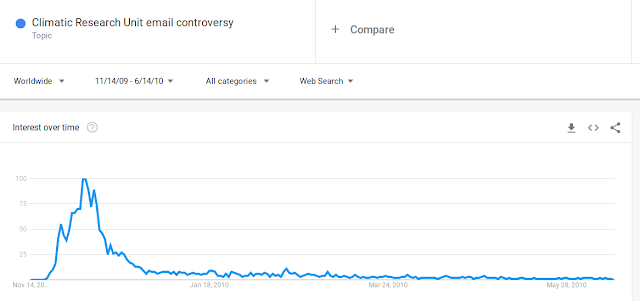


Note also how the peak goes in bumps. It is another characteristic of fall-out memes. They are pushed from above by the timed release of new data that keep the interest of the public alive. A meme managed in this way is like a city attacked by successive waves of bombers.

The searches for the Climategate story rapidly abated, after about one month the "infective" phase of the meme was over. But the meme remains dormant like an encysted virus, you can see that from the fact that the "tail" never goes exactly to zero. It is remarkable how "Climategate" has a search volume comparable to that of "Russiagate" despite being ten years old -- an age that for news exceed that of the Biblical Methuselah.


So, did the Climategate meme have something special that made it so resilient? I'd say no: it was just one of those memes that live on pointing at an enemy of the people ("orange man bad"). These memes are extremely effective and long-lasting (see this post of mine for a series that includes Jews eating children and Marie Antoinette telling the hungry people of Paris to eat cake). There is very little that can be done to stop them once they start growing along their viral trajectory. Rational arguments against memes are not more effective than they would be with biological viruses. Just like a virus doesn't "see" the macroscopic world in which we live, a meme doesn't "see" the real world. The memesphere is another dimension.

Still, we are not completely defenseless against memetic attacks. We could say that the false information (aka fake news) that pervades the Web is a form of pollution. Then, it could be reduced by using the same methods used to reduce the real world's pollution. That is, forcing polluters to clean up their act and to pay for the damage they caused. That could be applied also to the people who spread fake news on the Web but, unfortunately, right now, those who claim to be fighting fake news are also the main producers of fake news, so it is hard to think that they would act against their own interests. But, in the long run, something good could be done using this approach.

Then, at the individual level, we can learn from biology how to fight back against memetic attacks. For instance:
  1. Avoid contact with contaminated areas: That means mainly avoiding the mainstream media (MSM), but also social media can be highly toxic. They are carpet bombing your brain with destructive memes every day: if you don't dodge them, eventually they'll destroy your defenses and, with that, your brain.
  2. Avoid contact with infected people. Don't debate with people who are infected by some especially malign meme: it is like thinking that you can cure someone of aids by sleeping with him or her. It is much more likely that you will be infected yourself.
  3. Build up your immune system. Create a meme filter: any and every meme that arrives to you, especially if it is from the MSM, has to be considered false unless proven to be true.
  4. Reinforce your defenses. Counter the MSM and social media with other sources of information. Blogs are an especially effective way, not for nothing they are under continuous attack, nowadays. But as long as you have access to independent information (we don't know for how long that will be possible), use it. Just don't forget that even what you learn from blogs has to be considered false unless proven true. Otherwise, you risk being infected by opposed but just as malign memes.

Of course, that's hardly sufficient to stop the diffusion of evil memes but, at least, it will help you maintain a certain degree of mental sanity. And that's the best we can do for now.

(See also a previous comment of mine on the same subject)


Thursday, December 20, 2018

Not Even a Blip: The Great Flop of Climategate #3

The results of a "Google Trends" examination of the number of searchers for the term "Climategate." The large peak in 2009 was generated by the wave of interest created by the release of the first batch of e-mails exchanged among climate scientists. A few weeks ago, a new batch of mails was released, but it generated no interest: not even a blip in the curve.


You remember the "Climategate" story, don't you? It was in November 2009 when a batch of private e-mail messages exchanged by climate scientists was stolen and diffused over the Web. The bruhaha that resulted was unbelievable and the messages were described as the "proof" that Climate Science was an elaborate hoax, a conspiracy created by scientists in order to gain money, prestige and influence.

The peak you see at the beginning of this post is a plot from "Google Trends," it shows how the Climategate term literally exploded in the memesphere. Today, after nearly 10 years, we could legitimately scratch our heads at thinking what there was so interesting in this story that deserved so much time and so much discussion. Really, there was nothing in those emails-- on the whole, they were as boring as mail messages among scientists could be (*).

So much overhyped was the Climategate 'scandal' that the later attempts to resuscitate it were hit by the memetic curse of irrelevance. A new batch of e-mails exchanged among climate scientists was released in 2011, it was termed "Climategate #2" and it is barely visible as a small peak in the Google Trends curve (see above). Then, a third batch was released just a few weeks ago, this time by the force of an FOIA directed at the University of Arizona.

The result? Not even a blip in the Google Trends curve (see the figure above). Nothing, zero, zilch, nul, nada, niente. The infamous blog what's there that's up? tried to raise interest in these mails, but the results were dismaying. The posts on the subjects generated a few hundred comments from hardcore science deniers, but it doesn't seem that anyone could find anything interesting to say. It is part of the harsh laws of memetics: nothing goes viral if there is not a good reason for it to do so.

So, Climategate seems to have died not with a bang, but with a whisper, as it was probably unavoidable. But that raises the question of why such an uninteresting story raised so much interest. There is only one possible explanation for this, it was a Dark Public Relations (DPR) job. Someone paid for having the Climategate story to go viral and it worked beautifully. Indeed, from the results we reported in a recent paper that we (myself and my coworkers Perissi and Falsini) published in Kybernetes, we can say that this growth was not generated by a bottom-up 'viral' mechanism, but by a top-down 'fallout' mode generated by the media. As I argued in a previous post, a concerted (and financed) defamation campaign against climate science started in 2006, the Climategate story was part of it.

Now, the concerted effort of defamation of climate science seems to have faded, as shown by the failure of keeping the Climategate story alive. It may be because there is no money available to push the mainstream media to rekindle the interest in this subject and that, in turn, may be because there is no need to defame climate science anymore. The DPR operation has been a success: the legend that climate change is a hoax is by now entrenched in a significant fraction of the public, especially in the US. Once they are 'encysted" memes may have a long life and they may well kill their host, I this case, the victim will be humankind, unable to react effectively against the threat of global warming. Indeed, the laws of memetics aren't just harsh -- they can be deadly.


______________________________________________________________


(*) In 2016, Aaron Bandler tried to pick up again the Climategate story in an article titled "Nine Things you Need to Know About the Climate Change Hoax"appeared on the Daily Wire, where he endeavored to explain why and how the Climategate mails proved that Climate Science is a hoax. The first item of his list is titled "The Climategate scandal proved that key data involving man-made climate change was manipulated."

Oh, yeah? So, what is this "proof"?  -- read carefully the whole article by Bandler and scratch your head. There is strictly nothing in the article that comes directly from the Climategate mails -- yep, not a single citation, not an excerpt, not a summary, nothing-nothing. The "nine things you need to know" are either posterior to the Climategate story or unrelated to it. There is nothing in the Climategate mails that could even vaguely prove that climate science is a hoax. Nothing interesting here, move along, folks.


Monday, August 27, 2018

So, You Think Science Will Save the World? Are You Sure?

I understand that by publishing this post I may be giving ammunition to the anti-science crowd. But we can't just hide in the ivory tower and tell people that science is perfect as it is. We need deep reforms in the way science is done.


In Italy, we have a term for those who engage in a task much too big and too difficult for them. We call them a "Brancaleone Army" (Armata Brancaleone), a term coming from the title of a wonderful 1966 Italian movie where an Italian self-styled knight tries to lead a ragtag army of incompetent fighters. The sad conditions of science nowadays sometimes look to me like the story of the Brancaleone army.


What is truth? These famous words come not from a scientist but from a politician, Pontius Pilate, governor of Palestine in Roman times. As a politician, Pilate knew very well how truth could be twisted, stretched, sliced, cooked, flavored, and rearranged in many ways in order to be sold to people. Things are not different, today. In politics, truth is what you perceive to be true. After all, isn't it true that we can create our own reality? (a US government official is reported to have said that at the time of the invasion of Iraq, in 2003).

Eventually, the Roman Empire drowned in its own lies, it was an epistemological collapse. Something similar may happen to us: we cannot continue for long to ignore reality, believing that we can manufacture our own, and deceive everyone in the process.

But how about science? Isn't science able to tell us what reality is according to its much-praised "scientific method?" In principle, yes, but science is far from being a perfect truth-seeking machine. The attacks that science is receiving from all quarters have some justification: as scientists, we cannot claim to be able to save the world if we don't clean up our act first.

A critical element of the soft belly of modern science is the process called "Peer Review." If you are not familiar with this procedure, let me explain it to you. The idea is that when scientists want to diffuse the results of their studies in the form of a "paper", they will submit it to a "peer-reviewed" journal. Their manuscript will be sent to a number (typically 2 or 3) anonymous reviewers - scientists working in the same field - who will recommend rejection or publication and, in the latter case, changes to improve the paper. (for details, see this excellent paper by Jon Tennant)

So far, so good: if everyone does their best to do the reviewing job, the process might provide good results. And, indeed, peer review is supposed to be the "golden standard" of science. The typical accusation that climate scientists direct to their critics is that their papers are not peer-reviewed: they are often published in politically motivated blogs, and they lack the rigor that real scientific papers have. This is often a correct viewpoint, climate science is one of the most advanced and vital fields of science, today, and the criticism made at it is normally of poor quality and politically biased.

But there is a problem: the gold standard called Peer Review is neither gold nor a standard. First of all, it doesn't prevent bad science from filtering through. It is always possible with some effort and some patience to find a favorable combination of reviewers and editors and manage to publish on a serious journal a paper that's wrong from top to bottom. It has happened and some cases are truly a scandal. You can see this one, for instance, where the authors invented out of whole cloth a completely new nuclear physics based on shaky (to say the least) experimental evidence, and all in order to explain phenomena that had other, perfectly good, explanations.

At this point, get ready for a surprise: Scientific Journals have NO WAY to remedy a mistake. Once a paper is published in a peer-reviewed journal, it is enshrined in the corpus of "officially approved science." Unless there are evident scams involved, such as plagiarism or fake data, the fact that most scientists in the field think that the paper is wrong is not sufficient to have it removed. The best that other scientists can do is to submit a comment to the editors - who will be usually as happy to publish it as they are happy to see their dentist. Then, the authors of the commented paper will be able to submit their counter-comments and the whole process will only serve to give them more visibility - and that's exactly what happened with the paper I was telling you about.

On the other side of the peer review process, the filter makes it nearly impossible to publish innovative ideas, especially for young researchers. Reviewers are a self-selected group, often formed of elderly gentlemen, whose purpose seems to be to make sure that nothing that contrasts with their views goes through the filter. To say nothing about the incredibly slow, time-consuming, and frustrating process of dealing with reviewers who understood nothing of one's work but nevertheless think that they can demolish it, even poking fun at it. Reviewers can always manage to transform a perfectly good paper into an ugly mongrel just because they want to throw their weight around. The worst is when they won't be happy until they have imposed their views on the authors, forcing them to write the paper the way they (the reviewers) want.

How about standards in reviewing? Again, brace for a surprise: there are none, zero, zilch, null. The whole process is carried out in secrecy, the authors don't know who is the person who has somehow gained the right to abuse them from a comfortable anonymity position, there is no standard for what kind of criticism is supposed to be acceptable or not, nor for what kind of rebuttal is supposed to be acceptable or not. The editors can do whatever they want with a submission and normally there is no procedure that an author can follow to protest against what they see as an unfair treatment of their paper.

Now, would you assign to someone the job of - say - designing a plane on the basis of this review method? Would you fly in it once it is built? So, if you are a scientist, do you think that you can save the world in this way? And peer review is not the only problem plaguing modern science!

You may wonder how come that scientists - who are supposed to be so smart - behave in such a sloppy manner when it is question of publishing their results. I am baffled by myself on this point; the only thing I can propose is that they are good at whatever they are specialized in, but not necessarily in all fields. In other words, many scientists can be defined as "Idiot Savants," interested only in their narrow specialized field. The final result is something like the Brancaleone Army I was mentioning at the beginning of this post.

Fortunately, science is not yet the scam it is accused to be, for instance, by those engaged in rejecting climate science. But, if we don't do something fast to improve, we risk seeing science perceived by everyone to be a scam. And  didn't we say that in politics truth is what you perceive to be true?


This post was inspired by a paper by Jon Tennant. http://fossilsandshit.com/the-state-of-the-art-in-peer-review/  and by a post by Jem Bendell


And here is the original Brancaleone in action!

Monday, August 13, 2018

Why is it so Easy to Deceive People? The Strange Case of the Cooling Trend of the United States


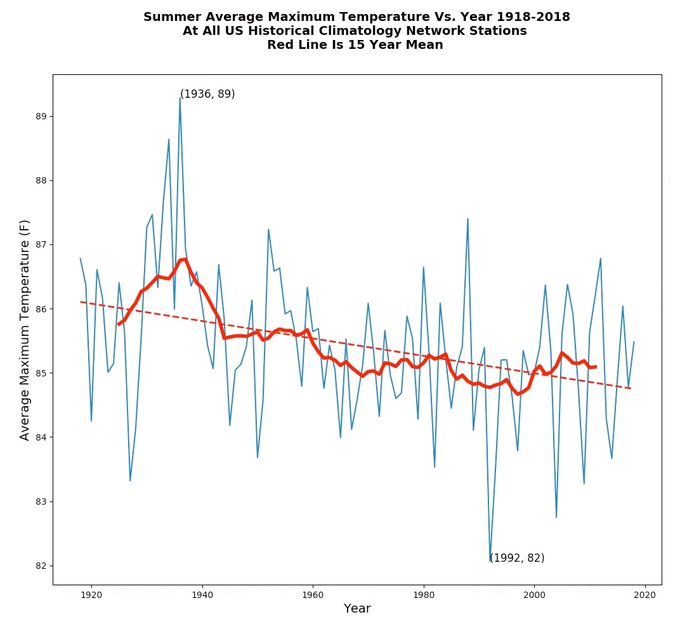
The figure above, showing a cooling trend in the United States, was posted by Steven Goddard (aka Tony Heller) on his blog with the remarkable title of "The Deplorable Climate Science Blog" (actually there is a slightly different one on the blog, right now, but it is simply a difference in the smoothing procedure). The author claims that this graphic is based on real data and that turns out to be true: but is it a honest graph?


The world is becoming more and more complicated. And the more complicated it is, the more difficult to understand it becomes. And there appear more and more opportunities to deceive people: we are all swamped by the news and have neither the competence nor the time to verify what the media serve to us.

So, this August, Mr. Tony Heller, writing under the pen name of Steven Goddard, published on his blog the graph you see above, showing a clear cooling trend in the United States. Make no mistake, these are real data, or so they are said to be. And they do show that summers have been cooling. But what about heat waves we are experiencing nowadays? Just an impression, apparently, because the data say otherwise. Then, what about global warming? An illusion, probably a fraud.

The graph is having a certain diffusion in the social media. An earlier version was even picked up by James Delingpole in his Breitbart news site. It quickly became a growing meme, scoffed or cheered depending on the attitude of the people commenting on it. As usual, the debate on climate on the social media is little more than a shouting match. It took some work by an expert, Tamino, on his "Open Mind" blog to dissect the story of this graph and show the tricks behind it. Tamino's whole post is reproduced below.

Basically, Steven Goddard's post is a textbook example of two well-known propaganda methods.  Carlo Kopp describes the technique called "deception by omission" noting that it works when "the victim has poor a priori knowledge or no a priori knowledge or understanding of what the attacker is presenting to be a picture of reality" He also notes that deception by omission is often accompanied by "deception by spin" which consists in presenting only the information favorable to a certain viewpoint of a certain issue.

Note that neither deception by omission nor deception by spin require lying. It is all a way to present (or not to present) the data. This is what Goddard does, carefully choosing the data available on the NOAA site and presenting only those supporting the idea that the US has been cooling, not warming, during the past century or so. That's just not true, but the trick of these things is the ability to demonstrate a wrong thesis by using real data.

And that's what is truly impressive: how little it takes to deceive people. All that was needed to create a wholly new alternate reality was some patience and a high school level ability to manipulate data. No need for Goddard to be a government agent or to be paid by the PTB. All he needs is to be a lone troll with a stone ax to grind.

Now, stop for a moment and think: what if the real spooks were to engage in deceiving us for good? I mean, governments have resources and competencies in propaganda infinitely larger than those of a single person. What could they do to us if they were to direct us to a completely wrong perception of reality? Do you remember the story of the "weapons of mass destruction" at the time of Saddam Hussein? Now they can do much better than that. Yes, they can deceive us. And probably they do - they are doing that right now.

So, what's happening? The anthropologist Roy Rappaport spoke about "diabolical lies," defined as lies which tamper with the very fabric of truth.  Maybe our whole civilization is being destroyed by lies, diabolical or not, and we desperately need a new epistemology to rebuild trust in our institutions and in ourselves as human beings. This is the task that the early Christian thinkers had engaged in at the time when another civilization, the Roman one, was being destroyed from inside by the very truths it had been built on - by then become diabolical lies. As Poul Anderson said, "all evil is rotten good" and that may well describe our situation.

At this point, I can only propose to you to read Tamino's post, below. At least, it clarifies a section of our perception of the universe.

___________________________________________________________________

USA Temperature: can I sucker you?


Suppose I wanted to convince people that temperature in the USA wasn’t going up, it was going down. What would I show? Let’s try yearly average temperature in the conterminous U.S., also known as the “lower 48 states” (I’ll just call it “USA”):


Well that won’t do. It shows that temperature has been rising, not falling. By the way, I’ve included two trend estimates. The blue straight line is a linear trend estimate and it’s going up. The red curvy line is a nonlinear trend estimate, it has gone up and down and up, and is now rising fast. Scary fast. That definitely won’t do.

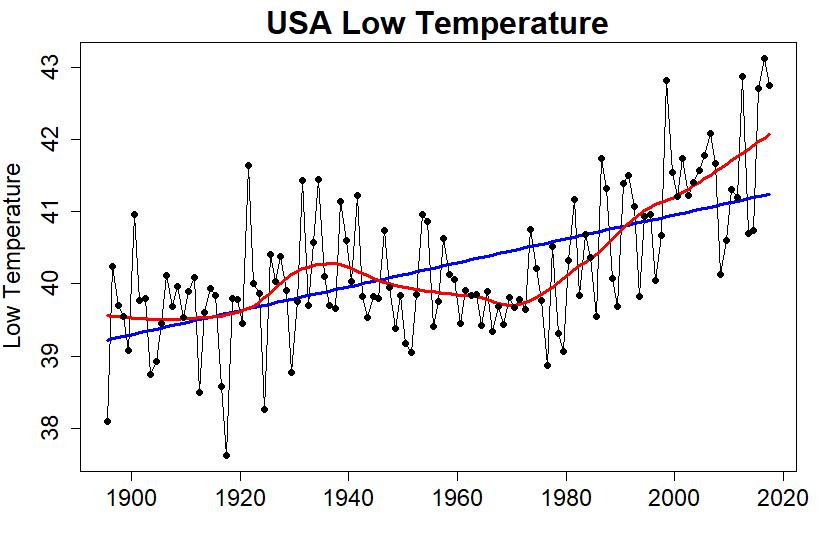
But wait! The temperature shown is the mean temperature, which is the average of the high and low temperatures. What if I tried just low temperatures?


That won’t do either. Scary fast.
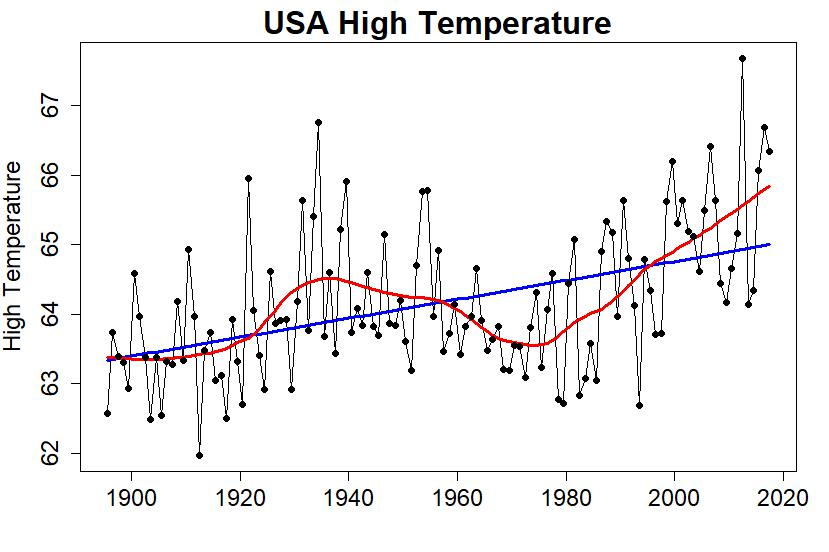
How about high temperatures?


That still won’t do, but it’s a little better. There’s a more pronounced hump in the 1930s — that’s the dustbowl era. Could I maybe make the most of that?

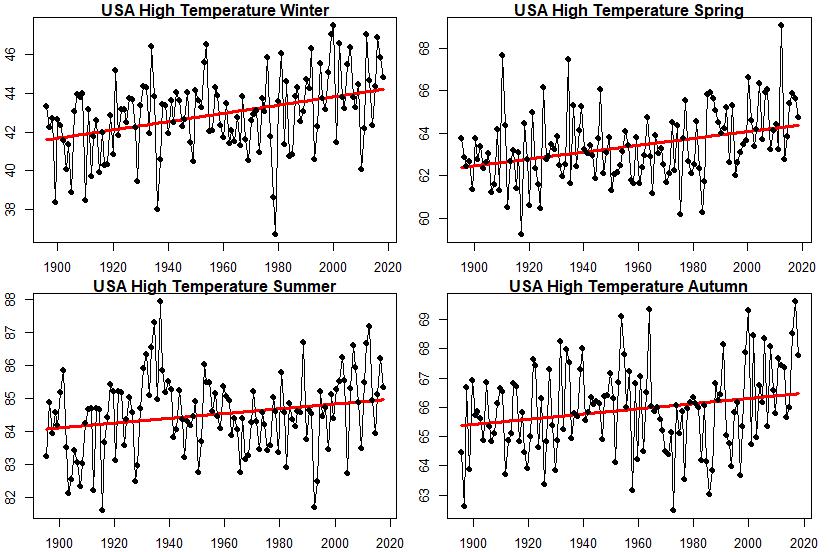
Let’s try this: look at high temperature during the different seasons of the year. After all, we know winter has been warming faster than summer, maybe summertime only — or maybe at least one of the seasons — will give a more useful “sucker people” picture. Here are the average high temperatures for all four seasons separately:


Now we’re getting somewhere! Summer high temperature has still been increasing overall, but that hump during the 1930s (the dust bowl era) is far more pronounced. Maybe I could make something of that?

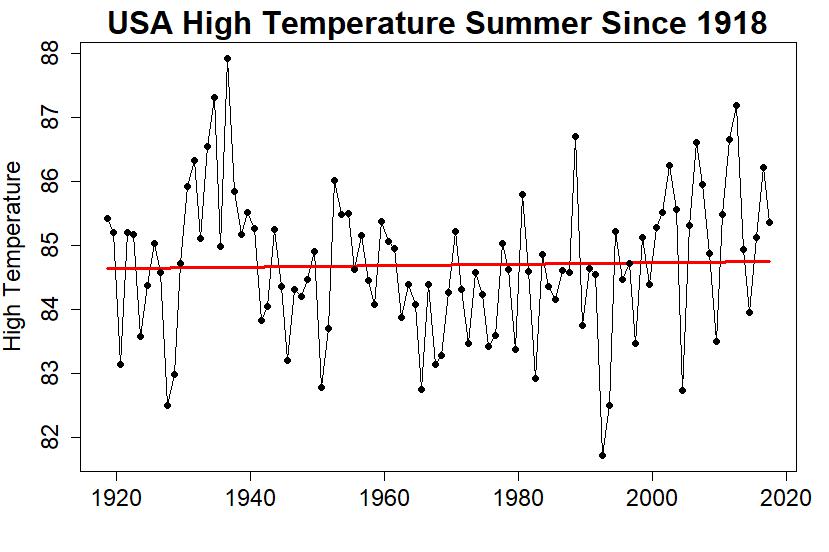
Perhaps I could just get rid of some of the data I don’t like. I can’t get rid of the most recent stuff — then people will figure out I’m trying to sucker them. How about I get rid of some of the early stuff? I’ll start with 1918, instead of starting when the data actually start (1895). That leaves this:


Finally! I’ve got a graph that looks like there’s nothing to worry about, where the linear trend is so small you almost can’t tell it’s still (barely) rising, and I only had to pick one of 12 possible combinations (mean/high/low temperature over winter/spring/summer/autumn) and leave out the early data to get it. Clever.

Even so, the trend is still going up even if just barely. And that’s the linear trend; the nonlinear trend looks like it might be rising noticeably lately, maybe even getting close to as hot as the summer of the dust bowl era. Could I fix that?

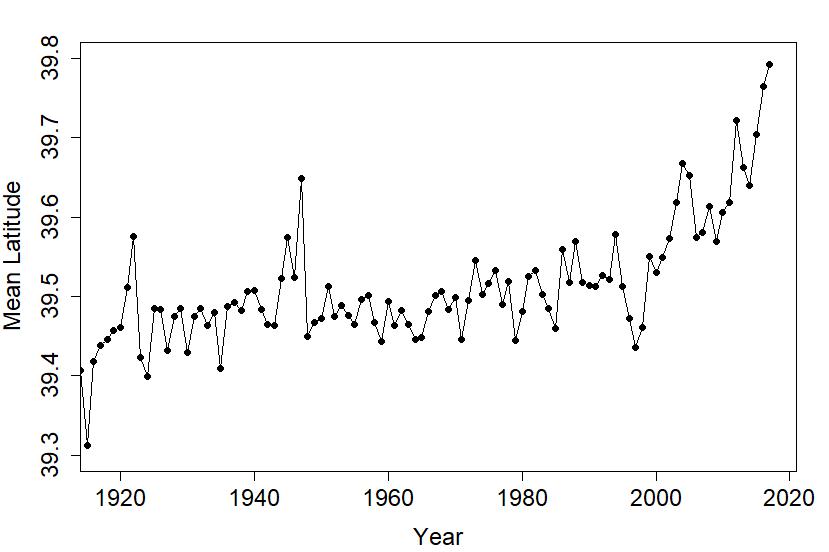
Of course I can! Instead of using the USA temperature data from the “experts,” those people at NOAA (the National Oceanic and Atmospheric Administration) who think they’re so good at it just because they’ve spent decades studying all that “math” and learning how to do it “right,” I’ll just take the raw data and form a simple average. Those NOAA people will tell you that isn’t right, that over the years new stations have come online and old ones have retired so you have to take that into account. They’ll talk about fancy-schmancy math stuff like “area weighting.” That’s all just NOAA tricks, aren’t they just a bunch of frauds? We can completely ignore the fact that over the years the average location of all the contributing stations has moved slightly northward to colder territory:

Heck we can completely ignore everything that they’ve learned about how to do it right … mainly because if we just take a simple, naive average we’ll get what we want.

There’s a graph going around the internet from Steve Goddard a.k.a. Tony Heller, claiming to show that temperature in the U.S. has been declining, using only high temperatures, using only summertime temperatures, using only data since 1918, based on a simple average without taking into account new stations coming online or old stations retiring or area-weighting or any of that “expert” stuff:


Imagine that.


Thursday, June 18, 2015

The climate encyclical: should the pope be hanged?


Image above: an internet site with wild accusations against Pope Francis. That's, of course, just the work of an isolated crackpot, but, a hundred years ago, Pope Benedict XV was widely accused of "defeatism" and threatened with hanging when he requested to stop the "useless slaughter" of the first world war. Could something similar occur because of Pope Francis' encyclical on climate change?    


The Pope's encyclical on climate is out. I went through it, I think I agree with just about everything in it. From a scientific viewpoint, it seems to me flawless (at least after a first read). In terms of its ethical and human approach, it is even better. I don't see myself as a very religious person, but I think we badly need ways to overcome that peculiarly evil view of the world that sees each one of us as a mere economic agent, interested only in maximizing profits and accumulating capital. That can't be the way to run things on this planet and if we need a religion to tell us that we should do better than that, then welcome religion!!

This said, now what? It was Stalin who mocked the pope by asking how many division he could muster on the battlefield, but - apart from armored divisions - if I were a denier, I would feel dismayed. The beauty of the pope's intervention is that it demolishes right away one of the main stumbling blocks that prevented most people from understanding the gravity and the seriousness of the situation. So far, the forces of denial could paint the whole story of climate change as a silly idea concocted by an isolated group of crackpot scientists. But, now, not anymore. You may agree or not with the pope, but you can't ignore that he represents more than a billion Christians. Not an isolated group of crackpots, for sure. Clearly, the pope's encyclical has forever changed the terms of the debate.

On the other hand, if I were a climate science denier, I would also start thinking about what I could do to oppose the pope and his ideas. And, for this purpose, there are ways. We have, today, a giant mud-slinging machine in place that's called "public relations" (called propaganda in old times). This PR machine is truly an evil force that can destroy anything it decides to destroy; even the pope.

It is not farfetched. Something similar already happened about one century ago, in August 1917, during the first world war. The pope of the time, Benedict XV, appealed to "the heads of warring peoples" to end the "useless slaughter." He was not heard and, at least in Italy, the reaction of some exponents of the war party was that the pope should have been hanged.

So, it is not difficult to imagine ways to use the mud-slinging machine to paint the pope as feeble-minded, misguided, or perhaps much worse than that. Will we see again people asking for "hanging the pope", as it happened in 1917? (*) We can only say that the present situation is even more dramatic than it was at the time of the first world war. There is still time to avoid a climate disaster, but we still face a hard fight. What is sure, anyway, is that the pope's intervention is a big push in the right direction and a great hope for all humankind.


(*) Something like that seems to be already ongoing here.


Who

Ugo Bardi is a member of the Club of Rome, faculty member of the University of Florence, and the author of "Extracted" (Chelsea Green 2014), "The Seneca Effect" (Springer 2017), and Before the Collapse (Springer 2019)