Showing posts with label memes. Show all posts

Sunday, November 17, 2019

Climategate, 10 Years Later: What Can we Learn About it from Memetics?


Ten years ago, on November 20th, 2009, the "Climategate" story broke into the news, worldwide. At the beginning, it seemed to be just part of the heated debate on climate. Then, its true character appeared more clearly: it was a major demonstration of the power of the media to control the memesphere. Above, an image from The Telegraph of Nov 28th, 2009


You may think of "Climategate " as a scandal but, really, it was a startling demonstration of how propaganda can be effective. That dawned on me one day when I was having lunch at the university cafeteria with one of my former teachers. We were chatting of this and that when he came up with something like, "hey, Ugo, did you hear that they intercepted the phone calls of some climate scientists and they confessed that they had altered the data?" I remained frozen, holding my fork in mid-air. This scientist was like a child: outside his narrow field of study, he was unable to critically evaluate the news that he received from the media.

That was not the only experience that showed me that there is something deeply wrong in the way we manage knowledge, but surely it was a big push in that direction. As a scientist, I am trained in the scientific method, not a single rule but a general attitude that says, "verify everything before assuming it is true." Evidently, that doesn't apply to politics, not even to those issues that are important for the survival of humankind. But how is it that people are so easily swayed by propaganda?

As I discuss in my latest book, "Before the Collapse," believing in what looks true is a time-honored tradition. It is a quick and dirty epistemological trick that often works in situations where you have to take a rapid decision based on insufficient data. (say, you stumble into a sabertooth tiger that looks hungry -- it is safe to assume it is). It even has a name, the term "zetetics" is used sometimes, coming from a Greek word that means "I search." This approach is used also when you are overwhelmed by data and you have to simplify. The idea of zetetics is to avoid all kinds of theory or models: what you see is what is true. It is the attitude of flat-earthers: the Earth looks flat, then it has to be flat, and the hell with those "models" trying to show that it is round.

In the case of Climategate, the basis of the problem is that climate science is a complex story that proposes something that looks contrary to fact: that the Earth's climate changes. A good zeteticist would never accept that: climate looks stable, then it has to be stable. Then, why those scientists insist that it is not? Something smells bad, here. And there comes Climategate to confirm that there is something bad in the story, indeed. Of course, there was nothing in the mails that were released that could even vaguely indicate that climate scientists were conspiring in order to swindle humankind by tampering with their results. Out of 160 Mb of data, all that could be found were a couple of sentences taken out of context ("hide the decline" or "Mike's trick") and some legitimate personal opinions. But, apparently, if scientists could be made to look evil, then they had to be evil! Zetetics at work.

But it wasn't just that: Climategate was especially impressive not just for its rapid diffusion, but also for how resilient it was to all attempts to dislodge it from the public consciousness. Even today, 10 years later, you can read plenty of commentaries on the Web showing that many people are still convinced that the scientists involved with Climategate were doing something ugly and horrible, although it isn't clear to them exactly what. So, we can be easily swindled by this kind of hoaxes: Climategate is just one of them.  But can we at least learn something from these stories?

Yes, we can. For me, Climategate was the start of a research that went in some depth into understanding how the mechanisms of what we call "consensus" work. With some colleagues of mine, we discovered the existence of something called "memetics" and how memes diffuse through the "memesphere." Being good scientists, we even published papers in this subject, trying to define what pushes a meme to become "viral" as it is fashionable to say nowadays. In one of these papers, we observed that there is a difference between "bottom-up" memes (that is, the true viral memes) and memes diffused from above (we call them "fall-out" memes).

So, here are some data for "Climategate" obtained from Google trends. Note the abrupt "spike" in the signal: according to our models, it shows that the story was pushed into the public consciousness mainly by the media. What we see in the data is a reflection of how the public was driven to search more about what they had read in news sites or heard on TV,


Here are some more data on the peak of interest
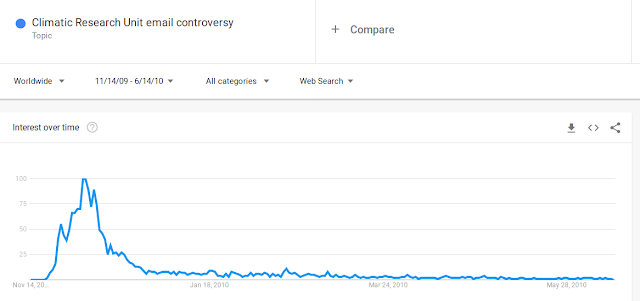


Note also how the peak goes in bumps. It is another characteristic of fall-out memes. They are pushed from above by the timed release of new data that keep the interest of the public alive. A meme managed in this way is like a city attacked by successive waves of bombers.

The searches for the Climategate story rapidly abated, after about one month the "infective" phase of the meme was over. But the meme remains dormant like an encysted virus, you can see that from the fact that the "tail" never goes exactly to zero. It is remarkable how "Climategate" has a search volume comparable to that of "Russiagate" despite being ten years old -- an age that for news exceed that of the Biblical Methuselah.


So, did the Climategate meme have something special that made it so resilient? I'd say no: it was just one of those memes that live on pointing at an enemy of the people ("orange man bad"). These memes are extremely effective and long-lasting (see this post of mine for a series that includes Jews eating children and Marie Antoinette telling the hungry people of Paris to eat cake). There is very little that can be done to stop them once they start growing along their viral trajectory. Rational arguments against memes are not more effective than they would be with biological viruses. Just like a virus doesn't "see" the macroscopic world in which we live, a meme doesn't "see" the real world. The memesphere is another dimension.

Still, we are not completely defenseless against memetic attacks. We could say that the false information (aka fake news) that pervades the Web is a form of pollution. Then, it could be reduced by using the same methods used to reduce the real world's pollution. That is, forcing polluters to clean up their act and to pay for the damage they caused. That could be applied also to the people who spread fake news on the Web but, unfortunately, right now, those who claim to be fighting fake news are also the main producers of fake news, so it is hard to think that they would act against their own interests. But, in the long run, something good could be done using this approach.

Then, at the individual level, we can learn from biology how to fight back against memetic attacks. For instance:
  1. Avoid contact with contaminated areas: That means mainly avoiding the mainstream media (MSM), but also social media can be highly toxic. They are carpet bombing your brain with destructive memes every day: if you don't dodge them, eventually they'll destroy your defenses and, with that, your brain.
  2. Avoid contact with infected people. Don't debate with people who are infected by some especially malign meme: it is like thinking that you can cure someone of aids by sleeping with him or her. It is much more likely that you will be infected yourself.
  3. Build up your immune system. Create a meme filter: any and every meme that arrives to you, especially if it is from the MSM, has to be considered false unless proven to be true.
  4. Reinforce your defenses. Counter the MSM and social media with other sources of information. Blogs are an especially effective way, not for nothing they are under continuous attack, nowadays. But as long as you have access to independent information (we don't know for how long that will be possible), use it. Just don't forget that even what you learn from blogs has to be considered false unless proven true. Otherwise, you risk being infected by opposed but just as malign memes.

Of course, that's hardly sufficient to stop the diffusion of evil memes but, at least, it will help you maintain a certain degree of mental sanity. And that's the best we can do for now.

(See also a previous comment of mine on the same subject)


Monday, October 7, 2019

The Public Interest in Climate Change Reaches and All-Time High. Greta Thunberg Conquers the Memesphere


Greta Thunberg is having a phenomenal success as
 climate messenger. Good targeting, flawless performance, the right person at the right moment.


A little more than one year ago, I wrote a post titled "Why, in a Few Years, Nobody Will be Talking About Climate Change Anymore." It turned out that I was completely wrong: Greta Thunberg changed everything. My mistake was the typical one we all make when we try to predict the future. As I tend to say, "the surest way to make wrong predictions is to extrapolate past trends." And I fell into the trap myself!

Look at what happened: the interest of the public in climate change had been fading for years and then, suddenly, it started rising. Now it is the highest level ever reached in the Google Trend record.


Isn't that fantastic? The Greta Thunberg meme, alone, changed the worldwide trend. There is no other explanation for the restarting interest in climate.

So, what's happening? Let's see if we can learn something from my wrong prediction. First of all, I based my prediction on the data from Google Trends that showed a constant and robust decline of the public's interest in climate change. It had been ongoing for more than a decade and it seemed logical to me that it would continue to do so. I noted also how the Trump government was practicing the propaganda technique known as "deception by omission." It seemed to be successful in generating a self-reinforcing feedback that led the public to forget about climate change, distracted by other issues.

Then, bang! Complex systems always take you by surprise and Greta Thunberg surely surprised everybody. What made her so successful in a task where the best scientists in the world had failed? The birth and the development of the Thunberg meme will be studied for years to come: it is truly a remarkable innovation in a memesphere where, so far, only negative memes seemed to have a chance to affect the public opinion (Climategate is an example). Surely, Ms. Thunberg was supported by a top-notch public relations agency. They did everything right from the beginning: the target, the delivery, the positioning. But it was the person, Greta Thunberg, who was absolutely perfect in her role: flawless on all occasions.

At the same time, the forces of darkness trying to stop Greta Thunberg managed only to propel her further forward. A large number of angry old men made fools of themselves by insulting her. Many so-called "experts" on climate could only show their ignorance. Most attacks against her backfired, also because the young lady turned out to be both smart and resilient.

But there is more, here, than a flawless P.R. operation. The time had come for a major memetic transition. Most of us were expecting it as the result of some climate disaster, hurricanes, sea-level rise, heat waves, this kind of things. But we were hit by every sort of climate disasters and the result was the opposite: in the wake of each terrible event, the public interest in climate change diminished!

Again, we should have expected that: the memesphere behaves very much like complex physical systems, it undergoes phase transitions. If you ever worked with this kind of systems, you surely noted how phase transitions occur, or do not occur, mostly when they please. If the conditions are not right, the chemical compound that took you months of work to synthesize will refuse to condense and precipitate. Or, it will do so when you don't expect that to happen. The memesphere does the same: when the conditions for the diffusion of a meme are right, it will diffuse. Otherwise, it won't.

So, Greta Thunberg was the right meme at the right moment. And, as all good memes, it diffused explosively. And now what?

Memes have a limited lifetime in the memesphere -- it is because they are akin to living creatures and they consume the resources that make them live. They flare up rapidly and then decline slowly. If nothing changes, this is the destiny of the Greta Thunberg's meme -- it might be hastened by ongoing demonization campaign: if there is something that modern Western propaganda can do is demonizing people. After decades of operation, they have learned to do it well.

So, there is a definite chance that Greta Thunberg will fade away and disappear from the memesphere, as her enemies surely hope. But that's not necessarily her future. It is also possible that the meme will mutate, becoming more structured, more propositive, more engaging. It seems that it is what's happening: Greta Thunberg is updating her message and she is starting to propose actual solutions to climate change with a recent video in which she promotes reforestation. That video has some problems and so far it didn't have a big impact, but it is a step in the right direction.

And here we are: complex systems always surprise us, and surely we are in for more. But with Greta around, the future is not anymore so bleak as it seemed to be just a few months ago.


On Greta Thunberg as a climate meme, see also this previous post of mine

Sunday, January 27, 2019

The Making of Greta Thunberg: Memetic Weapons for the Meme War


If I say that this young lady, Greta Thunberg, is a meme I mean no disrespect for her -- we all are memes! Actually, I think she is a great girl. But the story of how this particular meme was pushed up into becoming an important feature of the planetary memesphere is teaching us so much of how our world works. And how fundamental is memetics as a science. Truly, read on. You'll learn of things you wouldn't have suspected existed!!


Ladies and Gentlemen, first of all, let me introduce to you the study on memetics performed by myself and these two wonderful coworkers of mine, Sara Falsini and Ilaria Perissi. Everyone loves their own brainchild and I do love mine (ours): so, allow me to say that this work may be the first (at least one of the first, I believe) that uses system dynamics for the quantitative study memetics (many have made qualitative connections). Maybe it will open up a whole new field of study, but let me tell you this story.

So, what is a meme? A meme is a meme is a meme (as Gertrud Stein never said): a wonderful concept! Think of the blind crocodiles in sewers of New York, that was a pre-internet meme. Or, for a more recent one, "Obama was not born in the US." A meme is not just an idea, but an idea that reproduces itself -- analogous to the gene in biology. It was invented by Richard Dawkins in 1976 and he probably didn't suspect what can of memes he was opening.

Later on, Daniel Dennett said, "a human being is an ape infested with memes." Now, pause a moment to think of this sentence: isn't it wonderful? One of those sentences you look at, you pause for a moment to think about, and then -- poof! -- your view of the world is changed. The beauty of the universe is that you can keep learning new things and, boy, there are so many!

The point of memes is that they can "go viral" in the memesphere -- the Web -- you know this already. But what makes memes go viral? Well, there comes the fascinating thing we discovered in our paper: in biology, there is only one way to go viral: by infection. In memetics, there are two ways. One is the properly viral mode, that is, with the virus jumping from a host to another. The other is the "fallout" mode - it is like when an atomic weapon kills people by radiations -- everyone is affected at the same time. Here is the description we give in our paper

In the present study, for the first time, we discuss and compare the birth of a meme and its dynamic propagation both on the internet and in mass media environments. To grasp this fundamental difference in the meme’s origin, we built simple and intuitive models, with the system dynamic (SD) methods. SD models are particularly useful in representing the structure of complex systems, especially the non-linear systems, in which the properties-of-the-whole system are different from the properties that characterize the system’s constituent elements so that the behaviour of the whole cannot be explained in terms of a combination of the behaviour of the single parts. The result of our study reveals that the origin of a meme can be due to two different activities: internet propagation or media bombardment.
 ... memes have characteristics that genes do not have. In particular, memes can be “planted” in the mediasphere using a top-down mechanism based on scattershot diffusion on the part of the mass media. This behaviour can be seen as parallel to that of the radioactive cloud generated by a nuclear incident. The distinction between these two mechanisms can be useful to understand whether a specific meme is the result of a “natural” interest of the public that derives from its special virtues or has been diffused as a top-down operation designed to influence the public or the consumers of a specific product.


And here we are: looking directly into the belly of the great beast that is the memesphere -- the great cauldron of human thought as it boils, it quivers, it festers in the giant ecosystem we call the World Wide Web. And we can see the birth of the little beasts we call memes. Some grow by infecting one node after the other, some by being pushed from above: by that giant beast infecting the memesphere, what we call the "media" or the "mainstream media" (MSM). And what the MSM want to grow, grows.

Let me show first at a meme that grew virally: "Gangnam Style" (you remember the Korean song, popular a few years ago). Here it is, fitted with the system dynamics model


But you don't need a quantitative model to note how the viral propagation mode shows a typical exponential growth mode at the beginning: here is the same meme, Gangnam, on a different scale. It has an induction time -- it is clear. It grew by infecting one node after another, just like biological viruses do with cells.


That's not the case for a fallout mode meme. It has no induction time: it is born instantly, pushed by the MSM. Here is an example, Bataclan, the terror attacks in Paris, in 2015.

You see? No induction time. It grows from zero to the maximum in no time.


But we were speaking about Greta Thunberg, right? What kind of meme is she? Well, let's look for her memetic essence on Google Trends, and there you go:


You see how quick is the growth of the meme? It is a fallout mode, not a grassroots mode. Not so sharp as for Bataclan others but, clearly, there was some force pushing her on the Web.

But this was obvious from the beginning. We know exactly where the Greta Thunberg meme comes from: it is a creation of a Swedish company called "We Don't Have Time." The story is told by Cory Morningstar, and also by Nicolas Casaux, I haven't checked all the details, but these descriptions make sense to me, especially in view of the curve from Google trends. In short, Greta Thunberg is a memetic weapon.

That doesn't mean we should share Cory Morningstar's criticism. After all, the relation of Greta Thunberg and the company called "We Don't Have Time" is open for everybody to see -- it is no secret. Besides, the enemies of humankind are using the same memetic weapons, but in secrecy. Look at this


Yes, Climategate, the famous "scandal" that purportedly proved that all the world's scientists had formed a conspiracy to invent a non-existing danger for their personal advantage. Look at how fast the curve grows: there is almost no induction time. Not a grassroots emergence, someone has been pushing this meme. The MSMs were immediately involved to diffuse something that, in itself, was just boring: who would have cared about the personal messages that some scientists had exchanged? But who was that "someone" pushing? We don't know -- and probably we never will. The dark side of the memesphere fights against humankind and they use memetic weapons.

So, folks, this is a memetic war that we are fighting. We are fighting for our survival and we need weapons: no war in history was ever won using just moral superiority. If Greta Thunberg is a memetic weapon, then she is a good meme, created for a good purpose. And let's go on and fight.


h/t Philippe Gauthier and Nicolas Casaux

Friday, January 25, 2019

The Decline of Transition Towns: Why do Good Ideas Always Flare up and Then Disappear?


If you don't know what the Transition Town Movement is, you can take a look at their page, here. It is an interesting idea to increase the resilience of the civilization network by making each node less dependent on other nodes. 


The figure above shows how the concept of "Transition Towns" flared up in the late 2000s and then slowly declined in terms of Internet searches, as shown by Google Trends. That not everything is well with the Transition Town Movement seem to be confirmed by this page. What happened? Was it a bad idea? It didn't work in practice? Or people just got bored of it?

Sam Allen finds the reason for the decline Transition Towns in the fact that " we hitched our wagon to the peak oil narrative big time." In reality, complex systems always behave in a complex manner and the attempt to find a simple explanation for why things go in a certain way is normally bound to fail. Here, saying that "peak oil didn't come, therefore people stopped being interested in transition towns" is really forcing the system into an oversimplified narrative.

In the studies we are performing on memetics (1), we are discovering that memes are virtual creatures, only marginally correlated to the real world. So, if the Transition Town meme declined, it doesn't mean that the idea is not valid or not useful, it has to do, rather, with the limited lifetime of memes in our society, something probably correlated with the way the human mind works.

In practice, the transition meme behaved as all virtual memes do: it flared up and declined as the result of its internal dynamics. The same thing happened with the peak oil meme, which started to decline years before anyone could say whether it corresponded to reality or not, as I argue in this post. The same trajectory was followed also by other memes, for instance, "The Limits to Growth" study that declined in popularity decades before it could be said whether the concepts it proposed were right or wrong.

Memetics is a fascinating field, unfortunately not much studied today (2). Maybe, in the future, we'll know much more about memes. For the time being, anyway, we have to realize that the persistence of most good ideas in the memesphere is not long enough for these ideas to have an impact in changing things. And so it goes.


 __________________________________________________________________

(1) h/t Ilaria Perissi and Sara Falsini

(2) Below, the result of a search on "memetics" on the Web of Science. The number of studies in the field is increasing, but the numbers are still minuscule in comparison to those for other fields of science


Wednesday, February 14, 2018

The Life and Death of Memes: Vegan Vs. Macrobiotic


This 2009 book by Lierre Keith is a fascinating reflection on how ideology permeates people's eating habits. Ideology, then, is based on memes and that's a new and developing field of science. 


John Michael Greer (the Archdruid) tells the whole story of the great cycle of the macrobiotic and vegan diets. The macrobiotic movement started in the 1970 and peaked sometimes in the 1980-1990s. Greer himself tried to follow the rules of the macrobiotic diet and he reports an experience similar to that told by Lierre Keith in her book "The Vegetarian Myth" with a Vegan diet. Both Greer and Keith suffered serious health problems with these diets until they finally decided to abandon them - and then felt much better!

The question of diets can be utilized to illustrate how memes propagate in the global mindsphere. Data from "Google Ngrams" provide the number of times that a word is used in books. It can be used to quantify Greer's claim that Veganism somehow supplanted Macrobioticism in a memetic cycle that covered a few decades. It is true: here are the data:


You can see how the "macrobiotic" meme went through a classic memetic trajectory, virally infecting the consciousness space of a fraction of humankind. Then, it lost potency and started fading. These data are up to 2008, if you use Google Trends to measure how many times the term "macrobiotic" was searched for in the Web, you see that it is in terminal decline from 2004.

If "macrobiotic" is a dying meme, that's not true for "vegan" which is still showing growth in both Google Ngrams and Google Trends, the latter showing the number of times that a term is searched for in the Web. Here are the Google Trends data:


So, veganism is still alive and kicking, but it is hard to say for how long. Most likely, it will follow the same cycle of the macrobiotic meme, peaking and declining in the coming decades. This is not so much related to whether one diet is better than another, or whether either or both diets bring benefits to the people following them. It is the hard law of memes - they have a life of their own and a limited existence time (*).

Still, the fact that there is so much interest in diets tells us something. What we eat is not just a question of survival - even though in Italy we have a saying that goes as "what doesn't kill you, fattens you." (**). Rather, what we eat is a cultural, political, and religious statement. Not for nothing, most of the world's religions tell to their followers that God worries about the details of what His sons and daughters eat or do not eat.

Today, many people perceive that the world's food industry is operating on the basis of a new kind of religion: the religion of growth. Granted, the growth of food production has been successful in eliminating the major famines that plagued the world up to a few decades ago. But the food industry's approach to feeding the world is, literally, a "scorched earth" strategy. It destroys the soil, kills everything, razes forests, destroys the fisheries, fills the planet with chemicals and more. In the West, the result is the obesity epidemics and plenty of health problem.

So, following a diet such as the Vegan one is mainly a political - perhaps religious - statement. A statement that many people feel like they need to make in order to fight the way they are treated by the food powers that be. We'll see more of this in the future and it wouldn't be surprising if a new diet-based religion will arise one day.

In the end, food and diets illustrate how difficult it is for humans to understand (let alone manage) complex systems. The human metabolic system is hugely complex and it becomes coupled to the chemistry and the biological activity of food, just as it is interlaced with political and economic questions about the opportunity of using more and more precious resources in order to produce certain kinds of food. The result is a giant confusion of different opinions that may veer all the way to physical attacking people who don't share the same way of thinking about diets. It happened during the 1st century AD and in more recent times it happened to Lierre Keith, attacked by vegan fanatics.

Memetics doesn' tell us how to manage complex systems, but it allows us to have some idea of how memes diffuse and fight each other in the human memesphere. So far, we can at least say that dieting memes grow and die as virtual viral entities, apparently independently of whether they are beneficial to people or not. Maybe one day we'll learn how to do better. 


(*) We (myself, Ilaria Perissi, and Sara Falsini) have a paper that provides a theoretical assessment of these cycles. It is accepted for publication on "Kybernetes". If you like to have a preprint, write to me or to Ilaria at ilariaperissi(thingeything)gmail.com or Sara Falsini (sara.falsini(thingery)unifi.it)

(**) Quello che non ammazza, ingrassa

Thursday, March 16, 2017

Overpopulation: the life and death of a meme

The real problem with overpopulation seems to have to do with the fact that the human information dissemination and processing system (the "Cybersphere") is unable to deal with long-range planning. A single human brain is larger than a walnut, but that makes no difference. The system reacts to new information but doesn't really process it. And we are no better suited than dinosaurs to survive the challenges ahead.

Those of us who remember the 1970s and the 1980s may still have in mind how, in those years, speaking of overpopulation and birth control was not considered politically incorrect. Julian Simon (the "doomslayer") gives us a good description of the debate of those years (he was, needless to say, strongly against the idea that overpopulation was a problem).
Yet once again there is hysteria about there being too many people, and too many babies being born. Television presents notables ranging from Andrei Sakharov to Dan Rather repeating that more people on earth mean poorer lives now and worse prospects for the future. The newspapers chime in. A typical editorial in the June 3, 1989 Washington Post (p. A14) says that "in the developing world...fertility rates impede advances in economic growth, health, and educational opportunities". Nobel- winner Leon Lederman says in his statement as candidate for the president of the American Association for the Advancement of Science that "overpopulation' is one of our "present crises" (2 June, 1989 Announcement, p. 2). The president of NOW warns that continued population growth would be a "catastrophe" (Nat Hentoff in The Washington Post, July 29, 1989, p. A17). The head of the Worcester Foundation for Experimental Biology calls for more funding for contraceptive research becasue of "Overpopulation, together with continuing deterioration of the environment..." (The Wall Street Journal, August 14, 1989, p. A9). And this is just a tiny sample of one summer.
Simon's analysis is in good agreement with the results of a Google Ngram search. The term "overpopulation" reached a popularity peak in the 1970s, then it started a decline that's still ongoing.


You can see the same behavior with concepts such as "birth control" and also using "google trends." So, what happened that made the very concept of overpopulation obsolete? Surely, population growth continue and it is still continuing (image from Gerald Marten):

And it is impressive to note how the decline in the interest on overpopulation started while the population growth curve continued its steep increase, in particular in the poor nations of the world.

So, why did people lose interest in overpopulation just while it kept becoming a bigger problem? Something similar took place with other concepts such as the limits to growth and peak oil: people are losing interest just now that these problems are becoming gigantic and probably unsolvable.


I can propose a tentative explanation based on the recent work we have been performing with my coworkers, Sara Falsini and Ilaria Perissi. We have been examining the behavior of memes on the web using a simple viral propagation model, the same commonly used in epidemiology. It is called the SIR (susceptible, infected, recovered) model. Here it is in a simple form (image on the right).


The model depends on two parameters that describe the kinetics of propagation of the meme in the cybersphere (humankind's system of information diffusion and processing). These two parameters do NOT depend on what happens outside the cybersphere. The world's population may continue growing but the meme will go through its path, oblivious to everything that's not reported in the media. While it declines, the meme doesn't disappear, but it remains dormant. It is not infective anymore.

The model can be modified to take into account re-infection, which causes the interest in the meme not to go to zero after the peak. Theoretically, this parameter could be affected by events occurring outside the cybersphere, but we found that, apparently, people rapidly become resistant to re-infection for most memes.

Eventually, we have a problem that has to do with the capability of the cybersphere to process information. The cybersphere is not a "brain." When subjected external forcings in the form of memes, it reacts by readjusting some of its parameters, but no more than that. It can't act on external problems by long-term planning; it doesn't have the tools for that. We may call it a "governance" problem or, perhaps, a "command and control" problem. In any case, the system is nearly completely blind to external threats. We see this most clearly for the question of climate change. And that makes it likely that we'll go the way the dinosaurs went.


Monday, September 21, 2015

What happened to peak oil? The cycle of a meme and of its antimemes


The result of a Google Trends search for the term "Peak Oil". The fading out of the concept may be due not so much to reasons related to the validity (or non validity) of the concept but, rather, to a memetic phenomenon equivalent to the development of an immune response in the human body. Not all memes have sufficient viral power to entrench themselves in the human mindspace.


Likely, you haven't heard much, recently, about peak oil. If you did, it was only to hear that it was "wrong". Indeed, as you see in the figure above, peak oil had a peak of interest around 2006, a second one around 2008, then it gradually declined.

Why this decline? You might say that it was because the recent drop in oil prices. Maybe, but note, from the figure, that the interest in peak oil started a steady decline just when oil prices went up to reach a plateau at levels over 100 $/barrel. Then, you might say that the decline is because peak oil didn't appear when it was predicted. Maybe, but the record of the "peakist" approach is not bad at all when compared with of mainstream oil pundits. Had any of them anticipated such things as the burst of high oil prices that started in 2005? Did any of them foresee that the oil industry would have had to switch to expensive and difficult resources, that they had always shunned before, in order to keep production from falling?

So, why is peak oil fading away from our consciousness? The problem seems to be that, as a meme (a knowledge unit replicating in virtual space), peak oil just doesn't seem to have a large viral power. Peak oil is not the only case of a loss of interest in some concepts (memes) for no obvious reason. Take a look to the Google trends for "Global Warming." ("climate change" does a little better, but not so much)


So, the planet is going to hell, but people just don't care. Not even a blip of interest, for instance, in 2012, when the Arctic ice sheet collapsed to levels never seen before. The last peak of interest in global warming was created only by the climategate story, and then it was flatland all over.

There are many other examples of peaking and successive decline of various concepts. Take a look, for instance, to "communism"


Of course, the fact that a concept shows a peak of interest doesn't mean that it has to fade away forever. You could identify a peak of interest also in many commonplace concepts such as "electricity." But, here, the interest never faded away and, indeed, electricity remains a normal element of our lives.


Perhaps we could use the concept of "full width at half maximum" (FWHM) as an approximate measurement of the lifetime of these concepts. In this way, we can put together a list of memes and their lifetimes, measured by Google's trends or Google ngrams. This is, obviously, a very approximate set of numbers, they are there just to give an idea of the spread in the lifetime of some memes.

Meme                                approx FWHM, years

Nibiru                                0.3
Andrea Rossi's E-Cat        1
Peak Oil                             5
Global Warming                5
Cold Fusion                       17
Limits to Growth               30
Nuclear Energy                  35
Communism                      50
Electricity                          > 100


The FWHM (time duration) associated with these concepts can be seen as an indication of the capability of a meme to establish itself in virtual space. This depends, first of all, on the capability of the meme to replicate itself rapidly: the meme must be interesting, understandable, and, often, have some relation with reality. Then, if a meme is the equivalent of a gene (or a virus) in biology, then, if there are antigens, there must be antimemes (or, perhaps, "antimems"). This immune response may take the form of "memetic antibodies" which directly fight the invading meme. This is a fight that we see everyday: we call it "debate". As a result, the meme may go viral and infect the infospace of the Internet, or be rejected. In the second case, it may remain in a quiescent state, infecting only marginal areas.

This behavior can be seen in many examples. For instance, the meme of Andrea Rossi's nuclear device, the "E-Cat," flared up rapidly and then practically disappeared, just as rapidly. In this case, there was no need for a strong intervention of the immune system. The meme itself was weak, since the E-Cat simply couldn't deliver the cheap energy that it had promised to deliver. The same can be said of a meme such as the planet Nibiru hitting the Earth. It rapidly disappeared after that it was clear that no such thing was going to happen.

How about the "peak oil" meme? Unlike Nibiru or the E-Cat, peak oil is a serious concept, backed up by a lot of research. However, it didn't really get viral enough to become a mainstream meme. The main problem, here, may have been the choice of the term: "peak oil" conjures a specific moment in time when something exceptional should happen, even though it is not clear what. When people saw that nothing special was happening, they lost interest. The decline of the peak oil meme was helped by the anti-memetic system that created effective antimemes such as "they have been predicting peak oil already for 30 years ago."

About "global warming", we have problems, too: first of all, we propose a concept that people can't perceive in their everyday experience. Then, the immune system has generated strong antimemes that turned out to be extremely effective; such as "there has been no warming during the past 19 years". Indeed, "climate change" has fared much better than "global warming" as a meme. But even climate change is hard to perceive for the public, and it fails to evoke such things as ocean acidification, sea level rise, food supply disruption, and many others.

In the end,  it is all part of the game: the memetic immune system does its job of filtering away memes that are silly, useless, and dangerous. However, like its biological counterpart, sometimes it attacks the wrong targets, a true "autoimmune" genetic reaction. There are memes we badly need to diffuse in the world's infospace: that oil depletion is real and dangerous if we don't do something about it; that climate change is real and it is dangerous, if we don't do something to stop it.

Biological autoimmune diseases are common and dangerous; and the therapy is always difficult. In the memetic case, we are in also in a difficult situation. Maybe there are ways to avoid the slaughter of good memes; but it is not an easy task. In any case, I think that at least one thing is clear from this discussion: memes that have already generated a strong immune response have little or no chance to diffuse. "Peak oil" is basically a dead meme.

We need new memes that describe the same concepts. For instance, we should mention "depletion" rather than "peaking" as a way to describe the gradual loss of high yield mineral resources. Maybe ASPO (the association for the study of peak oil) should be renamed as something like ASOD (association for the study of oil depletion) (*)Maybe we could develop something more creative, such as "oil senility," why not? Then, it has been proposed to replace the term "climate change" with "climate disruption," and that could be a good idea. These are just examples; surely we can think of other possibilities. Just remember one thing: a good virus is a virus that mutates a lot!


(*) But we should be very careful with acronyms. I just discovered that, really, ASOD would not be a good name for an association studying oil depletion!


Who

Ugo Bardi is a member of the Club of Rome, faculty member of the University of Florence, and the author of "Extracted" (Chelsea Green 2014), "The Seneca Effect" (Springer 2017), and Before the Collapse (Springer 2019)