Showing posts with label memetics. Show all posts

Sunday, February 23, 2020

Italy Under the Coronavirus Attack: the Return of the Plague Spreaders


This post is about how Italy is reacting to the diffusion of the COVID-19 epidemics that arrived during the past few days in the Northern regions of the country. Among other effects, it generated a wave of hate on social media comparable to what had happened in Italy at the time of the bubonic plague, in Milano during the 17th century. That epidemics was widely attributed to evil plague-spreaders ("untori"), so much that a "column of infamy" -- shown above -- was erected to commemorate the execution of two of them.

(Italian version of this post)


Alessandro Manzoni (1785-1873) was one of the greatest Italian writers in history, known also outside Italy for his novel The Betrothed ("I Promessi Sposi"). Manzoni lived well before the existence of social media and, in his times, even newspapers were something new. But he was a fine observer of society and I would go as far as to say that he could be seen as one of the early creators of the science we call today "memetics," the science of the diffusion of ideas ("memes").

In The Bethroted and the later historical essay "A History of the Column of Infamy," Manzoni told the story of the bubonic plague that struck Milano in 1629-1631. Hitting a society already weakened by a previous famine and by the disaster of the 30 years war, the plague took a toll of nearly 50% of the population. Those who experienced it fell prey to a delusion that led them to think that the plague was caused by the actions of evil people termed the "untori", a well-known word in Italian but hard to translate into English. Literally, it means "greasers," and it refers to people who would spread poisonous substances over people and things in order to spread the infection -- the term could also be translated as "plague-spreaders." The greasers were supposed to engage in infecting people because they were possessed by the devil, maybe for political or economic gains, or simply because they were evil.

The novel and the essay by Manzoni provide an amazing account of how the untori meme spread among the citizens of Milano to the point that several innocent people were lynched in the street. Others were accused, tortured, and forced to confess their pretended crimes. Then they underwent trials that were nothing more than witch-hunts (in this case, greaser-hunts). Several were executed and, in one case, a stone column ("The Column of Infamy") was erected to commemorate the execution of two of them.

In this story, we can immediately recognize our world: the existence of the evil greasers is a classic example of fake news. The aggressive reaction of the public is something we see every day on our social media where, fortunately, people are not lynched for real (so far). An especially interesting touch by Manzoni is the fictional character of Don Ferrante, a mediocre intellectual who finds a moment of popularity when he starts declaring that the plague doesn't exist or that, in any case, it is not contagious -- rather, it is the result of a weird astral conjunction. We recognize in this character some of our modern climate-deniers who maintain more or less the same thing about climate change. Eventually, Don Ferrante catches the plague, too, but up to the last moment he keeps denying that it exists. He dies cursing the stars!

Certain things are timeless and don't depend on the existence of the Internet or even of the printed media. But, today, for sure the Web can spread hate and fake news at an unbelievably fast speed. In Italy, the COVID-19 epidemics arrived just a couple of days ago and the social media are already exploding in a wave of hate against the current untori, supposed to be the Greens, the Government, the Communists, Immigrants, Africans, and in general the "do-gooders" (in Italian, buonisti) who did nothing to avoid the spreading of the pandemics when it was still possible to stop it.

Overall, the coronavirus is a threat that can't be even remotely compared to the bubonic plague, but the reaction of many people is about the same: they want blood. They are stating that clearly in their comments (just one example I read yesterday: "I am a mother, if my children catch the coronavirus, you Communists will die first!). Curiously, these are often the same people who accuse climate scientists of being "alarmists."

In the beginning, the leaders of the Italian Right seemed to be willing to ride the issue and use it as a tool to make the current left-center government fall. But it seems that they are now somewhat backtracking, leaving the task of fanning the flame to their overexcited henchmen. So, cool heads may still prevail and we won't see people lynched in the street accused of being untori (but we did see physical attacks on people looking Chinese -- fortunately without victims, so far). The situation is rapidly evolving and we'll see what happens in the coming days.

One thing that's already clear, anyway, is that the current political system, polarized as it is, makes it impossible to face emergencies without exaggerating the threat or, conversely, denying it. In every case, one of the two sides is tempted to ride the issue to gain traction in the political game. That's a disaster that leads nowhere. We are seeing it well for climate change and not just in Italy: with this decisional system, we can't control anything. We can only hope for the best (a concept expressed in Italian as trusting "lo stellone" the great star of Italy).


Note: Manzoni was not a prolific writer. Apart from poems, he left us one novel, two tragedies, and one long essay. All are absolutely worth reading. In particular, if you have time, read Manzoni's Adelchi. The story of this Longobard prince is written in a style that for us is a little unusual, but it is a powerful story, truly epic and human at the same time. It prefigures our modern fascination with the Middle Ages. More on this subjec on my blog "Chimeras"



Sunday, November 17, 2019

Climategate, 10 Years Later: What Can we Learn About it from Memetics?


Ten years ago, on November 20th, 2009, the "Climategate" story broke into the news, worldwide. At the beginning, it seemed to be just part of the heated debate on climate. Then, its true character appeared more clearly: it was a major demonstration of the power of the media to control the memesphere. Above, an image from The Telegraph of Nov 28th, 2009


You may think of "Climategate " as a scandal but, really, it was a startling demonstration of how propaganda can be effective. That dawned on me one day when I was having lunch at the university cafeteria with one of my former teachers. We were chatting of this and that when he came up with something like, "hey, Ugo, did you hear that they intercepted the phone calls of some climate scientists and they confessed that they had altered the data?" I remained frozen, holding my fork in mid-air. This scientist was like a child: outside his narrow field of study, he was unable to critically evaluate the news that he received from the media.

That was not the only experience that showed me that there is something deeply wrong in the way we manage knowledge, but surely it was a big push in that direction. As a scientist, I am trained in the scientific method, not a single rule but a general attitude that says, "verify everything before assuming it is true." Evidently, that doesn't apply to politics, not even to those issues that are important for the survival of humankind. But how is it that people are so easily swayed by propaganda?

As I discuss in my latest book, "Before the Collapse," believing in what looks true is a time-honored tradition. It is a quick and dirty epistemological trick that often works in situations where you have to take a rapid decision based on insufficient data. (say, you stumble into a sabertooth tiger that looks hungry -- it is safe to assume it is). It even has a name, the term "zetetics" is used sometimes, coming from a Greek word that means "I search." This approach is used also when you are overwhelmed by data and you have to simplify. The idea of zetetics is to avoid all kinds of theory or models: what you see is what is true. It is the attitude of flat-earthers: the Earth looks flat, then it has to be flat, and the hell with those "models" trying to show that it is round.

In the case of Climategate, the basis of the problem is that climate science is a complex story that proposes something that looks contrary to fact: that the Earth's climate changes. A good zeteticist would never accept that: climate looks stable, then it has to be stable. Then, why those scientists insist that it is not? Something smells bad, here. And there comes Climategate to confirm that there is something bad in the story, indeed. Of course, there was nothing in the mails that were released that could even vaguely indicate that climate scientists were conspiring in order to swindle humankind by tampering with their results. Out of 160 Mb of data, all that could be found were a couple of sentences taken out of context ("hide the decline" or "Mike's trick") and some legitimate personal opinions. But, apparently, if scientists could be made to look evil, then they had to be evil! Zetetics at work.

But it wasn't just that: Climategate was especially impressive not just for its rapid diffusion, but also for how resilient it was to all attempts to dislodge it from the public consciousness. Even today, 10 years later, you can read plenty of commentaries on the Web showing that many people are still convinced that the scientists involved with Climategate were doing something ugly and horrible, although it isn't clear to them exactly what. So, we can be easily swindled by this kind of hoaxes: Climategate is just one of them.  But can we at least learn something from these stories?

Yes, we can. For me, Climategate was the start of a research that went in some depth into understanding how the mechanisms of what we call "consensus" work. With some colleagues of mine, we discovered the existence of something called "memetics" and how memes diffuse through the "memesphere." Being good scientists, we even published papers in this subject, trying to define what pushes a meme to become "viral" as it is fashionable to say nowadays. In one of these papers, we observed that there is a difference between "bottom-up" memes (that is, the true viral memes) and memes diffused from above (we call them "fall-out" memes).

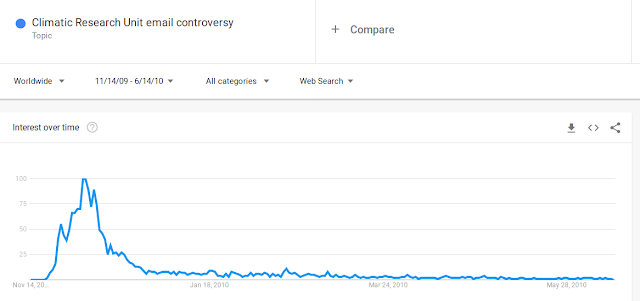
So, here are some data for "Climategate" obtained from Google trends. Note the abrupt "spike" in the signal: according to our models, it shows that the story was pushed into the public consciousness mainly by the media. What we see in the data is a reflection of how the public was driven to search more about what they had read in news sites or heard on TV,


Here are some more data on the peak of interest


Note also how the peak goes in bumps. It is another characteristic of fall-out memes. They are pushed from above by the timed release of new data that keep the interest of the public alive. A meme managed in this way is like a city attacked by successive waves of bombers.

The searches for the Climategate story rapidly abated, after about one month the "infective" phase of the meme was over. But the meme remains dormant like an encysted virus, you can see that from the fact that the "tail" never goes exactly to zero. It is remarkable how "Climategate" has a search volume comparable to that of "Russiagate" despite being ten years old -- an age that for news exceed that of the Biblical Methuselah.


So, did the Climategate meme have something special that made it so resilient? I'd say no: it was just one of those memes that live on pointing at an enemy of the people ("orange man bad"). These memes are extremely effective and long-lasting (see this post of mine for a series that includes Jews eating children and Marie Antoinette telling the hungry people of Paris to eat cake). There is very little that can be done to stop them once they start growing along their viral trajectory. Rational arguments against memes are not more effective than they would be with biological viruses. Just like a virus doesn't "see" the macroscopic world in which we live, a meme doesn't "see" the real world. The memesphere is another dimension.

Still, we are not completely defenseless against memetic attacks. We could say that the false information (aka fake news) that pervades the Web is a form of pollution. Then, it could be reduced by using the same methods used to reduce the real world's pollution. That is, forcing polluters to clean up their act and to pay for the damage they caused. That could be applied also to the people who spread fake news on the Web but, unfortunately, right now, those who claim to be fighting fake news are also the main producers of fake news, so it is hard to think that they would act against their own interests. But, in the long run, something good could be done using this approach.

Then, at the individual level, we can learn from biology how to fight back against memetic attacks. For instance:
  1. Avoid contact with contaminated areas: That means mainly avoiding the mainstream media (MSM), but also social media can be highly toxic. They are carpet bombing your brain with destructive memes every day: if you don't dodge them, eventually they'll destroy your defenses and, with that, your brain.
  2. Avoid contact with infected people. Don't debate with people who are infected by some especially malign meme: it is like thinking that you can cure someone of aids by sleeping with him or her. It is much more likely that you will be infected yourself.
  3. Build up your immune system. Create a meme filter: any and every meme that arrives to you, especially if it is from the MSM, has to be considered false unless proven to be true.
  4. Reinforce your defenses. Counter the MSM and social media with other sources of information. Blogs are an especially effective way, not for nothing they are under continuous attack, nowadays. But as long as you have access to independent information (we don't know for how long that will be possible), use it. Just don't forget that even what you learn from blogs has to be considered false unless proven true. Otherwise, you risk being infected by opposed but just as malign memes.

Of course, that's hardly sufficient to stop the diffusion of evil memes but, at least, it will help you maintain a certain degree of mental sanity. And that's the best we can do for now.

(See also a previous comment of mine on the same subject)


Saturday, March 16, 2019

The Thunberg Effect Seems to be in Full Swing: Will it Last?


This young lady, Greta Thunberg, is breaking all the memetic barriers: the effect is weak but already evident. Most likely, we'll see it growing in the coming days. It might be the start of an epochal change in the way the challenges ahead are perceived.

On the other hand, expect a reaction from the Powers That Be to put this girl back in her proper place. Interesting times ahead, as always.....


Monday, February 25, 2019

Winning the War of Climate Communication. Is Greta Thunberg the Memetic Weapon we Needed?


Who speaks on behalf of young people about climate? Greta Thunberg does. She is the embodiment of the concept that what matters in communication is not the message but the messenger. Only a believable messenger can pass a believable message. And she is believable: she has a direct stake on the issue, it is HER future she is defending, just as the future of the people of her age. She is defending her future from old people who think only of their immediate satisfaction. They are the virus destroying the planet, she is the cure.


Years ago, I think it was in the mid-1980s in Berkeley, I was berated at length and in colorful terms (to say the least) by a young mother for not having buckled up her 4 years old daughter, a classmate of my son, while I was transporting her in my car. As partial justification for my inexcusable wickedness in that occasion, I can say that, as far as I can remember, at that time there was no mandatory seat belt law in California (and also that the car I drove at that time, a Dodge Dart, was so old that I think it didn't have seat belts in the back seats!). But never mind that:  I was wrong and she was right.

The story of that day in Berkeley came to my mind more than once in the debate on climate change. You see, today we tend to think as obvious that seat belts are saintly things that save lives. But it was not so obvious in the 1970s and in the 1980s: we forgot about that, but there was a strong debate on the matter with some people maintaining that there was no proof that seat belts actually saved lives. According to a 2006 article by John Adams, risk expert of the University College London, mandating the use of seat belts in 18 countries resulted in either no change or actually a net increase in road accident deaths.

Think about that using the eyes of those people who deny the validity of climate science: you could ask what proof do we have that seat belts make you safer? Of course, we can play as much as we like with crash tests using sophisticated dummies, but hey, those are just models! You know how these debates go over the Web, once they start, they never arrive at a conclusion. And nothing is done.

So, why do we wear seat belts but don't do anything about climate change? It is because there are people like the lady who berated me in Berkeley who want everybody to wear seat belts. They are parents, siblings, spouses, they have a stake in the safety of the members of their families, they don't care so much about subtleties, demonstrations, and statistics, they can see that if their child is belted she won't smash into the windshield with her head in case of a collision. If you argue that they are wrong, they will say you are a monster (as I was told I was, that time in Berkeley) and they'll be perfectly right. It is because these people have argued, pushed, and worked in favor of seat belts that today there are mandatory seat belts laws.

Now, about climate change: who is arguing about people's safety? Mostly, scientists. And there lies the snag: scientists do not have a direct stake in the issue of climate. Most scientists, old or young, seem to be interested mostly in their carers. And if the climate situation is so bad as scientists say they are, why do they still take planes to attend their silly international meetings? Scientists are not here to save the planet: they are there to write papers, speak at conferences, teach formulas to their students, they are just boring people.

In practice, scientists are the worst possible messengers to pass the climate change message. Not surprisingly, they haven't had too much success, as we all know. Imagine that if -- that day in Berkeley -- instead of a young woman berating me I had been facing a white-haired scientist showing me data and diagrams. I am a polite person, but I am sure I could have told him something not so polite, instead of the apologies I told to the mother of my son's friend.

That's the problem, and it can be solved only by a change of paradigm in the memetic struggle: We need to change the message, but more than that we need to change the messenger. And there we are: Greta Thunberg. You see the difference? She has a stake in the issue: it is her future that's being jeopardized by old men, the future of her generation. She has a right to speak, she has a duty to speak, she has the force to speak, and she does that. And the message she carries is extremely strong. It is a meme that diffuses in the memesphere and even the dark forces of denial will have a hard time stopping it.

Of course, it is not enough to be young, to be intelligent, to be motivated to succeed in this task. The memetic war is no child's play. It is a deadly struggle, even though, normally, only virtually so. But even a smart young lady as Greta Thunberg needs to be supported - in a certain way "weaponized." And that's what has been done by the people of "wedonthavetime." She is not just a different messenger, she carries a different message: it is "I want you to panic" -- it is a much powerful message than the edulcorated version carried by scientists ("see, folks, we don't want to trouble you but, well, there might be a little problem...").

Greta Thunberg is now an awesome memetic weapon to fight the battle against the dark forces of ignorance and of denial.

We still have a chance.


___________________________________________________

How to neutralize Greta Thunberg. I think that today just the thought of Greta Thunberg scares the bejesus out of the people of the anti-science crowd but I am sure they are already thinking of strategies to fight her. So far, the best they could concoct has been to ignore her, but some kind of smear campaign is likely in the near future. It was already done 50 years ago to silence Rachel Carson, the author of "Silent Spring" by defining her a "histerical priestess of nature". Already a few days ago, Ms. Angela Merkel hinted that Greta Thunberg is part of a hybrid warfare attack waged by the Russians against Europe: you can't imagine what these evil Russians are capable of! And, of course, if Ms. Thunberg makes the smallest slip in one of her speeches that can be twisted and packaged in order to make her look racist or anti-semitic, then she is dead in the water. But the most effective campaign against Greta Thunberg might come from her potential allies, people on "the left" who think she is not radical enough and that the very fact that she is helped by PR experts is an insult to the intelligence of humankind. Among this nefarious band, the deranged people belonging to the NTHE (near term human extinction) sect are the worse. They believe that we are going to go extinct soon anyway, so there is no need to do anything and we can continue to live as we did before and so Ms. Thunberg and her ilk should just stay quiet, go home, and die in silence. They are very vocal and could do real damage, fortunately, so far they are a tiny minority


Sunday, January 27, 2019

The Making of Greta Thunberg: Memetic Weapons for the Meme War


If I say that this young lady, Greta Thunberg, is a meme I mean no disrespect for her -- we all are memes! Actually, I think she is a great girl. But the story of how this particular meme was pushed up into becoming an important feature of the planetary memesphere is teaching us so much of how our world works. And how fundamental is memetics as a science. Truly, read on. You'll learn of things you wouldn't have suspected existed!!


Ladies and Gentlemen, first of all, let me introduce to you the study on memetics performed by myself and these two wonderful coworkers of mine, Sara Falsini and Ilaria Perissi. Everyone loves their own brainchild and I do love mine (ours): so, allow me to say that this work may be the first (at least one of the first, I believe) that uses system dynamics for the quantitative study memetics (many have made qualitative connections). Maybe it will open up a whole new field of study, but let me tell you this story.

So, what is a meme? A meme is a meme is a meme (as Gertrud Stein never said): a wonderful concept! Think of the blind crocodiles in sewers of New York, that was a pre-internet meme. Or, for a more recent one, "Obama was not born in the US." A meme is not just an idea, but an idea that reproduces itself -- analogous to the gene in biology. It was invented by Richard Dawkins in 1976 and he probably didn't suspect what can of memes he was opening.

Later on, Daniel Dennett said, "a human being is an ape infested with memes." Now, pause a moment to think of this sentence: isn't it wonderful? One of those sentences you look at, you pause for a moment to think about, and then -- poof! -- your view of the world is changed. The beauty of the universe is that you can keep learning new things and, boy, there are so many!

The point of memes is that they can "go viral" in the memesphere -- the Web -- you know this already. But what makes memes go viral? Well, there comes the fascinating thing we discovered in our paper: in biology, there is only one way to go viral: by infection. In memetics, there are two ways. One is the properly viral mode, that is, with the virus jumping from a host to another. The other is the "fallout" mode - it is like when an atomic weapon kills people by radiations -- everyone is affected at the same time. Here is the description we give in our paper

In the present study, for the first time, we discuss and compare the birth of a meme and its dynamic propagation both on the internet and in mass media environments. To grasp this fundamental difference in the meme’s origin, we built simple and intuitive models, with the system dynamic (SD) methods. SD models are particularly useful in representing the structure of complex systems, especially the non-linear systems, in which the properties-of-the-whole system are different from the properties that characterize the system’s constituent elements so that the behaviour of the whole cannot be explained in terms of a combination of the behaviour of the single parts. The result of our study reveals that the origin of a meme can be due to two different activities: internet propagation or media bombardment.
 ... memes have characteristics that genes do not have. In particular, memes can be “planted” in the mediasphere using a top-down mechanism based on scattershot diffusion on the part of the mass media. This behaviour can be seen as parallel to that of the radioactive cloud generated by a nuclear incident. The distinction between these two mechanisms can be useful to understand whether a specific meme is the result of a “natural” interest of the public that derives from its special virtues or has been diffused as a top-down operation designed to influence the public or the consumers of a specific product.


And here we are: looking directly into the belly of the great beast that is the memesphere -- the great cauldron of human thought as it boils, it quivers, it festers in the giant ecosystem we call the World Wide Web. And we can see the birth of the little beasts we call memes. Some grow by infecting one node after the other, some by being pushed from above: by that giant beast infecting the memesphere, what we call the "media" or the "mainstream media" (MSM). And what the MSM want to grow, grows.

Let me show first at a meme that grew virally: "Gangnam Style" (you remember the Korean song, popular a few years ago). Here it is, fitted with the system dynamics model


But you don't need a quantitative model to note how the viral propagation mode shows a typical exponential growth mode at the beginning: here is the same meme, Gangnam, on a different scale. It has an induction time -- it is clear. It grew by infecting one node after another, just like biological viruses do with cells.


That's not the case for a fallout mode meme. It has no induction time: it is born instantly, pushed by the MSM. Here is an example, Bataclan, the terror attacks in Paris, in 2015.

You see? No induction time. It grows from zero to the maximum in no time.


But we were speaking about Greta Thunberg, right? What kind of meme is she? Well, let's look for her memetic essence on Google Trends, and there you go:


You see how quick is the growth of the meme? It is a fallout mode, not a grassroots mode. Not so sharp as for Bataclan others but, clearly, there was some force pushing her on the Web.

But this was obvious from the beginning. We know exactly where the Greta Thunberg meme comes from: it is a creation of a Swedish company called "We Don't Have Time." The story is told by Cory Morningstar, and also by Nicolas Casaux, I haven't checked all the details, but these descriptions make sense to me, especially in view of the curve from Google trends. In short, Greta Thunberg is a memetic weapon.

That doesn't mean we should share Cory Morningstar's criticism. After all, the relation of Greta Thunberg and the company called "We Don't Have Time" is open for everybody to see -- it is no secret. Besides, the enemies of humankind are using the same memetic weapons, but in secrecy. Look at this


Yes, Climategate, the famous "scandal" that purportedly proved that all the world's scientists had formed a conspiracy to invent a non-existing danger for their personal advantage. Look at how fast the curve grows: there is almost no induction time. Not a grassroots emergence, someone has been pushing this meme. The MSMs were immediately involved to diffuse something that, in itself, was just boring: who would have cared about the personal messages that some scientists had exchanged? But who was that "someone" pushing? We don't know -- and probably we never will. The dark side of the memesphere fights against humankind and they use memetic weapons.

So, folks, this is a memetic war that we are fighting. We are fighting for our survival and we need weapons: no war in history was ever won using just moral superiority. If Greta Thunberg is a memetic weapon, then she is a good meme, created for a good purpose. And let's go on and fight.


h/t Philippe Gauthier and Nicolas Casaux

Friday, January 25, 2019

The Decline of Transition Towns: Why do Good Ideas Always Flare up and Then Disappear?


If you don't know what the Transition Town Movement is, you can take a look at their page, here. It is an interesting idea to increase the resilience of the civilization network by making each node less dependent on other nodes. 


The figure above shows how the concept of "Transition Towns" flared up in the late 2000s and then slowly declined in terms of Internet searches, as shown by Google Trends. That not everything is well with the Transition Town Movement seem to be confirmed by this page. What happened? Was it a bad idea? It didn't work in practice? Or people just got bored of it?

Sam Allen finds the reason for the decline Transition Towns in the fact that " we hitched our wagon to the peak oil narrative big time." In reality, complex systems always behave in a complex manner and the attempt to find a simple explanation for why things go in a certain way is normally bound to fail. Here, saying that "peak oil didn't come, therefore people stopped being interested in transition towns" is really forcing the system into an oversimplified narrative.

In the studies we are performing on memetics (1), we are discovering that memes are virtual creatures, only marginally correlated to the real world. So, if the Transition Town meme declined, it doesn't mean that the idea is not valid or not useful, it has to do, rather, with the limited lifetime of memes in our society, something probably correlated with the way the human mind works.

In practice, the transition meme behaved as all virtual memes do: it flared up and declined as the result of its internal dynamics. The same thing happened with the peak oil meme, which started to decline years before anyone could say whether it corresponded to reality or not, as I argue in this post. The same trajectory was followed also by other memes, for instance, "The Limits to Growth" study that declined in popularity decades before it could be said whether the concepts it proposed were right or wrong.

Memetics is a fascinating field, unfortunately not much studied today (2). Maybe, in the future, we'll know much more about memes. For the time being, anyway, we have to realize that the persistence of most good ideas in the memesphere is not long enough for these ideas to have an impact in changing things. And so it goes.


 __________________________________________________________________

(1) h/t Ilaria Perissi and Sara Falsini

(2) Below, the result of a search on "memetics" on the Web of Science. The number of studies in the field is increasing, but the numbers are still minuscule in comparison to those for other fields of science


Thursday, December 20, 2018

Not Even a Blip: The Great Flop of Climategate #3

The results of a "Google Trends" examination of the number of searchers for the term "Climategate." The large peak in 2009 was generated by the wave of interest created by the release of the first batch of e-mails exchanged among climate scientists. A few weeks ago, a new batch of mails was released, but it generated no interest: not even a blip in the curve.


You remember the "Climategate" story, don't you? It was in November 2009 when a batch of private e-mail messages exchanged by climate scientists was stolen and diffused over the Web. The bruhaha that resulted was unbelievable and the messages were described as the "proof" that Climate Science was an elaborate hoax, a conspiracy created by scientists in order to gain money, prestige and influence.

The peak you see at the beginning of this post is a plot from "Google Trends," it shows how the Climategate term literally exploded in the memesphere. Today, after nearly 10 years, we could legitimately scratch our heads at thinking what there was so interesting in this story that deserved so much time and so much discussion. Really, there was nothing in those emails-- on the whole, they were as boring as mail messages among scientists could be (*).

So much overhyped was the Climategate 'scandal' that the later attempts to resuscitate it were hit by the memetic curse of irrelevance. A new batch of e-mails exchanged among climate scientists was released in 2011, it was termed "Climategate #2" and it is barely visible as a small peak in the Google Trends curve (see above). Then, a third batch was released just a few weeks ago, this time by the force of an FOIA directed at the University of Arizona.

The result? Not even a blip in the Google Trends curve (see the figure above). Nothing, zero, zilch, nul, nada, niente. The infamous blog what's there that's up? tried to raise interest in these mails, but the results were dismaying. The posts on the subjects generated a few hundred comments from hardcore science deniers, but it doesn't seem that anyone could find anything interesting to say. It is part of the harsh laws of memetics: nothing goes viral if there is not a good reason for it to do so.

So, Climategate seems to have died not with a bang, but with a whisper, as it was probably unavoidable. But that raises the question of why such an uninteresting story raised so much interest. There is only one possible explanation for this, it was a Dark Public Relations (DPR) job. Someone paid for having the Climategate story to go viral and it worked beautifully. Indeed, from the results we reported in a recent paper that we (myself and my coworkers Perissi and Falsini) published in Kybernetes, we can say that this growth was not generated by a bottom-up 'viral' mechanism, but by a top-down 'fallout' mode generated by the media. As I argued in a previous post, a concerted (and financed) defamation campaign against climate science started in 2006, the Climategate story was part of it.

Now, the concerted effort of defamation of climate science seems to have faded, as shown by the failure of keeping the Climategate story alive. It may be because there is no money available to push the mainstream media to rekindle the interest in this subject and that, in turn, may be because there is no need to defame climate science anymore. The DPR operation has been a success: the legend that climate change is a hoax is by now entrenched in a significant fraction of the public, especially in the US. Once they are 'encysted" memes may have a long life and they may well kill their host, I this case, the victim will be humankind, unable to react effectively against the threat of global warming. Indeed, the laws of memetics aren't just harsh -- they can be deadly.


______________________________________________________________


(*) In 2016, Aaron Bandler tried to pick up again the Climategate story in an article titled "Nine Things you Need to Know About the Climate Change Hoax"appeared on the Daily Wire, where he endeavored to explain why and how the Climategate mails proved that Climate Science is a hoax. The first item of his list is titled "The Climategate scandal proved that key data involving man-made climate change was manipulated."

Oh, yeah? So, what is this "proof"?  -- read carefully the whole article by Bandler and scratch your head. There is strictly nothing in the article that comes directly from the Climategate mails -- yep, not a single citation, not an excerpt, not a summary, nothing-nothing. The "nine things you need to know" are either posterior to the Climategate story or unrelated to it. There is nothing in the Climategate mails that could even vaguely prove that climate science is a hoax. Nothing interesting here, move along, folks.


Monday, September 21, 2015

What happened to peak oil? The cycle of a meme and of its antimemes


The result of a Google Trends search for the term "Peak Oil". The fading out of the concept may be due not so much to reasons related to the validity (or non validity) of the concept but, rather, to a memetic phenomenon equivalent to the development of an immune response in the human body. Not all memes have sufficient viral power to entrench themselves in the human mindspace.


Likely, you haven't heard much, recently, about peak oil. If you did, it was only to hear that it was "wrong". Indeed, as you see in the figure above, peak oil had a peak of interest around 2006, a second one around 2008, then it gradually declined.

Why this decline? You might say that it was because the recent drop in oil prices. Maybe, but note, from the figure, that the interest in peak oil started a steady decline just when oil prices went up to reach a plateau at levels over 100 $/barrel. Then, you might say that the decline is because peak oil didn't appear when it was predicted. Maybe, but the record of the "peakist" approach is not bad at all when compared with of mainstream oil pundits. Had any of them anticipated such things as the burst of high oil prices that started in 2005? Did any of them foresee that the oil industry would have had to switch to expensive and difficult resources, that they had always shunned before, in order to keep production from falling?

So, why is peak oil fading away from our consciousness? The problem seems to be that, as a meme (a knowledge unit replicating in virtual space), peak oil just doesn't seem to have a large viral power. Peak oil is not the only case of a loss of interest in some concepts (memes) for no obvious reason. Take a look to the Google trends for "Global Warming." ("climate change" does a little better, but not so much)


So, the planet is going to hell, but people just don't care. Not even a blip of interest, for instance, in 2012, when the Arctic ice sheet collapsed to levels never seen before. The last peak of interest in global warming was created only by the climategate story, and then it was flatland all over.

There are many other examples of peaking and successive decline of various concepts. Take a look, for instance, to "communism"


Of course, the fact that a concept shows a peak of interest doesn't mean that it has to fade away forever. You could identify a peak of interest also in many commonplace concepts such as "electricity." But, here, the interest never faded away and, indeed, electricity remains a normal element of our lives.


Perhaps we could use the concept of "full width at half maximum" (FWHM) as an approximate measurement of the lifetime of these concepts. In this way, we can put together a list of memes and their lifetimes, measured by Google's trends or Google ngrams. This is, obviously, a very approximate set of numbers, they are there just to give an idea of the spread in the lifetime of some memes.

Meme                                approx FWHM, years

Nibiru                                0.3
Andrea Rossi's E-Cat        1
Peak Oil                             5
Global Warming                5
Cold Fusion                       17
Limits to Growth               30
Nuclear Energy                  35
Communism                      50
Electricity                          > 100


The FWHM (time duration) associated with these concepts can be seen as an indication of the capability of a meme to establish itself in virtual space. This depends, first of all, on the capability of the meme to replicate itself rapidly: the meme must be interesting, understandable, and, often, have some relation with reality. Then, if a meme is the equivalent of a gene (or a virus) in biology, then, if there are antigens, there must be antimemes (or, perhaps, "antimems"). This immune response may take the form of "memetic antibodies" which directly fight the invading meme. This is a fight that we see everyday: we call it "debate". As a result, the meme may go viral and infect the infospace of the Internet, or be rejected. In the second case, it may remain in a quiescent state, infecting only marginal areas.

This behavior can be seen in many examples. For instance, the meme of Andrea Rossi's nuclear device, the "E-Cat," flared up rapidly and then practically disappeared, just as rapidly. In this case, there was no need for a strong intervention of the immune system. The meme itself was weak, since the E-Cat simply couldn't deliver the cheap energy that it had promised to deliver. The same can be said of a meme such as the planet Nibiru hitting the Earth. It rapidly disappeared after that it was clear that no such thing was going to happen.

How about the "peak oil" meme? Unlike Nibiru or the E-Cat, peak oil is a serious concept, backed up by a lot of research. However, it didn't really get viral enough to become a mainstream meme. The main problem, here, may have been the choice of the term: "peak oil" conjures a specific moment in time when something exceptional should happen, even though it is not clear what. When people saw that nothing special was happening, they lost interest. The decline of the peak oil meme was helped by the anti-memetic system that created effective antimemes such as "they have been predicting peak oil already for 30 years ago."

About "global warming", we have problems, too: first of all, we propose a concept that people can't perceive in their everyday experience. Then, the immune system has generated strong antimemes that turned out to be extremely effective; such as "there has been no warming during the past 19 years". Indeed, "climate change" has fared much better than "global warming" as a meme. But even climate change is hard to perceive for the public, and it fails to evoke such things as ocean acidification, sea level rise, food supply disruption, and many others.

In the end,  it is all part of the game: the memetic immune system does its job of filtering away memes that are silly, useless, and dangerous. However, like its biological counterpart, sometimes it attacks the wrong targets, a true "autoimmune" genetic reaction. There are memes we badly need to diffuse in the world's infospace: that oil depletion is real and dangerous if we don't do something about it; that climate change is real and it is dangerous, if we don't do something to stop it.

Biological autoimmune diseases are common and dangerous; and the therapy is always difficult. In the memetic case, we are in also in a difficult situation. Maybe there are ways to avoid the slaughter of good memes; but it is not an easy task. In any case, I think that at least one thing is clear from this discussion: memes that have already generated a strong immune response have little or no chance to diffuse. "Peak oil" is basically a dead meme.

We need new memes that describe the same concepts. For instance, we should mention "depletion" rather than "peaking" as a way to describe the gradual loss of high yield mineral resources. Maybe ASPO (the association for the study of peak oil) should be renamed as something like ASOD (association for the study of oil depletion) (*)Maybe we could develop something more creative, such as "oil senility," why not? Then, it has been proposed to replace the term "climate change" with "climate disruption," and that could be a good idea. These are just examples; surely we can think of other possibilities. Just remember one thing: a good virus is a virus that mutates a lot!


(*) But we should be very careful with acronyms. I just discovered that, really, ASOD would not be a good name for an association studying oil depletion!


Who

Ugo Bardi is a member of the Club of Rome, faculty member of the University of Florence, and the author of "Extracted" (Chelsea Green 2014), "The Seneca Effect" (Springer 2017), and Before the Collapse (Springer 2019)