Showing posts with label memesphere. Show all posts

Sunday, November 17, 2019

Climategate, 10 Years Later: What Can we Learn About it from Memetics?


Ten years ago, on November 20th, 2009, the "Climategate" story broke into the news, worldwide. At the beginning, it seemed to be just part of the heated debate on climate. Then, its true character appeared more clearly: it was a major demonstration of the power of the media to control the memesphere. Above, an image from The Telegraph of Nov 28th, 2009


You may think of "Climategate " as a scandal but, really, it was a startling demonstration of how propaganda can be effective. That dawned on me one day when I was having lunch at the university cafeteria with one of my former teachers. We were chatting of this and that when he came up with something like, "hey, Ugo, did you hear that they intercepted the phone calls of some climate scientists and they confessed that they had altered the data?" I remained frozen, holding my fork in mid-air. This scientist was like a child: outside his narrow field of study, he was unable to critically evaluate the news that he received from the media.

That was not the only experience that showed me that there is something deeply wrong in the way we manage knowledge, but surely it was a big push in that direction. As a scientist, I am trained in the scientific method, not a single rule but a general attitude that says, "verify everything before assuming it is true." Evidently, that doesn't apply to politics, not even to those issues that are important for the survival of humankind. But how is it that people are so easily swayed by propaganda?

As I discuss in my latest book, "Before the Collapse," believing in what looks true is a time-honored tradition. It is a quick and dirty epistemological trick that often works in situations where you have to take a rapid decision based on insufficient data. (say, you stumble into a sabertooth tiger that looks hungry -- it is safe to assume it is). It even has a name, the term "zetetics" is used sometimes, coming from a Greek word that means "I search." This approach is used also when you are overwhelmed by data and you have to simplify. The idea of zetetics is to avoid all kinds of theory or models: what you see is what is true. It is the attitude of flat-earthers: the Earth looks flat, then it has to be flat, and the hell with those "models" trying to show that it is round.

In the case of Climategate, the basis of the problem is that climate science is a complex story that proposes something that looks contrary to fact: that the Earth's climate changes. A good zeteticist would never accept that: climate looks stable, then it has to be stable. Then, why those scientists insist that it is not? Something smells bad, here. And there comes Climategate to confirm that there is something bad in the story, indeed. Of course, there was nothing in the mails that were released that could even vaguely indicate that climate scientists were conspiring in order to swindle humankind by tampering with their results. Out of 160 Mb of data, all that could be found were a couple of sentences taken out of context ("hide the decline" or "Mike's trick") and some legitimate personal opinions. But, apparently, if scientists could be made to look evil, then they had to be evil! Zetetics at work.

But it wasn't just that: Climategate was especially impressive not just for its rapid diffusion, but also for how resilient it was to all attempts to dislodge it from the public consciousness. Even today, 10 years later, you can read plenty of commentaries on the Web showing that many people are still convinced that the scientists involved with Climategate were doing something ugly and horrible, although it isn't clear to them exactly what. So, we can be easily swindled by this kind of hoaxes: Climategate is just one of them.  But can we at least learn something from these stories?

Yes, we can. For me, Climategate was the start of a research that went in some depth into understanding how the mechanisms of what we call "consensus" work. With some colleagues of mine, we discovered the existence of something called "memetics" and how memes diffuse through the "memesphere." Being good scientists, we even published papers in this subject, trying to define what pushes a meme to become "viral" as it is fashionable to say nowadays. In one of these papers, we observed that there is a difference between "bottom-up" memes (that is, the true viral memes) and memes diffused from above (we call them "fall-out" memes).

So, here are some data for "Climategate" obtained from Google trends. Note the abrupt "spike" in the signal: according to our models, it shows that the story was pushed into the public consciousness mainly by the media. What we see in the data is a reflection of how the public was driven to search more about what they had read in news sites or heard on TV,


Here are some more data on the peak of interest
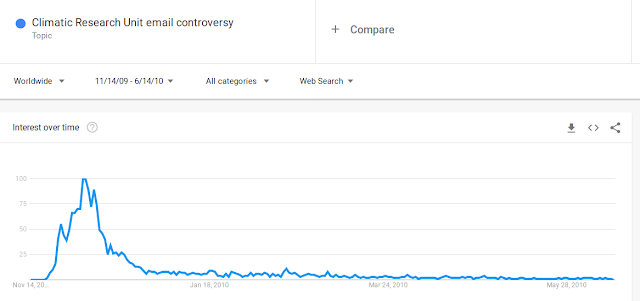


Note also how the peak goes in bumps. It is another characteristic of fall-out memes. They are pushed from above by the timed release of new data that keep the interest of the public alive. A meme managed in this way is like a city attacked by successive waves of bombers.

The searches for the Climategate story rapidly abated, after about one month the "infective" phase of the meme was over. But the meme remains dormant like an encysted virus, you can see that from the fact that the "tail" never goes exactly to zero. It is remarkable how "Climategate" has a search volume comparable to that of "Russiagate" despite being ten years old -- an age that for news exceed that of the Biblical Methuselah.


So, did the Climategate meme have something special that made it so resilient? I'd say no: it was just one of those memes that live on pointing at an enemy of the people ("orange man bad"). These memes are extremely effective and long-lasting (see this post of mine for a series that includes Jews eating children and Marie Antoinette telling the hungry people of Paris to eat cake). There is very little that can be done to stop them once they start growing along their viral trajectory. Rational arguments against memes are not more effective than they would be with biological viruses. Just like a virus doesn't "see" the macroscopic world in which we live, a meme doesn't "see" the real world. The memesphere is another dimension.

Still, we are not completely defenseless against memetic attacks. We could say that the false information (aka fake news) that pervades the Web is a form of pollution. Then, it could be reduced by using the same methods used to reduce the real world's pollution. That is, forcing polluters to clean up their act and to pay for the damage they caused. That could be applied also to the people who spread fake news on the Web but, unfortunately, right now, those who claim to be fighting fake news are also the main producers of fake news, so it is hard to think that they would act against their own interests. But, in the long run, something good could be done using this approach.

Then, at the individual level, we can learn from biology how to fight back against memetic attacks. For instance:
  1. Avoid contact with contaminated areas: That means mainly avoiding the mainstream media (MSM), but also social media can be highly toxic. They are carpet bombing your brain with destructive memes every day: if you don't dodge them, eventually they'll destroy your defenses and, with that, your brain.
  2. Avoid contact with infected people. Don't debate with people who are infected by some especially malign meme: it is like thinking that you can cure someone of aids by sleeping with him or her. It is much more likely that you will be infected yourself.
  3. Build up your immune system. Create a meme filter: any and every meme that arrives to you, especially if it is from the MSM, has to be considered false unless proven to be true.
  4. Reinforce your defenses. Counter the MSM and social media with other sources of information. Blogs are an especially effective way, not for nothing they are under continuous attack, nowadays. But as long as you have access to independent information (we don't know for how long that will be possible), use it. Just don't forget that even what you learn from blogs has to be considered false unless proven true. Otherwise, you risk being infected by opposed but just as malign memes.

Of course, that's hardly sufficient to stop the diffusion of evil memes but, at least, it will help you maintain a certain degree of mental sanity. And that's the best we can do for now.

(See also a previous comment of mine on the same subject)


Thursday, December 20, 2018

Not Even a Blip: The Great Flop of Climategate #3

The results of a "Google Trends" examination of the number of searchers for the term "Climategate." The large peak in 2009 was generated by the wave of interest created by the release of the first batch of e-mails exchanged among climate scientists. A few weeks ago, a new batch of mails was released, but it generated no interest: not even a blip in the curve.


You remember the "Climategate" story, don't you? It was in November 2009 when a batch of private e-mail messages exchanged by climate scientists was stolen and diffused over the Web. The bruhaha that resulted was unbelievable and the messages were described as the "proof" that Climate Science was an elaborate hoax, a conspiracy created by scientists in order to gain money, prestige and influence.

The peak you see at the beginning of this post is a plot from "Google Trends," it shows how the Climategate term literally exploded in the memesphere. Today, after nearly 10 years, we could legitimately scratch our heads at thinking what there was so interesting in this story that deserved so much time and so much discussion. Really, there was nothing in those emails-- on the whole, they were as boring as mail messages among scientists could be (*).

So much overhyped was the Climategate 'scandal' that the later attempts to resuscitate it were hit by the memetic curse of irrelevance. A new batch of e-mails exchanged among climate scientists was released in 2011, it was termed "Climategate #2" and it is barely visible as a small peak in the Google Trends curve (see above). Then, a third batch was released just a few weeks ago, this time by the force of an FOIA directed at the University of Arizona.

The result? Not even a blip in the Google Trends curve (see the figure above). Nothing, zero, zilch, nul, nada, niente. The infamous blog what's there that's up? tried to raise interest in these mails, but the results were dismaying. The posts on the subjects generated a few hundred comments from hardcore science deniers, but it doesn't seem that anyone could find anything interesting to say. It is part of the harsh laws of memetics: nothing goes viral if there is not a good reason for it to do so.

So, Climategate seems to have died not with a bang, but with a whisper, as it was probably unavoidable. But that raises the question of why such an uninteresting story raised so much interest. There is only one possible explanation for this, it was a Dark Public Relations (DPR) job. Someone paid for having the Climategate story to go viral and it worked beautifully. Indeed, from the results we reported in a recent paper that we (myself and my coworkers Perissi and Falsini) published in Kybernetes, we can say that this growth was not generated by a bottom-up 'viral' mechanism, but by a top-down 'fallout' mode generated by the media. As I argued in a previous post, a concerted (and financed) defamation campaign against climate science started in 2006, the Climategate story was part of it.

Now, the concerted effort of defamation of climate science seems to have faded, as shown by the failure of keeping the Climategate story alive. It may be because there is no money available to push the mainstream media to rekindle the interest in this subject and that, in turn, may be because there is no need to defame climate science anymore. The DPR operation has been a success: the legend that climate change is a hoax is by now entrenched in a significant fraction of the public, especially in the US. Once they are 'encysted" memes may have a long life and they may well kill their host, I this case, the victim will be humankind, unable to react effectively against the threat of global warming. Indeed, the laws of memetics aren't just harsh -- they can be deadly.


______________________________________________________________


(*) In 2016, Aaron Bandler tried to pick up again the Climategate story in an article titled "Nine Things you Need to Know About the Climate Change Hoax"appeared on the Daily Wire, where he endeavored to explain why and how the Climategate mails proved that Climate Science is a hoax. The first item of his list is titled "The Climategate scandal proved that key data involving man-made climate change was manipulated."

Oh, yeah? So, what is this "proof"?  -- read carefully the whole article by Bandler and scratch your head. There is strictly nothing in the article that comes directly from the Climategate mails -- yep, not a single citation, not an excerpt, not a summary, nothing-nothing. The "nine things you need to know" are either posterior to the Climategate story or unrelated to it. There is nothing in the Climategate mails that could even vaguely prove that climate science is a hoax. Nothing interesting here, move along, folks.


Sunday, September 9, 2018

Stunning News from the Memesphere: Forest Fires had no Effect on the Public's Perception of Climate Change


In 2018, the fires in California and in other parts of the world have been especially devastating. But they had little or no effect on people's perception of global warming and climate change. It seems that we are operating on the basis of a wrong model of governance: the bottom-up mechanism is simply not working.


This year, we had the largest forest fires ever seen in history in California. And we had terrible forest fires in Greece, Portugal, and Scandinavia. Climate scientists were quick in stating that these fires were made more likely and more severe by global warming, but you don't need to be a climate scientist to understand that higher temperatures mean drier conditions and more fires.

Then, if you live, as I do, in a bubble in the memesphere where climate change is regarded as a serious and imminent problem, you surely had the impression that the fires of this summer was an important factor in affecting the perception of the general public. All that sound and fury couldn't signify nothing, right? I saw several self-congratulatory messages in the meme bubble stating something like, "now they will start understanding the problem of climate change!"

Alas, that's not true. The results are stark clear: there is NO evidence of an increased public interest in global warming as a result of the fires. Below, you can see the results of a search on Google Trends for the United States. These data record the number of times that a certain term was searched on the Google Search Engine.


Note how the interest in the term "wildfires" spikes up in correspondence with major wildfire events. You can see in the graph the three California fires of 2017, August, October, and November. You can also see the rising interest in the 2018 fires. But climate change? No detectable effect. At best, a very minor increase, not even compensating the decline generated by the Trump administration starting to use deception by omission. (note how the spike in interest in climate change in 2017 is the result of Trump's announcement that the US would withdraw from the Paris treaty). Other countries showed the same pattern: I could detect some rising interest in climate during the 2018 fire season only in France, in Germany, and in some other countries of central Europe. A minor effect, anyway.

All that is nothing less than stunning. We had this big disaster, fires everywhere, giant columns of smoke, incinerated buildings, all pointing directly to global warming. Of course, it is possible to argue that there are other factors that caused the fires, but at least you would think that people would have been stimulated to look over the Web on the subject. Instead, nothing, zero, null, zilch, nada. No detectable rise in interest in climate change despite the fires. People just didn't make the connection.

So, what's happening? One of the problems is that the media didn't emphasize the climate factor in causing the fires. The many articles published on the subject normally contained a few sentences about the effects of climate change buried somewhere in the text, but the subject never appeared in the title and was never emphasized in the summaries. But it was not a conspiracy of the media: simply, they found that mentioning climate change in the news about the fires was a "palpable ratings killer." So, the media had no interest in diffusing a subject that the public found uninteresting and the public found the subject uninteresting because it was not diffused by the media. It is a damping feedback which is gradually marginalizing climate change to the status of a non-problem. (see this post on Cassandra's Legacy and this article).

In the end, the problem is that we have a wrong model for how to generate action against climate change. We tend to think that, as the change becomes more evident in the form of major disasters, people will take notice and that will force politicians and opinion leaders to do something. That's not happening. We are having giant fires, scorching heatwaves, and droughts, besides, of course, rising temperatures. But people don't care if they are not directly affected and, if they are, they have other priorities than worrying about climate change. The bottom-up model of diffusion of the climate change meme is simply not working.

So, what do we need? One thing that can be said is that no major environmental problem was ever solved by means of a bottom-up meme diffusion mechanism: refrigerator owners never pushed for their CFC refrigerating fluid to be replaced with non-ozone depleting fluids. Instead, manufacturers were forced by law to stop their production of CFCs. We need to find a way to go in that direction in order to stop greenhouse emissions, hoping that it is not too late.


__________________
As a further note, during this year's fire season, I published a comment on an Italian newspaper on the fires in Greece, trying to highlight the connection with climate change. The result was discouraging: most commenters angrily disagreed with me and much preferred a conspiracy theory that attributed the fires to "arsonists." It seems that not only people can't see the connection between forest fires and climate change, they become positively angry when it is pointed out to them.


Who

Ugo Bardi is a member of the Club of Rome, faculty member of the University of Florence, and the author of "Extracted" (Chelsea Green 2014), "The Seneca Effect" (Springer 2017), and Before the Collapse (Springer 2019)